Do Visiting Riders Need a Georgia Forest Permit?
A rider visiting Georgia can usually use a home-state registration or trail document only where that document is accepted; it does not replace a permit required for a Georgia national forest OHV trail system. The key is knowing which land you plan to ride, who needs a permit, and what proof to carry. This guide explains how to check those details before you tow.
The Short Answer: A Visiting Rider May Need a Georgia Forest Permit
If you plan to operate an ATV, UTV or other off-highway vehicle on one of Georgia’s designated national forest OHV systems, expect to need the applicable forest OHV permit. Being a Georgia resident is not the deciding factor. The permit requirement applies to the riding location and the person operating the machine, so an out-of-state plate, registration card, trail sticker or riding permit does not automatically satisfy it.
The permit is not a general pass for every forest road, trail, wildlife management area or private riding park in Georgia. It is tied to the specified OHV systems and their rules. A pass for a forest trail system also does not guarantee that the system is open, that your vehicle fits its trails, or that you can ride on nearby roads.
That distinction is easy to miss when planning a trip. “We’re riding in a national forest” is not specific enough to establish what you need. Find the exact trail system, confirm that it is open to your kind of vehicle, and check its current permit instructions before leaving home.
Georgia’s designated national forest OHV systems include Houston Valley, Beasley Knob, Whissenhunt, Town Creek, Oakey Mountain and Davenport Mountain. The annual forest permit is described as valid across all six systems, but that does not mean every trail is open to every machine or available on every visit. Conditions, seasonal restrictions, closures and local trail rules still apply. For an overview of the pass types, see Georgia’s Day and Annual Forest OHV Permits and Georgia Annual Permits Valid at All Six Systems.
| Your riding plan | What to check |
|---|---|
| Riding a designated national forest OHV system | Whether the system is open, which permit is required, and whether your machine meets its rules |
| Visiting from another state | Whether your home-state documents are relevant to the machine; do not assume they replace the Georgia forest permit |
| Riding on a wildlife management area | Separate WMA access rules, including where and when riding is allowed |
| Riding at a private off-road park | The park’s own admission, age, waiver, equipment and insurance rules |
| Riding a forest road outside an OHV system | Whether that road is open to your vehicle; an OHV permit is not permission to use a closed road |
| Carrying passengers | Whether the passenger will operate the machine and what the system says about passenger eligibility |
A permit is only one part of a legal and practical ride plan. You may also need to follow vehicle-width limits, age requirements, safety rules and route-specific restrictions. Check the trail operator’s current directions rather than relying on an old permit, a social-media post or a friend’s experience from a different system.
Who Needs a Permit, and What Does “Per Operator” Mean?
Georgia’s forest OHV permit is associated with the operator, not simply with the ATV or UTV. In practical terms, a person who takes a turn driving should plan on having their own valid operator permit. One permit should not be treated as a group pass that several drivers can share just because everyone is riding together or using the same machine.
The distinction matters most when two adults plan to swap driving duties. If both people may operate during the trip, each should confirm and obtain the permit required for them. A single vehicle with multiple drivers is not the same as a single operator using multiple vehicles. For the basic rule, read Georgia National Forest Permits Are Per Operator and Georgia’s Per-Operator Permit, Not Per Vehicle.
A passenger is not automatically an operator
A person riding as a passenger is not driving simply because they are on the machine. The permit question changes if that passenger takes the controls, even briefly. Before the trip, decide who will drive and make sure each intended operator has the required permit.
Do not assume that a child or teen is exempt from every requirement because an adult is present. The permit rule is only one part of the answer. Age, supervision, passenger capacity and vehicle suitability may be governed by separate trail-system rules or other applicable requirements. Confirm them for the specific location and the rider’s age. The page Do Georgia Kids Need Their Own Permit? may help with that question.
Passenger rules also depend on the machine. A two-seat UTV and a single-rider ATV do not offer the same safe passenger options. Never carry someone where the manufacturer has not provided a seat and passenger handholds or restraints. A forest permit does not make an unsafe or unapproved passenger setup acceptable.
One person, several machines
The permit follows the operator rather than serving as a separate registration for each vehicle. That is useful if you own more than one machine, but it does not mean you can ignore a trail’s equipment rules. A system may restrict vehicle width, type or access on particular routes. Check those limits before hauling a larger side-by-side or a machine with added accessories.
If your group has several people and several machines, make a simple operator list. Include each person who might drive, not only the person who booked the trip or owns the vehicles. Then compare that list with the permits in hand. This avoids the common problem of reaching a trailhead and discovering that the pass belongs to someone who is not the person operating.
Keep operator and vehicle paperwork separate
A forest OHV permit is not a vehicle title, registration or proof of ownership. Likewise, a vehicle’s registration does not automatically purchase the forest access permit. Treat these as separate documents serving different purposes:
- Operator permit: evidence that the person operating has obtained the required access permit for the system.
- Vehicle paperwork: records that may relate to ownership, registration, identification or insurance.
- Trail-system rules: instructions about which vehicles, routes and activities are allowed.
Visitors should carry whatever vehicle documents are required for their circumstances, but should not expect those documents to replace the forest permit. If you are unsure what a permit covers, What an Operator Permit Does Not Cover explains the important boundary.
Where the Permit Applies, and What It Does Not Grant
A forest OHV permit applies to the designated forest OHV systems covered by that permit. It does not function as a statewide ATV license, a general national forest pass or permission to ride anywhere that looks like a trail.
Before loading the machine, identify the named system you intend to use. A trail map, official system page or ranger district contact can help distinguish designated OHV routes from forest roads, closed routes and other recreation areas. The six named systems are not interchangeable with every road or path in the surrounding forest.
A permit is not an open-road pass
A forest road may have a gate, seasonal closure or vehicle restriction. A permit does not override any of those restrictions. Nor does seeing tire tracks prove that a road is currently open to motorized use. Follow posted signs and current closures, and turn around rather than going around a gate or riding past a closure notice.
This is particularly important in mountain terrain, where storms, erosion, maintenance work or wet conditions can make a route unsuitable. Even if you hold a valid permit, you may arrive to find a trail temporarily closed. Check Georgia Trail Conditions Before You Drive and How to Check Georgia Forest Trail Status as part of trip planning.
A forest OHV permit also does not grant public-road access. If your ride involves a public road, crossing or a trip from a staging area to a trailhead, check the rules for that exact road and location. Forest access and road legality are separate questions. A machine that can legally use a designated off-highway trail is not necessarily legal on a public road.
Wildlife management areas have their own rules
A forest OHV system and a wildlife management area can involve different access rules, even when they are close to one another or share a broader landscape. WMA riding may be limited to designated roads and particular times or days, and special requirements can apply. A forest permit should not be treated as a substitute for WMA rules or any separate access authorization.
If you plan to combine trail riding with hunting access or travel through a WMA, check the specific property’s current directions before you go. Read Georgia WMA Riding Rules Explained and Georgia’s WMA Vehicle Rule in Plain English for the separate framework. When the planned route crosses land with different managers, verify each segment instead of assuming one permit covers the whole trip.
Private riding parks are a different category
A private off-road park sets its own admission and operating requirements. A forest permit does not automatically pay a private park’s entry charge or satisfy its waiver, age, equipment or insurance rules. Similarly, a private park wristband or day pass does not grant access to a national forest OHV system.
Check the park’s own information if you are combining a forest ride with private-park riding. Conditions can differ on helmet use, minimum ages, passengers, sound limits, riding hours and vehicle inspections. Georgia Private Park Waivers and Rules is a useful starting point for that separate type of visit.
Permit coverage is not a trail guarantee
A valid permit does not promise that:
- every trail will be open on the day you arrive;
- your ATV or UTV will be allowed on every route;
- a narrow trail will accommodate a wide side-by-side;
- a route will be passable after rain or storm damage;
- the system will have space in its parking area;
- the permit will cover a nearby WMA, public road or private park.
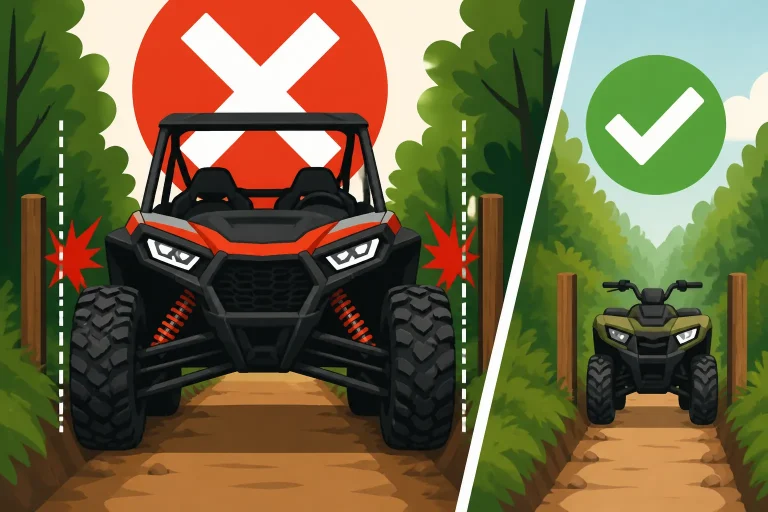
Check system-specific details close to departure. A route that suited a small ATV may not suit a wider UTV. A trail that was open during a prior visit may now be closed for maintenance or weather. For machine fit, review Georgia Trail Widths and What Fits and measure the vehicle as equipped, including any accessories that increase its width.
How to Get the Permit Before You Travel
The usual choices are a day permit or an annual forest OHV permit. Which one makes sense depends on how often you expect to ride the covered systems and on the current terms and cost. The annual permit is described as covering all six systems; the day option is intended for a shorter visit. Check the official permit listing for current availability, validity, cost and conditions before buying.
A visitor can purchase the permit through the official online route or at a ranger district counter where permits are offered. Availability and counter procedures can vary, so do not build a tight travel schedule around a counter visit without confirming its hours and service. See How to Buy a Georgia Forest OHV Permit and Georgia Permits on Recreation.gov for the purchase process.
A practical purchase process
- Choose the actual riding system. Identify the trail system by name rather than searching only for a general “Georgia forest ATV permit.”
- Confirm that it is open. Look for current alerts, closures, seasonal restrictions and access instructions.
- Check the vehicle rules. Confirm that your machine type, width and equipment are permitted on the trails you plan to use.
- Count the operators. Every person who may drive should be considered separately. Do not buy one permit and assume it covers a group.
- Compare the available permit options. Review the official terms for the day and annual choices, including the period covered and where each is valid.
- Buy through the official channel. Use the current official purchase route or confirm counter availability directly.
- Save the issued proof. Keep the permit confirmation or pass accessible and follow instructions about carrying or displaying it.
- Recheck the trip before leaving. Conditions and access notices can change after purchase.
Avoid purchasing from an unofficial seller or relying on a secondhand claim that someone else’s pass can be transferred. The permit terms describe whether a pass can be transferred or refunded; the listed forest permits are described as non-transferable and non-refundable. Because those terms matter if plans change, read the current official conditions before completing the transaction. See Georgia Permits Are Non-Transferable and Georgia Permits Are Non-Refundable.
Digital proof and a paper backup
If your permit is issued electronically, save the document in a place you can reach without a strong signal. A screenshot or downloaded file can be more useful than an email that requires a live connection, but follow the official instructions about what counts as acceptable proof. Do not assume that a payment receipt alone is the permit.
A paper copy is a sensible backup for a long drive, a low-signal trailhead or a phone with a nearly empty battery. Keep it protected from mud and rain. A small waterproof document pouch can hold the permit and other trip papers; if you shop for one on Amazon, check the dimensions and closure design rather than assuming any pouch will keep documents dry in rough conditions.
It is also worth saving the system map and closure information offline. A permit proves that you obtained access authorization; it is not a navigation tool and does not show which trail is currently open. Carry a current map or directions in a format you can use when mobile service is poor.
Budget for the permit, but verify current costs
Permit prices and purchase details can change. Check the official source for current charges before deciding between a day and annual permit. If several people will operate, compare the cost based on the number of operators, not just the number of machines. A group that shares one UTV may still have more than one operator.
Remember that the forest permit is only one possible trip expense. You may also need to budget for fuel, lodging, private-park admission, vehicle maintenance and any other access charges tied to your itinerary. Do not add the forest permit to your shopping cart as though it covers all recreation fees in the area.
Reciprocity: What Your Home-State Documents Do and Do Not Do
The word “reciprocity” can cause confusion because it may refer to different things: a machine’s registration, a rider’s trail authorization, or permission to use a particular property. For a Georgia forest OHV trip, keep those questions separate.
Your home-state registration or ownership paperwork relates to the machine. A Georgia forest OHV permit relates to the operator’s access to the designated forest system. Having one does not automatically supply the other. A visiting rider should not assume that an out-of-state plate, sticker or permit waives Georgia’s forest permit requirement.
Likewise, purchasing a Georgia forest permit does not automatically satisfy every requirement imposed by your home state, a private park or a WMA. It is not a replacement for registration where registration is required, and it does not settle questions about public-road use. If you are arriving with an out-of-state machine, review Georgia Visitors From Other States and [Georgia Rules for an Out-of-State Plate] for the vehicle side of the trip.
Ask about the document’s exact purpose
When someone tells you, “My permit works in Georgia,” ask what permit they mean and where they used it. A pass accepted at a private park may not be accepted on a forest OHV system. A state registration document may identify the machine but not provide trail access. A forest permit may cover the operator at named systems but not road travel or WMA access.
This simple check prevents a common planning error: treating every sticker or card as a universal pass. Look for the named land manager, the named location, the dates or validity period and the person to whom the document applies. If one of those details is unclear, ask the issuing authority before relying on it.
Coming from a neighboring state
A short drive across a state line does not make the rules interchangeable. If you are visiting from Alabama, Tennessee, South Carolina or Florida, check Georgia’s forest system instructions for the permit and the vehicle requirements. Then separately confirm any home-state paperwork obligations that apply to the machine while it is being transported or used.
For the Georgia riding portion, focus on three questions:
- Is the destination one of the designated forest OHV systems?
- Does each person who will operate have the required permit?
- Is the machine allowed on the intended trails under the current restrictions?
This approach is more dependable than relying on a general statement that a neighboring state has “reciprocity.” If a specific authority confirms that a document is accepted for a particular purpose, keep that confirmation and still follow the forest system’s rules.
Common Situations for Visiting Riders
The permit question becomes easier when you apply it to the actual trip. These examples are not substitutes for current official rules, but they show how to separate the operator permit from the other requirements.
One rider brings one ATV
If you are the only person who will operate and plan to ride a designated forest OHV system, check that system’s permit requirement and obtain the correct option before the trip. Confirm that the trail is open and that your ATV is allowed. Carry the issued proof and the vehicle paperwork you need for your circumstances.
A vehicle registration sticker does not replace the forest permit. Nor does a forest permit authorize the ATV on public roads to reach the trailhead. Arrange legal transport to the system and obey access signs once you arrive.
Two people share one UTV
If both people may drive, plan on each operator meeting the permit requirement. The fact that there is only one vehicle does not turn two operators into one. Decide in advance whether one person will drive the whole trip or whether you will alternate. If both will drive, check the current per-operator terms for both.
Also confirm that the UTV meets the system’s width and equipment rules. An annual permit’s coverage across several systems does not mean every machine fits every route. A tape measure can help, but use the system’s stated measuring method and include accessories that affect the vehicle’s width.
A parent rides with a child
Do not assume that an adult’s permit automatically covers a child who takes the controls. Confirm whether the young rider may operate, whether supervision is required and whether the permit rules apply to that age. Also confirm passenger rules for the machine and the trail system.
This is a situation where a quick call to the relevant office or a careful review of official instructions can prevent a wasted trip. An adult’s presence may be important for supervision, but it does not necessarily replace a youth operator’s own requirements.
A group travels together in several machines
Make a list of every person who may operate, then verify that each has the required permit. One person handling the group booking does not necessarily mean one permit covers the whole group. If you are coordinating several families, send the permit and trail information to each operator rather than assuming everyone has seen the same details.
Before setting out, choose a meeting point, exchange phone numbers and agree on a turnaround plan if the group is separated. Trail systems can have limited mobile service. A group’s permit paperwork may be in order while its basic communication plan is not; handle both.
The trip includes forest riding and a private park
Treat the two destinations as separate. Purchase the forest permit for the designated system and follow its conditions. Then check the private park’s entry process and requirements independently. Keep confirmation for both destinations, and do not assume a pass from one carries over to the other.
If you shop for basic trip supplies on Amazon, such as a document pouch or a compact tire gauge, use the manufacturer’s specifications and verify that the item is suitable for your machine and conditions. A receipt for gear or a park booking is not proof of a forest permit.
The forest system is closed when you arrive
A purchased permit does not require a trail manager to keep a route open. If the system or a particular trail is closed, follow the closure. Do not ride around a barrier or substitute an unverified road. Check official updates, contact the appropriate office if necessary, and use a lawful alternative only after confirming its separate rules.
This is another reason not to leave all planning until arrival. Review conditions before departure and again shortly before reaching the trailhead. If you buy an annual permit for flexibility, remember that flexibility means access to covered systems when they are open and when your machine is eligible; it is not a guarantee of year-round availability.
A Pre-Trip Checklist for Out-of-State Riders
A little preparation saves time at the trailhead and reduces the chance of turning a riding weekend into a paperwork problem. Use this checklist for each trip, even if you have ridden in Georgia before. The destination, rules or operating conditions may be different this time.
Confirm the destination and access
- Identify the exact forest OHV system by name.
- Verify that the system is open for the dates you plan to ride.
- Check for weather, maintenance, seasonal or route-specific closures.
- Confirm the vehicle types and width limits for the trails you intend to use.
- Check whether you will also enter a WMA, use a public road or visit a private park.
- Download or carry a current map and access directions.
A broad map pin is not enough. Confirm that the destination is an authorized OHV system and that the route from your staging area is legal for your machine. If you are planning a multi-system weekend, check each location separately even when one annual permit is described as covering all six.
Confirm the operators and documents
- List every person who may drive.
- Check that each operator has the required permit.
- Review age and supervision rules for younger riders.
- Save or print each issued permit according to its instructions.
- Carry relevant vehicle documents separately from the permit.
- Keep proof accessible without relying on cell service.
- Do not treat another person’s pass as transferable unless the official terms say it is.
If multiple adults will take turns operating, verify each person’s permit before loading. If one adult will be the sole operator, make sure the plan stays that way. In a group, keep the operator list with the ride organizer and ask each driver to confirm their own documents.
Prepare for trailhead conditions
Forest trailheads can be remote, and service may be limited. Arrive with fuel, water, basic tools and a way to contact the rest of your group. Make sure the machine is in good working order and that safety equipment fits every rider. A permit cannot compensate for a mechanical failure or an unprepared group.
Store the permit where it will remain readable. A document pouch is useful, and Amazon is one place some riders look for basic travel accessories; compare the closure, materials and size against what you actually need. Keep a backup copy in a separate location, such as a printed copy in a tow vehicle, so one wet phone or lost email does not leave you without your records.
For a larger group, have a simple plan for delays and separation. Agree on the trailhead meeting point, the time to check back in and what to do if someone does not return as expected. Keep the route within the group’s ability and turn around when conditions are unsafe.
Check official details again before departure
Permit prices, purchase procedures, opening conditions and local restrictions are details that can change. Confirm the current information through the official permit source and the relevant forest office rather than relying on a saved note from a past trip. If you are unsure whether your pass covers the planned system or how proof must be carried, ask before driving there.
For a quick final gear check, Amazon may be convenient for items such as a waterproof phone pouch or a compact first-aid kit, but inspect product details and suitability rather than choosing solely by a listing title. Keep essential safety equipment available even if you buy it locally or already own it. The permit is just one item in a well-prepared ride plan.
Disclaimer
This article is for general informational purposes only and does not constitute professional advice. Laws, prices and regulations vary by location and change over time. Consult a qualified professional for guidance on your specific situation.