Georgia Off-Road Parks With Cabins
Finding a Georgia riding park with a cabin can be harder than it sounds: lodging may be onsite, nearby, seasonal, or unsuitable for your group’s machine and trailer. This guide explains how to compare cabin options around Georgia off-road parks, plan for trail access, and check the details that can turn a promising weekend into a frustrating one.
Georgia off-road parks with cabin lodging
Cabin availability and park rules can change, so treat any listing as a starting point rather than a guarantee. Before booking, confirm directly with the park or lodging provider that the cabin is available for your dates, that your machines can be stored or parked where permitted, and that the trail system you want to ride is open.
Iron Mountain and the Dahlonega area
Iron Mountain Off Road Park, near Dahlonega in North Georgia, is one option to investigate if you want a riding-focused stay. The park is known for a large network of off-road routes, and cabin or bunkhouse-style lodging has been associated with the property. Ask what lodging is currently offered, whether it is inside the riding property, and how close it is to your assigned parking or unloading area.
The phrase “cabin at the park” can mean different things. A rental might be near the trails but still require you to trailer your machine to a separate staging area. It may also have different rules for pets, cooking, bedding, quiet hours, or the number of people allowed. Get the location and terms in writing before you pay a deposit, especially if your group includes several riders arriving with separate vehicles.
Iron Mountain can make sense for a group that wants to spend much of the weekend riding rather than driving between a hotel and a trailhead. But the cabin itself is only one part of the decision. Check whether the routes suit your machine and experience level, how the park handles check-in, and what happens if weather affects riding. For broader lodging comparisons, see [Georgia ATV Trails With Cabins](Georgia ATV Trails With Cabins) and [Iron Mountain Bunkhouse and Cabins](Iron Mountain Bunkhouse and Cabins).
Highland Park Resort and Cedartown
Highland Park Resort near Cedartown is another North Georgia-area name worth checking when you are looking for a stay close to riding. Contact the resort directly to ask whether cabin lodging is available for your dates and whether it is managed by the park or by a nearby independent provider. Confirm the exact distance between the place you will sleep and the trail entrance; “near the resort” does not always mean you can ride directly from your door.
This distinction matters if you are traveling with children, a large group, or a machine that is difficult to load and unload. A cabin on the property may simplify the weekend, while a cabin in the surrounding area might offer more space but require a second vehicle or trailer trip each day. Ask whether there is a safe, permitted place to park a trailer overnight, and whether the lodging has enough parking for everyone in your party.
Also ask what riding access the reservation actually includes. A lodging reservation does not automatically settle trail admission, machine rules, waiver requirements, or operating hours. If you are comparing facilities, use [Highland Park Off-Road Resort in Georgia](Highland Park Off-Road Resort in Georgia) as a starting point, then confirm the current lodging and riding arrangements with the resort.
Cabin stays near public trail systems
Some Georgia riding weekends work better with a cabin near a public trail system rather than a cabin inside a private park. In the Chattahoochee-Oconee National Forest region, for example, you may find cabins, campgrounds, and other lodging in nearby towns or mountain communities. The tradeoff is that your accommodation may not be directly connected to the trail, and you may need to tow your machine to the correct trailhead.
This can be a good fit if your group wants a more flexible trip, plans to explore the area beyond riding, or cannot find suitable lodging at a private park. It can also create extra logistics: check where trailers can be parked, whether the property has a driveway that can handle your rig, and whether local roads provide a comfortable route for a truck and trailer. A narrow, steep driveway that looks charming in a listing can be a real headache when you arrive after dark.
Keep public-land riding rules separate from private-park rules. A nearby cabin does not grant access to forest roads or trails, and a trail permit does not function as a lodging reservation. Review [Georgia ATV Camping With Trail Access](Georgia ATV Camping With Trail Access) and [Chattahoochee-Oconee National Forest Riding](Chattahoochee-Oconee National Forest Riding) while planning, then confirm trail access and closures before you tow.
Choosing a cabin based on your group and machine
A cabin that feels perfect for a couple can be a poor fit for a family with kids, two machines, a dog, and a trailer. Start with the shape of your trip: who is coming, what everyone needs after a day on the trails, and how much equipment must fit around the lodging.
Match the lodging to the people coming
Count sleeping spaces realistically. A listing that says it accommodates a certain number of guests may rely on sofa beds or shared rooms, which might not suit a group returning tired and muddy. Ask how many separate beds there are, whether linens are supplied, and whether the cabin has a shower and bathroom setup that works for your group. If kids are coming, check for stairs, lofts, open decks, and other features that may need closer supervision.
Think about how the group will spend downtime, too. Riders often picture the trails first and realize later that they need a place to dry wet clothes, prepare breakfast, store food, and relax when someone is sore or the weather turns. If the cabin has limited cooking facilities, you may need to plan meals around restaurants or bring a cooler and simple food. Ask whether there is a refrigerator, basic cookware, and a covered outdoor area rather than assuming every cabin has the same amenities.
For a mixed group where some people ride and others do not, location becomes even more important. A cabin close to town may be more comfortable for non-riders, while a park-side stay can reduce the daily drive for everyone. Consider whether the non-riders can reach nearby food, shops, or attractions without depending on the person who is transporting the machines.
Check trailer and machine logistics before booking
Parking is one of the most overlooked parts of cabin planning. A listing may show space for passenger cars but not for a truck with a long trailer. Ask for the driveway dimensions or a clear description of the parking area, whether the surface is paved or gravel, and whether there is room to turn around. If the property is in the mountains, also ask about steep grades and tight approaches.
Confirm where machines can be unloaded and stored. Some lodging providers may allow machines in a designated parking area but prohibit riding on property roads or leaving muddy machines close to the cabin. Others may not allow trailers to remain at the lodging at all. These are not minor details: a group that arrives late and discovers there is nowhere to park the trailer can lose hours looking for an alternative.
If you are using navigation to compare cabins and trailheads, onX Offroad can help you review routes and orient yourself before the trip. Treat any mapped route as a planning aid, not permission to ride on a road or property. Verify access with the park or land manager, and use current directions from your lodging provider for the final approach.
| Trip factor | Questions to ask before booking | Why it matters |
|---|---|---|
| Cabin location | Is it on the park property, nearby, or in a separate town? | A nearby cabin may require daily towing to the trailhead. |
| Trailer parking | Can a truck and trailer park overnight and turn around safely? | Many residential driveways are tighter than they appear online. |
| Machine storage | Where may machines be unloaded, parked, and secured? | Lodging rules may restrict equipment on lawns, decks, or roads. |
| Sleeping setup | How many actual beds and private rooms are available? | Maximum occupancy does not tell you how comfortable the layout is. |
| Amenities | Are linens, cooking equipment, and laundry available? | Missing basics can add packing, shopping, and meal-planning work. |
| Riding access | Does lodging include trail access, or is it booked separately? | A cabin reservation may not cover park admission or permits. |
| Weather policy | What happens if roads or trails close? | Lodging and riding cancellation terms may be different. |
Decide whether convenience is worth the tradeoff
Onsite lodging often reduces daily driving and makes it easier to take a break, retrieve forgotten gear, or get back to the cabin after riding. It may also put you close to other park visitors and activity. The downside can be less privacy, a busier setting, or fewer choices in room layout and amenities than you would find in a separate vacation rental.
A cabin farther away may offer more space, a quieter evening, or access to grocery stores and restaurants. But every extra mile adds time, particularly when you are towing. Consider the whole day rather than just the map distance: loading machines, checking in at the trailhead, finding parking, and returning after a long ride all affect how convenient a location feels.
For help comparing stays with different levels of trail access, see [Georgia Off-Road Parks With Full Hookups](Georgia Off-Road Parks With Full Hookups). Full hookups are more relevant to RV travel than a cabin stay, but comparing nearby lodging formats can help you decide whether you want a park-centered weekend or a more flexible base.
Plan trail access separately from your cabin
The most comfortable lodging cannot fix a mismatch between your machine and the trails. Before you reserve, identify where you plan to ride, what equipment is allowed, and what access requirements apply to your group.
Confirm that your machine fits the riding area
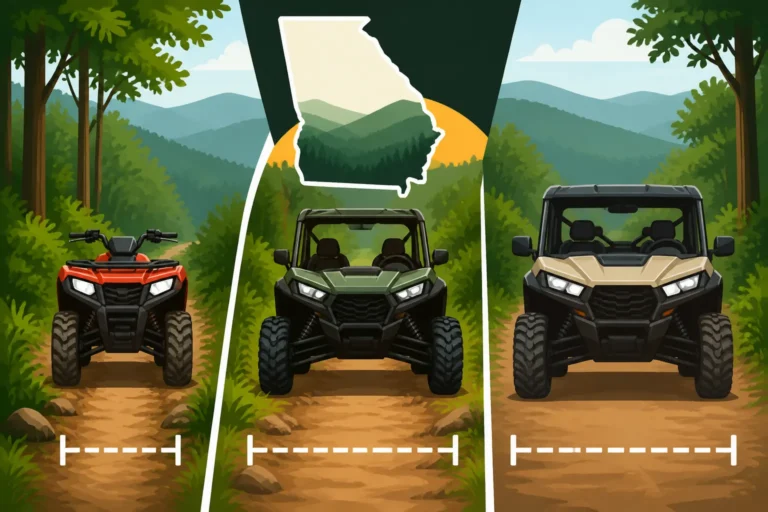
Trail width limits can exclude some side-by-sides even when the vehicle is otherwise capable of handling the terrain. Measure the machine as the trail operator instructs, including any added accessories that affect width. A machine that is close to a stated limit deserves extra care: tires, wheel offsets, mirrors, or aftermarket components may change the measurement.
Ask the park which trails are open to your type of machine. An ATV, a narrow side-by-side, and a wider utility vehicle may have different route options. Do not assume that because a park permits one category of vehicle, every route is open to every vehicle. For a general overview, read [Georgia ATV Trails That Allow Side-by-Sides](Georgia ATV Trails That Allow Side-by-Sides) and [Georgia Trails Within Two Hours of Atlanta](Georgia Trails Within Two Hours of Atlanta).
The same caution applies to rider experience. A trail system with easy loops may also have steep climbs, rocky sections, or narrow routes that are not a good first ride for every driver. Ask the park how it describes trail difficulty and whether there are routes that let a group stay together without pushing a newer rider beyond their comfort level. If the group splits up, agree on meeting points and a check-in plan.
Check permits, hours, closures, and local rules
Private parks and public forest trail systems do not necessarily use the same access rules. A private park may require registration, waivers, or other park-specific steps. Public OHV areas may have their own permits, operating hours, seasonal closures, and designated routes. Confirm which rules apply to the exact trail system you plan to visit rather than relying on a general statement about Georgia riding.
Weather can change a weekend quickly, especially on clay and mountain trails. Ask how the park communicates closures and whether the trail system limits riding after heavy rain. A cabin reservation may remain active when trails are closed, and a park may have different policies for lodging, riding, and rescheduling. Check both sides of the booking before making plans that assume the trails will be open.
Use [Georgia's Six National Forest OHV Systems](Georgia's Six National Forest OHV Systems) and [Georgia Trail Conditions Before You Drive](Georgia Trail Conditions Before You Drive) to understand the kinds of public trail options and conditions worth checking. onX Offroad can also be useful for reviewing mapped routes and organizing a trip plan, but it should not replace posted signs, official closures, or permission from the land manager.
Build a realistic weekend schedule
A simple schedule helps prevent the first day from disappearing into unloading, paperwork, and supply runs. If the drive is long, consider arriving before dark, checking into the cabin, and unloading only what you need for the evening. Then handle machine preparation and trail check-in in daylight, when it is easier to spot missing straps, low tire pressure, or a problem with the trailer lights.
Keep some flexibility in the schedule. A group might plan to ride both days but find that a storm has softened the trails or that one machine needs attention. Leave room for a shorter ride, a rest period, or a nearby meal rather than treating every hour as fixed. It is easier to enjoy the trip when a minor delay does not make everyone feel behind.
Before leaving home, save the cabin’s address and the trailhead or park entrance separately. Cell service can be limited in mountain areas, and the entrance may not be at the same location as the lodging. onX Offroad can help with route planning, but download or save the information you will need before leaving reliable service, and carry the park’s directions and contact details as a backup.
What to ask before reserving a cabin
A short call or message before booking can prevent the most common surprises. The goal is not to interrogate the host; it is to confirm the details that affect your machines, your group, and your arrival.
Ask the lodging provider specific questions
Avoid relying on broad phrases such as “near the trails” or “ample parking.” Ask how far the cabin is from the trail entrance, whether that distance is measured by road or as the crow flies, and whether a trailer can safely make the approach. If the listing shows a shared property, ask which parking spaces belong to your reservation and whether other guests use the same driveway.
Clarify the practical rules. Can muddy gear be stored in a particular area? Are machines allowed to be parked outside overnight? Is there a place to wash equipment, or should you bring a tarp and cleaning supplies? Are pets permitted, and are there restrictions on leaving them unattended? A cabin may be comfortable while still having rules that do not match the way your group travels.
Get the cancellation and weather terms in plain language. Ask whether a trail closure affects the lodging reservation, whether a reschedule is possible, and whether the terms differ for a private cabin and park admission. Save the provider’s reply so everyone in the group is working from the same information.
Ask the riding venue about machine access
Contact the park or trail manager separately from the lodging provider if they are not the same business. Confirm that your machine type is permitted, that the routes you hope to ride are open to it, and whether any width, age, equipment, or operator requirements apply. If your side-by-side has accessories or a nonstandard setup, describe it clearly rather than asking only whether “UTVs” are allowed.
Ask how check-in works and what you need to bring. Depending on the site, there may be waivers, permits, proof of reservation, or equipment rules. Find out where to unload, whether trailers stay at the trailhead, and what time visitors are expected to leave the riding area. If you are bringing a child or a passenger, verify any age or passenger rules in advance.
If your weekend involves a national forest system, review the permit information in [How to Buy a Georgia Forest OHV Permit](How to Buy a Georgia Forest OHV Permit) and [Georgia National Forest Trail-Only Rule](Georgia National Forest Trail-Only Rule). Requirements can differ by location, so make sure you are looking at the rules for the system you actually intend to visit.
Keep a backup plan for lodging and riding
Mountain weather, maintenance problems, and full reservation calendars can all disrupt a trip. Before booking, identify a second lodging option within a reasonable drive and know whether it can accommodate your trailer. You do not need to reserve two cabins; simply having a backup search area and a few contact details can reduce stress if your first choice falls through.
For riding, choose a second trail option only if it is genuinely accessible to your machine and group. A nearby trail on a map may have a width restriction, a seasonal closure, or a separate permit requirement. Use onX Offroad to get a better sense of the surrounding route layout, then confirm any access questions with the relevant park or land manager. The app can help you plan; it cannot authorize entry onto private land.
Finally, make sure the whole group understands the plan. Share the cabin address, check-in instructions, parking arrangement, trailhead location, and the person to contact if anyone arrives separately. This simple step avoids the familiar scene of one truck circling a rural road while another group is already unloading at the wrong entrance.
A practical checklist for a cabin riding weekend
Once you have chosen the park and lodging, write down the essentials in one place. This is especially useful when the trip involves several vehicles, family members, or a mix of riders and non-riders.
Before you reserve
- Confirm the cabin’s exact location and whether it is onsite or offsite.
- Ask whether your truck, trailer, and machines can be parked legally and safely.
- Verify the sleeping arrangement, amenities, pet policy, and check-in process.
- Confirm the lodging cancellation terms separately from riding access.
- Ask the park whether your machine type is permitted and which trails fit it.
- Check whether park admission, permits, waivers, or other requirements are separate.
- Save written answers about parking, machine storage, and trail access.
Before you leave home
Inspect your machine and trailer, including tires, lights, tie-downs, and safety equipment. Pack helmets, appropriate riding gear, basic tools, and any supplies needed for wet or dusty conditions. Bring the cabin’s check-in information, the park’s directions, and contact details in a form you can access if cell service is weak.
Check the forecast and the trail system’s closure notices close to departure. A forecast alone does not tell you whether a specific trail is open, and a general map cannot confirm that a route is currently permitted. If conditions change, contact the park or land manager before towing to the trailhead.
When you arrive
Check in before unloading if the host or park requires it. Confirm where to park, where machines may be stored, and how to reach the designated riding area. Read posted signs and follow the venue’s instructions, even if a route appears open on a map or was accessible during a previous visit.
Keep the cabin and riding areas clean and respect the property’s rules about noise, fires, parking, and muddy equipment. A little care makes it easier for the next group to enjoy the same facilities—and helps preserve access for riders who come after you.
Disclaimer
This article is for general informational purposes only and does not constitute professional advice. Laws, prices and regulations vary by location and change over time. Consult a qualified professional for guidance on your specific situation.