Georgia Off-Road Parks With Full Hookups
Finding an off-road park that also has full RV hookups can take more work than choosing a trail. A listing may say “camping” when it means primitive tent sites, or “RV access” without confirming sewer connections. This guide explains which Georgia riding destinations to check first, what to verify before booking, and how to plan a trip that works for both your machine and your campsite.
What full hookups mean at an off-road park
Check what is connected at your individual site
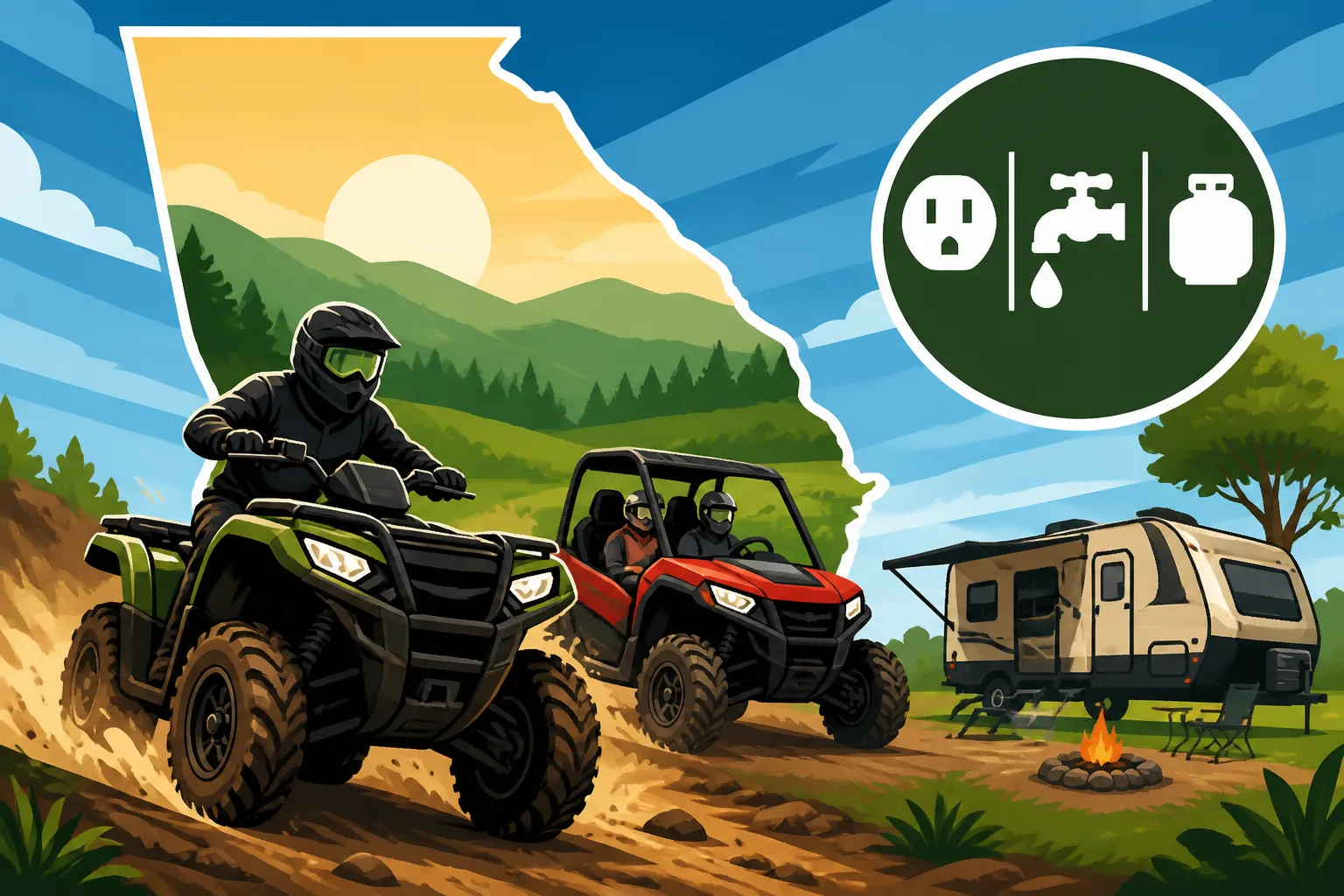
For most RV travelers, “full hookups” means water, electricity, and sewer connections at the site. But campground descriptions can use the phrase loosely, and amenities may differ between site types. One row of RV pads might have all three services, while another offers only electric and water. A dump station somewhere on the property is useful, but it is not the same as a sewer connection beside your RV.
Ask the park to confirm the hookups for the exact site you intend to reserve. It is also worth asking whether the water connection is seasonal, whether the electrical service matches your RV’s needs, and whether the site can accommodate your vehicle and trailer together. A large motorhome towing a side-by-side needs more than a convenient trailhead; it needs enough room to park without blocking access or maneuvering into a tight turn.
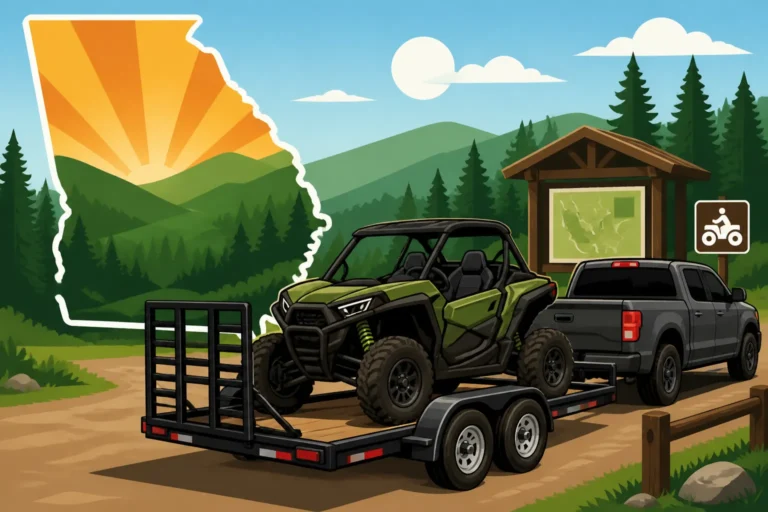
If you’re traveling with a toy hauler, clarify whether the site is appropriate for both the RV and machine unloading. Some sites have a level pad but limited space behind or beside it. A quick phone call can prevent the frustrating arrival-day surprise of discovering that your machine trailer has nowhere practical to go.
Distinguish camping access from trail access
A park can have camping on the property without offering direct trail access from every campsite. You may need to trailer your machine to a staging area, follow a designated internal route, or comply with rules about where machines can be operated. Confirm whether you can ride from your site to the trails, where unloading is allowed, and whether a trailer is needed once you arrive.
Also ask about the kind of riding the park permits. A destination that works well for a side-by-side may not suit a wider machine on every route, and a park with technical ATV trails may not offer the relaxed family ride you had in mind. Compare the riding style, machine restrictions, and campsite setup rather than relying on the word “off-road” alone. [Georgia Private Off-Road Parks Compared] can help you think through the differences between privately operated riding areas.
Georgia riding destinations to check for RV hookups
Highland Park Off-Road Resort near Cedartown
Highland Park is a private riding destination in the Cedartown area and a practical place to ask about combining a trail weekend with an RV stay. Before booking, confirm whether full-hookup sites are available for your dates, and ask what “full hookup” means at the specific site being offered. Do not assume that every campsite or accommodation has the same services.
Talk through your group’s needs when you contact the park. Mention your RV length, whether you are towing a machine trailer, the number and type of off-road vehicles, and whether you need a site that makes unloading straightforward. If your group includes both experienced riders and beginners, ask about route options and difficulty levels as well. That conversation can help you avoid reserving a site that fits the RV but leaves the machines awkward to park or unload.
Before leaving home, check the park’s operating information for trail access, riding rules, and any reservations or waivers your group must complete. It is sensible to ask what facilities are available near the campsites, too. A campground may have restrooms or other shared amenities even when individual RV sites have hookups; those details matter if you are traveling with children or a larger group.
Iron Mountain Resort near Dahlonega
Iron Mountain Resort, near Dahlonega, is another private Georgia riding destination worth contacting when you are looking for an RV stay near off-road routes. Ask directly whether full-hookup RV sites are offered for your chosen dates, and confirm whether the site includes water, electricity, and sewer. If you see “RV camping” in a listing, treat that as a reason to ask follow-up questions—not proof that all three connections are present.
Dahlonega is a convenient base for a North Georgia trip, but the mountain setting makes site access worth discussing. Ask about the approach to the campground, the size and surface of the RV space, and whether your rig and trailer can be parked together. If you are arriving in a larger motorhome, ask about turning room and any site-specific limits before you commit. A site that looks roomy in a short description may feel very different when you are maneuvering with a trailer.
It can also help to ask whether riding is available directly from the campground area and which routes are appropriate for your machine. If cabins are another possibility for part of your group, compare their location and facilities with the RV sites rather than assuming they are all near the same trail access. [Georgia Off-Road Parks With Cabins] offers a useful companion topic if your group is splitting between RV camping and other lodging.
| What to confirm | Why it matters | A useful question |
|---|---|---|
| Water, electric, and sewer at the site | “RV camping” may not mean full hookups | “Does this specific site have all three connections?” |
| Electrical service | RVs have different power requirements | “What electrical service is available at the site?” |
| Site dimensions and parking | The RV, tow vehicle, and trailer all need room | “Can I fit my RV and machine trailer together?” |
| Trail access from camp | Camping on-site does not always mean ride-from-site access | “Can we ride from this campsite to the trails?” |
| Machine restrictions | Width and vehicle type can affect route access | “Are our specific machines allowed on the routes?” |
| Arrival and check-in details | Late arrivals or narrow access can complicate setup | “Where should we check in, and when can we enter?” |
How to choose between a private park and public trails
Match the riding area to your machine and group
Private parks and public trail systems solve different problems. A private park may make it easier to plan a weekend around a single destination, but you still need to check its machine rules, trail difficulty, camping setup, and operating information. Public lands can offer a different riding experience, but a nearby campground with full hookups may be separate from the trail system. In that case, you will need to confirm the drive between the campground and the riding area, along with legal staging and access arrangements.
Before choosing a destination, identify the widest machine in your group and check any trail-width restrictions. Then consider whether everyone is comfortable with the terrain. A novice rider who expects an easy scenic route may have a very different weekend from a skilled rider seeking steep or technical sections. [Georgia ATV Trails That Allow Side-by-Sides] is a useful starting point when your group includes UTVs and you need to make sure the routes fit.
You can use onX Offroad to help visualize routes and plan the drive, but treat any map as a planning aid—not permission to ride. Check the managing landowner’s or park’s rules for current access, closures, and machine limits. A route that appears connected on a map may cross land where riding is not allowed, or it may be closed even if it remains visible in a mapping app.
Understand the difference between a trailhead and an RV campground
Georgia’s national forest OHV systems are trail destinations, not a promise of full-service RV camping at the trailhead. If you are considering a public system, look separately for a campground that can accommodate your RV and provides the utilities you need. Then confirm whether you can legally trailer your machine to the trailhead, where you can park, and whether any permits or other requirements apply to the ride.
This distinction is especially important for travelers who picture driving straight from a full-hookup campsite onto a trail. A campground nearby may be several miles away, may have different operating rules, or may not permit off-road machines to travel between camp and trail access. Verify the details before planning your day around a direct connection. [Georgia's Six National Forest OHV Systems] provides context on the public riding systems, while [Georgia Day and Annual Forest OHV Permits] covers the permit topic to review before a forest ride.
Avoid assuming that services at a campground are available at a trailhead. Restrooms, water, fuel, and places to dispose of waste may be limited or located elsewhere. Check the details for your specific destination, and plan to bring what you need for the ride. [Georgia Trailhead Restrooms and Water] is a helpful reminder to check those practical basics before you leave the campground.
Plan the campsite and riding logistics together
Confirm the whole trip before you reserve
A good booking call covers more than site availability. Have your RV length, trailer length, machine models, and arrival plans ready. Ask whether the site is level, what surface it has, and whether the campground has restrictions on where trailers can be parked. If you are bringing a toy hauler, clarify whether you can unload at the site or need to use a designated area.
Then ask about the riding side of the trip. Confirm operating hours, check-in procedures, machine restrictions, route difficulty, and whether any permits, waivers, or reservations are required. Ask what happens if weather changes the trail conditions. Heavy rain can affect access, traction, and route availability, particularly on clay or steep terrain. [Georgia Trail Conditions Before You Drive] and [Georgia Trails That Close After Rain] are useful topics to review while making a weather plan.
If you are using onX Offroad to organize a route, save the information you need before traveling and carry a backup navigation option. Cell coverage can vary in rural and mountainous areas. Still, use the park’s own directions and current access information as your authority; an app’s mapped route should not replace posted rules or instructions from staff.
Build a practical arrival-day routine
Try to arrive with enough daylight to check in, position the RV, connect utilities, and unload your machine without rushing. If your travel schedule makes a late arrival likely, ask whether the campground permits it and how you will receive instructions. Set the tow vehicle and trailer where they will not block a neighbor, access lane, or trail route.
Once parked, connect utilities carefully and keep hoses and cables arranged so they do not create trip hazards or interfere with vehicle movement. Follow the campground’s rules for greywater, sewer connections, generators, and machine washing. If the park does not allow washing machines at the site, ask whether a designated wash area is available. Muddy gear and equipment can quickly make a small RV space feel crowded, so plan where helmets, boots, and wet clothes will go.
Before the first ride, review the day’s route with everyone in the group. Agree on a turnaround point, a meeting place if riders get separated, and a plan for mechanical trouble. Keep essentials such as water, basic tools, and any required documents with the group. Navigation tools like onX Offroad can help everyone understand the planned route, but riders should still follow park signs and stay on authorized trails.
Choose a backup plan for weather and availability
Trail plans can change because of rain, maintenance, crowded parking, or temporary closures. Ask about the park’s cancellation and rescheduling terms before booking, and clarify whether a campsite reservation and riding access are handled together or separately. If there is no room for your RV at the preferred park, identify a nearby campground that can accommodate the rig and ask whether it is practical to trailer to the riding area.
For a backup destination, look beyond the campground’s name or a map pin. Confirm that it is open to your machine, that the route is suitable for your group, and that parking is available for your tow vehicle and trailer. Do not assume an informal dirt road, utility corridor, or private access road is a legal substitute for a designated trail. For Georgia riding options and the access rules that can affect your plans, explore [Georgia ATV Trails: Where You Can Legally Ride].
A little flexibility makes the trip less stressful. If trails close after heavy rain, you may be able to spend the day exploring nearby towns, relaxing at camp, or shifting your ride to another permitted area. Having a backup plan is especially helpful when you have driven a long distance or have a group with different expectations for the weekend.
Questions to ask before booking
Use a short checklist when you call
When you speak with a campground or park, ask for clear answers about the site—not only general information about the property. A few precise questions can uncover whether the location truly fits your setup:
- Does the site I am booking have water, electricity, and sewer connections?
- What electrical service is available, and does the site fit my RV?
- Can my RV, tow vehicle, and machine trailer fit at the site together?
- Can I unload at the site, or is there a designated unloading area?
- Can I ride from camp to the trails, or must I trailer to the staging area?
- Are my specific machine types and dimensions allowed on the routes?
- What riding rules, check-in steps, permits, or waivers should I know about?
- What is the plan if rain or a closure affects trail access?
- Are shared restrooms, water, or other campground facilities available?
- What are the cancellation, arrival, and quiet-hour rules?
Write down the answers and the name of the person you spoke with. If a key detail is unclear, ask for confirmation before paying or making a long drive. This is particularly useful when “hookups,” “RV access,” or “trail access” appear in a brief listing without explaining exactly what they include.
Make the final choice around your group’s priorities
For some travelers, the deciding factor is reliable utilities. For others, it is direct trail access, room for a large trailer, or routes that suit a first-time rider. Rank your group’s needs before comparing locations. A campground with full hookups may be the better choice even if you need to trailer to the trailhead; a ride-from-camp option may be worth more to a group that wants to avoid loading and unloading every day.
Think about the less exciting details, too: where you will park muddy machines, how you will store riding gear, whether your group needs separate sleeping arrangements, and how much driving you are willing to do between camp and the trail. Those small decisions often determine whether the weekend feels easy or exhausting.
For a Georgia trip, start by contacting Highland Park near Cedartown and Iron Mountain near Dahlonega to ask about the exact RV site and trail arrangements you need. Confirm each detail directly, compare the answers against your machine and group, and keep a backup campground or riding plan in mind. That preparation is the best way to avoid arriving with a full tank, a loaded trailer, and the wrong idea about what “full hookups” includes.
Disclaimer
This article is for general informational purposes only and does not constitute professional advice. Laws, prices and regulations vary by location and change over time. Consult a qualified professional for guidance on your specific situation.