Reporting Riders on Posted Land
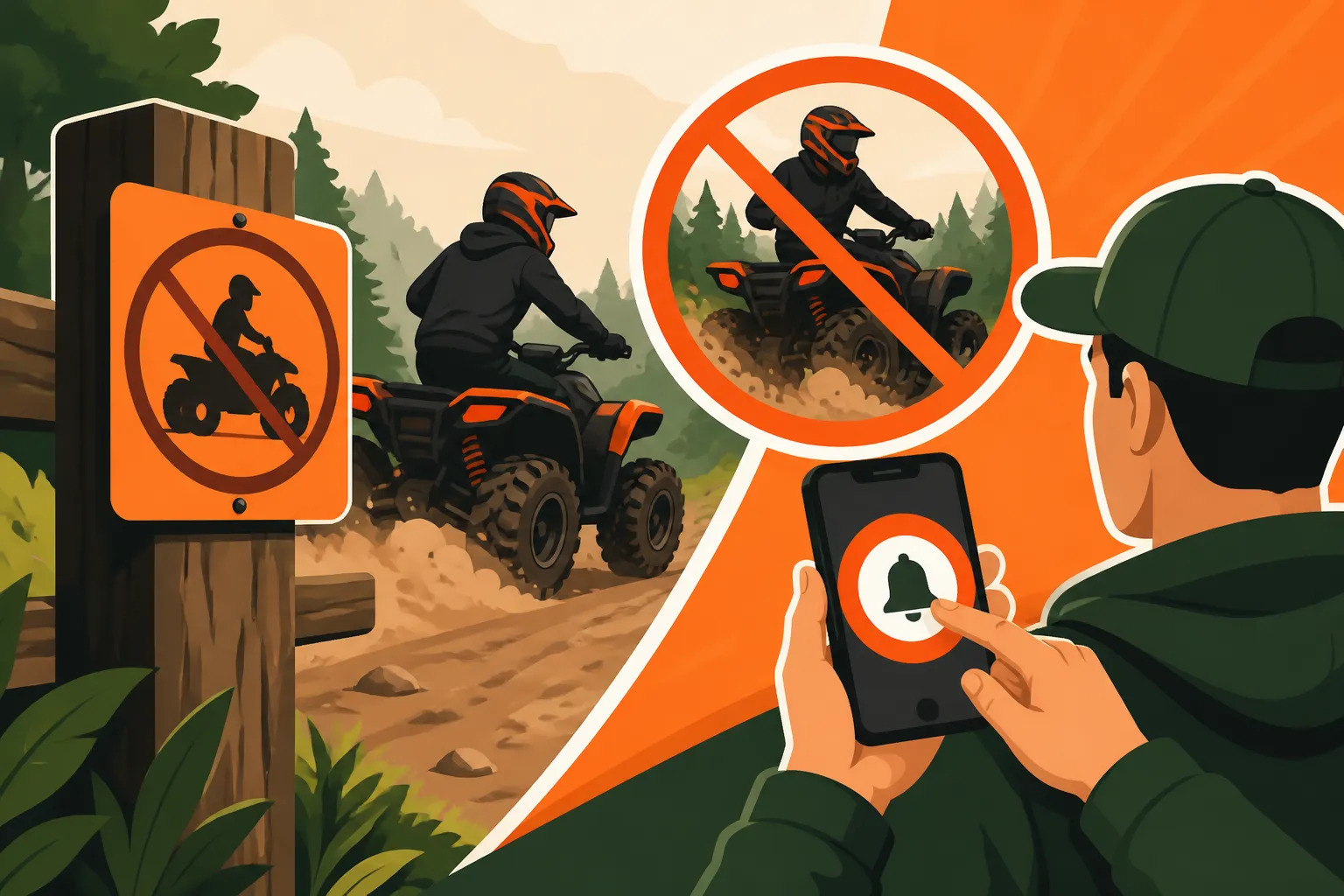
Riders tearing across posted land can leave more than ruts: damaged fences, stressed livestock, and a safety risk for anyone nearby. In Georgia, the right response depends on whether the machine is on private property, a public road, or managed land. This guide explains how to document what you see, who to contact, and how to avoid turning a report into a dangerous confrontation.
First confirm where the riders are
Before reporting anyone, get as clear as you safely can about the location and type of land. A posted sign on a property boundary does not automatically tell you whether the riders are on that property, a public right-of-way, an easement, or a designated trail nearby. That distinction can affect which agency has jurisdiction and what information is useful.
Private property, public roads, and easements are different
A rider crossing a private field or traveling down a private access road is different from a rider on a county road that passes beside posted land. Public road rights-of-way can extend beyond the visible pavement or gravel, while an easement may allow particular uses without giving the public general permission to ride there. From the roadside, those boundaries can be hard to judge.
If the machine appears to be on a public road, report the behavior as a road-safety concern rather than assuming the rider is trespassing. Georgia’s rules for ATVs and UTVs on roads are separate from private-property trespass questions; see [Georgia Sheriff Enforcement on County Roads] and [Georgia ATV Road Access Law Explained] for related context. If you are unsure whether the route is public, describe the location and what you observed rather than stating a legal conclusion.
A timber road, utility corridor, railroad bed, or farm lane may also be subject to specific access rules. An old track that looks like a road is not necessarily open to recreational riding. For example, [Georgia Rules for Riding a Timber Road] and [Georgia Rules for Riding a Utility Easement] cover situations where the appearance of a route alone may not settle whether riders have permission.
Posted signs are useful details, not the whole story
A “No Trespassing” or “Private Property” sign can help explain that access is restricted, but do not treat a sign as proof that you know exactly where the boundary lies or who owns the land. Signs may be missing, weather-damaged, turned away from the route, or posted at a different entrance. A rider may also claim permission, even if a landowner believes that claim is false.
When you report the incident, share what you personally saw: the sign’s location, the rider’s route, whether the rider crossed a fence or gate, and whether the machine continued onto the property. Avoid guessing about ownership, motives, or legal status. Georgia’s trespass rules involve details and circumstances that authorities may need to assess; [Georgia Trespass Law for ATV Riders] provides more background on that distinction.
If you own the property, keep a simple record of where signs and gates are placed. Clear, maintained notices and visible boundary markers can make it easier for visitors to understand that the land is not open for riding. They do not replace contacting law enforcement when a serious or recurring problem occurs.
Decide who to contact
The best contact depends on the immediate risk and the agency responsible for the land. A rider on private acreage, a rider on a public road, and a rider inside a state wildlife area may all call for different responses. If you are not certain which agency has jurisdiction, start with the local law-enforcement non-emergency line and ask where the report should go.
Call 911 for an immediate threat
Call 911 if riders are creating an immediate danger, such as driving toward people, threatening someone, causing a crash, setting property on fire, or damaging a structure while the incident is unfolding. Give the dispatcher the location first, then explain what is happening and whether anyone may be injured. Do not delay an emergency call to gather photos or a license plate number.
Stay in a secure place. Do not step into a rider’s path, block a trail with a vehicle, or try to take the machine’s keys. Riders may be moving quickly, may not see you, or may react unpredictably if they believe they are being confronted. Even if you are the landowner, the safest response is usually to observe from a distance and let responders handle an active conflict.
For a past incident with no immediate danger, use the sheriff’s office or local police non-emergency contact. If the riders have left, say so clearly. Dispatchers can help determine whether an officer should respond, whether the matter should be documented for follow-up, or whether another land-management agency is responsible.
Contact the agency responsible for the land
For suspected trespass on private property, the county sheriff’s office is generally the practical starting point. Depending on the location and circumstances, a municipal police department may be the appropriate contact within city limits. If you are the landowner, explain whether you gave the riders permission, whether you asked them to leave, and whether the problem has happened before.
If the activity is on a Wildlife Management Area or other land managed by the Georgia Department of Natural Resources, contact the relevant DNR office or law-enforcement channel. Rules for riding on managed land can differ from rules on private property. For instance, [Georgia WMA Riding Rules Explained] describes restrictions that may apply to vehicle use in those areas. On federal land, such as a national forest, contact the responsible land-management office or law-enforcement authority rather than assuming a county office can address every access rule.
A useful first sentence is: “I’m reporting ATV or UTV riders on land I believe is private, at this location, and I’d like to confirm which agency handles it.” That makes room for the dispatcher or agency to clarify jurisdiction without weakening the facts you have observed.
| Situation | Practical first contact | Details to provide |
|---|---|---|
| Riders are creating immediate danger or someone may be hurt | 911 | Exact location, current danger, injuries, direction of travel |
| Suspected trespass on private land with no immediate threat | County sheriff or local police non-emergency line | Property location, observed route, signs or barriers, time |
| Activity on a state-managed wildlife area | Georgia DNR or the relevant area authority | Area name, access point, trail or road, date and time |
| Activity on federal land | The responsible federal land-management office or law enforcement | Forest or recreation area, road or trail, machine description |
| Riders are on a public road or creating a traffic hazard | Local law enforcement or the appropriate road authority | Road name, direction, traffic risk, what the machine did |
Document the incident without putting yourself at risk
A report is easier to assess when it includes specific, neutral details. You do not need to investigate, follow the riders, or prove a legal violation yourself. Your role is to pass along what you safely observed so the landowner or appropriate authority can decide what action makes sense.
Write down what you saw while it is fresh
Record the date and approximate time, the exact location, the direction the riders came from and went, and how many machines were involved. Note whether they crossed a fence, opened a gate, cut a barrier, drove through crops, or disturbed livestock. If you can identify the machine type or a distinctive feature without getting closer, include it.
Describe people and vehicles in observable terms. For example: “Two side-by-sides, one dark green and one red, entered through the west gate and continued toward the creek,” is more useful than “a group of reckless trespassers.” If you cannot see a plate or registration decal, say that rather than trying to fill in the gap. A clear account is more credible than a confident guess.
Also note whether you saw signs, gates, fencing, or other boundary markers near the route. Do not assume the riders noticed a sign simply because you did. If you are the property owner, mention whether the entrance is normally locked and whether anyone had been given permission to use the land.
Use photos or video only from a safe, lawful place
A photo or short video may help show the route, damage, machine appearance, or location. Take it from your own property or another place where you are allowed to be. Do not trespass onto someone else’s land to get a better view, follow riders down a trail, or stand in the road to photograph a moving machine.
Avoid posting identifying footage online to shame or threaten people. Public posts can spread inaccurate accusations, reveal private information, and escalate a dispute. Share relevant material with the landowner, law enforcement, or the land-management agency handling the report. Keep the original files when possible, and make a note of when and where they were recorded.
If the incident is recurring, use a consistent log. A few separate reports with dates, locations, and repeated routes may reveal a pattern better than one long, emotional account. For an overview of private-property rules that may matter to the situation, see [Georgia ATV Rules on Private Property].
What to do after making a report
Reporting an incident does not guarantee an immediate response, an arrest, or a particular outcome. An agency may need to determine who owns the land, whether the route is public, whether the riders had permission, and whether the reported behavior falls within its jurisdiction. A calm follow-up with additional facts is often more useful than repeated calls that add no new information.
If you are the landowner, strengthen prevention
After a report, inspect the property from a safe location for fresh damage, broken fencing, displaced gates, tire tracks, or signs that riders are using a regular entry point. Photograph damage before repairing it if doing so is safe. If livestock, crops, or equipment were affected, record that too. Avoid confronting riders during an inspection if they may still be nearby.
Consider repairing damaged barriers, improving signs at access points, and making sure gates close securely. Do not create hidden obstacles, wires, or traps intended to injure riders; those can create serious danger for everyone, including lawful visitors and emergency responders. If you share a boundary with a public road or trail, ask the local authority or a qualified property professional about the boundary and access questions rather than relying on appearance alone.
If you are not the owner, notify the landowner or property manager with the location and time of the incident. They may have permission records or know whether the route is subject to an agreement. A landowner’s ability to order riders off land is connected to the details of the property and access; [Can a Georgia Landowner Order Riders Off Their Land?] explores that issue further.
If the issue involves a specific kind of land or route
A farm lane, pasture, poultry operation, or rail corridor can involve added safety concerns. Riders near animals or agricultural buildings can create risks even when no fence is visibly damaged. In that case, include the potential hazard in your report rather than describing only the noise or inconvenience. [Georgia Rules for Riding on a Pasture] and [Georgia Rules for Riding Near a Poultry Operation] offer related guidance on those settings.
If the incident occurs near a hunting area or on land used for recreation, avoid assuming that a posted boundary means every nearby route is closed. Some land may have designated roads or trails, while adjoining parcels remain private. Report the precise route and landmarks so the agency can distinguish the permitted area from the disputed one.
Finally, keep expectations realistic. A single report may be recorded without an officer arriving while the riders are gone. If the activity continues, share new dates and observations and ask how to reference the earlier report. Avoid exaggerating or making accusations you cannot support. Clear, consistent documentation helps the right people evaluate what happened and decide on a safe next step.
Disclaimer
This article is for general informational purposes only and does not constitute professional advice. Laws, prices and regulations vary by location and change over time. Consult a qualified professional for guidance on your specific situation.