What a County Road System Includes
Oh, the open road! Or, in our case, the open county road. If you've ever owned a side-by-side or a beefy utility ATV in Georgia, you've likely daydreamed about taking it beyond the private land and onto some of those less-traveled paths. But figuring out exactly where you can legally and safely ride without running afoul of the law can feel like navigating a maze blindfolded. This guide is here to untangle the confusion, helping you understand precisely what constitutes a "county road system" in Georgia and how your off-road machine fits into the picture.
Unpacking the "County Road System" for Georgia Off-Roaders
When Georgia law talks about allowing certain off-highway vehicles on "county roads," it's not just a casual phrase. There's a specific legal framework behind it, and understanding that framework is absolutely crucial for any rider who wants to avoid fines, impoundment, or even worse, an accident on unfamiliar territory. It's not just about what a road looks like; it's about how it's classified and maintained.
The Legal Definition and Its Roots
In Georgia, a "county road" is generally defined as a public road that is under the jurisdiction and maintenance of the county government. These aren't just dirt tracks cut through farmland, though many of them are unpaved. They are official parts of the public infrastructure, dedicated to public travel, and maintained by county funds and crews. The authority for counties to manage these roads comes from state law, but the specifics of how they’re designated and cared for often fall to local county commissions. It's important to remember that this classification isn't just about whether it has a centerline or is paved; it's about the governmental entity responsible for its upkeep and control. This distinction is foundational to Georgia's MPOHV (Multi-purpose Off-Highway Vehicle) laws, which carve out specific allowances for certain machines to operate on these very roads.
Many folks assume any road that isn't a major highway is fair game, but that's a dangerous assumption. The state has gone to lengths to define what's permissible, and the very existence of specific legislation for MPOHVs on county roads highlights how different they are from other types of thoroughfares. Without this legal backing, your side-by-side would have no business on any public road, regardless of its surface or traffic volume.
Who Manages and Maintains These Roads?
The responsibility for Georgia's county roads lies squarely with the individual county governments. Each of Georgia's 159 counties has a department, often called the Public Works Department or Roads and Bridges Department, dedicated to this task. These departments handle everything from grading dirt roads and patching potholes to maintaining right-of-ways, clearing fallen trees, and ensuring proper signage. Their funding comes from local property taxes, state grants, and sometimes specific SPLOST (Special Purpose Local Option Sales Tax) initiatives that voters approve.
This local control means that while the state sets the overarching framework for MPOHV use, the day-to-day reality and even some minor local variations in signage or enforcement can come down to county-level decisions. For instance, a county might prioritize paving a particular stretch of road, thus changing its character, or dedicate more resources to maintaining gravel roads in rural areas. It also means that when you have questions about a specific road, your local county commission or public works department is often the best resource. Understanding [Georgia County Road Systems and Where They Run] can give you a clearer picture of the local layout and jurisdictional boundaries, which is invaluable for planning a legal ride.
Common Characteristics of Georgia County Roads
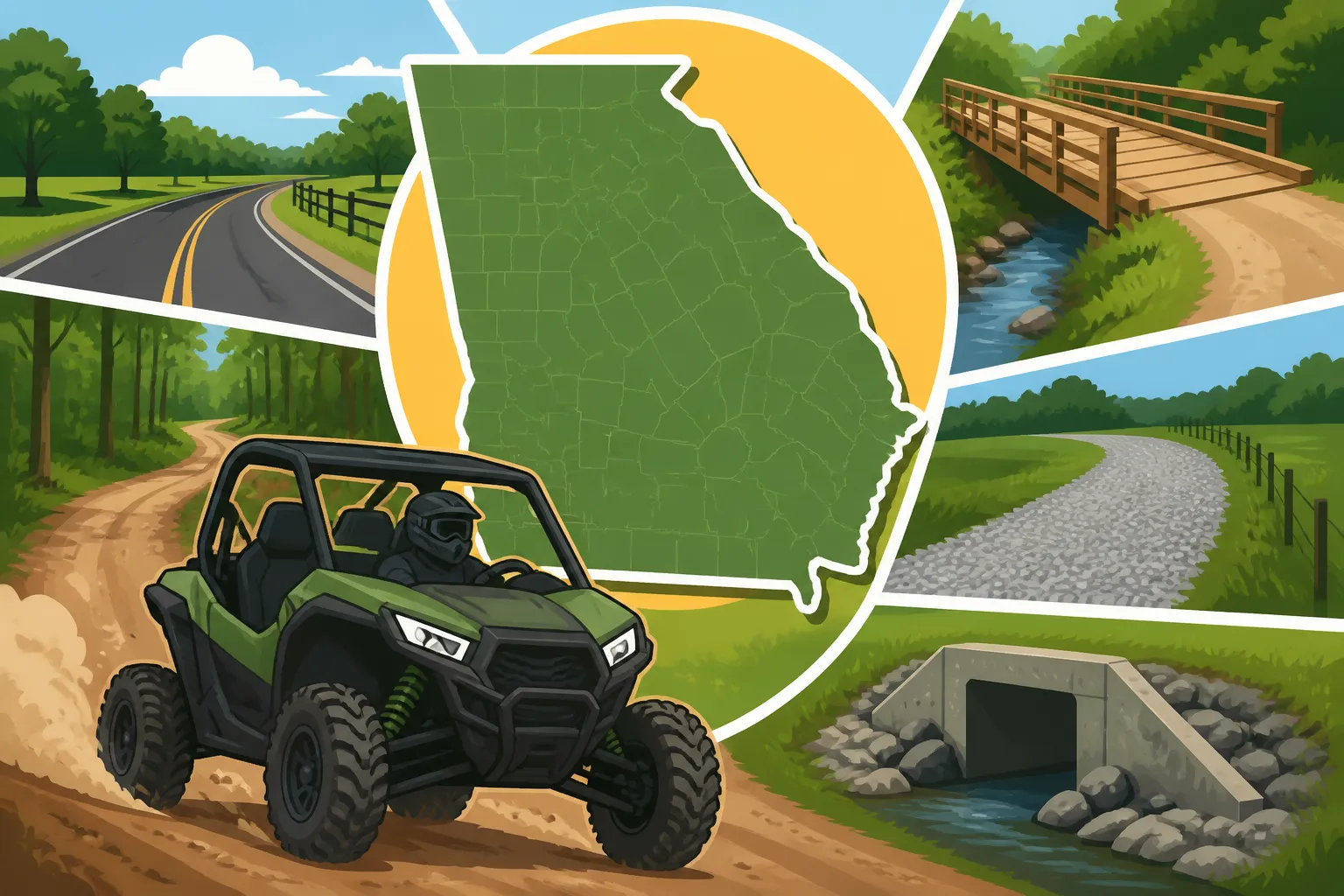
While county roads vary widely across Georgia, from pristine paved stretches in more developed areas to well-maintained gravel or dirt roads in rural and agricultural regions, they share some common characteristics. They typically have lower speed limits than state highways, often ranging from 35 to 45 mph, and serve to connect smaller communities, farms, and individual residences to larger transportation arteries. You'll often find them winding through forests, open fields, or alongside rivers, sometimes with minimal shoulder space or guardrails.
These roads are usually less traveled than state routes, but they are by no means empty. You'll encounter everything from passenger vehicles and school buses to farm equipment and logging trucks. The surface condition can change dramatically with weather, turning a smooth dirt road into a muddy, rutted track after a heavy rain. This variety means that what you consider "off-road" riding might occasionally merge with navigating these public, yet often rustic, thoroughfares. For those looking to equip their UTVs for this kind of diverse terrain, reputable brands like SuperATV offer a range of accessories, from heavy-duty tires to improved suspension, that can make transitioning between private land and county roads much smoother and safer.
The Critical Distinctions: What's NOT a County Road?
This is where many riders get into trouble. Just because a road "looks" like a county road, or is lightly traveled, doesn't mean it is. The distinction between county roads and other types of public roads is absolutely paramount for anyone operating an MPOHV in Georgia. Misidentifying a road can lead to significant legal repercussions, not to mention putting yourself and others at risk.
State Routes and Highways: The Big No-Gos
Let's be crystal clear: MPOHVs are generally not allowed to operate on Georgia state routes or highways. These roads, often identified by numerical designations (like GA-17, US-41, or I-75), are under the jurisdiction of the Georgia Department of Transportation (GDOT) and are designed for higher speeds and traffic volumes. They typically have multiple lanes, painted centerlines, and specific signage indicating their state or federal designation. Even if a state route looks like a quiet, two-lane road in a rural area, it's still off-limits for continuous MPOHV travel.
The only exception generally recognized by law is the ability to cross a state highway at a designated intersection, provided it's done safely and perpendicular to traffic flow. You cannot ride along a state highway, even for a short distance, to get from one county road to another. This is a common pitfall. Many riders assume a brief stint on a state route won't matter, but law enforcement sees it differently. Understanding [Georgia Crossing a Georgia State Highway on a UTV] is critical, as it details the precise circumstances and limitations for these necessary but brief maneuvers.
Interstates: Absolute Forbidden Territory
This should be obvious, but it bears repeating: Interstate highways are absolutely, unequivocally forbidden for MPOHVs, golf carts, or practically any vehicle that isn't designed for high-speed, controlled-access highway travel. These roads are for cars, trucks, and commercial vehicles traveling at speeds upwards of 60-70 mph. Not only would attempting to ride an MPOHV on an interstate be illegal, but it would also be incredibly dangerous, putting your life and the lives of countless others at severe risk.
Interstates are characterized by their multi-lane design, limited access points, and the distinct blue-and-red shield signs marking them with an "I-" prefix. There are no "crossing" allowances for MPOHVs on interstates; they are entirely off-limits. If your route even glances at an interstate, you need to find an alternative.
Municipal Streets: A Different Set of Rules
Beyond county roads and state routes, you have municipal streets, which fall under the jurisdiction of city, town, or village governments. Here's where it gets a little more complicated, because while state law sets a framework for MPOHVs, it often grants local municipalities the power to enact their own ordinances regarding street legal vehicles, especially for golf carts and other low-speed vehicles (LSVs). For example, a town might have specific rules for golf carts on its streets, but these rules do not automatically apply to MPOHVs like side-by-sides, which fall under a different legal classification.
Generally, without a specific local ordinance allowing them, MPOHVs are not permitted on city streets, even if they're registered for county road use. The state MPOHV law primarily grants access to county roads, not necessarily city streets. This means you need to be very aware of city limits and jurisdictional boundaries. What's legal on a rural county road just outside city limits might become illegal the moment you cross into town. Always check with the specific city or town hall if you plan to operate your MPOHV on any municipal street. A helpful reference could be [Georgia PTV Ordinances Cities Can Pass], which highlights the variability of local rules for personal transportation vehicles, though MPOHVs often require their own separate consideration.
What the MPOHV Law Means for County Road Access
The passage of Georgia's MPOHV registration law was a significant step for side-by-side and UTV owners. It provided a pathway for these machines to legally access certain public roads, something that was largely impossible before. However, this access comes with very specific conditions and limitations that every rider must understand. It's not a blanket "street legal" stamp; it's a carefully defined privilege.
The "Voluntary Registration" Connection to Road Use
One of the most important aspects of the Georgia MPOHV law is that registration is voluntary. You don't have to register your machine if you only ride it on private property. However, if you ever want to legally operate your eligible MPOHV on a public county road, that registration becomes mandatory. This is why [Georgia MPOHV Registration Explained] is such a vital resource. The act of registering your machine means you've affirmed it meets a stringent set of eligibility criteria, often referred to as the "eight-point test," which includes requirements for things like width, weight, speed capabilities, and safety equipment like seatbelts, headlights, and mirrors.
Without this registration, your machine is considered an off-road vehicle in the eyes of the law, and its presence on any public road, even a county road, would be illegal. The registration process itself involves presenting proof of ownership, undergoing potential inspections, and paying the annual registration fee. It's the state's way of ensuring that machines operating on public thoroughfares meet a minimum safety and operational standard, protecting both the rider and other road users.
Navigating the Sunset Clause: A Looming Change
Here's a critical detail that many riders might overlook or misunderstand: Georgia's law allowing MPOHVs on county roads currently includes a "sunset clause." This means the law is set to expire on July 1, 2027, unless the state legislature takes action to extend, modify, or make it permanent. This isn't just a distant date; it's a looming deadline that could fundamentally change where and how you can ride your registered MPOHV.
What this means for riders is that the current legal framework isn't set in stone indefinitely. While we hope for a positive outcome that allows continued access, it's important to stay informed about any legislative discussions or potential changes as that date approaches. For now, enjoy the access, but be aware that it's currently a temporary provision. Keep an eye on resources like [Georgia's July 2027 Sunset on Road Access] for the latest information on this critical deadline.
Permitted Crossings Versus Continuous Riding
The MPOHV law distinguishes between riding on a county road and simply crossing a more restricted road type. As mentioned, while continuous travel on state highways is forbidden, you are generally allowed to cross them at a designated intersection, provided it's safe and you proceed directly across. This is crucial for connecting segments of county roads that might be separated by a state route.
However, even on county roads where MPOHVs are permitted, the law still emphasizes responsible operation. It's not a free-for-all. You must adhere to all traffic laws, including speed limits, stop signs, and yield signs. You also need to have a valid driver's license. [Georgia MPOHV Road Rules: County Roads Only] outlines these specifics in detail, reinforcing that riding a side-by-side on a public road demands the same respect for traffic laws as driving a car. The registration is an allowance, not a waiver of standard road etiquette and regulations.
Signs, Ordinances, and Local Specifics
Understanding the legal definitions is one thing, but translating that into practical riding decisions on the ground requires paying attention to local cues and knowing where to look for specific information. What you see on a sign, or what a local sheriff tells you, often reflects the underlying legal framework.
How to Identify a County Road Visually
While the ultimate authority rests with county records, there are several visual cues that can help you identify a county road in Georgia:
- Road Names: County roads often have traditional names (e.g., "Jones Creek Road," "Old Mill Road") rather than state route numbers.
- Signage: Look for county road signs, which might be green or blue with white lettering, indicating the road name. These are distinct from the white-on-black or white-on-green signs used for state routes.
- Maintenance: You'll see county road crews working on these roads—patching, grading, clearing ditches.
- Paving Status: While many county roads are paved, a significant number, especially in rural areas, are gravel or dirt. Don't assume an unpaved road isn't a county road. Conversely, some state routes are also unpaved, adding to the confusion.
- Context: If you're traveling between two state routes on a non-numbered road, it's highly likely to be a county road.
When in doubt, it's always best to consult a local county road map or contact the county's public works department. They can definitively tell you the jurisdiction of any given road.
Local Ordinances That Can Further Restrict or Define
While the state MPOHV law opens up county roads, individual counties (or cities, regarding their own municipal streets) retain the ability to enact further restrictions or specific local ordinances. For example, a county could theoretically pass an ordinance that limits MPOHV access to certain county roads, or restricts them to daylight hours, even if the state law doesn't explicitly mandate it.
This is less common for county roads, where the state law is fairly broad, but it's particularly prevalent with municipal streets and personal transportation vehicles like golf carts. The key takeaway is that state law provides the baseline, but local governments can layer on additional rules. Before planning an extensive trip through an unfamiliar county, it's wise to do a quick check on their county commission's website or call their administration office to see if any specific MPOHV ordinances exist.
The Role of Law Enforcement on County Roads
Georgia law enforcement, including county sheriffs and state troopers, are responsible for enforcing traffic laws and MPOHV regulations on county roads. They are well-versed in the distinctions between road types and the requirements for legal MPOHV operation. If you're pulled over, they'll be checking for a valid [Georgia MPOHV Registration Explained], proof of insurance, a valid driver's license, and that your machine meets the basic safety equipment criteria.
Officers are also looking for responsible operation. Speeding, reckless driving, or operating under the influence are just as illegal on a county road with an MPOHV as they are in a car. They also know that MPOHVs have specific limitations, such as not being allowed on state routes. An officer might issue a citation if they observe you on a forbidden road, or if your machine doesn't meet the eligibility requirements. Understanding [Georgia Sheriff Enforcement on County Roads] can help you prepare for what deputies might be looking for during a roadside stop.
Practical Tips and Safety for County Road Riding
So, you've got your MPOHV registered, you know the difference between a county road and an interstate, and you're ready to explore. Great! But riding on public roads, even quiet county roads, is a different beast than tearing up private trails. Safety and preparedness become even more paramount.
Essential Gear and Machine Upgrades for Road Use
Just because your side-by-side or UTV passed the eight-point eligibility test doesn't mean it's optimized for road comfort or safety. Many riders opt for upgrades to enhance their road-going experience.
- Tires: Off-road tires are great for mud and rocks, but they can be loud and wear quickly on pavement. Some riders choose hybrid tires or even street-specific UTV tires for extended road use. Brands like SuperATV offer a variety of tire options, including those designed to be more road-friendly while still capable off-pavement.
- Windshields: A full windshield is highly recommended to protect against wind, bugs, and road debris.
- Lighting: While the eligibility test requires basic headlights and taillights, consider adding auxiliary lighting for better visibility, especially if you anticipate riding at dawn, dusk, or night (where permitted by local ordinance).
- Mirrors: You need rearview mirrors, but additional side mirrors can greatly improve situational awareness.
- Horn: A loud horn is a must for alerting other drivers.
- Turn Signals: If your machine didn't come with them, turn signals are a smart addition for clear communication on the road.
- Fender Flares: To reduce debris thrown by tires, especially on gravel roads, fender flares are a good investment.
Remember, the goal is to make your machine as visible and as safe as possible to other motorists, who might not be expecting an MPOHV on the road.
Defensive Riding and Sharing the Road
When you're on a county road, you're sharing it with cars, trucks, farm equipment, and potentially even pedestrians or cyclists. Defensive riding is key.
- Be Predictable: Use your turn signals, maintain a steady speed (within the limit), and avoid sudden maneuvers.
- Stay Visible: Wear bright clothing, use your headlights (even during the day), and consider adding reflective tape to your machine.
- Maintain Distance: Give yourself plenty of stopping room, especially on unpaved roads where traction might be reduced.
- Be Aware of Others: Assume other drivers don't see you. Scan mirrors frequently and be prepared for oncoming traffic, especially around blind curves or hillcrests.
- Pull Over: If a line of vehicles is building up behind you, find a safe spot to pull over and let them pass. This fosters goodwill and improves safety for everyone.
When In Doubt, Stay Off – Prioritizing Safety
This is perhaps the most important piece of advice: if you are unsure whether a road is a legal county road, if you doubt your machine's readiness, or if weather conditions make road travel unsafe, do not ride on it. It's simply not worth the risk. A ticket or an accident can ruin your day, damage your machine, and potentially lead to serious injury or financial hardship.
Always prioritize safety over convenience or a scenic route. If a road looks questionable, turn around and find an alternative. There are plenty of legal places to ride in Georgia, including designated OHV trails in national forests and private parks. While the MPOHV law offers exciting opportunities for exploration, it demands a high degree of responsibility and caution from riders. For more on safe operation, understanding [Georgia ATV Helmet Law for Riders Under 18] and [Georgia Driver's License Rules for MPOHV Operators] can provide further context on critical safety and legal requirements.
Here's a quick comparison of road types in Georgia:
| Road Type | Jurisdiction | MPOHV Access (Registered) | Key Characteristics | Identification Cues |
|---|---|---|---|---|
| County Road | County Government | Generally Permitted | Connects rural areas, farms; varying surfaces (paved/dirt); lower speed limits. | Road names (not numbers); county maintenance signs; often unpaved in rural areas. |
| State Highway | Georgia DOT | Crossing Only | Numbered routes (e.g., GA-17, US-41); higher speed limits; connects towns/cities. | Numerical signs (white on black/green); typically well-paved; more traffic. |
| Interstate | Georgia DOT/Federal | Forbidden | Multi-lane, limited access; high speed limits; connects major regions. | I- (e.g., I-75) shield signs; major traffic arteries; no local access points. |
| Municipal Street | City/Town Government | Local Ordinance Required | Within city limits; diverse functions; varies widely by city. | Within town boundaries; specific city road signs; check local ordinances for rules. |
| Private Road | Private Owner | Permission Required | Driveways, logging roads, farm tracks on private land. | No public signs; often gated or marked "Private Property." |
Disclaimer
This article is for general informational purposes only and does not constitute professional advice. Laws, prices and regulations vary by location and change over time. Consult a qualified professional for guidance on your specific situation.