A Learner’s Permit at 15 on a Cart
Navigating the rules for young drivers operating golf carts and other personal transportation vehicles (PTVs) in Georgia can feel like trying to solve a complicated puzzle, especially when you factor in learner's permits and varying local ordinances. Many parents and teens alike are left scratching their heads, wondering exactly what's allowed and what's not, often fearing an unexpected ticket or, worse, an unsafe situation. This guide aims to clear up that confusion, specifically addressing the question of whether a 15-year-old with a Georgia learner's permit can legally operate a golf cart on public paths and designated roads, breaking down the state laws and the crucial local variations that apply.
Understanding Georgia's Age and Licensing Rules for Carts
Georgia's approach to golf carts and other low-speed vehicles is quite distinct from its rules for traditional automobiles or even off-highway vehicles like ATVs and UTVs. This can be a significant source of misunderstanding, leading many to assume that if you can drive a car with a permit, you can surely drive a golf cart. However, the legal landscape is more nuanced, specifically designed to address the unique characteristics and common uses of golf carts.
State Law vs. Local Ordinances for PTVs
The fundamental challenge with understanding golf cart laws in Georgia is the split jurisdiction. While the Georgia state code provides a framework, it often delegates significant authority to local municipalities and counties to define where and how golf carts can be operated within their boundaries. This means that what's perfectly legal in one town might be strictly prohibited just a few miles down the road. It's a patchwork of regulations that requires careful attention to the specific rules of your city or county. This is a key reason why it's always critical to check [Georgia PTV Ordinances Cities Can Pass] for the specific area you plan to ride in.
For example, the state law defines what a "personal transportation vehicle" (PTV) is, often including golf carts that meet certain speed and equipment criteria. It also generally sets a baseline for age and licensing. However, the state often allows local governments to create ordinances that can be more restrictive or, in some cases, expand access under specific conditions. This flexibility is intended to allow communities to tailor rules to their unique infrastructure, such as dedicated golf cart paths or low-speed residential streets. So, while state law might say one thing about a 15-year-old with a permit, a local ordinance could either affirm it or add further restrictions, like requiring adult supervision regardless of the permit status.
The Role of a Learner's Permit (Class CP)
A Georgia Class CP learner's permit, typically obtained at age 15, allows a young person to operate a motor vehicle when accompanied by a licensed driver who is at least 21 years old and is occupying the front passenger seat. The purpose of this permit is to provide supervised driving experience before a provisional license (Class D) or full license is issued. The question then becomes, does a golf cart fall under the definition of a "motor vehicle" for this specific permit requirement? For the purpose of operating on designated public roads and paths where a license is required, the answer is generally yes.
However, this doesn't automatically mean that a 15-year-old with a learner's permit can drive a golf cart anywhere a car can go, or even anywhere a golf cart can go. Many communities have specific ordinances that dictate the minimum age for operating a golf cart on public paths, which can sometimes be higher than the learner's permit age, or require a full driver's license. The presence of a supervising driver, as mandated by the learner's permit, is often a crucial element when it comes to compliance. Without proper supervision, even with a permit, a young driver could be in violation of local laws, potentially leading to fines or other penalties. This distinction is vital when considering [Georgia Driver's License Rules for MPOHV Operators].
The Nuances of Driving a Golf Cart with a Learner's Permit in Georgia
Understanding that a learner's permit can apply to golf cart operation on public ways is just the first step. The specifics of how and where a 15-year-old with a Class CP can legally drive a cart are where the details truly matter. It's not a blanket permission slip, but rather a conditional authorization that depends heavily on the type of roadway, the presence of supervision, and the specific rules of the local jurisdiction.
Public Paths and Designated Golf Cart Roads
Many Georgia cities and planned communities, like Peachtree City, have extensive networks of designated golf cart paths or have explicitly opened certain low-speed roads to golf cart traffic. These are the primary areas where a 15-year-old with a learner's permit might consider operating a cart. In these specific environments, the rules often align more closely with general state driver's license laws, meaning that if a driver's license is required, a learner's permit with proper supervision usually suffices. This aligns with specific provisions like [Learner's Permits at 15 on a Path].
However, even on these designated paths, there might be additional local stipulations. Some ordinances might require that the supervising adult also possesses a valid driver's license, which is standard for a learner's permit. Others might impose curfews for young drivers or restrict the number of passengers. It's not just about having the permit; it's about understanding the specific operational context. For instance, a path that runs alongside a state highway might have different rules than a path within a residential subdivision. Always verify the signage and published ordinances for the area.
The Importance of Adult Supervision
For a 15-year-old operating any motor vehicle with a Class CP learner's permit, including a golf cart on public paths or roads where a license is required, adult supervision is not optional – it's mandatory. The licensed driver, aged 21 or older, must be in the front passenger seat. This isn't just a technicality; it's a safety measure designed to provide immediate guidance and intervention if needed. Without this supervision, the learner's permit is essentially invalid for public road use, and the young driver could be cited for unlicensed operation.
This supervision requirement extends beyond just sitting in the passenger seat. The adult is expected to be attentive and capable of taking control if necessary. For parents, this means actively monitoring the driving, offering instructions, and being ready to react. It's also important to ensure the golf cart itself is in good, safe working order. Companies like SuperATV offer a range of accessories, such as enhanced mirrors or turn signal kits, that can improve visibility and safety, which could be particularly beneficial when a new driver is behind the wheel, even with supervision. While these aren't always legally required for basic operation, they contribute to a safer environment.
Crossing State Routes and Limited Road Access
While some local ordinances permit golf carts to operate on certain low-speed county or city roads, or to cross state highways at designated intersections, these privileges are often conditional and come with stricter age and licensing requirements. In many cases, these specific crossing points or road segments might demand a full driver's license, not just a learner's permit, for operation. This means a 15-year-old with a learner's permit, even with supervision, might be restricted from these specific maneuvers. The exact rules for [Crossing a Georgia State Highway on a UTV] often apply differently to golf carts, and are very localized.
It's paramount to understand that golf carts are generally not considered street-legal for widespread road use in the same way cars are. They are often limited to roads with speed limits below a certain threshold (e.g., 25 or 35 mph) or specifically designated paths. Attempting to drive a golf cart on roads not explicitly permitted by local ordinance, or attempting to cross a state route where it's forbidden for a cart, can lead to serious consequences, regardless of whether the driver has a permit or not. Always check the local laws carefully.
Comparing Golf Cart Rules with ATV/UTV Regulations
It's easy to lump all off-highway vehicles and low-speed transportation together, but Georgia's laws draw clear distinctions, particularly when it comes to age, licensing, and where these machines can legally operate. Understanding these differences is crucial for parents and young riders to avoid legal trouble and ensure safety. A golf cart, a utility vehicle (UTV), and an all-terrain vehicle (ATV) each have their own set of rules, even though they might seem similar at a glance.
Why a Golf Cart Isn't an ATV or UTV
The core difference lies in their design and intended use. A golf cart, often defined as a Personal Transportation Vehicle (PTV) in Georgia, is built for low-speed travel, typically on golf courses or within planned communities, with a top speed usually capped at around 20 mph. They are designed for paved or well-maintained paths and generally have minimal suspension. The state has specific definitions for [Georgia Golf Cart Laws and PTV Ordinances].
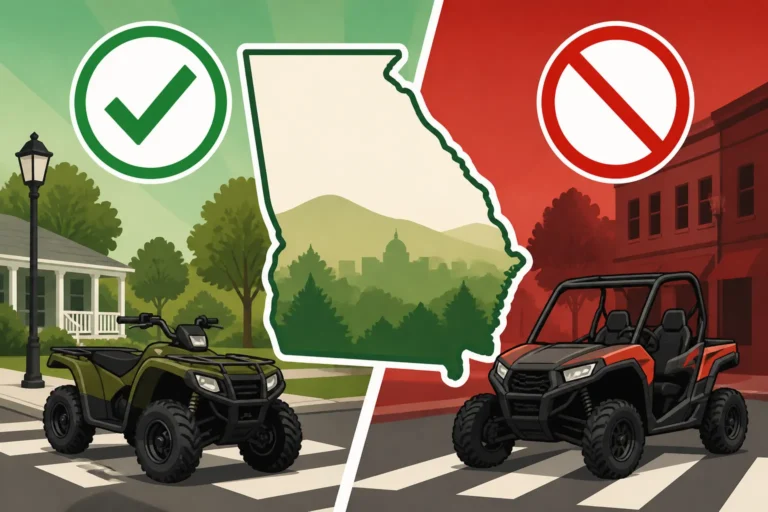
ATVs (All-Terrain Vehicles) and UTVs (Utility Terrain Vehicles, often called side-by-sides) are a different breed entirely. ATVs are designed for off-road single-rider use with handlebars and a straddle seat, while UTVs are multi-passenger, often with a steering wheel and bucket seats, built for rough terrain, utility work, or recreational trail riding. Both typically have higher ground clearance, robust suspensions, and can achieve much higher speeds than golf carts. Critically, [Georgia ATVs Are Not Road Machines] generally, and UTVs have very specific, recent, and often temporary provisions for limited road access on county roads. This fundamental difference in design and purpose dictates vastly different legal frameworks.
Age and License Requirements: A Different Ballgame
The age and licensing requirements for ATVs and UTVs are significantly more restrictive than for golf carts, especially when considering any form of public road access. For instance, while a 15-year-old with a learner's permit might be able to drive a golf cart with supervision on a designated path, the same permit almost never grants permission to operate an ATV or UTV on a public road, even if permitted by the new MPOHV (Multipurpose Off-Highway Vehicle) registration system. This is often tied to Georgia's long-standing rule that [Why a Four-Wheeler Cannot Be Registered in Georgia] for street use, which distinguishes them from the newly permitted MPOHVs.
For MPOHVs (which are essentially UTVs that meet strict criteria), drivers typically need a full Class C driver's license to operate them on approved county roads. A learner's permit for a UTV on a county road would be highly unusual and is not generally permitted under current MPOHV regulations, which explicitly state a full license is required for operators. Furthermore, Georgia has strict [Georgia ATV Helmet Law for Riders Under 18], which applies to off-road riding, a rule generally not enforced for golf cart use unless a local ordinance specifically requires it. This stark difference underscores the need to know exactly what type of machine you are operating.
Where Each Vehicle Can Be Operated
This is perhaps the most critical distinction. Golf carts (PTVs) are primarily designed for and legally restricted to golf courses, private property, and specific public roads or paths designated by local ordinances. Their road access is almost exclusively granted through local municipality decisions.
ATVs, by nature, are almost exclusively for off-road use on private land or designated [Georgia ATV Trails: Where You Can Legally Ride]. Public road access for ATVs in Georgia is virtually non-existent, and attempting to ride one on a public road will almost certainly result in a citation.
UTVs (MPOHVs), on the other hand, can now be registered for limited access to county roads under specific conditions (since December 2023), but this is explicitly not for state highways or interstates. This new registration allows UTVs that meet stringent equipment and design requirements to use county road systems, but still requires a licensed driver, proper insurance, and adherence to specific equipment mandates like [Headlights, Brake Lights and Mirrors on the Checklist]. Even then, [Georgia's ATV Road Access Law Sunsets in July 2027], which means these privileges are temporary. This contrasts sharply with golf carts, whose road access is typically more entrenched in local community planning and less about state registration for general road use.
Navigating Local Ordinances: Peachtree City and Beyond
While Georgia's state laws provide a foundation for vehicle operation, when it comes to golf carts and personal transportation vehicles (PTVs), the real rules often live at the local level. Each city and county has the power to enact its own ordinances, creating a diverse regulatory landscape that can be incredibly confusing if you're not paying close attention to your specific location. This is especially true for young drivers, including those with learner's permits, where age restrictions and supervision requirements can vary widely.
Peachtree City: The Gold Standard for Cart Paths
Peachtree City stands out as Georgia's prime example of a community built around golf cart use. With over 100 miles of multi-use paths, golf carts are an integral part of daily life there. The city has comprehensive ordinances specifically addressing golf cart operation, including detailed rules for minors. In Peachtree City, a 15-year-old with a valid Georgia learner's permit (Class CP) can operate a golf cart on the city's paths, provided they are accompanied by a licensed driver who is at least 21 years old and occupies the passenger seat. This specific provision makes Peachtree City one of the places where [Learner's Permits at 15 on a Path] are explicitly recognized for golf cart use.
However, even in Peachtree City, there are nuances. For instance, a 12 to 14-year-old can operate a golf cart on the paths if accompanied by a parent or guardian who is 18 years or older and in the passenger seat. And those under 12 are generally prohibited from driving a cart at all, reinforcing the rule that [Under 12 and Why They Cannot Drive]. These age distinctions highlight how local ordinances can go into fine detail, making it imperative to consult the city's specific rules, not just general state guidelines. The extensive [Peachtree City's 100 Miles of Georgia Cart Paths] makes clear why their rules are so detailed and specific.
Other Cities with Specific Golf Cart Rules
Peachtree City isn't alone; many other Georgia communities have embraced golf cart usage, particularly in neighborhoods or areas with limited car traffic. Cities like Senoia, Tyrone, and some coastal communities also have specific ordinances allowing or regulating golf cart use on certain streets or designated paths. However, the details of these ordinances can differ significantly from Peachtree City's model. Some might require a full driver's license for all operators, regardless of age or permit status, effectively prohibiting a 15-year-old with a learner's permit from driving a cart on public ways. Others might have stricter rules regarding passenger limits, hours of operation, or even require specific safety equipment beyond what state law mandates for PTVs.
It's critical that if you plan to operate a golf cart with a learner's permit in any Georgia city or county, you must directly contact that local government (city hall, police department, or county clerk) to obtain the most current and accurate copy of their golf cart ordinances. Assuming one city's rules apply to another is a recipe for trouble. For instance, the general guideline of [Georgia Golf Cart Age Rules] can be superseded by a local ordinance.
The Contrast with Rural Counties
In contrast to cities with dedicated cart paths, many rural Georgia counties have very few, if any, specific golf cart ordinances. In these areas, golf carts are often treated simply as low-speed vehicles, and their operation on public roads might be severely restricted or outright prohibited beyond private property. If a county has no specific PTV ordinance, state law regarding motor vehicles usually prevails, and golf carts typically do not meet the criteria for general road use. This means that a 15-year-old with a learner's permit, even with supervision, would likely have no legal public road access for a golf cart in such areas.
The key takeaway is that the freedom to operate a golf cart, especially for a younger driver with a learner's permit, is heavily dependent on location. What's accepted in a planned community with a robust path network might be strictly illegal in a rural county. Always do your homework regarding local laws before setting out.
Ensuring Safety and Compliance for Young Drivers
Beyond just understanding the legalities, ensuring the safety of young drivers behind the wheel of a golf cart, especially with a learner's permit, is paramount. The low speeds and seemingly innocuous nature of golf carts can sometimes lead to a false sense of security, but accidents can and do happen. Compliance with both state laws and local ordinances, coupled with a strong emphasis on responsible driving, is the best approach.
Essential Safety Equipment and Practices
Even if not explicitly mandated by every local ordinance, certain safety features are crucial for any golf cart, particularly when a younger, less experienced driver is operating it. Factory-installed seat belts are a must, and if the cart lacks them, aftermarket kits can be installed. Headlights, taillights, and brake lights are not just good ideas but are often required by law for operation on any public path or road, especially after dark. Rearview mirrors also significantly enhance situational awareness, a point supported by general requirements for [Rearview Mirrors on the Required List] for registered MPOHVs.
Beyond equipment, instilling safe driving practices is vital. This includes:
- Always yielding to pedestrians and bicycles: Golf cart paths are often shared.
- Maintaining a safe speed: Especially around turns, blind spots, or in congested areas.
- Avoiding distractions: No phone use while driving.
- Never overloading the cart: Respect passenger and cargo limits.
- Operating sober: This is non-negotiable for any driver, regardless of age.
Companies like SuperATV offer a variety of aftermarket parts and accessories that can enhance the safety profile of a golf cart, such as stronger mirrors, LED light bars for improved visibility during [Georgia Night Riding on a County Road], or even turn signal kits to make intentions clearer to other path users. Investing in these can provide an extra layer of protection and compliance.
The Consequences of Non-Compliance
Operating a golf cart without adhering to state and local laws can lead to a range of penalties. For a 15-year-old with a learner's permit, these consequences can include:
- Citations and Fines: For unlicensed operation, driving without supervision, or violating local ordinances regarding speed, passengers, or restricted areas. These fines can be substantial.
- Driving Record Impact: While not always tied to a state driver's license for golf cart violations, some infractions could impact future driving privileges or insurance rates.
- Vehicle Impoundment: In serious or repeated cases of non-compliance, local law enforcement may impound the golf cart.
- Accident Liability: If an accident occurs while operating illegally, the driver and their parents could face significant civil liability, and insurance coverage might be denied. This is where [Georgia UTV Insurance Minimums] become very relevant, as similar principles apply to golf carts.
It's a serious matter, and the potential costs far outweigh the convenience of cutting corners. Parents should be fully aware of the laws and enforce them rigorously.
Education and Parental Responsibility
Ultimately, the responsibility for ensuring a 15-year-old with a learner's permit operates a golf cart safely and legally rests heavily on the parents or guardians. This involves:
- Thoroughly researching local ordinances: Before allowing any operation on public ways.
- Providing comprehensive instruction: Beyond just basic driving, teach defensive driving techniques specific to golf cart environments.
- Setting clear rules: Define where, when, and with whom the cart can be operated.
- Leading by example: Adults should always follow the rules themselves.
- Regularly checking the cart: Ensure all safety equipment is functional.
A golf cart can be a wonderful tool for transportation and recreation in appropriate settings. However, when placed in the hands of a young, inexperienced driver, even with a learner's permit, it demands respect for the rules and a commitment to safety from everyone involved. By understanding the distinctions between golf carts, ATVs, and UTVs, and by diligently adhering to the unique patchwork of state and local regulations, families can ensure that the experience is both enjoyable and free from unnecessary risks.
Summary of Georgia Golf Cart Driving Rules for 15-Year-Olds with a Learner's Permit
To help clarify the intricate rules surrounding a 15-year-old with a Georgia learner's permit driving a golf cart, here's a quick reference table. Remember, always verify with your specific local municipality for the most accurate and up-to-date information, as local ordinances can override or add to state guidelines.
| Feature / Condition | General State Guideline (for PTVs) | Common Local Ordinance (e.g., Peachtree City) | ATVs/UTVs (MPOHVs) Contrast |
|---|---|---|---|
| Driver Age / Permit | 15 with Class CP Learner's Permit (supervised) | 15 with Class CP Learner's Permit (supervised) | ATVs: No public road access, no permit/license relevance. UTVs (MPOHV): Full Class C license required for county roads, no learner's permit allowed. |
| Supervision Required | Yes, licensed driver 21+ in passenger seat for public road/path use. | Yes, licensed driver 21+ in passenger seat for public path use. (Some allow 12-14 with 18+ parent). | Not applicable for ATVs. For UTVs on county roads, full license means no supervision required (but always recommended for young drivers). |
| Where Allowed | Private property, designated PTV paths, or public roads/crossings explicitly permitted by local ordinance. | Extensive network of designated multi-use paths and specific low-speed roads. | ATVs: Private land, designated [Georgia ATV Trails: Where You Can Legally Ride]. UTVs (MPOHV): Registered machines on designated county roads only, with restrictions on state routes and interstates. |
| Speed Limit | Generally low speed (e.g., <20 mph, defined as PTV). | Strict adherence to posted speed limits on paths/roads. | ATVs/UTVs can go much faster; UTVs on county roads must adhere to road speed limits, but their registration requires them to be capable of 25-65 mph, so they are faster than carts. |
| Equipment Requirements | Headlights, taillights, brake lights, horn, rearview mirror (often for PTV registration). | Similar to state, plus city-specific requirements for safety on paths. | [Georgia Equipment a Road Machine Must Carry] for MPOHVs is extensive: steering wheel, seat belts, mirrors, lights, etc. ATVs generally have fewer requirements as they are not road-legal. |
| Insurance | Recommended, though not always state-mandated for PTVs unless used on public roads where required. | Often required by local ordinance for public path use. | [Georgia Insurance Minimums for Road Use] are mandatory for registered MPOHVs. Not applicable for ATVs. |
| Local Authority Impact | High: Local ordinances can define or restrict operation significantly. | High: Peachtree City has very detailed and specific ordinances for cart operation, more than state minimums. | Moderate for UTVs: State law sets core MPOHV rules, but counties decide which roads are open. High for ATVs: Local ordinances cannot grant general road access for ATVs not meeting MPOHV criteria. |
Disclaimer
This article is for general informational purposes only and does not constitute professional advice. Laws, prices and regulations vary by location and change over time. Consult a qualified professional for guidance on your specific situation.