What a Ranger Checks at a Georgia OHV Trailhead
A ranger check at a Georgia OHV trailhead is usually about whether you and your machine may use that trail system under its current rules. Knowing what to have ready can prevent delays and help you avoid an expensive mistake, especially if permits, trail closures, machine-width limits or rider requirements apply where you plan to ride.
Before You Reach the Trailhead
Start by confirming the rules for the specific riding area. “Georgia OHV trail” can mean a designated trail on national forest land, a private off-road park, or another area with its own access rules. A permit or pass that works at one place may not satisfy the requirements at another. Check the managing agency or park for current access, operating hours, closures, machine restrictions and payment details before setting out.
For national forest OHV systems, operators may need a day or annual permit. The permit is generally tied to the person operating the machine, not to the vehicle, so a group should check how many operators need permits. See Georgia’s Day and Annual Forest OHV Permits and Georgia National Forest Permits Are Per Operator for the key distinction. If you are riding multiple machines or sharing driving duties, make sure each person who will operate has the required permit.
Have your permit easy to show. Depending on how you obtained it, that might mean carrying a printed copy or having an electronic copy ready on your phone. Do not assume that a screenshot will be accepted in every situation, or that you will have cell service at the trailhead. Check the permit’s instructions and consider carrying a backup copy if that is allowed. Carrying a Permit on the Trail covers practical ways to keep proof available.
Also check the trail system’s vehicle limits. A machine that is legal to own or ride elsewhere may not fit a particular trail. Some routes have width limits or exclude certain vehicle types. Measure your machine using the method the site specifies, rather than relying only on a manufacturer’s advertised width; accessories such as wheels or other add-ons may affect the measurement. For a narrower system, Measuring 50 Inches at Check-In explains why a tape measure can matter.
| What to prepare | Why it matters | What to check |
|---|---|---|
| Required permit or pass | Staff may ask for proof before or during a ride | Whether it applies to each operator, how it must be carried and which area it covers |
| Machine dimensions and type | A route may restrict vehicle width or type | The current trail-system limits and how the site measures the machine |
| Rider and passenger plan | Age, supervision and passenger rules can vary | Who may operate, who may ride as a passenger and any helmet rules |
| Safety equipment | Site rules or applicable law may require specific equipment | Current requirements for helmets, eye protection or other gear |
| Trail status | Routes can close because of weather, maintenance or seasonal rules | Open routes, operating hours and any temporary restrictions |
| Payment and proof | Access procedures differ by site | Whether payment is online, at a kiosk, at an office or through a private park |
A forest OHV permit is not a general road-use authorization. It does not automatically make a machine street legal, grant access to every forest road, or replace permission to ride on private property. For road access questions, see Georgia MPOHV Road Rules: County Roads Only. Trail access and public-road access are separate issues.
What a Ranger or Trail Staff May Check
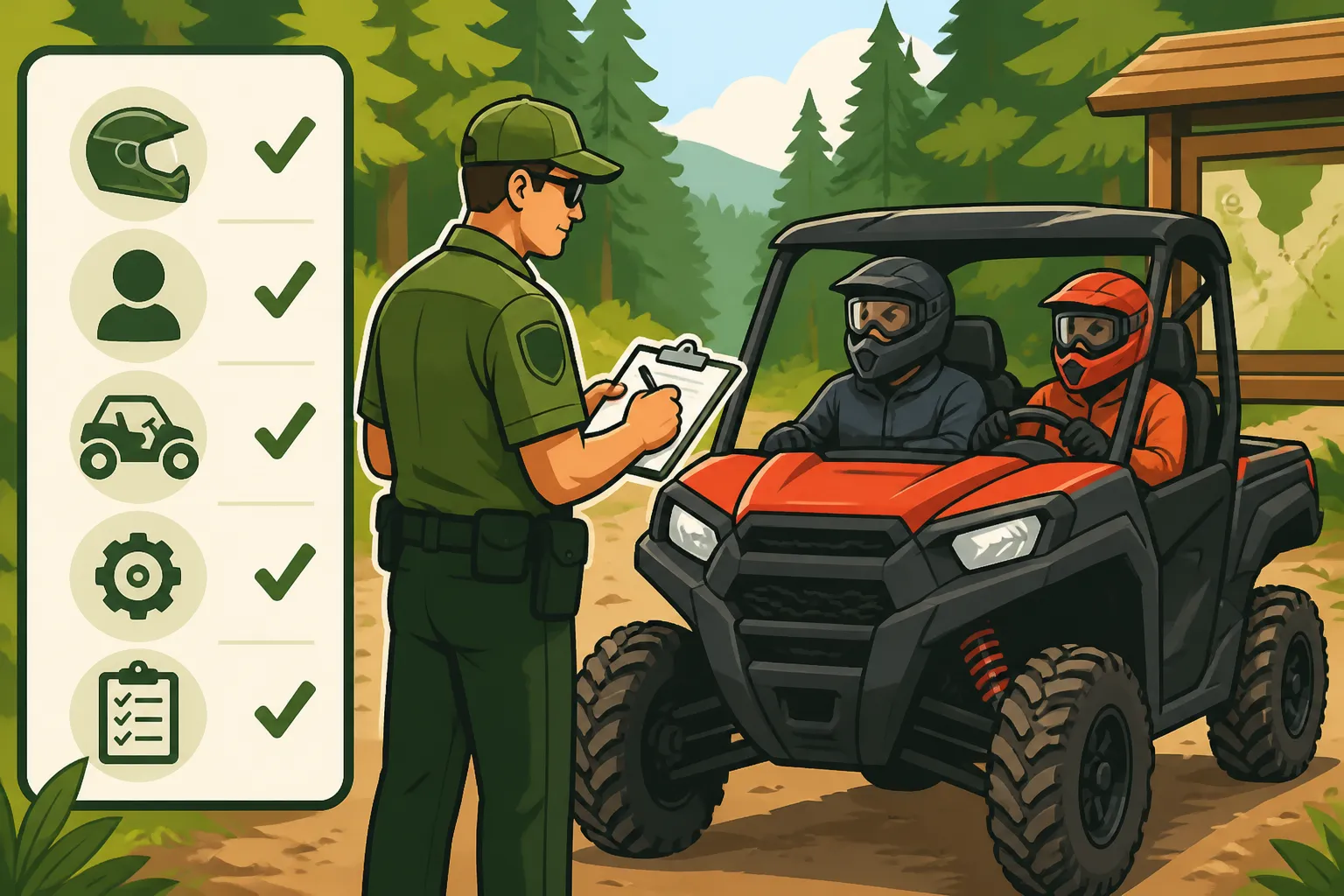
The exact check depends on who manages the property, the conditions that day and what the staff member observes. A national forest ranger, a private park employee and a wildlife-area officer do not necessarily use the same procedure. There is no single checklist that applies at every Georgia trailhead. The following are practical items to be ready for, not a promise that each one will be inspected on every visit.
Permit and access
A staff member may ask whether the operator has the required permit or pass and whether it covers the location being used. They may also want to know that the rider is using the correct system or trailhead. Keep the permit proof accessible rather than buried in a trailer, packed under gear or stored on a phone that has run out of battery.
If you are unsure whether your permit is valid for the site, ask before unloading. A permit for one kind of recreation or property does not necessarily cover another. Likewise, a permit does not make a closed trail open. What an Operator Permit Does Not Cover explains the limits of what an OHV permit provides.
Machine type and trail fit
Staff may verify that the machine is allowed on the route and fits any applicable size restriction. This is especially important on a system with narrow trails. A large side-by-side may be excluded even when smaller OHVs are allowed. A machine’s ability to physically travel a path does not mean that the route is open to it.
The trail system’s posted information should be your guide. Check restrictions for the actual trail you intend to ride, not only the general rules for the broader recreation area. If your machine is close to a posted width limit, measure before leaving home and ask the managing office how the measurement is made. Do not wait until the machine is blocking the entrance or unloading area to resolve a fit question. Georgia ATV Trails That Allow Side-by-Sides is useful when comparing systems.
Rider, passenger and helmet rules
A ranger or park employee may check that the operator and passengers follow the rules for that property. Requirements can depend on age, vehicle type, supervision and location. Georgia’s under-18 helmet rules are one issue to consider, but a trail system or private park can have its own safety requirements as well. Confirm the rules for the place you are visiting rather than assuming that the rules for a public road or private property apply unchanged on a designated trail.
Passengers must also be seated and carried as the machine is designed for. Do not take an extra rider in a cargo area or on a machine without an appropriate passenger seat. A passenger’s presence does not turn them into an operator for permit purposes, but a passenger may still be subject to separate age, safety and park rules. For permit questions involving riders who are not driving, see Does a Passenger Need Their Own Georgia Forest Permit?.
Closures and trail conduct
Trail status can change. Heavy rain, damage, maintenance, seasonal restrictions or other management decisions may close a route temporarily. Staff may direct riders away from a closed section or remind them to stay on designated routes. A trail map downloaded earlier can help with navigation, but it may not show a closure issued after the map was made. Check current notices at the entrance and before riding.
Follow posted direction even if a closed route looks passable. Riding around a barrier can damage vulnerable ground, create a safety hazard or violate the access conditions. The same goes for turning onto an unmarked road or shortcut because it looks like a convenient connection.
Equipment and vehicle condition
Some sites may have equipment-related requirements, and staff can respond to an obvious safety concern or a complaint. Depending on the property and applicable rules, requirements may address helmets, sound or spark arrestors. Do not assume that a condition accepted at one park will be accepted at another. Check the local rules before you arrive, and make sure required equipment is fitted and working rather than packed away.
A ranger check is not necessarily a full mechanical inspection. Still, a machine with a leaking fuel line, failing brakes, loose steering or another visible problem can create a danger for its riders and others. A quick pre-ride inspection is worthwhile even when no one asks to see the machine.
If Something Is Missing or Your Machine Is Turned Away
If you cannot show a required permit, do not argue that the machine is registered or that you paid for access somewhere else. Ask calmly what proof is accepted and whether there is a permitted way to obtain or confirm it. If the issue is a missing pass, follow the site’s payment procedure. Some locations may have limited connectivity or no convenient sales point, so buying or checking your permit before traveling is safer. Buying a Day Permit the Morning You Ride discusses why last-minute arrangements can be uncertain.
If the problem is machine width or type, do not try to squeeze through a restricted entrance or ride an unauthorized route. Ask whether another route or area is open to your machine. If there is no suitable route, the practical answer may be to leave and choose a trail system with rules that fit the machine. Trail restrictions exist for reasons that may include trail design, damage prevention and safe sharing.
If a posted closure conflicts with information you found earlier, treat the on-site closure as current unless the managing agency clarifies otherwise. Ask where to find an updated status notice and whether any alternate route is open. Avoid moving a gate, riding around a barrier or treating a closure as optional because other riders have gone through.
For a private park, ask staff about the park’s own waiver, admission, age and equipment requirements. Those policies are separate from a national forest permit. For a wildlife management area, confirm the particular area’s access conditions rather than assuming a forest OHV permit covers it. Georgia WMA Riding Rules Explained summarizes why WMA access should be checked separately.
Keep the interaction straightforward. Have your permit ready, answer questions accurately and follow any direction about where you may ride. If you believe a rule has been misunderstood, ask which posted requirement or site policy applies and how to contact the managing office for clarification. A trailhead is a poor place to test an uncertain interpretation by riding ahead anyway.
A Simple Trailhead-Ready Routine
Use this sequence before each ride, especially when visiting a trail system for the first time:
- Identify who manages the area. Confirm whether it is a national forest OHV system, private park, wildlife area or other property. Use that manager’s current rules, not a general assumption about Georgia trails.
- Check that the route is open. Look for current closures, operating hours and weather-related notices. Recheck close to departure because trail conditions can change.
- Confirm permits and payment. Verify which operators need a permit, where it is valid and what proof you must carry. If you plan to show a phone copy, charge your phone and keep a backup if the instructions allow one.
- Compare your machine with the trail limits. Check allowed vehicle types and width restrictions. Measure before you tow, particularly if your machine is near a posted limit.
- Review rider and passenger requirements. Check age, supervision, helmet and seating rules for the location. Do not assume a passenger is exempt from safety requirements.
- Inspect the machine and gear. Check brakes, steering, tires and fuel lines. Pack any equipment required by the property and wear appropriate protective gear.
- Keep proof easy to reach. Place permit details and any necessary paperwork where the operator can show them without unpacking the entire vehicle. A waterproof phone pouch can help protect an electronic permit copy; if shopping on Amazon, confirm that the pouch fits your phone and can be used as intended.
- Read signs at the entrance. Pay attention to the rules and closures posted at the trailhead, even if you reviewed the area online. Ask staff before unloading if anything is unclear.
The main benefit of preparing is not simply getting through a check faster. It helps you avoid towing a machine to a trail where it cannot ride, arriving without the correct permit, or entering a route that has closed. For a broader pre-ride list, see What Every Rider Carries on a Georgia OHV Trail and Georgia Trail Conditions Before You Drive.
Disclaimer
This article is for general informational purposes only and does not constitute professional advice. Laws, prices and regulations vary by location and change over time. Consult a qualified professional for guidance on your specific situation.