Why One-Way Trails Reduce Collisions
A head-on meeting on a narrow trail can turn a fun Georgia ride into a stressful, dangerous scramble—especially around blind turns, steep climbs, or dusty stretches where you cannot see far ahead. One-way trails reduce that risk by organizing traffic in a single direction. This guide explains how that helps, what it does not prevent, and how to ride more safely on Georgia ATV and UTV trails.
How one-way trails reduce the chance of a collision
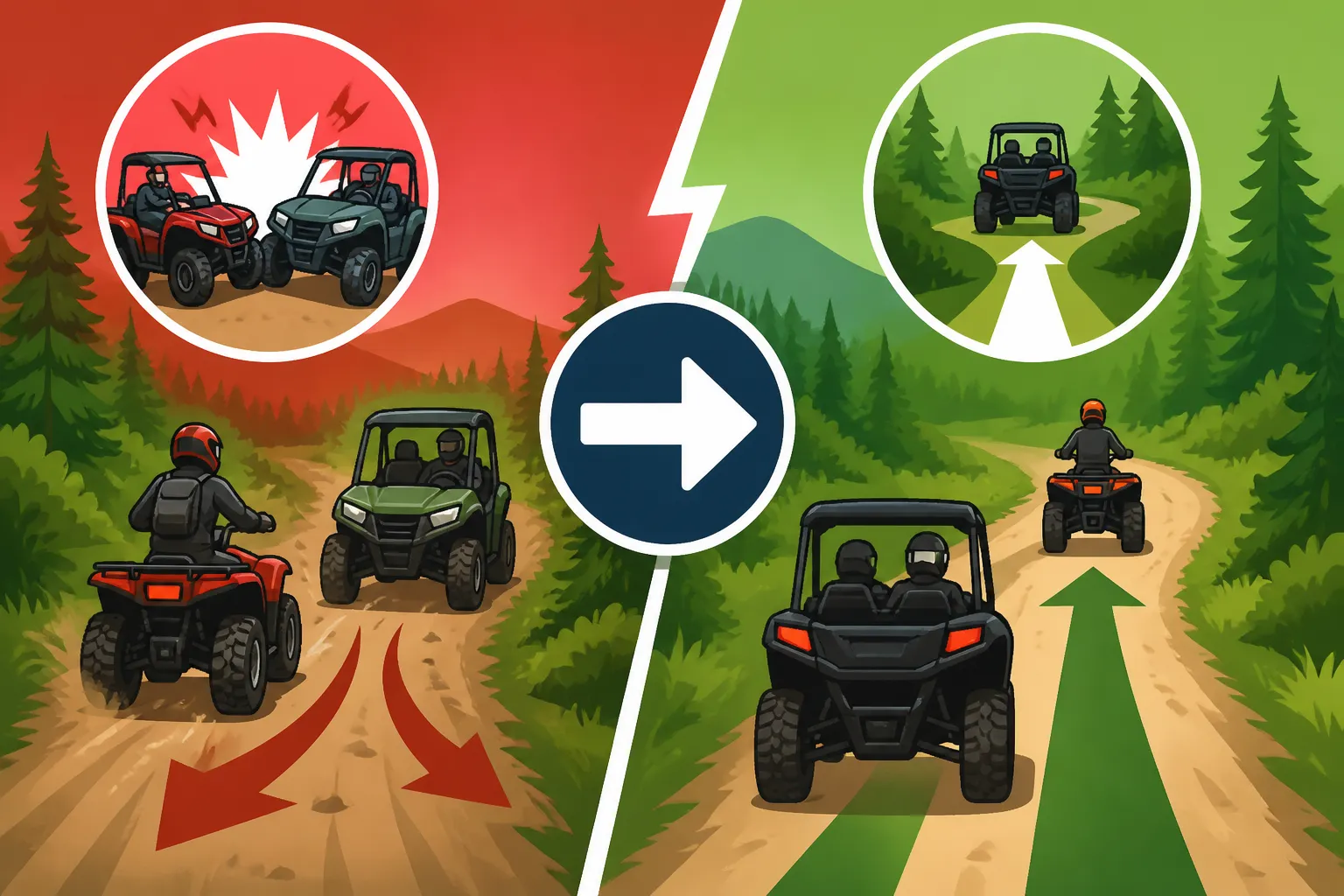
They remove most head-on traffic
On a two-way trail, every bend or rise could hide a rider coming toward you. On a one-way loop, riders are expected to travel in the same direction, so the main threat of meeting another machine nose-to-nose is greatly reduced. That matters on narrow trails where there may be little room to pull aside without dropping a tire into a rut or brushing a tree.
The safety benefit is clearest where visibility is short. Georgia’s wooded trails can twist through trees, dip into hollows, and climb over uneven ground. A rider approaching a blind bend cannot count on seeing far enough around it to avoid someone coming the other way. One-way traffic removes that particular conflict when everyone follows the marked route.
It does not make the trail collision-proof. A rider may stop around a corner, lose control, or travel the wrong way. Someone could also be walking on the trail or working on a disabled machine. Think of one-way travel as a way to reduce a common risk—not a reason to ride faster or assume the trail ahead is clear.
They make passing and meeting situations more predictable
Direction matters because riders can make better decisions when they know what to expect. On a one-way trail, groups are less likely to face an oncoming vehicle in a spot where neither driver has an easy place to yield. This can be especially helpful when a UTV and a smaller ATV meet on a narrow section: even if both riders are careful, the width and shape of the trail may make passing awkward.
One-way routes can also help reduce confusion at intersections. If the signs and route markers are clear, riders can follow the loop without guessing which direction to take. For visitors who are unfamiliar with a trail system, checking Georgia Trail Etiquette on One-Way Loops before riding helps set expectations about direction, spacing, and yielding.
Predictability only works when riders follow the same system. Do not assume a trail is one-way because it looks like a loop, because you saw other riders traveling in one direction, or because a map displays a suggested route. Check signs at the trailhead and at intersections, and obey any temporary direction or closure notices.
They reduce one risk, not every trail hazard
A one-way designation is not a substitute for controlling speed. A rider can still hit someone from behind, run into a stopped group, or lose traction on loose clay. A fast approach to a blind corner is risky even when all traffic should be moving in the same direction; the rider ahead may have stopped to help someone, clear an obstacle, or check the route.
Other hazards remain, too: exposed roots, washouts, fallen branches, water crossings, loose gravel, and sudden changes in elevation. Keep a pace that lets you stop within the visible distance ahead. On a shaded, winding trail, that may mean slowing well before a curve rather than braking sharply at the last moment.
| Trail situation | How one-way travel helps | What riders still need to do |
|---|---|---|
| Blind corner | Reduces the chance of meeting oncoming traffic | Slow down and stay alert for stopped riders or walkers |
| Narrow wooded section | Makes opposing vehicle conflicts less likely | Keep to the marked route and avoid cutting corners |
| Trail intersection | Can make travel direction easier to anticipate | Read signs and confirm the correct branch before proceeding |
| Steep or uneven section | Reduces opposing traffic on a difficult stretch | Leave room between machines and use a controlled speed |
| Dusty trail | Limits the chance of a head-on meeting | Increase following distance and wait for visibility to improve |
Where one-way travel helps most on Georgia trails
Narrow, twisting routes and wooded corridors
The tighter the trail, the more valuable predictable traffic flow can be. On a broad road, two machines may have room to pass carefully. On a narrow path bordered by trees, a bank, or a ditch, meeting another vehicle head-on can force one or both riders to stop in an unstable spot. A one-way route reduces the chance of that encounter.
This is relevant when choosing a trail for your machine, not just when deciding which direction to ride. A side-by-side may be too wide for some routes, even if it is allowed elsewhere in the riding area. Read the posted restrictions and review Georgia Trail Widths and What Fits before bringing a wide machine. A route that works for a narrow ATV may feel uncomfortably tight in a larger UTV.
Trail systems can have different layouts and vehicle rules, and those details can change with conditions or management decisions. Before towing to a riding area, check the current trail information and confirm that your machine is allowed. Georgia ATV Trails That Allow Side-by-Sides is a useful starting point for understanding why fit and access should be checked rather than guessed.
Hills, curves, and limited sight lines
A one-way route can reduce the chance of a rider climbing a hill and meeting someone descending it. That does not eliminate the need for caution. A machine can stall, slide, or stop on a slope, and a rider coming up behind it needs room to react. Keep enough distance to avoid crowding the machine ahead, particularly where the trail narrows or the surface is loose.
Curves are another place where direction helps, but visibility still sets the safe pace. If brush, trees, or terrain block your view, approach as though there may be a stopped rider just beyond the turn. Avoid swinging wide across the trail to take a corner faster; another rider or obstacle could be there, and the outside edge may be unstable.
Weather can change how a familiar trail behaves. Rain may deepen ruts, soften a slope, or leave slick patches under leaf cover. Before leaving home, review Georgia Trails That Close After Rain and Georgia Trail Conditions Before You Drive. A route that is technically one-way may still be a poor choice if the surface is too slick for your experience or machine.
Shared routes and mixed rider groups
Not every person on a trail will be traveling at the same pace. A family group with newer riders may move slowly, while an experienced rider may be comfortable covering the same ground more quickly. One-way travel reduces opposing traffic, but it does not solve the problem of catching up to a slower group.
If you approach another group, ease off well before reaching them. Give them time to notice you, and wait for a safe, sufficiently wide place to pass. Do not squeeze between machines, pass on a blind corner, or assume that a rider at the back knows you are there. A brief, calm signal is more useful than revving aggressively or tailgating.
Plan group rides with the least experienced rider in mind. Agree on a pace, decide how the group will handle stops, and keep enough space to avoid a chain reaction if someone brakes suddenly. For route planning, onX Offroad can help riders review their intended route before they arrive. Treat it as a planning aid rather than a replacement for posted signs, local rules, or current trail information.
How to ride a one-way trail safely
Confirm the direction before entering
Start at the trailhead. Look for arrows, maps, warnings, and notices about closures or temporary changes. At each junction, pause long enough to identify the marked route instead of following tire tracks or assuming that the widest path is the right one. Signs can be easy to miss when riders are focused on unloading, adjusting helmets, or getting the group moving.
If the route is unfamiliar, talk through it with your group before starting. Decide who will lead, who will ride at the back, and what to do if someone needs to stop. Riders should know how to rejoin the group without turning around on a one-way section. If you are unsure whether a trail is one-way, ask the riding area’s staff or consult the current official information for that area.
A route-planning app such as onX Offroad may help you get familiar with an intended ride and its general layout before leaving the staging area. Still, digital maps cannot replace a sign at a junction or a posted closure. If the map and the trail signage seem to disagree, stop safely and follow the on-site instructions while confirming the route with the relevant land manager or park staff.
Set a speed that matches what you can see
The safest speed is not a number that works everywhere. It depends on the surface, slope, visibility, traffic, machine, and rider skill. On a straight, open stretch, you may be able to see farther ahead. Around a wooded bend or over a crest, you may have only a short window to react. Slow down before visibility disappears rather than waiting until you are already in the turn.
Leave a gap between machines. Dust can make it difficult to judge distance, and following too closely leaves little room if the rider ahead stops or swerves around an obstacle. If dust blocks your view, back off or wait for it to settle rather than creeping forward by following taillights alone.
Keep your line predictable. Avoid sudden swerves, abrupt braking, and cutting across corners. If you need to stop, choose the safest available place and make sure you are visible to riders approaching from behind. A one-way trail reduces the likelihood of opposing traffic, but riders still need to communicate and leave room for one another.
Use maps and local information as supporting tools
Before a trip, check that the area is open, that your machine fits the rules, and that the route suits your group’s experience. Trail ratings can provide helpful context, but a rating does not guarantee that every section will feel easy in wet weather or after trail conditions change. Use Georgia Trail Ratings and What They Mean alongside current information from the riding area.
onX Offroad can be useful when you want to review a planned route or help your group understand where it expects to ride. For example, a group meeting near Dalton may want to compare its planned route with the riding area’s posted signs before setting off. Keep the app available as a reference, but do not navigate by staring at a screen while moving. Stop in a safe place to check it, and give trail signs priority.
It is also worth planning for the moments when a ride does not go as expected. Make sure the group knows where to regroup, carry the supplies appropriate to the outing, and avoid leaving a rider alone if a machine has a problem. If someone gets stuck or needs assistance on a slope, the rest of the group should stop in a place that does not block the route or create another hazard.
Common one-way trail mistakes to avoid
Treating an arrow as permission to ride faster
One of the easiest mistakes is to see a one-way sign and relax too much. The arrow tells you which direction to travel; it does not tell you the trail is clear, wide, dry, or free of people. A fallen branch, a stopped machine, or a rider who has taken a wrong turn can still be just around the bend.
That false sense of security can lead to riding too fast for the visible trail. It can also make riders less attentive to conditions under their tires. Stay alert, especially in places where the surface changes from packed dirt to loose gravel or where water has cut grooves through the trail.
Do not use a one-way route as a reason to bunch up with other riders. A safe gap gives you time to respond if the machine ahead slows unexpectedly. If the group is getting compressed, let the riders in front move ahead and restore spacing rather than trying to keep every vehicle close together.
Turning around when the route is blocked
If you encounter a closure, downed tree, stalled machine, or other blockage, do not automatically reverse down the trail. Backing up or turning around can put you in conflict with riders who are following the marked direction. A U-turn may also be difficult on a narrow or sloped section.
Stop somewhere safe if possible, make your group visible, and check the posted instructions. Follow guidance from trail staff or land managers. If there is no clear, safe way to proceed, communicate with the appropriate staff rather than improvising a route around the obstacle. Riding off-trail can damage the area and may take you onto land where riding is not permitted.
Before the trip, discuss what the group will do if it reaches a blockage. A simple plan—stop, regroup, and check the route—can prevent riders from scattering or making separate decisions. For broader planning on where riding is permitted, see Georgia ATV Trails: Where You Can Legally Ride.
Following another group without checking the route
It is tempting to follow the machines ahead, particularly when a trail divides and the signs are not immediately obvious. But that group may be heading to a different loop, returning to a staging area, or riding a route that is not suitable for your machine. Following without checking can leave your group off-route or facing a section it did not intend to ride.
Pause at intersections and confirm the markers for yourself. If the route is confusing, use the official trail information or ask staff before proceeding. A navigation app such as onX Offroad may help you compare your position with the route you planned, but it should not override a trail closure or on-site direction.
One-way trails are safest when everyone understands and follows the same pattern. Checking the route, holding a sensible pace, and leaving room for the riders ahead are small habits that make the system work. They also make the ride less stressful for newer riders who may already be concentrating hard on steering, terrain, and machine control.
Disclaimer
This article is for general informational purposes only and does not constitute professional advice. Laws, prices and regulations vary by location and change over time. Consult a qualified professional for guidance on your specific situation.