Georgia Visitors From South Carolina
South Carolina riders planning a Georgia trail trip often wonder whether a home-state registration, permit, or plate is enough. The answer depends on where you ride: Georgia’s national forest OHV trails have their own permit rules, while private parks, wildlife areas, and public roads follow different requirements. Here’s what to check before loading your machine.
Do South Carolina visitors need a Georgia OHV permit?
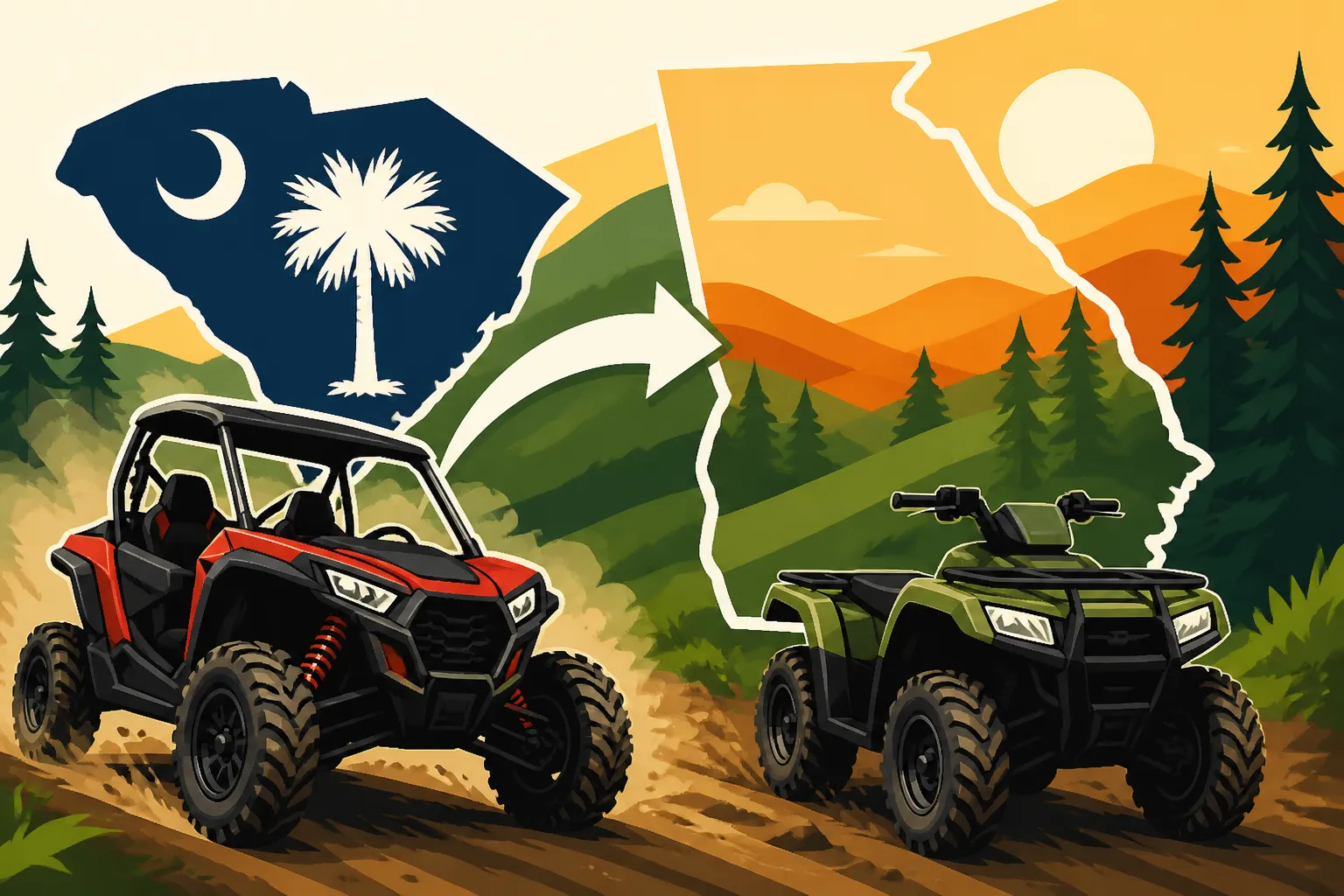
For designated OHV trails in Georgia’s national forests, plan on getting the Georgia forest OHV permit required for the operator. A South Carolina registration or other home-state credential does not automatically replace that permit. The Georgia permit is tied to the rider, not simply to the ATV or UTV, so each person operating a machine should check the current requirement for the trail system they plan to visit.
That distinction matters when one person brings multiple machines or a group shares a vehicle. A permit should not be assumed to transfer from one operator to another. A passenger who does not operate the machine may be treated differently from a rider who takes the controls; check the current permit instructions for your situation. The basic distinction is covered in Georgia National Forest Permits Are Per Operator and Does a Passenger Need Their Own Georgia Forest Permit?.
A Georgia forest OHV permit is for access under the forest permit program. It is not a general Georgia ATV registration, a street-use tag, a private-park pass, or permission to ride anywhere in the state. Likewise, a South Carolina plate or document may help establish information about your machine, but it does not grant access to a Georgia trail or override that trail’s rules.
| Where you plan to ride | What to verify before leaving South Carolina |
|---|---|
| Designated national forest OHV trail | Whether a Georgia forest OHV permit is required, and how each operator must carry or display it |
| Private off-road park | The park’s entry fee, waiver, age, equipment, and machine-size rules |
| Wildlife Management Area | Whether ATV riding is allowed there, and the location, dates, hours, and route restrictions |
| Public road | Whether that particular road is open to your vehicle and what road-use requirements apply |
| Private property | The landowner’s permission and any conditions attached to it |
Georgia offers day and annual forest OHV permits, but do not rely on an old receipt, a friend’s permit, or a remembered fee. Permit availability, instructions, and current charges should be checked through the official purchasing channel before travel. Georgia’s Day and Annual Forest OHV Permits explains the general options, while Georgia Permits on Recreation.gov covers one way riders may encounter the permit process. Confirm the current details before you pay or head to a trailhead.
What the permit does not cover
A forest permit does not guarantee that a trail is open on the day you arrive. Seasonal closures, weather, maintenance, and other restrictions may affect access. It also does not exempt you from posted trail rules or make an ineligible machine suitable for a trail system. Width limits and allowed vehicle types can vary by system, so look up the rules for the specific destination rather than assuming every Georgia OHV trail accepts every ATV or UTV.
A permit is also not an authorization for road riding. Forest trails, forest roads, county roads, and state highways are different kinds of routes with different rules. A machine that is legal to ride on an open forest trail is not automatically legal on the road leading to the trailhead. For the broader distinction between access and riding locations, see Georgia ATV Trails: Where You Can Legally Ride and Georgia OHV Permits: What You Need Before You Ride.
Check the destination: forests, private parks, WMAs, and roads
“Riding in Georgia” can mean several different things, and the permit answer changes with the land manager. Before you travel, identify the exact trail, park, or property—not just the nearest town or forest. Then check the rules from the organization responsible for that location.
National forest OHV trails
On designated national forest OHV routes, verify the permit requirement, operating dates and hours, machine restrictions, and any temporary closures. A forest permit only applies within the program’s scope; it does not turn an unmarked road or closed route into an authorized trail. Follow the signs at the entrance and along the route, and check current trail status shortly before the trip.
If you’re riding with a group from South Carolina, make the permit check part of the group plan. Confirm that every operator understands the requirement and has their own permit if required. Keep the permit information accessible in the format the official instructions allow. Don’t assume that a single permit purchase covers everyone in a party just because the group is traveling together or sharing a trailer.
Private riding parks
A private park sets its own admission and operating conditions. A Georgia forest permit should not be treated as a substitute for the park’s entry process, and a South Carolina permit should not be assumed to satisfy it either. Check the park’s current rules for machine size, helmets, passenger limits, minimum ages, waivers, noise requirements, and whether advance arrangements are needed.
Private parks may also have different requirements for rented machines than for privately owned ones. If you are borrowing or renting a UTV, ask who is responsible for entry paperwork and whether each operator must complete a separate waiver. The park’s own rules control its property, so confirm directly rather than relying on another rider’s past visit.
Wildlife Management Areas
Wildlife Management Areas are not interchangeable with national forest OHV trail systems. ATV use may be restricted to particular roads and may depend on the area, date, time, or hunting activity. A forest OHV permit does not by itself authorize riding wherever you like on a WMA.
Before using a WMA, check the current rules for that specific area and the activity you plan to do. Pay close attention to whether riding is limited to designated roads, hunt days, or a defined time window. Gates and signs matter: do not ride around a closure or treat a road as open just because it appears on a map. Georgia WMA Rules for ATV Riders explains why WMA access needs its own check.
Roads and connecting routes
A permit for an off-road trail does not make public-road travel legal. Nor does an out-of-state registration automatically grant road access in Georgia. Road access can depend on the road’s classification and local rules, along with the machine’s eligibility and required equipment. State highways and county roads are not the same as designated OHV trails.
If your route requires riding on a public road to reach a trail, verify that the specific stretch is open to your machine and that you meet the applicable requirements. Do not infer road permission from the existence of a Georgia plate or permit. [Georgia Rules for an Out-of-State Plate] is useful background, but confirm the rules for the actual road and vehicle before riding.
A practical checklist for South Carolina riders
A little preparation can prevent a wasted drive, a denied trail entry, or a costly misunderstanding. Use this checklist for each trip, especially if the destination or machine changes.
- Pin down the exact riding location. Identify the trail system, private park, WMA, or road network. “National forest” or “near a trail” is not specific enough to establish what is open to riding.
- Check the land manager’s current rules. Look for permit requirements, hours, closures, allowable vehicle types, width limits, and any route-specific restrictions.
- Get the correct permit for every operator. For designated Georgia national forest OHV trails, do not assume a South Carolina credential substitutes for the Georgia forest permit. Check whether each person who may operate needs an individual permit.
- Keep proof available. Follow the current instructions for carrying or displaying the permit. Save confirmation details before leaving home, and bring a backup if the instructions or your phone setup make that sensible.
- Confirm your machine fits the route. Check width and other equipment or vehicle restrictions for the specific system. A permit does not override trail limits.
- Separate trail access from road use. Plan a legal way to get from your parking or staging area to the trail. Do not ride an unverified public road just because it connects two trail areas.
- Check the weather and closures close to departure. A route that was open when you planned the trip may be closed or unsuitable after rain, damage, or maintenance.
- Review safety rules for the riders in your group. Age requirements, helmet rules, passenger limits, and supervision rules can apply separately from the permit. For example, check Georgia Helmet Rules for Riders Under 18 if anyone under 18 will ride.
- Ask about anything unclear before traveling. Contact the relevant forest office, park, or wildlife-area manager with the exact location and machine type. A general answer about “Georgia trails” may not apply to your destination.
What to bring and what to confirm
Bring your permit confirmation and any ownership or registration documents you normally carry for the machine. These documents serve different purposes: proof that you own or identify the machine is not the same as permission to ride a particular trail. Keep them organized so you can show the right information if asked.
For a group, share the destination’s rules before departure. Make sure operators know where the permit applies, which routes are open, and where riding is prohibited. Passengers should understand that they cannot necessarily take over driving without meeting the operator requirements and having any required permit of their own.
If the trailhead has a kiosk or posted notice, read it before unloading. Conditions and closures can change, and posted directions may be more specific than general trip-planning information. If a sign closes a route, use another route only if it is clearly authorized; don’t treat an informal track around a barrier as an approved detour.
Common mistakes to avoid
The most common mistake is treating registration, a permit, and legal access as if they were the same thing. They are not. A home-state document may relate to the machine, a Georgia forest permit may relate to an operator’s access to a designated trail system, and a road-use rule may determine whether a public route can be used at all.
Other avoidable errors include:
- Assuming South Carolina rules carry over. A credential or riding practice accepted at home does not automatically satisfy Georgia’s requirements.
- Buying one permit for a whole group. Check the per-operator rule and make sure each person who may drive is covered.
- Using a forest permit at a private park or WMA. Each land manager has separate access rules.
- Assuming a permit means a trail is open. Check closures and operating conditions immediately before the trip.
- Riding on a public road to connect trails without checking. Trail permission is not road permission.
- Relying on a map alone. A mapped road or track may be closed, restricted, or not designated for OHV use.
- Waiting until the trailhead to resolve basic questions. Permit availability, signal coverage, and payment options may be limited at the destination. Check the current process and prepare before leaving.
The simplest approach is to treat a Georgia visit as a destination-specific trip. Confirm the land manager, get the right permit for each operator where required, and check the route and machine restrictions. A South Carolina registration may still be useful documentation, but it is not a universal pass for Georgia trails, parks, WMAs, or roads.
Disclaimer
This article is for general informational purposes only and does not constitute professional advice. Laws, prices and regulations vary by location and change over time. Consult a qualified professional for guidance on your specific situation.