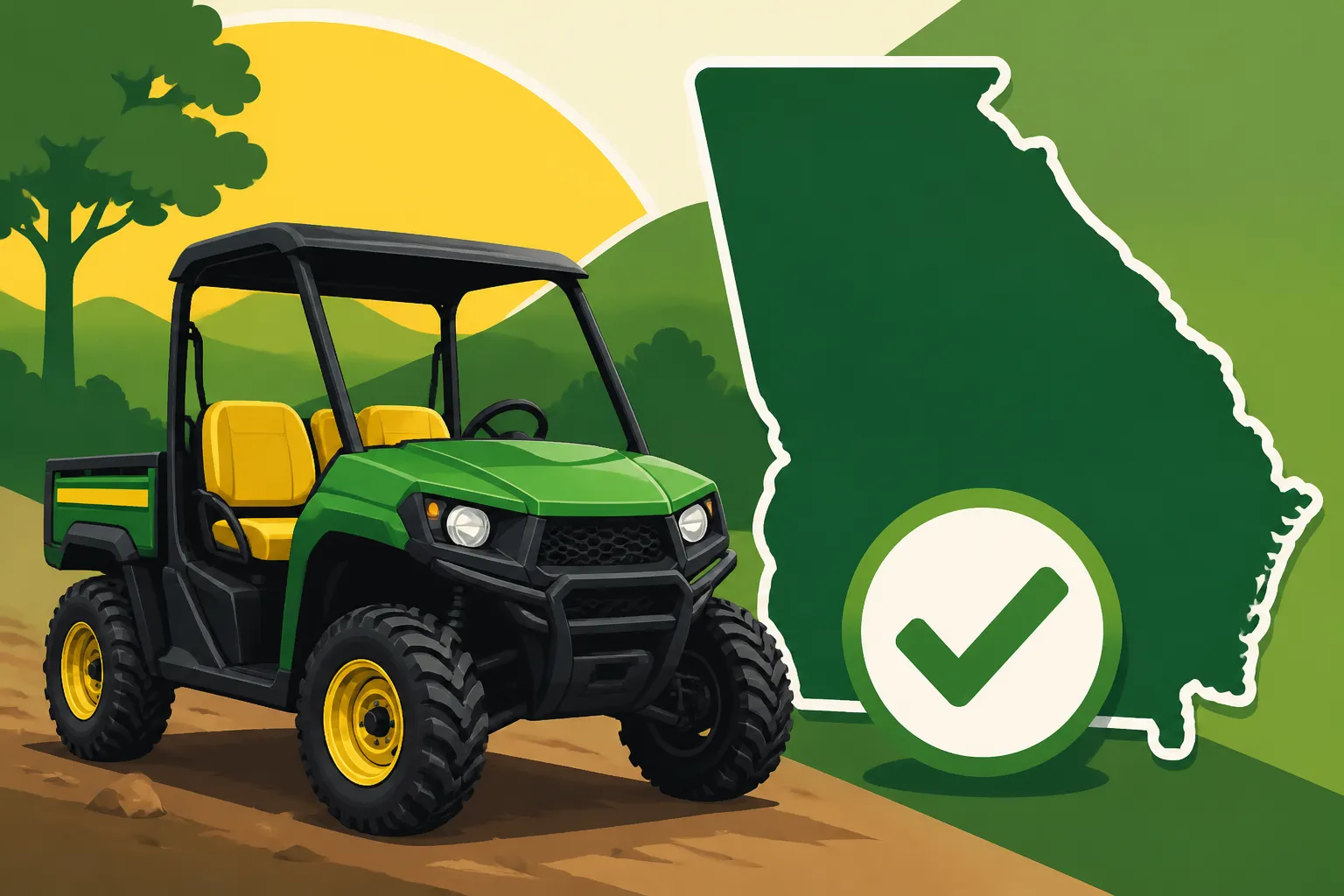
A John Deere Gator on Georgia’s Eligibility List
It can be incredibly confusing to navigate Georgia's new rules for registering off-highway vehicles, especially when you own a workhorse like a John Deere Gator. Many folks are wondering if their beloved utility vehicle, which is indispensable for property maintenance, farm work, or just getting around the land, can actually qualify for road use. This guide is here to cut through the noise and explain exactly what a John Deere Gator needs to meet Georgia's MPOHV eligibility requirements for county road access.
Understanding Georgia's MPOHV Rules for Utility Vehicles
For years, the idea of legally riding a UTV or side-by-side on Georgia's county roads seemed like a distant dream for many landowners and enthusiasts. Our machines were relegated strictly to private property or designated off-road trails. But with the introduction of the new Multi-Purpose Off-Highway Vehicle (MPOHV) registration process, things have changed significantly. This new pathway allows certain machines, including many utility vehicles, to get a special plate for limited road access.
The core of this new system isn't about calling every off-road machine "street legal"—it's about providing a specific registration for multi-purpose vehicles that meet a very particular set of criteria. This means your John Deere Gator isn't suddenly a car; it's a specially recognized off-highway vehicle with defined privileges and restrictions. The MPOHV program focuses on features that differentiate these utility-oriented machines from typical recreational ATVs, which often leads to questions like [Why a Four-Wheeler Cannot Be Registered in Georgia].
The Purpose of Georgia's MPOHV Registration
The motivation behind Georgia's MPOHV registration, which officially started in December 2023, was largely driven by the practical needs of rural residents, farmers, and those who use utility vehicles for work or transportation around their communities. Imagine needing to cross a county road to get from one part of your farm to another, or from your house to a neighbor's property for a quick chore. Before MPOHV, this was technically illegal, forcing many to either risk a citation or trailer their machines for short distances—neither of which is practical or efficient.
The MPOHV plate provides a legal framework for these necessary movements on county roads. It acknowledges that machines like a John Deere Gator serve a crucial role beyond pure recreation. This isn't about taking your UTV on a highway joyride; it's about enabling legitimate, safe, and regulated access to specific public roadways. It means your Gator can become a more versatile tool for your daily life, bridging the gap between private land and the public infrastructure that connects it. Keep in mind that [Georgia MPOHV Registration Is Voluntary], but for road use, it's essential.
Why MPOHV Isn't "Street Legal" in the Traditional Sense
It's crucial to understand that MPOHV registration in Georgia doesn't grant your John Deere Gator the same status as a passenger car or even a low-speed vehicle (LSV). This isn't a "street legal" conversion in the way some other states might allow. There are distinct limitations on where and how you can operate an MPOHV. For instance, these vehicles are strictly confined to county roads, and cannot be operated on state highways or interstates, except to cross them at designated points.
This distinction is fundamental. While you gain valuable access to local roadways, you're not getting a free pass to drive anywhere. The vehicle remains an off-highway machine, albeit one with a new, state-sanctioned role on specific public roads. Think of it as a highly specialized privilege, not a broad entitlement. Understanding [Georgia MPOHV Road Rules: County Roads Only] is paramount to avoiding citations and ensuring safe operation.
Specific John Deere Gator Features and the MPOHV Checklist
So, what about your John Deere Gator specifically? Does it have what it takes to meet Georgia's MPOHV eligibility? The state has a clear, eight-point test that any machine must pass to qualify. This isn't a vague guideline; it's a specific checklist that ensures the machine is designed for utility and safety in a way that differentiates it from recreational ATVs. Many John Deere Gator models, especially the popular utility and crossover series, are inherently well-suited to meet these requirements.
It's vital to pull out your Gator's specifications and literally check each box. Don't assume; verify. You'll need to know its dimensions, weight, seating configuration, and factory-installed safety features. If you've modified your Gator extensively, you'll need to ensure those modifications haven't inadvertently disqualified it from the MPOHV program.
Steering, Seating, and Weight Requirements
One of the first things Georgia looks for is a steering wheel, not handlebars. This immediately sets machines like a John Deere Gator apart from traditional ATVs or dirt bikes. [Georgia Requires a Steering Wheel, Not Handlebars] means most Gators, with their automotive-style controls, are already off to a good start here.
Next up is the seating arrangement. The MPOHV rules specify that the machine must have a non-straddle seat. This means you sit in the vehicle, not on it with your legs straddling the engine or frame. Again, this is a natural fit for virtually all John Deere Gator models, which come with bench or bucket seats. [Why a Straddle Seat Disqualifies a Machine] makes it clear that traditional quads are out.
Weight is another critical factor. Your John Deere Gator must have a gross vehicle weight (GVW) of 4,000 pounds or less. This is the weight of the machine itself plus its maximum payload. Many Gators fall comfortably within this limit, but it's essential to check the specific model and trim level, especially if you have heavier accessories installed. You'll also need to ensure your Gator has a minimum payload capacity of 350 pounds. This speaks to its utility purpose, as it needs to be able to carry a substantial load. [Measuring Payload Capacity Against 350 Pounds] and [Georgia's 4,000-Pound Gross Weight Ceiling] are important checks.
Speed, Width, and Safety Features
The state also sets limits on speed. Your Gator must be capable of exceeding 25 miles per hour but not capable of exceeding 65 miles per hour. Most John Deere Gator models are designed to operate within this range, making them suitable. [A Machine That Tops Out Below 25 mph] or [A Machine That Exceeds 65 mph] will not qualify.
Width is another key dimension: the machine must be 80 inches or less in overall width. This is measured from the widest points, typically the outside edge of the tires. Most standard-width John Deere Gators will meet this, but some wider special editions or those with aftermarket offset wheels might need a careful measurement. [Measuring Width Against the 80-Inch Limit] is a crucial step.
Finally, for safety, your John Deere Gator must have factory-installed seat belts for all designated seating positions, and the machine must have been manufactured on or after January 1, 2000. These are non-negotiable safety standards. [Georgia Requires Seat Belts on a Registered Machine] for a reason, and if your Gator predates the year 2000, it simply won't qualify. Additionally, your Gator will need headlights, brake lights, and rearview mirrors. While many Gators come with these, it's worth checking to ensure everything is functional and present.
Here's a quick reference table for John Deere Gator owners to check against the MPOHV criteria:
| MPOHV Requirement | John Deere Gator Common Feature | Does it Qualify? | Notes |
|---|---|---|---|
| Steering Wheel (not handlebars) | Yes, most models | Likely Yes | Standard automotive-style steering. |
| Non-straddle Seating | Yes, most models | Likely Yes | Bench or bucket seats are standard. |
| Gross Weight <= 4,000 lbs | Varies by model | Check Specs | Heavier models or loaded machines might exceed. |
| Payload >= 350 lbs | Varies by model | Check Specs | Utility models typically exceed this, sport models might be tighter. |
| Speed 25-65 mph | Yes, most models | Likely Yes | Most utility/crossover Gators fall in this range. |
| Width <= 80 inches | Varies by model | Check Specs | Most standard models are within limits, measure carefully for wider versions. |
| Factory Seat Belts | Yes, most models | Likely Yes | Standard safety feature on modern Gators. |
| Manufactured After 1/1/2000 | Varies by model | Check VIN | Check your VIN for the manufacture date; [Machines Built Before 2000 and Georgia Registration] are excluded. |
The Registration Process for Your John Deere Gator in Georgia
Once you've confirmed that your John Deere Gator meets all the eligibility criteria, the next step is to actually get it registered. This process involves gathering the necessary paperwork and visiting your local County Tag Office. It's not as daunting as it might seem, but it does require attention to detail to ensure you have everything in order the first time.
Many people find the paperwork aspect to be the most intimidating, especially if they bought their Gator in a private sale and don't have a traditional "title" for it, since Georgia doesn't title ATVs or UTVs. However, the state has specific provisions for proving ownership.
Gathering Your Paperwork and Proof of Ownership
To register your John Deere Gator as an MPOHV, you'll need several key documents. First and foremost, you'll need proof of ownership. Since Georgia doesn't title these machines, this usually means a bill of sale, a dealer invoice, or a manufacturer's certificate of origin (MCO/MSO) if you purchased it new. If you've owned your Gator for a while and have lost these documents, or if you bought it in a private sale without a formal bill of sale, you might need to complete an Affidavit of Ownership (Form MV-OHV). Companies like LawDepot offer templates for bills of sale and other legal documents that can be customized to your specific situation, which can be very helpful for creating a valid record for the tag office. This form can also help establish [Proving You Own an ATV in Georgia Without a Title].
You'll also need proof of your Georgia residency, such as a Georgia driver's license or ID card. The vehicle must be registered in the county where you live, so [Registering in the County Where You Live] is key.
Another critical document is proof of liability insurance. [Georgia Liability Insurance Tied to Registration] means you can't get that MPOHV plate without demonstrating continuous coverage. Your insurance policy needs to meet Georgia's minimum liability requirements, just like a car. Most insurance providers offer specific policies for UTVs and side-by-sides.
Completing Georgia Form MV-OHV
The primary form for MPOHV registration is Georgia Form MV-OHV. This is an affidavit where you attest that your John Deere Gator meets all eight eligibility requirements. You'll need to fill this out accurately, providing details about your machine, including its VIN, make, model, and confirming that it has the required features.
The form also asks for information about when you acquired the machine and the sales price. This is important because [Georgia Sales Tax Paid Before Registration] is a requirement. If you purchased your John Deere Gator from a dealer, they likely collected sales tax at the time of purchase. If you bought it in a private sale, you'll be responsible for paying the sales tax to the County Tag Office before your registration can be completed. However, there's a significant consideration for machines owned prior to July 1, 2024: [Georgia Machines Owned Before June 30, 2024] may be presumed to have had sales tax paid or not be subject to it, which simplifies things for long-time owners.
Your Visit to the County Tag Office
Once you have all your documents ready – your proof of ownership, proof of insurance, Georgia ID, and the completed MV-OHV form – you'll visit your local County Tag Office. This is where the magic happens and where you'll officially apply for your MPOHV registration. The staff there will review your paperwork and verify your John Deere Gator's eligibility.
They may also perform a visual inspection of your Gator, or at least confirm the VIN. Be prepared to pay any applicable registration fees and sales tax (if not already paid). The [Georgia MPOHV Registration Cost] is typically an annual fee, similar to car tag renewals. Once approved, you'll receive your MPOHV plate and registration decal. This will allow you to legally operate your John Deere Gator on designated county roads. You can find more details on what to expect by reviewing [Georgia County Tag Office Steps for an MPOHV].
Beyond Registration: What to Know About Operating Your Gator
Getting your John Deere Gator registered for MPOHV use is a fantastic step, but it's just the beginning. There are important rules and considerations you need to keep in mind when actually operating your machine on Georgia's county roads. This isn't just about avoiding tickets; it's about ensuring safety for yourself, your passengers, and others on the road.
Remember, the goal of this registration is to provide practical utility, not to turn every county road into an off-road playground. Responsible operation is key to maintaining these new privileges.
Road Rules and Operational Restrictions
The most critical restriction to remember is that your registered John Deere Gator is only permitted on county roads. You cannot operate it on state highways (which often have numbers like GA-1, US-41, etc.) or interstate highways. You are allowed to cross state highways at designated intersections, but you cannot travel along them. Understanding [Georgia UTV Road Rules by County] is crucial, as some counties may have additional local ordinances.
When operating your Gator on a county road, you must follow all standard traffic laws, just as you would in a car. This includes obeying speed limits, stopping at stop signs, yielding the right of way, and using turn signals if your Gator is equipped with them (or hand signals if not). Even though it's an off-road machine, on the road, it's part of traffic. [Georgia Night Riding on a County Road] is permitted, but your Gator must have proper lighting, including headlights and brake lights, which are part of the MPOHV requirements.
Insurance, Safety Gear, and Age Limits
As mentioned, liability insurance is mandatory for MPOHV registration, and you must maintain continuous coverage. A deputy may ask for proof of insurance if you're pulled over. [Georgia UTV Insurance Minimums] are the same as for other motor vehicles.
Regarding safety gear, there's a specific helmet law for MPOHV operators under a certain age. [Georgia ATV Helmet Law for Riders Under 18] states that anyone under 18 operating an MPOHV on a public road must wear a helmet. This rule even extends to private land in some cases. While adults are not legally required to wear a helmet when operating a registered MPOHV on county roads, it is always a smart safety practice.
Finally, age and licensing rules apply. To operate a registered MPOHV on Georgia county roads, you must possess a valid Georgia driver's license. [Do You Need a License to Drive a UTV in Georgia?] The minimum age for a licensed driver in Georgia is 16. This means that a 15-year-old with a learner's permit cannot legally operate a registered John Deere Gator on a county road, even with a licensed adult present.
What Happens When the Sunset Date Arrives?
It's important to be aware that Georgia's MPOHV road access law has a sunset date. [Georgia's ATV Road Access Law Sunsets in July 2027]. This means that the current provisions allowing MPOHVs on county roads are set to expire unless renewed or changed by the state legislature. While many hope it will be extended, it's a date worth keeping in mind. This doesn't mean your registration will become void overnight, but the rules for road access could potentially change significantly. Stay informed on legislative updates as that date approaches.
Disclaimer
This article is for general informational purposes only and does not constitute professional advice. Laws, prices and regulations vary by location and change over time. Consult a qualified professional for guidance on your specific situation.