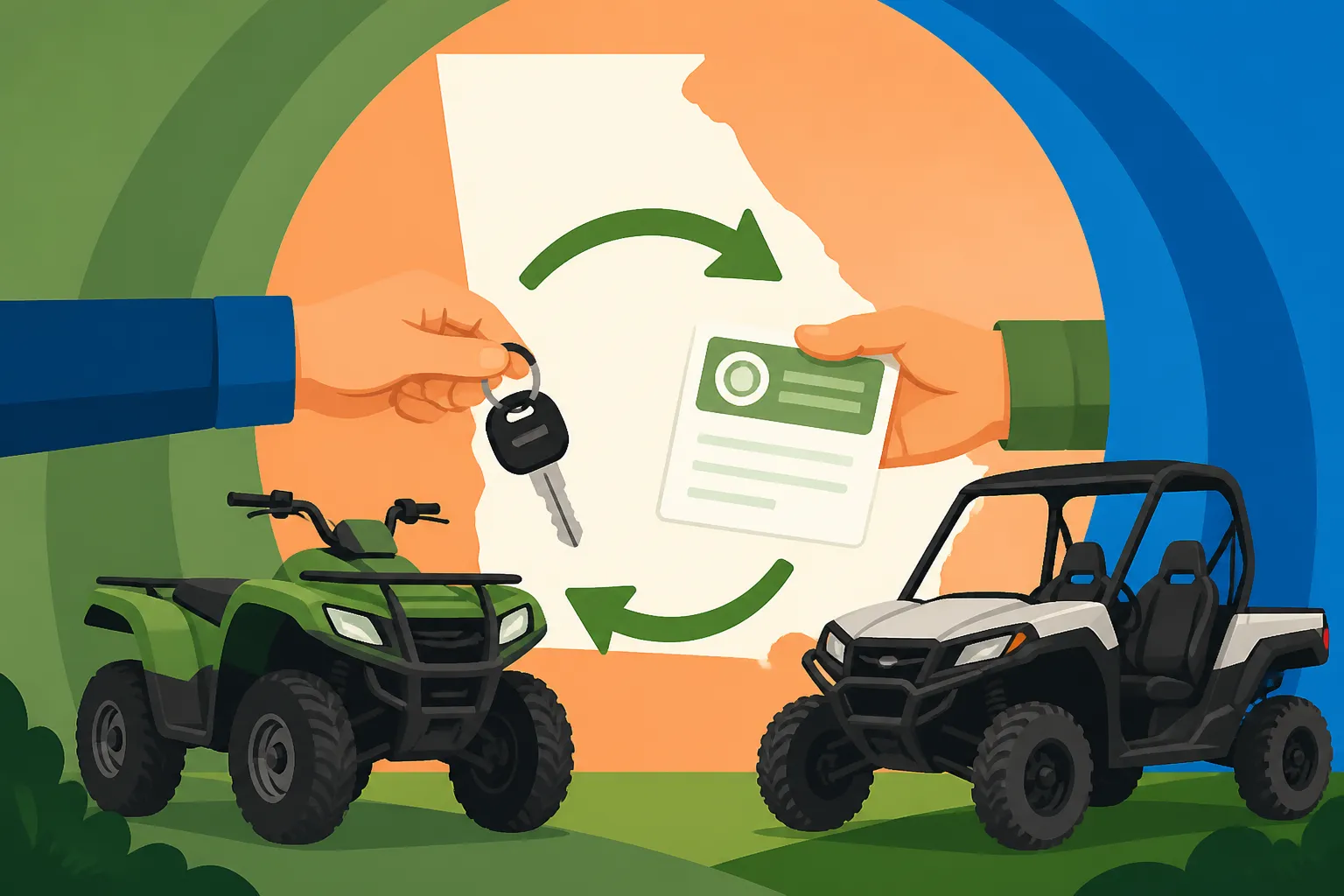
Georgia Registration Transfer After a Sale
Selling your off-highway vehicle (OHV) in Georgia, especially one that's been registered as an MPOHV for road use, can feel like navigating a maze. You want to make sure you've done everything right on your end, and the buyer wants to ensure they can legally take over ownership and get their own plate. This guide will walk you through the entire process of transferring a Georgia MPOHV registration after a sale, ensuring a smooth transition for both parties and preventing future headaches.
The Seller's Responsibility When Transferring Georgia MPOHV Registration
When you sell an MPOHV that has a current Georgia registration plate, it’s not as simple as handing over the keys and a handshake, especially if you want to avoid potential liability down the road. While Georgia doesn't title ATVs or UTVs in the traditional sense, the MPOHV registration is a significant step that ties the machine to an owner for road use purposes.
First and foremost, understand that the MPOHV registration plate stays with the seller – it does not transfer to the buyer. This is a crucial distinction from traditional car titles, where the plate often stays with the car until renewed. Your plate and registration are tied to you as the owner and your intent to operate that specific machine on designated county roads. When you sell the machine, you need to remove your registration plate and decal. It’s a good practice to physically remove the plate at the time of sale. You’ll want to notify the Georgia Department of Revenue (DOR) that you’ve sold the machine and no longer own it. This helps ensure that you aren't held responsible for any violations the new owner might incur while riding with your plate or, worse, if they abandon the machine and it's still linked to you.
Secondly, a robust bill of sale is your best friend. Even though Georgia doesn't issue a title for these machines, a comprehensive bill of sale is the primary proof of ownership transfer. This document should clearly identify the machine (make, model, year, VIN), the sale price, the date of sale, and the full names and addresses of both the buyer and seller. It's wise to include a statement that the machine is sold "as-is, where-is" to protect yourself from any implied warranties. You and the buyer should each get an original signed copy. Platforms like LawDepot offer customizable templates that can help you create a thorough bill of sale quickly, giving both parties peace of mind and an official record of the transaction. Having this document is vital not just for you, but also for the buyer when they go to register the machine in their name.
Canceling Your Existing MPOHV Registration
Once the sale is complete, you should officially cancel your MPOHV registration with the county tag office where it was issued. This formally severs your connection to the machine in the state's system. You can usually do this by returning the plate to the tag office or by submitting an affidavit stating the machine has been sold. The exact process might vary slightly by county, so it's always a good idea to call your local tag office first. They can provide specific instructions on what paperwork, if any, they require to process the cancellation. Doing this promptly removes any lingering liability for you, should the buyer decide not to register the machine or misuse it. Without a clear cancellation, the machine could still be linked to you in various state databases, which could lead to complications later.
Providing Necessary Documentation to the Buyer
Beyond the bill of sale, what else should you give the buyer? If you have the original manufacturer's certificate of origin (MCO) or manufacturer's statement of origin (MSO), that's invaluable. This document is like a birth certificate for the machine and is often required for the buyer's new registration, especially if the machine is relatively new. If you don't have it, and the machine was manufactured before January 1, 2000, or you bought it used without one, a solid bill of sale becomes even more critical. You should also provide any previous bills of sale you received when you purchased the machine, creating a clear chain of ownership. This helps the buyer establish their claim to the machine and avoid questions when they try to register it. Think of it as passing on the machine's historical paperwork – every piece helps.
Steps for the Buyer to Complete a Georgia MPOHV Registration Transfer
If you've just purchased an MPOHV in Georgia that was previously registered, congratulations! Now comes the important part: getting it registered in your name so you can legally ride it on Georgia's designated county roads. This isn't an automatic process; you have specific steps to follow to ensure the registration is properly transferred to you. Remember, the previous owner's plate and registration are not yours to keep or use. You need a new one.
Your journey starts at your local Georgia county tag office. This is the same place you would register a car or truck, and they handle MPOHV registrations. Be prepared for a detailed process, as the requirements for MPOHV registration are quite specific.
Gathering Your Required Documents
Before you even head to the tag office, gather all the necessary paperwork. This is perhaps the most critical step to a smooth transfer. You will need:
- A Bill of Sale: This is paramount. It must clearly identify the machine by its VIN, list the purchase price, date of sale, and the full names and addresses of both the seller and buyer. If you created a bill of sale using a service like LawDepot, ensure all fields are correctly filled out and both parties have signed.
- Manufacturer's Certificate of Origin (MCO) or Manufacturer's Statement of Origin (MSO): If available, especially for newer machines. If not, be prepared to show a chain of ownership through previous bills of sale. For machines manufactured before January 1, 2000, the MCO/MSO might not be necessary if you have a strong bill of sale.
- Georgia Form MV-OHV, Off-Highway Vehicle Ownership Affidavit: You'll need to complete this form, attesting to your ownership. It requires detailed information about the machine and how you acquired it. The tag office can provide this form, or you may be able to download it from the Georgia DOR website.
- Proof of Georgia Residency: A valid Georgia driver's license or state ID is typically sufficient.
- Proof of Georgia Liability Insurance: For the MPOHV. The policy must meet Georgia's minimum liability requirements. This insurance must be active when you apply for registration and must cover road use.
- Payment for Fees and Sales Tax: You'll need to pay the MPOHV registration fee and any applicable Georgia sales tax. The sales tax is paid to the county tag office at the time of registration, based on the purchase price listed on your bill of sale.
- Photo Identification: Your current Georgia driver's license or state ID.
Ensuring you have all these documents ready before you go will save you a lot of time and a potential second trip to the tag office. For instance, sometimes buyers purchase a machine and only have a handwritten note as a bill of sale. While a tag office might accept it, a professionally drafted [Bills of Sale That Hold Up at a Tag Office] provides much more certainty.
The Application Process at the County Tag Office
Once you have your documents, head to your county tag office. You'll submit your application, including the MV-OHV Ownership Affidavit and all supporting documents. The tag office clerk will review everything to ensure it meets the eligibility criteria for MPOHV registration, which includes factors like vehicle weight, width, speed capabilities, and safety features. You might find it useful to review the [Georgia Side-by-Side Registration Checklist] before your visit to ensure your machine meets all the criteria.
The clerk will also verify that you've paid Georgia sales tax on the purchase price of the machine, unless you're exempt (e.g., specific farm use cases, or if you can prove ownership prior to June 30, 2024, when the sales tax rule for these machines came into effect). Be prepared for questions about how you acquired the machine, especially if the chain of ownership isn't perfectly clear or if the MCO/MSO is missing. They will process your payment for the registration fee and sales tax.
After your application is approved and fees are paid, you'll be issued a Georgia MPOHV registration plate and decal. You must affix this plate to the rear of your machine in a clearly visible location. The decal will typically go on the plate itself, indicating the year the registration is valid.
Essential Documents for a Smooth Georgia MPOHV Registration Transfer
Navigating the paperwork for a Georgia MPOHV registration transfer can feel like a game of "hide and seek" if you're not prepared. Unlike traditional vehicle transfers that rely heavily on a state-issued title, MPOHV transfers in Georgia lean heavily on robust documentation proving ownership and eligibility. Without the right papers, you could face significant delays or even outright rejection at the tag office.
The Critical Role of the Bill of Sale
For any private sale of an MPOHV in Georgia, the bill of sale is the cornerstone of your ownership claim. It acts as the legal record that money or other consideration changed hands for the machine. A good bill of sale isn't just a scribble on a napkin; it's a detailed document that leaves no room for ambiguity. It needs to include:
- Full legal names and addresses of both the seller and the buyer.
- Date of sale.
- Purchase price (or details of trade, if applicable).
- Complete description of the MPOHV, including make, model, year, and crucially, the Vehicle Identification Number (VIN). This VIN is paramount for identification.
- A statement that the seller is conveying clear title (meaning, free of liens or encumbrances, to the best of their knowledge).
- A statement that the machine is sold "as-is" to protect the seller.
- Signatures of both the buyer and seller, ideally with a witness signature or notarization for added security.
A well-drafted bill of sale is critical, especially when you consider situations like [Georgia MPOHV Registration Without a Bill of Sale] – a situation you definitely want to avoid as a buyer. If you're buying from a private party, encourage the seller to use a template from a reputable source, or suggest using one you've prepared, perhaps from a legal document service like LawDepot, to ensure all essential details are covered.
Manufacturer's Certificate of Origin (MCO/MSO) and Chain of Ownership
While a title isn't issued, the MCO or MSO is the machine's initial proof of existence from the factory. If you're buying a relatively new MPOHV from its original owner, they should provide you with the MCO/MSO. This document formally proves the machine's specifications and manufacturing date, which is especially important given Georgia's eligibility requirements, such as the [Machines Built Before 2000 and Georgia Registration] rule.
If the MCO/MSO isn't available (common for older machines or those that have changed hands multiple times), you'll need to rely on a complete "chain of ownership." This means providing bills of sale from every owner, going back as far as possible, leading up to your purchase. Each bill of sale helps connect the dots, proving that the machine was legitimately bought and sold each time. Without an MCO/MSO, a robust chain of bills of sale is absolutely vital for the tag office to verify legitimate ownership. If there are gaps in this chain, the tag office might require additional steps, such as completing an [Georgia Ownership Affidavit for an MPOHV] or even requiring a law enforcement inspection.
Insurance Verification and Sales Tax Proof
Before you can complete the registration transfer, you need to prove you have active liability insurance coverage for your MPOHV. The tag office will verify this electronically, so make sure your policy is active and the vehicle information (VIN) matches exactly. This is not optional; [Georgia Liability Insurance Tied to Registration] is a mandatory requirement for road-legal MPOHV use.
Additionally, Georgia state law requires that sales tax be paid on the purchase of the MPOHV. When you present your bill of sale, the tag office will calculate and collect this tax. This is a one-time tax, separate from the annual registration fee. Be aware that you'll need to pay this tax even if you bought the machine from a private seller. Failing to pay the sales tax will prevent you from completing the registration. For machines owned prior to a specific date (June 30, 2024), there might be a presumption that tax was already paid, but new purchases will certainly require it.
Why Swift Action Prevents Headaches After a Sale
You might be thinking, "What's the rush?" After selling or buying an MPOHV in Georgia, it's natural to want to kick back and enjoy your new machine or the proceeds from your sale. However, delaying the official transfer of registration can lead to a surprising number of complications for both the seller and the buyer. Acting quickly protects everyone involved from unnecessary legal, financial, and administrative headaches down the road.
Avoiding Liability for the Seller
For the seller, failing to promptly remove your registration plate and notify the DOR of the sale can keep you legally tied to a machine you no longer own. Imagine this scenario: you sell your side-by-side, but the buyer never gets around to registering it. A few weeks later, that machine is involved in an accident on a county road, or worse, used in an illegal activity. If your registration is still active on that VIN in the state's system, you could potentially be contacted by law enforcement or even face civil liability because the machine is still officially "yours" for road use purposes.
This isn't about distrusting the buyer; it's about protecting yourself. By canceling your registration and removing the plate immediately, you create a clear separation. The state's records will show you are no longer the responsible party for that specific MPOHV. This is particularly important because [Georgia Liability Insurance Tied to Registration] means that if you still have an active policy linked to that plate, your insurance company could be brought into a claim involving a machine you no longer possess. It’s better to be safe than sorry and ensure all ties are severed right after the transaction.
Ensuring Legal Road Access for the Buyer
For the buyer, delaying registration means you cannot legally operate your new MPOHV on any designated Georgia county roads. While it might be tempting to take your new ride out immediately, doing so without your own current registration plate means you're operating an unregistered vehicle on public roads. This can lead to citations, fines, and potentially even impoundment of your machine. [Georgia Penalties for an Unregistered Road Machine] can be quite substantial, making that immediate joyride a costly mistake.
Furthermore, without current registration in your name, you won't have the proof of insurance that is tied to the registration. If you're pulled over or involved in an incident, you'll be cited for both lacking registration and possibly for no proof of insurance, even if you have a policy. The tag office needs to see that you've completed all the steps, including paying sales tax, before they'll issue you a plate. Waiting only puts off the inevitable and increases your risk. Completing the registration transfer promptly allows you to ride legally and with peace of mind. It also ensures that if any issues arise with the previous ownership documents, you can address them while the seller is still reachable.
| Item | Seller's Responsibility | Buyer's Responsibility |
|---|---|---|
| Old Registration | Remove plate & decal, cancel registration | Do not use seller's plate/decal |
| New Registration | N/A | Apply for new registration in their name at county tag office |
| Bill of Sale | Provide original signed copy to buyer, keep a copy | Obtain original signed copy from seller, keep a copy |
| MCO/MSO | Provide to buyer (if available) | Obtain from seller (if available) |
| Chain of Ownership | Provide all previous bills of sale (if MCO/MSO missing) | Obtain all previous bills of sale (if MCO/MSO missing) |
| Georgia MV-OHV | N/A | Complete and submit affidavit to tag office |
| Insurance | Ensure your policy is canceled/adjusted for the sold machine | Obtain new liability insurance for the MPOHV |
| Sales Tax | N/A | Pay applicable sales tax at tag office |
| Plate Placement | N/A | Properly affix new MPOHV plate to the machine |
Disclaimer
This article is for general informational purposes only and does not constitute professional advice. Laws, prices and regulations vary by location and change over time. Consult a qualified professional for guidance on your specific situation.