Georgia MPOHV Registration and VIN Checks
Getting an off-highway vehicle registered in Georgia can feel like navigating a maze, especially with all the new rules for Motorized Play Vehicles (MPOHV). One of the most critical, yet often overlooked, steps in this journey is the VIN check. This guide will walk you through why it’s so important, what to expect, and how to ensure your MPOHV passes this essential verification process.
Navigating Georgia's MPOHV Registration: An Overview
The state of Georgia has specific requirements for registering MPOHVs, which include many side-by-sides, utility vehicles (UTVs), and certain other recreational machines. This isn't like registering a car or truck, which typically has a clear title history from day one. Many MPOHVs were never meant for public road use, and thus, a formal titling process often didn't exist before Georgia's new registration program. This creates a unique set of challenges and procedures, with the Vehicle Identification Number (VIN) being at the absolute heart of it all. It’s about more than just getting a plate; it’s about establishing the legitimate identity and history of your machine.
Why VIN Verification is Non-Negotiable
Think of your MPOHV's VIN as its unique fingerprint. It’s a 17-character code that identifies the manufacturer, make, model, and specific characteristics of your vehicle. For the Georgia Department of Revenue (DOR) and your local county tag office, verifying this VIN is a critical step in preventing theft, ensuring the machine meets certain eligibility criteria, and creating an accurate record in the state's system. Without a properly verified VIN, the county tag office simply cannot process your registration application. It’s the foundational piece of information that links your machine to all its documentation, from your bill of sale to any future transfer of ownership. It protects both you as the owner and potential future buyers.
The MPOHV Form and Initial Steps
Your journey often begins with Georgia Form MV-OHV, which is the application for a Certificate of Registration for a Motorized Play Vehicle. This form is absolutely crucial and asks for detailed information about your machine, including that all-important VIN. You’ll need to accurately transcribe the VIN from your machine directly onto this form. Any discrepancies between the physical VIN on your machine and what's on the form or supporting documents can cause significant delays. Before you even think about heading to the county tag office, ensure this form is filled out meticulously. Gathering all your [Georgia ATV Registration Requirements] beforehand can save you a lot of headache.
Diving Deep into the VIN Check Process
The VIN check isn't just a casual glance at a sticker; it's a formal verification step designed to confirm the machine's identity and legitimacy. This can feel a bit daunting, especially if you're unsure what they're looking for, but understanding the process can help you prepare. This process ensures that the machine you're trying to register is indeed the machine you claim it to be and that it hasn't been reported stolen or tampered with.
What a VIN Check Actually Entails
During a VIN check, a trained official will physically locate and inspect the VIN on your MPOHV. They'll compare it to the VIN listed on your application and any supporting documentation, like a bill of sale or ownership affidavit. They're looking for several things:
- Accuracy: Does the VIN on the machine match the paperwork exactly? Even a single digit or letter mismatch can be a problem.
- Legibility: Is the VIN clearly stamped or affixed to the machine, or is it worn, painted over, or otherwise unreadable?
- Tampering: Are there any signs that the VIN has been altered, removed, or replaced? This is a serious red flag and can lead to immediate refusal of registration and potentially further investigation.
- Location: The VIN is typically found on the frame, usually on the front left side, but locations can vary by manufacturer and machine type. Knowing where yours is located can expedite the process.
This verification is an essential part of [Georgia MPOHV Eligibility: The Eight-Point Test], ensuring your machine meets identification standards before it can hit designated county roads.
Who Conducts the VIN Inspection in Georgia?
Unlike some states where a notary or even self-certification might suffice, Georgia often requires a specific type of professional to conduct a VIN inspection for MPOHV registration. Generally, this inspection is performed by:
- Law Enforcement: A certified law enforcement officer (like a sheriff's deputy or police officer) is often the go-to for VIN verifications. They have the training and access to databases to check for stolen vehicles and confirm legitimate identities. This is particularly true if your machine lacks a clear ownership history or has any unusual circumstances.
- Designated County Tag Office Staff: In some cases, the county tag office might have staff authorized to perform this inspection, especially for straightforward registrations with clear documentation. However, it's always best to call ahead to your specific county tag office to confirm their procedure. Don't assume they can do it on the spot; some require you to bring the machine to a specific location or schedule an appointment. You can find out more about the overall process through [Georgia County Tag Office Steps for an MPOHV].
- Licensed Dealers: If you purchase a new MPOHV from a licensed dealer in Georgia, they typically handle much of the initial paperwork, and their internal processes often include VIN verification as part of the sale. However, for private sales or machines without previous Georgia registration, you'll almost certainly need to go through one of the first two options.
When a T-22B Inspection Certification is Required
There are specific instances where a standard VIN check escalates to needing a Georgia T-22B Inspection Certification. This form, officially titled "Vehicle Inspection by a Law Enforcement Officer," is usually required when:
- The MPOHV has never been registered in Georgia. This ensures a clean entry into the state's system.
- There is an out-of-state VIN that needs verification. Bringing an out-of-state machine into Georgia requires this extra layer of scrutiny to confirm its legitimacy.
- The VIN appears to be altered, missing, or illegible. If the officer inspecting the machine finds anything suspicious or hard to read, they will likely require a T-22B.
- There's a branded certificate of registration. A [What a Branded Registration Warns You About] status often triggers a T-22B to verify the machine's identity post-branding.
- The county tag office specifically requests it. When in doubt, always confirm with your local office what forms they need.
The T-22B requires a law enforcement officer to physically inspect the machine, compare the VIN to all available documents, and confirm that the VIN has not been tampered with. This is a more thorough inspection than a simple visual check and often requires scheduling time with a local police department or sheriff's office.
Overcoming Common VIN-Related Hurdles
It’s not uncommon to hit a snag during the VIN verification process. Many MPOHVs have had long, active lives off-road, and sometimes the VIN area can get damaged, obscured, or records can be hard to track down. Facing these issues can be frustrating, but knowing what to do can turn a potential roadblock into a minor detour.
Dealing with Missing or Illegible VINs
One of the most challenging situations is when the VIN on your MPOHV is missing, unreadable, or severely damaged. This could be due to rust, accident damage, a previous owner painting over it, or even a factory defect. If your VIN is completely missing or illegible, the county tag office cannot register your machine without a specific process to re-establish its identity. Here's how it generally works:
- Law Enforcement Involvement: You will almost certainly need a law enforcement officer to inspect the machine. They will attempt to locate any secondary VINs (sometimes found in less obvious places) or determine if the primary VIN can be made legible.
- Affidavit of Ownership: You might need to provide an affidavit of ownership, detailing how you acquired the machine and explaining the VIN's condition. Tools like those from LawDepot can assist you in drafting a formal affidavit, which might be necessary to attest to the machine's history under oath.
- Special Procedures: In some extreme cases, the DOR might have specific procedures for assigning a new VIN or providing a special identification number if the original cannot be recovered or validated. This is a rare occurrence and involves significant documentation and review.
The key is to not try to hide the issue or fabricate a VIN. Be honest and proactive with the authorities; they are there to help you navigate the legitimate process. Proving you own an ATV in Georgia without a title is already a challenge, and an illegible VIN only compounds it.
The Ramifications of a Branded Certificate of Registration
Sometimes, during the VIN check, the history of your MPOHV reveals a "branded" status. A branded certificate of registration indicates that the vehicle has a past that includes significant damage, salvage, or other issues that might affect its value or safety. Common brands include:
- Salvage: The machine was declared a total loss by an insurance company.
- Flood: The machine suffered significant water damage.
- Rebuilt: A salvaged machine has been repaired and inspected to be roadworthy again.
- Non-removable Branded: A brand that cannot be removed, indicating a permanent condition.
If your MPOHV has a branded status, it doesn't necessarily prevent registration, but it will be noted on your Certificate of Registration. This serves as a warning to potential future buyers. The VIN check process helps uncover this history, ensuring transparency. For more details, refer to [Georgia Branded Certificates of Registration] and [What a Branded Registration Warns You About]. If you're purchasing a used MPOHV, especially from a private seller, you can often use the VIN to run a history check yourself, which can reveal these brands before you commit to a purchase. Be diligent, because buying a machine with an undisclosed lien on a branded certificate can lead to major headaches down the road.
Ensuring Your Paperwork Aligns with the VIN
Beyond the physical inspection, the VIN check also involves a thorough review of all your supporting documents. Every piece of paper you submit, from your bill of sale to any previous registration documents (if applicable), must clearly display the exact same VIN as what's on the machine. Common discrepancies include:
- Transcription Errors: A simple typo on a bill of sale or affidavit.
- Incorrect VIN from Previous Owner: A seller might have mistakenly listed the wrong VIN on a handwritten bill of sale.
- Multiple Machines, Mixed Paperwork: If you own more than one MPOHV, it's easy to accidentally mix up documents.
Before you go to the tag office, carefully compare the VIN on your machine to every single document you plan to submit. If you find errors, try to get them corrected by the original issuer (e.g., the seller for a bill of sale). If a correction isn't possible, you might need to create a new affidavit, potentially using a template from LawDepot, explaining the discrepancy and attesting to the correct VIN. Clear and consistent paperwork is your best friend in this process.
Beyond the VIN Check: Completing Your Georgia MPOHV Registration
Once your VIN has been successfully verified, you're past a major hurdle! But the process isn't over yet. There are still other essential documents to gather and steps to take before your MPOHV is fully registered and ready for approved county road use. It's about pulling all the pieces together for a smooth finish.
Gathering Remaining Essential Documents
With the VIN validated, turn your attention to the rest of the required paperwork. This typically includes:
- Proof of Ownership: This is paramount. For a new machine, this would be a manufacturer's statement of origin (MSO) or equivalent. For a used machine, it's usually a bill of sale. Make sure your [Georgia Ownership Affidavit for an MPOHV] is properly notarized if required.
- Proof of Georgia Residency: You’ll need documents like a utility bill or driver's license showing your current Georgia address.
- Georgia Driver's License or ID: For the primary owner/registrant.
- Proof of Insurance: Even though the registration is voluntary, if you intend to ride on designated county roads, you'll need at least minimum liability insurance. The county tag office will look for this. Check out [Georgia Liability Insurance Tied to Registration] for more details.
- Payment for Fees: Be prepared to pay the registration fee. While Georgia doesn't charge TAVT (Title Ad Valorem Tax) on these untitled machines, there is an annual registration fee. Understand the [Georgia MPOHV Registration Cost] before you arrive.
- Any Other Supporting Documents: Depending on your unique situation (e.g., a gifted machine, inherited machine, or one purchased at auction), you might need additional affidavits or court documents.
Double-check the entire [Georgia Side-by-Side Registration Checklist] to ensure nothing is missed.
What Happens at the County Tag Office
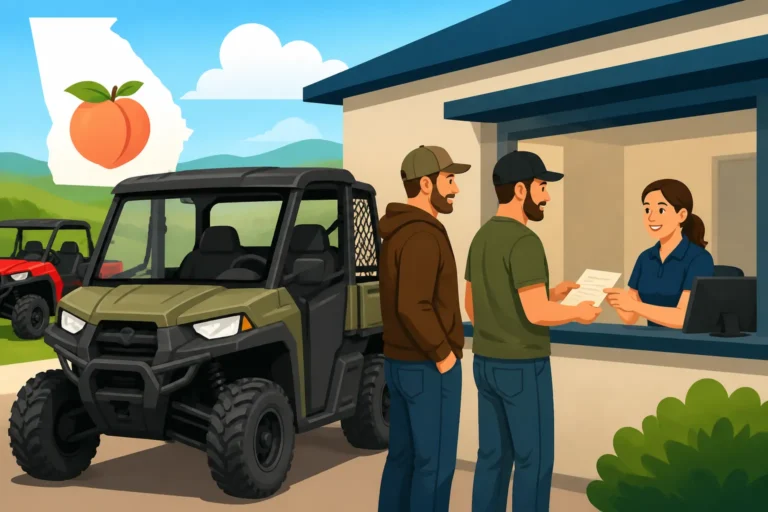
Once you have all your documents in order, including a clean VIN verification, you'll head to your local county tag office. This is where all your hard work comes together.
- Submission of Documents: Present your completed Georgia Form MV-OHV, your VIN verification (often the T-22B if required), proof of ownership, insurance, and identification.
- Review by Clerk: A tag office clerk will meticulously review all your submitted documents to ensure they are complete and accurate. They'll verify VINs across all papers, confirm ownership, and check for any outstanding issues.
- Fee Payment: Once everything is approved, you'll pay the applicable registration fee.
- Issuance of Registration: If all goes well, you’ll receive your MPOHV Certificate of Registration, a license plate, and a decal. You'll need to know about [Georgia Plate Placement on a Side-by-Side] to ensure proper display.
The entire process is designed to ensure legitimate ownership and compliance with state regulations for road access. Being organized will make your visit much smoother.
Maintaining Compliance After Registration
Getting your MPOHV registered is a fantastic achievement, but it's not a one-and-done deal. To maintain compliance and avoid potential issues, remember a few key things:
- Annual Renewal: Your MPOHV registration will need to be renewed annually. Pay attention to your renewal notice and ensure you complete the [Georgia MPOHV Renewal Each Year] process on time.
- Continuous Insurance: If you're using your machine on county roads, you must maintain continuous liability insurance. Lapses in coverage can lead to penalties or even suspension of your registration.
- Update Information: If you move, change insurance providers, or sell your machine, update your registration information promptly with the county tag office. For selling a registered MPOHV in Georgia, there are specific steps to follow to transfer the registration to the new owner.
- Understand Road Rules: Remember, MPOHV registration in Georgia is for access to county roads only, under specific conditions. It does not make your machine street legal on state highways or interstates. Be fully aware of [Georgia MPOHV Road Rules: County Roads Only] to avoid fines and ensure safe, legal riding.
By staying on top of these responsibilities, you can enjoy the freedom that Georgia's MPOHV registration offers, knowing you're fully compliant with state law.
Common VIN Check Scenarios & Solutions
| Scenario | Common Issue | Required Document / Action | Who Conducts / Where to Go |
|---|---|---|---|
| New Machine, Dealer Purchase | VIN verified by dealer, part of sales process | Manufacturer's Statement of Origin (MSO) with VIN | Dealer handles initial paperwork |
| Used Machine, Private Sale | Unverified VIN, potential unknown history | Bill of Sale (ensure VIN accuracy), potentially [Georgia Ownership Affidavit for an MPOHV] | Law enforcement (T-22B) or tag office staff |
| Out-of-State Purchase | VIN needs Georgia verification for state records | T-22B Inspection Certification | Law enforcement |
| Missing/Illegible VIN | Cannot identify machine, tampering concern | T-22B, detailed affidavit explaining condition (LawDepot can help) | Law enforcement, potentially DOR review |
| Branded Certificate | Previous salvage, flood, or other history flagged | T-22B (often required to confirm identity post-brand) | Law enforcement |
| Paperwork Discrepancy (VIN) | VIN on bill of sale doesn't match machine | Corrected bill of sale, or affidavit explaining discrepancy | Seller, or applicant (with affidavit) |
Disclaimer
This article is for general informational purposes only and does not constitute professional advice. Laws, prices and regulations vary by location and change over time. Consult a qualified professional for guidance on your specific situation.