What a Course Teaches a New Rider
A new ATV or UTV rider needs more than a quick explanation of the controls. The right safety course can build practical skills and help prevent common mistakes, but it is easy to confuse training with legal permission to ride. Here’s what a course typically teaches, what can vary, and how to pair training with Georgia’s permit and trail rules.
What a beginner course covers
A beginner course usually combines safety information with basic operating skills. The exact curriculum depends on the provider, the machine, and whether the course is online or includes supervised riding. A classroom or online course can explain decisions and hazards; hands-on instruction lets a rider practice those skills with an instructor nearby.
| Course topic | What a new rider may learn | Why it matters |
|---|---|---|
| Pre-ride checks | Inspect tires, controls, brakes, lights, fluids, and protective equipment | Problems are easier to address before riding than after a breakdown |
| Controls and starting | Identify the controls and start, stop, and secure the machine | Familiarity reduces fumbling and unintended movement |
| Body position | Shift weight and keep a stable posture for the machine and terrain | Balance and control change on slopes, turns, and uneven ground |
| Speed and stopping | Choose a manageable pace and leave room to stop | A machine can travel farther before stopping than a new rider expects |
| Terrain and hazards | Read trail surfaces and spot obstacles, drop-offs, and changing conditions | Looking ahead gives the rider more time to choose a safe line |
| Passengers and load | Understand how added weight can affect handling and braking | A loaded machine may respond differently from an unloaded one |
| Trail conduct | Share space, communicate, and follow posted directions | Courtesy and predictability reduce conflict and collision risk |
| Emergency response | Know what to do after a tip-over, injury, or mechanical problem | A calm plan helps riders avoid turning a small problem into a larger one |
Pre-ride inspection
A course may teach riders to check the machine before each outing. That can include looking for damaged parts, leaks, worn tires, loose fasteners, and controls that do not work as intended. Riders should also confirm that the machine fits the person using it and that the operator’s manual is available for model-specific instructions.
The point is not to turn a beginner into a mechanic. It is to notice warning signs early, avoid riding a machine with an obvious safety problem, and know when a repair belongs with a qualified technician.
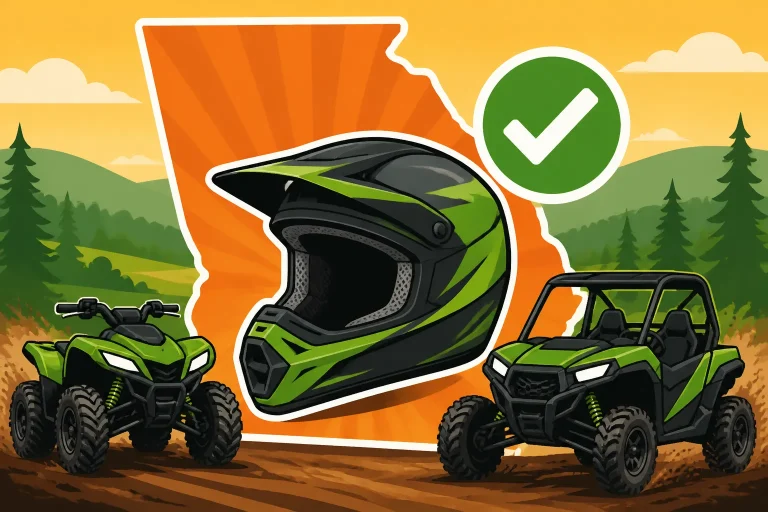
A pre-ride routine can also include protective gear. A helmet that fits properly, eye protection, gloves, long sleeves, long pants, and over-the-ankle footwear can help reduce exposure to common riding hazards. The course may explain how to select and use protective equipment, but riders should check the rules that apply to their activity and location. Georgia’s requirements for young riders are covered in Georgia Helmet Rules for Riders Under 18.
Controls, balance, and stopping
A new rider should learn where the controls are and how the machine responds before entering a busy or difficult trail. Instruction may cover starting and shutting down, shifting where applicable, using the brakes, and securing the machine when parked. The details differ between ATVs and UTVs, and among models, so instruction should match the machine whenever possible.
Balance is a central skill on an ATV. Riders may practice keeping their body position stable, looking through a turn, and shifting weight appropriately rather than leaning away from the direction of travel. A UTV has a steering wheel, seats, and a different riding position, but the driver still needs to understand how speed, terrain, and load affect control.
Stopping deserves deliberate practice. A beginner should learn to brake smoothly and early, keep enough distance from other riders, and avoid assuming that a machine can stop instantly on loose soil, mud, gravel, or a downhill slope. A course may introduce controlled exercises in a safe practice area before a rider attempts unfamiliar trails.
Skills that matter once the wheels are moving
The hardest part of riding is often making good decisions while the terrain changes. A useful course teaches riders to look ahead, control their pace, and choose a route that fits their ability and machine. It should not suggest that a beginner can handle every obstacle after one session.
Reading terrain and choosing a line
Riders may learn to scan beyond the front tires and recognize changing surfaces, ruts, loose gravel, mud, roots, rocks, and water crossings. A course can discuss how these features affect traction and stability, and why a rider should slow down when visibility or footing is poor.
Line choice means selecting a path through an obstacle or around it. That decision depends on the machine’s size, ground clearance, tires, experience level, and what lies beyond the obstacle. A route that appears manageable from a distance may hide a steep edge or soft ground. If a rider cannot see a safe way through, stopping to assess the situation or turning back is a sound choice.
For UTV drivers, course content may include vehicle width, turning space, passenger safety, and keeping all occupants seated and belted as intended by the manufacturer. A machine that feels stable on a smooth surface can still behave differently on a slope or uneven trail. Riders should follow the model’s operating instructions and avoid treating a roll cage as a reason to take unnecessary risks.
Speed, spacing, and group riding
A course should emphasize riding at a speed that leaves time to react. That speed changes with visibility, surface conditions, traffic, rider skill, and the machine itself. Posted limits and trail rules still apply; training does not grant permission to ride faster or enter a closed area.
Spacing matters because dust, blind corners, and sudden stops can leave little room for the rider behind. In a group, riders can agree on a route, regrouping points, and a way to signal a problem before setting out. New riders should be able to ride within their own limits rather than feeling pushed to keep pace with more experienced people.
Groups should also avoid crowding a rider who is learning. A beginner needs enough space to focus on controls and terrain, and should not be pressured into an obstacle or speed that feels beyond their current ability. If a group ride becomes too demanding, stopping or choosing an easier route is safer than trying to prove competence.
Passengers, loads, and machine limits
Passenger instruction is especially important for side-by-sides. Riders should use only the seating positions designed for occupants, follow the manufacturer’s passenger and seat-belt instructions, and make sure each person understands how to stay seated. Carrying someone on a machine or in a position not intended for passengers can create serious risks.
For ATVs, a passenger should not be carried unless the machine is designed for that use and the operator’s instructions allow it. Extra weight can change balance, braking, and steering, so adding a passenger or cargo is not a minor adjustment.
A class may also discuss how to secure cargo and respect the machine’s load limits. Riders should consult the owner’s manual for payload and towing limits rather than relying on a guess or a general rule of thumb. A load that shifts can affect handling even if its total weight seems modest.
What a course cannot replace in Georgia
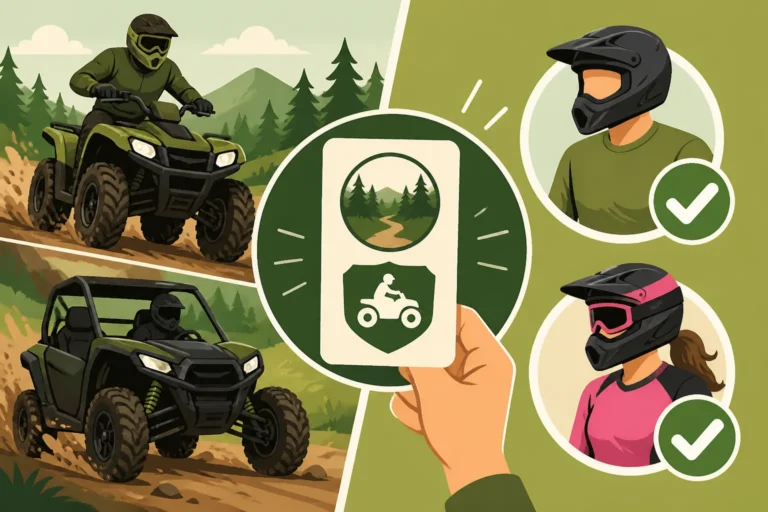
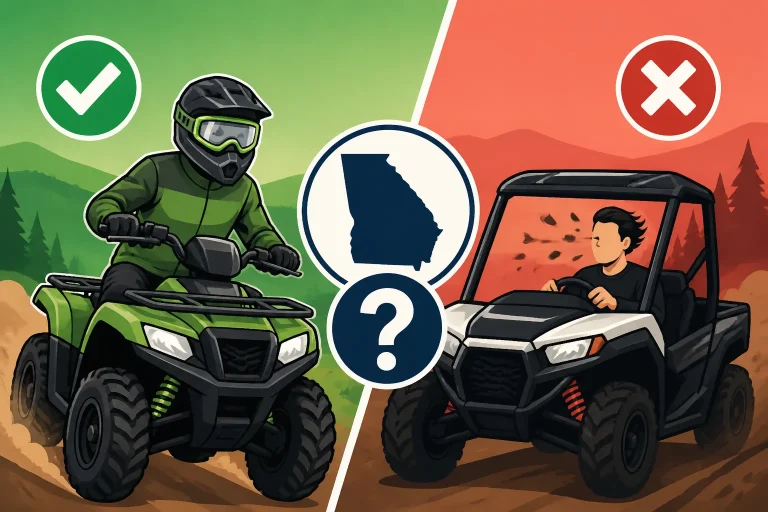
Safety training is valuable, but it is not the same as a permit, registration, insurance, landowner permission, or legal access to a trail. Georgia does not have a general state ATV safety course requirement; for an overview of that distinction, see Georgia Has No State ATV Safety Course. A particular park, rental operator, event, or land manager may still set its own training, age, supervision, or equipment conditions. Check those rules before traveling.
A course certificate is also not a universal riding pass. It does not automatically authorize a rider to use a national forest trail, a wildlife management area road, private property, or a public road. Georgia’s forest permit system is separate from a course, and the permit follows the operator rather than the machine. See Georgia’s Per-Operator Permit, Not Per Vehicle and What an Operator Permit Does Not Cover before planning a forest ride.
Rules can differ by land type and activity. For example, access on a wildlife management area may depend on designated routes and the conditions for that area, rather than simply on having completed safety training. Riders should confirm the specific property’s rules through the responsible land manager. For questions about out-of-state credentials or claims that a permit carries across borders, check Georgia Reciprocity Claims Worth Checking rather than assuming a course or card is recognized everywhere.
Training does not settle road access
A rider who has learned to control a machine still needs to know where it may legally be operated. A course does not make an ATV or UTV street legal, nor does it open a public road to off-highway use. Rules depend on the road, the machine, and applicable state and local requirements. Georgia UTV Road Rules by County explains why checking the route matters.
The same distinction applies to private property. A landowner’s permission and the property’s rules matter, and permission to ride on one parcel does not necessarily extend to a neighboring road, utility corridor, or trail. Training can help a rider avoid hazards, but it cannot substitute for permission or make trespassing lawful.
Training does not guarantee safe judgment
Completing a course does not mean a rider is ready for every machine, passenger, trail, or condition. Skills need practice, and confidence can grow faster than ability. A beginner should start with a suitable machine and manageable terrain, ride with a responsible companion when appropriate, and stop when fatigue, poor visibility, or changing weather makes conditions harder to manage.
A course also cannot guarantee that a machine will remain safe or that another trail user will behave predictably. Continue checking the machine, use the required protective equipment, and make conservative choices even after training.
Choosing a course and putting the lessons to use
The best course is one that matches the rider’s age, experience, machine, and intended use. A general online class may be convenient for learning terminology and safety concepts, while an in-person course can give a beginner a chance to practice controls under supervision. Some providers focus on ATVs, some on side-by-sides, and some offer different instruction for different ages or experience levels.
Before enrolling, ask what the course includes and what it does not. Useful questions include:
- Does it include supervised riding, or is it classroom or online instruction only?
- Is the content intended for an ATV, a UTV, or both?
- What equipment and clothing must the student bring?
- Are age, height, or experience restrictions in place?
- Is the course held on a practice range or on a trail?
- Does the provider issue a completion record, and what is that record accepted for?
- Are there separate rules for minors, guardians, or passengers?
A completion record can be useful to keep, especially if a park, rental business, or event asks about prior training. But ask the organization requiring it what it accepts. Do not assume that a certificate from one provider satisfies a separate land manager’s rules or an out-of-state requirement.
A practical learning sequence
A beginner can put training into practice without jumping straight to a challenging ride:
- Read the machine’s owner’s manual and identify its controls, limits, and recommended operating practices.
- Complete a course suited to the machine and rider, including hands-on practice if available.
- Check the intended riding location’s access rules, permit requirements, closures, and equipment conditions.
- Begin in a controlled, low-traffic area with manageable terrain and no pressure to keep up with others.
- Practice starting, stopping, turning, and maintaining a safe pace before attempting more difficult features.
- Review what felt uncertain after the ride and seek additional instruction before increasing the challenge.
For a minor, confirm both the course provider’s supervision policy and the rules for the intended riding location. Requirements can differ among public land, private parks, rental operations, and private property. Georgia Supervision Rules for Minors is a useful starting point for understanding that course participation and permission to ride are separate questions.
A new rider should also learn to recognize when not to ride. Poor conditions, fatigue, a machine that does not fit, missing protective equipment, unclear access permission, or pressure from a group are all good reasons to pause. A course is most useful when it builds habits that continue after the class ends: inspect first, ride within ability, look ahead, respect closures, and turn around when the situation is beyond the rider’s skill.
Disclaimer
This article is for general informational purposes only and does not constitute professional advice. Laws, prices and regulations vary by location and change over time. Consult a qualified professional for guidance on your specific situation.