Georgia Private Park Quiet Hours
A quiet-hours rule can affect more than music at a campsite: it may limit when you can start an ATV or UTV, run a generator, unload a trailer, or arrive after dark. Georgia private parks set their own policies, so there is no single schedule to assume. Confirm the park’s rules before you travel, especially if your trip includes overnight camping.
What quiet hours may cover at a private park
Quiet hours are usually meant to reduce noise during the part of the day when other visitors are sleeping or winding down. The details depend on the property. One park may focus on music and campground behavior; another may also restrict engines, generators, or vehicle movement in camping areas.
Do not assume that “quiet hours” means only “turn the stereo down.” Ask which activities are covered and where the rule applies. A park might have separate policies for riding trails, paddocks, parking areas, cabins, and campgrounds. Trail closing time and campground quiet time are also different things: trails may close before quiet hours begin, or a park may permit limited movement around camp after riding has ended.
| Activity | What to confirm with the park |
|---|---|
| ATV or UTV engine | Whether starting, warming up, loading, or moving a machine is restricted |
| Music and speakers | Whether the rule covers campsite speakers, vehicle stereos, and indoor sound that carries outside |
| Generators | Whether they are allowed overnight, restricted to certain hours, or limited by location |
| Arrival and unloading | Whether late arrivals are permitted and how to unload without disturbing others |
| Campfires and conversation | Whether there are separate fire, gathering, or campground rules |
| Trail riding | The actual riding schedule, which may differ from campground quiet hours |
The rule may be stricter in a campground than in a distant riding area. Sound carries differently across an open field, through trees, and between closely spaced campsites, so “we’re only a short distance away” is not a reliable measure of whether your activity will disturb someone.
The park may also distinguish between permitted operating hours and quiet hours. A machine can be allowed on the property but not allowed to run at every hour. Similarly, permission to camp does not automatically mean you can arrive, unload, or operate a generator whenever you like. Review the park’s Georgia Private Park Camping Rules separately from its riding schedule.
How to confirm the rules before you go
Look for the quiet-hours policy on the park’s official booking page, camping information, waiver materials, or posted rules. If the wording is incomplete, contact the park directly. Policies can differ between parks and may also vary by camping area or event, so do not rely on a rule you heard about at another property.
When you contact the park, ask questions that match your plans. “What are quiet hours?” may produce a time range but leave the important details unanswered. If you expect to arrive late, run a generator, or use a machine early the next morning, say so plainly and ask whether those specific activities are allowed.
A short checklist can make the conversation more useful:
- Ask when quiet hours begin and end, and whether the schedule applies every night or only on certain days.
- Confirm whether the rule applies to the whole property or only to camping and lodging areas.
- Ask whether engines can be started or moved during quiet hours, including for loading or unloading.
- Check whether generators, outdoor speakers, and amplified music have separate restrictions.
- Confirm the latest permitted arrival time and whether late check-in is available.
- Ask where to park a trailer if you arrive after the office closes.
- Request the current rules in writing or save the park’s official page for reference.
That last step is useful because broad statements such as “campground is open all night” may describe access, not permission to make noise. Keep a copy of the park’s policies with your reservation information. If there is a dispute, it is easier to refer to the written rule than to rely on a conversation remembered differently by each person.
Policies about quiet hours are only one part of a private park’s requirements. Review its Georgia Private Park Waivers and Rules before signing, and check Georgia Private Park Alcohol Rules if your group plans to bring alcohol. Those policies may affect conduct even when they are not specifically described as quiet-hour rules.
If you are bringing children or pets, check the relevant requirements before booking. The park’s Georgia Private Park Minimum Ages and Georgia Private Park Pet Rules can clarify who may ride, where pets are allowed, and what supervision is expected. That planning helps avoid last-minute changes that could lead to extra vehicle movement or noise after other guests have settled in.
Planning a ride and overnight stay around quiet hours
The easiest way to avoid a problem is to finish noisy tasks before the quiet period begins. Load gear, secure tie-downs, fuel or prepare machines as the park permits, and settle your campsite while there is still time to do it without rushing. If the park requires check-in before a certain time, build that into your route rather than assuming you can arrive late and sort everything out at the gate.
Before leaving home
Prepare your machine and trailer so you do not need to troubleshoot in the campground at night. Check straps, lights, tires, fuel, and essential gear before departure. Pack items you will need first—such as a flashlight, campsite supplies, and paperwork—where you can reach them without unloading everything. If your machine needs maintenance, do it at home or in a suitable service area, not beside occupied campsites during quiet hours.
For a broader look at campground logistics, see Georgia Private Park Camping Rules. Also confirm equipment and rider requirements, including the park’s Georgia Private Park Helmet Rules. Compliance with safety requirements does not replace quiet-hour rules, but checking both in advance can prevent avoidable trips back to the vehicle or trailer.
If you expect to arrive late
Call ahead rather than treating a late arrival as a routine check-in. Ask whether the park allows it, whether staff will be available, and where you should go. Find out whether you can unload quietly, whether your machine must remain on the trailer until morning, and whether there is a designated area for late arrivals.
If late arrival is allowed but unloading is not, consider staying somewhere else for the night or changing your travel schedule. Do not assume that turning off the headlights or keeping conversation low makes engine noise acceptable. A brief engine start can still be disruptive in a quiet campground.
If you are staying with a group
Agree on a simple plan before arriving. Choose a time to stop riding, identify who is responsible for the trailer and campsite setup, and tell everyone where the quiet boundary is. A group can unintentionally create more noise through repeated trips between campsites, doors slamming, engines starting one at a time, or people talking loudly around a fire.
Keep music contained and at a low level, and follow the park’s rules even if your group is the only one using a particular section at that moment. Other guests may be out riding, asleep in a cabin, or staying just beyond the next row of trees. If the park has a designated gathering area, use it rather than creating a second social spot near sleeping guests.
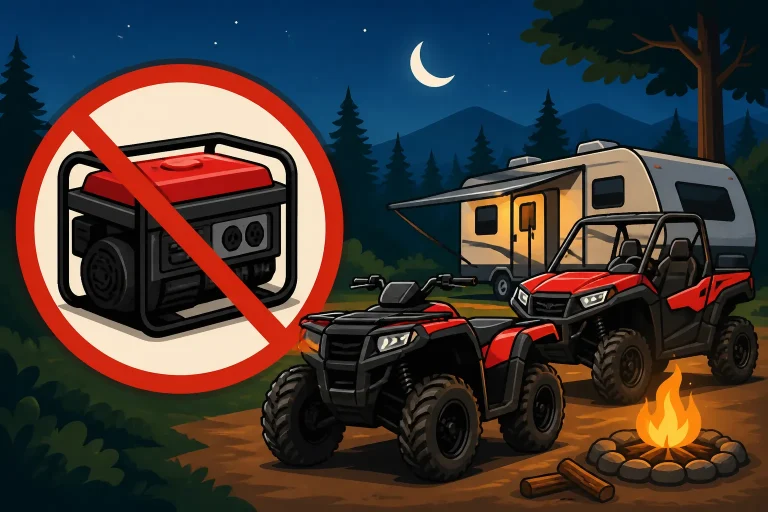
Generators deserve special attention. Some camping areas may allow them only during specified periods, while others may prohibit them or offer electrical hookups instead. Ask about the park’s rule before packing one. If it is allowed, place it only where the park permits, follow any direction about distance from other sites, and shut it off at the required time. Never treat a quiet generator as automatically exempt from the rule.
What to do if there is a complaint or a rule is unclear
If a park employee asks you to reduce noise or stop an activity, comply first and clarify afterward. Turn off the engine or speaker, move away from occupied sites if directed, and ask which written policy applies. Arguing in the campground is likely to disturb more people and will not make the rule clearer.
If you believe the rule was applied inconsistently, speak with park management during an appropriate time. Keep the conversation calm and specific: explain what you were doing, when it happened, and what you understood the policy to say. A screenshot of the posted rules or a written response from the park can help sort out a misunderstanding.
Do not assume that another guest’s behavior gives you permission to do the same. A park may have given someone an exception, may not yet have noticed a violation, or may be handling it privately. Ask staff rather than escalating the issue with another visitor.
When a policy is genuinely unclear, the practical choice is to follow the more conservative interpretation until staff confirms otherwise. For example, if you cannot establish whether a generator is allowed late at night, leave it off. If you do not know whether a machine can be moved after the stated quiet period begins, wait until morning or call the park. This is especially sensible when nearby campsites are occupied.
A private riding park may also have rules about coverage, liability, and what riders must carry. Check Georgia Private Park Insurance Requirements if you are unsure what protection or documentation is expected. Quiet-hour compliance and insurance are separate issues, but both are part of arriving prepared and avoiding surprises at check-in.
Before booking, make sure the park’s schedule fits the way you actually plan to travel. If you need to arrive late, run medical or accessibility equipment, or use a generator, explain the need in advance and ask whether an accommodation or alternative arrangement is available. Do not assume an exception exists, and do not wait until you are at the gate to ask.
Quiet hours are easiest to manage when treated as part of the trip plan, not as a rule to figure out after dark. Confirm the hours, learn what activities they cover, organize your arrival, and make sure everyone in your group knows the limits. That keeps a late check-in or a noisy campsite from turning into the main event of the weekend.
Disclaimer
This article is for general informational purposes only and does not constitute professional advice. Laws, prices and regulations vary by location and change over time. Consult a qualified professional for guidance on your specific situation.