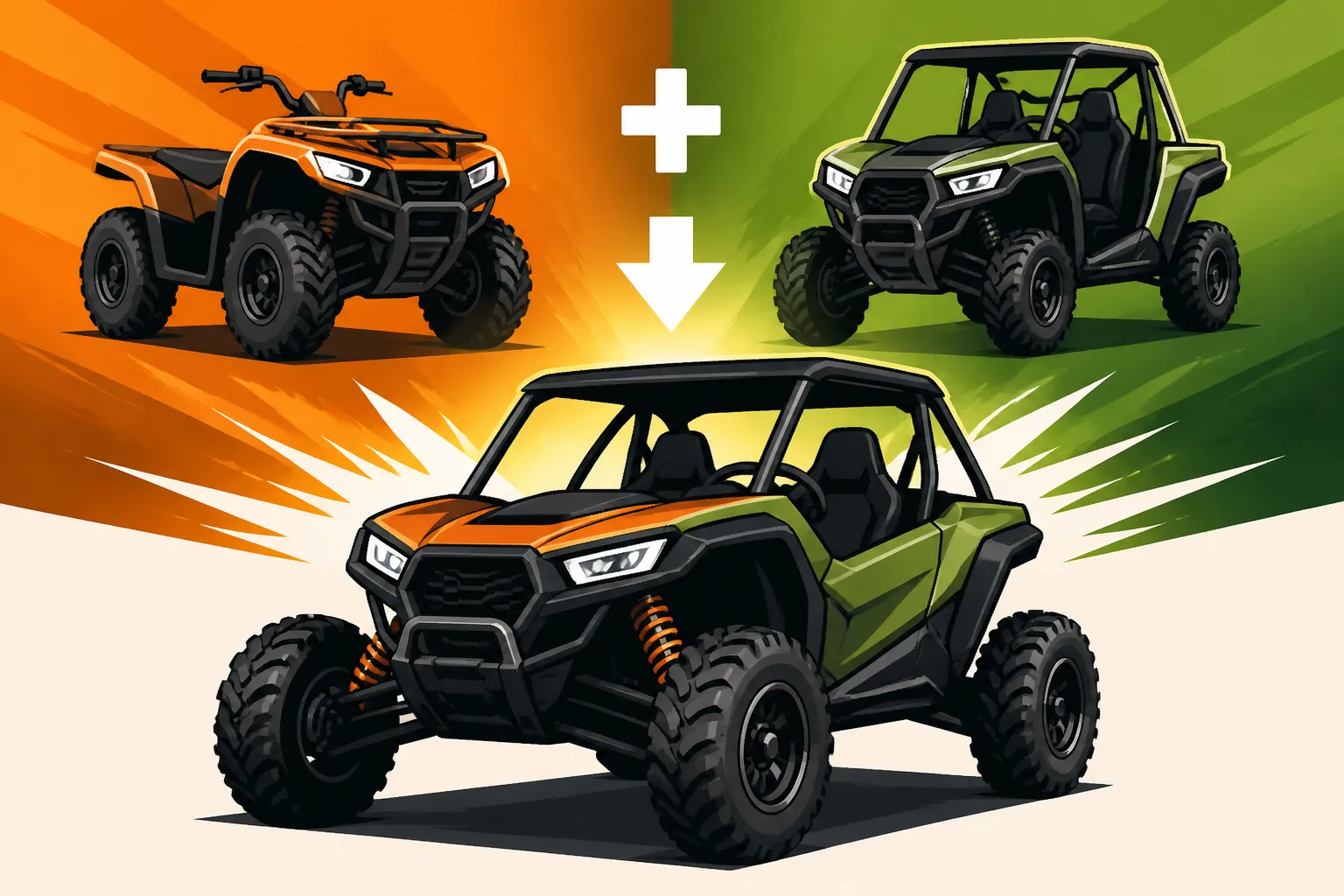
Two Machines Combined Into One
It's incredibly frustrating when you've poured your heart, sweat, and probably a few scraped knuckles into building a truly unique off-road machine, only to hit a brick wall when it comes to getting it officially recognized. Many enthusiasts piece together the perfect side-by-side or ATV from parts of two or more existing machines, dreaming of hitting Georgia's trails or even county roads, but then discover that registering this custom creation isn't as straightforward as buying one off the showroom floor. This guide will walk you through the unique challenges and steps involved in registering a "combined" off-road vehicle in Georgia, offering practical advice to help you navigate what can sometimes feel like a bureaucratic maze.
Understanding the Challenge of "Combined" Machines for Registration
Building a custom off-road machine from the ground up, or by combining significant components from two different vehicles, is a testament to ingenuity and skill. However, when it comes to the official world of registration and identification, this kind of creativity can introduce some significant hurdles. Georgia's vehicle registration system, even for multi-purpose off-highway vehicles (MPOHVs), is primarily designed for factory-built machines with clear, singular identities.
Why Two VINs Create a Headache
Every manufactured vehicle comes with a unique Vehicle Identification Number (VIN) stamped on its frame or a prominent data plate. This VIN is the machine's official identity, tied to its manufacturing history, ownership records, and any potential liens. When you combine two machines, you inherently bring two (or more) VINs into the equation. For example, you might have the frame from one side-by-side and the engine and transmission from another. Which VIN becomes the primary identifier for your newly combined machine?
The challenge here is that official recognition generally only allows for one primary VIN. The state's Motor Vehicle Division (MVD) and your local county tag office are looking for a clear, unambiguous identification number to associate with the registration. They need to know what they are registering and that it's not a stolen collection of parts. This often means that one of the original VINs will need to be designated as the primary identifier, or, in some very rare and complex cases, a new state-issued VIN might be considered, though this is far more common for titled vehicles and much less clear-cut for untitled off-highway vehicles. The process can feel like trying to fit a square peg into a round hole, as the system isn't really set up for these unique, enthusiast-driven projects.
The Concept of a "Rebuilt" Machine in Georgia
In the context of automobiles, Georgia has specific rules and processes for "rebuilt" vehicles, which typically involve a damaged vehicle being repaired to operational status. For off-highway vehicles, the concept of "rebuilt" isn't as formally defined or processed, especially since [Why Georgia Does Not Title an ATV]. However, the spirit of proving the legitimacy and safety of a significantly modified machine absolutely applies when you're trying to register it.
If you've swapped a major component like the frame or the engine from a different vehicle, your machine effectively becomes a "rebuilt" or "custom-built" entity. The state wants to ensure that these components were legally acquired and that the resulting vehicle meets certain safety and operational standards. For an MPOHV, this means your combined machine still needs to satisfy the specific eligibility criteria Georgia has laid out for road-legal use on county roads. It’s not just about getting a plate; it’s about proving that your unique creation isn't a hazard and that all its constituent parts were obtained legitimately. This lack of a clear, formal "rebuilt" designation specifically for untitled MPOHVs can actually make the process feel more ambiguous, as you're often navigating general vehicle laws and trying to apply them to a niche category.
Gathering the Essential Paperwork for a Hybrid Build
The key to successfully registering a machine built from multiple donors is an ironclad paper trail. Without a single, clear VIN from a manufacturer's complete vehicle, the county tag office will scrutinize every piece of documentation you provide. Think of yourself as building a legal case for your machine's existence.
Proving Ownership of Each Donor Machine
This is, without a doubt, the most critical step. For every major component that retains a serial number or could be reasonably identified as coming from another vehicle, you must have proof of ownership. This isn't just about the frame or the engine, but potentially axles, transmissions, or other major sub-assemblies. This proof could come in several forms:
- Bills of Sale: If you purchased a donor machine, even if it was just for parts, a clear, dated bill of sale from the seller is essential. It should include the seller's name, address, signature, and the VIN or serial number of the machine or part sold.
- Previous Registration Documents: If you purchased a complete machine and harvested parts, the prior registration card in your name helps establish ownership of the donor vehicle.
- Ownership Affidavits: Sometimes, you might acquire parts without a formal bill of sale, perhaps from an old machine on your property or a trade with a friend. In these cases, a sworn statement, or affidavit, detailing how you came into possession of the part, who you got it from, and affirming that it was not stolen, becomes vital. [Georgia Ownership Affidavit for an MPOHV] provides a template for this kind of sworn statement, and while it's intended for entire machines, its principles can be adapted for major components.
It’s crucial to understand that if you cannot prove legal ownership for all significant components, especially those with VINs or serial numbers, you will likely face insurmountable challenges. The tag office needs to verify that your combined machine isn't comprised of stolen parts, and a gap in the chain of ownership for any major component will raise red flags. When preparing these documents, especially for individual components, consider using a service like LawDepot to generate clear, legally sound bills of sale or affidavits. This can provide an extra layer of professionalism and clarity to your documentation, which can be immensely helpful when dealing with clerks who may be unfamiliar with custom builds.
Documenting the Build Process
Beyond proving ownership of the donor parts, it's incredibly beneficial to document the entire build process. This might sound excessive, but remember, you're creating a narrative for your machine's unique journey. This documentation serves several purposes:
- Transparency: It shows the tag office exactly how your machine came to be, dispelling any suspicion.
- Identification: It can help identify which original VIN (if any) is being used as the primary identifier, or why one has been chosen over another.
- Legitimacy: It reinforces that this is a legitimate, well-thought-out project, not a hastily cobbled-together vehicle.
What kind of documentation should you keep?
- Photos: Take plenty of photos at every stage of the build, from the initial donor machines, through disassembly, component cleaning, frame modifications, engine installation, and the final assembly. These visual records are incredibly powerful.
- Receipts: Keep receipts for every new part you purchased, even small ones. This further demonstrates legitimate acquisition and your investment in the build.
- Logbook: Maintain a detailed logbook or journal. Note the dates you worked on the machine, what tasks you performed, and which parts you installed. Include serial numbers of components as you integrate them.
- Specifications: List the final specifications of your combined machine, including its dimensions, weight, engine size, and intended top speed. This will be important for meeting MPOHV eligibility requirements.
Having a clear paper trail, including a detailed declaration of the build process, can significantly smooth your path. Services like LawDepot can assist you in creating structured documents, such as a formal "Declaration of Vehicle Assembly" or a detailed parts manifest, that can present your comprehensive documentation in an organized and professional manner, rather than just a pile of loose papers. This kind of thorough preparation indicates to the authorities that you've been meticulous and responsible throughout the entire process.
The Inspection Process for a Modified Off-Road Vehicle in Georgia
Once you have your combined machine built and your comprehensive documentation in hand, the next hurdle is the inspection. This isn't just a formality; it's a critical step where a state official verifies your claims and ensures your vehicle meets necessary standards.
Understanding the Purpose of the Inspection
The inspection for a modified or "combined" off-road vehicle in Georgia serves multiple crucial purposes. Firstly, it's about identity verification. The inspector needs to confirm that the VIN or serial number you've designated as the primary identifier for your custom build is actually present on the frame and matches your paperwork. They'll also be checking the VINs of other major components against your ownership documents to rule out any discrepancies or the use of stolen parts. This is a crucial step in maintaining vehicle integrity and deterring theft.
Secondly, the inspection covers safety and eligibility. Even though it's a custom build, if you intend to register it as a Multi-Purpose Off-Highway Vehicle (MPOHV) for limited use on Georgia's county roads, it must meet all the established MPOHV criteria. The inspector will be looking at everything from seating arrangements to lighting and overall dimensions.
Who performs this inspection? In many cases, especially when there are questions about identity or a custom build, it will likely be law enforcement. A Georgia deputy or state patrol officer might be called upon to verify the machine's serial numbers and overall legitimacy. While [Georgia Law Enforcement Inspection for a Branded Plate] refers specifically to branded certificates, the principle of an official law enforcement inspection for unusual or potentially problematic vehicle identification scenarios is highly relevant here. Be prepared for a thorough examination.
Meeting Georgia's MPOHV Eligibility Requirements
This is where your combined machine must truly shine. Even if it's a one-of-a-kind creation, it still needs to fit within the predefined box of what Georgia considers an eligible MPOHV for county road use. The state has an eight-point test that every machine must pass. The inspector will meticulously check each of these requirements.
Here’s a breakdown of what they’ll be looking for, and where your combined machine needs to align:
| Requirement | Description | Relevance to Combined Machine |
|---|---|---|
| 1. Steering Wheel | The machine must have a steering wheel. This immediately disqualifies traditional ATVs with handlebars. | Ensure your custom build incorporates a legitimate steering wheel. If you started with an ATV chassis, this is a major modification that needs to be properly engineered. [Georgia Requires a Steering Wheel, Not Handlebars] |
| 2. Non-Straddle Seat | The vehicle must have a non-straddle seat. This means you sit in it like a car, not on it like a motorcycle or traditional quad. | Most side-by-sides fit this naturally. If your custom frame or seating was modified, confirm it provides a true non-straddle seat. [Why Georgia's MPOHV Rules Demand a Non-Straddle Seat] |
| 3. Max Width 80 Inches | The machine's overall width, including mirrors, must not exceed 80 inches. | Measure carefully! If you used wider axles or custom suspension, you could easily exceed this. [Measuring Width Against the 80-Inch Limit] |
| 4. Max Gross Weight 4,000 Pounds | The Gross Vehicle Weight Rating (GVWR) cannot exceed 4,000 pounds. This includes the vehicle, passengers, and cargo. | Larger frames, heavier engines, or extensive additions can push you over this limit. [Weighing a Machine Against the 4,000-Pound Limit] |
| 5. Min Payload 350 Pounds | The machine must be designed to carry a payload of at least 350 pounds. This is usually easily met by UTVs. | Ensure your custom bed or cargo area is capable of this. |
| 6. Speed Capability (25-65 mph) | The machine must be capable of exceeding 25 mph but not exceeding 65 mph on level pavement. | Your choice of engine, transmission, and gearing from the donor machines will dictate this. Ensure it falls within this specific range. [A Machine That Tops Out Below 25 mph] and [A Machine That Exceeds 65 mph] |
| 7. Manufacture Date | The machine must have been manufactured on or after January 1, 2000. | This is tricky for combined machines. You'll need to demonstrate that the primary VIN or the overall build date falls within this parameter. If you're using a frame from a pre-2000 machine, you might have issues. |
| 8. Required Equipment | Must have headlights, brake lights, a tail light, turn signals, at least one rearview mirror, and seat belts for all seating positions. | All this equipment must be fully functional and properly installed. Your custom build needs to integrate these features effectively. |
Meeting [Georgia MPOHV Eligibility: The Eight-Point Test] is non-negotiable for registering your machine for road use. The inspector will thoroughly verify each point, and any failure means your custom build won't qualify for MPOHV registration.
Navigating the Registration Process at the Tag Office
After all the wrenching, the paperwork, and the inspection, the final step is to visit your local county tag office. While you might feel like you've conquered the hardest part, presenting a custom-built, combined machine for registration can still involve some unique challenges.
Preparing for Your Visit to the County Tag Office
Walking into the county tag office with a stack of papers for a unique vehicle requires a bit more preparation than just bringing a title for a new car. You need to be ready for questions, potential confusion, and possibly even a clerk who has never encountered such a situation before. Here’s what to bring and how to prepare:
- All Ownership Documents: This includes every bill of sale, ownership affidavit (perhaps generated professionally through a service like LawDepot), and previous registration card for every major component you've used. Organize these meticulously, perhaps in a binder with tabs, so you can easily reference them.
- Documentation of the Build: Your photos, logbook, receipts for new parts, and any declaration of assembly will be crucial. These tell the story of your machine and demonstrate its legitimacy.
- Inspection Report: If a law enforcement officer has already inspected and signed off on your machine's VIN and MPOHV compliance, bring that official report. This is extremely valuable.
- Proof of Insurance: Just like any other registered vehicle in Georgia, you'll need to provide proof of liability insurance for your MPOHV. Make sure your policy specifically covers the machine you're attempting to register, including its unique identification.
- Application Forms: You'll need to fill out Georgia Form MV-OHV, the application for a Multi-Purpose Off-Highway Vehicle registration. Ensure you have accurately listed the designated primary VIN. [Georgia Form MV-OHV and What It Asks] details the specific information required on this form.
- Primary VIN Designation: Be prepared to clearly state and justify which VIN from your donor machines you are proposing as the primary identifier for registration purposes. Usually, this would be the VIN from the frame.
- Be Patient and Articulate: The tag office clerks are the front line, and while they are knowledgeable about standard vehicle transactions, a custom-built MPOHV might be outside their usual experience. Be polite, clearly explain your situation, and be ready to answer detailed questions about your build.
Having all your ducks in a row, with documents neatly organized and potentially formalized through resources like LawDepot, can make a significant difference in how smoothly your transaction proceeds.
What to Expect When Registering a Unique Build
Even with meticulous preparation, registering a combined machine can be a process. Here’s a realistic expectation of what you might encounter:
- Questions, Questions, Questions: Expect a barrage of questions about where the parts came from, why you chose a specific VIN, and how the machine was assembled. This is normal; they're doing their due diligence.
- Potential Delays: It’s unlikely this will be a quick in-and-out visit. The clerk may need to consult with a supervisor, call the state MVD, or even ask you to return with additional information. This is part of the process for non-standard registrations.
- Verification of VIN: The clerk might physically inspect your vehicle's VIN if it's visible, or review the law enforcement inspection report very carefully. They need to ensure the VIN on your application matches the machine.
- The "Rebuilt" Status Discussion: While there isn't a specific "rebuilt" title for ATVs in Georgia, the concept of a significantly modified machine will come up. Your documentation of the build process will be vital here.
- Possible Rejection and Further Steps: In some rare and challenging cases, the tag office might not be able to process your registration. This could happen if there are lingering doubts about ownership, safety, or if your chosen primary VIN is problematic. If this occurs, you might be advised to seek further inspection from a state MVD official or even a specialized law enforcement unit that deals with vehicle identification issues. This is a rare outcome for MPOHVs, but it's a possibility when dealing with a truly unique build.
The ultimate goal at the county tag office is to successfully register your machine and receive your [Georgia Plates for Off-Highway Vehicles]. When you present your documentation, including the completed MV-OHV form and proof of insurance, they will process your application based on the primary VIN you’ve identified. Patience, thoroughness, and a clear explanation of your unique build are your best assets when completing [Georgia County Tag Office Steps for an MPOHV] for a machine made of two.
Disclaimer
This article is for general informational purposes only and does not constitute professional advice. Laws, prices and regulations vary by location and change over time. Consult a qualified professional for guidance on your specific situation.