Georgia Side-by-Side Registration Checklist
Heading straight to your local county tag office to register a utility vehicle without the exact paperwork can turn an exciting morning into a frustrating series of rejected forms and wasted trips. Navigating Georgia’s Multi-Purpose Off-Highway Vehicle (MPOHV) registration process requires meeting strict physical machine standards and bringing a precise bundle of legal documents. This practical checklist breaks down every document, inspection, and equipment requirement you need to successfully register your side-by-side in Georgia.
The Essential Documentation Checklist for Georgia Side-by-Side Registration
Gathering your paperwork before heading to the counter is the single most important step in registering your utility machine. Tag office clerks in Georgia must strictly enforce state revenue guidelines, meaning a missing line on a bill of sale or an incomplete form will immediately halt your application.
Ownership Documents and Bills of Sale
Establishing a clean, unbroken chain of ownership is where many side-by-side owners run into hurdles, especially when buying used machines on the private market. You will need to show clear evidence that you legally own the vehicle. For a new machine purchased from a dealership, this means presenting the Manufacturer’s Statement of Origin (MSO) or Manufacturer’s Certificate of Origin (MCO).
For used side-by-sides, you must present a detailed bill of sale signed by both the buyer and the seller. The bill of sale must explicitly list the year, make, model, complete Vehicle Identification Number (VIN) or serial number, purchase price, and date of purchase. If you bought your machine from a private party who never had formal title paperwork, using a standardized contract platform like LawDepot to generate a legally binding, detailed bill of sale ensures all mandatory legal elements are captured. When filing your main application, you will complete Georgia Form MV-OHV and What It Asks, which formally records the vehicle details and your ownership claim. If you find yourself in a tricky situation where previous transfer receipts are missing, navigating Georgia MPOHV Registration Without a Bill of Sale requires extra steps to avoid outright application rejection.
Proof of Identity and County Residence
Georgia registration rules mandate that you process your MPOHV application within the specific county where you maintain your primary residence. You cannot simply drop into a tag office in a neighboring county because it happens to be closer to your hunting cabin or trail spot. You must present a valid Georgia driver’s license or state-issued identification card reflecting your current residential address.
If your driver’s license displays a former address or a P.O. Box, you must bring secondary proof of residency. County tag clerks typically accept recent utility bills (electric, water, or gas), a property tax receipt, or a formal lease agreement showing your physical street address. Making sure your identification matches the county records is crucial for smooth processing when Registering in the County Where You Live.
Sales Tax and Financial Documentation
Before a Georgia tag office will issue an MPOHV plate or decal, they must verify that appropriate Georgia sales tax has been satisfied. If you purchased your utility machine from an authorized Georgia dealership, your sales invoice will clearly detail the state and local sales tax collected at the time of sale. You must present this detailed invoice as proof.
If you purchased the machine out of state or through a private seller, you will be required to pay the applicable state and local county sales tax at the tag office counter before your registration can proceed. The clerk calculates this based on the purchase price listed on your bill of sale or the fair market value of the machine. Ensuring you have resolved Georgia Sales Tax Paid Before Registration prevents unexpected tax bills from stalling your file. In cases where tax history is unclear or documentation is fragmented, submitting a formal Georgia Ownership Affidavit for an MPOHV helps clarify your ownership timeline. You can easily draft a custom, notarized affidavit using LawDepot to satisfy county record requirements when original paper trails are incomplete.
Physical Machine Eligibility and Required Safety Equipment
Not every off-road vehicle qualifies for an MPOHV plate in Georgia. The state has established strict physical definitions to separate utility side-by-sides from sport quads, dirt bikes, and standard golf carts.
The Eight-Point MPOHV Criteria
To qualify for registration, your side-by-side must pass a set of dimensional and design criteria established by state law. If your vehicle fails even one point, county tag offices cannot register it as an MPOHV.
- Width: The vehicle must have a total width of 80 inches or less.
- Payload Capacity: It must feature a manufacturer-designed payload capacity of at least 350 pounds.
- Gross Weight: The maximum gross vehicle weight rating cannot exceed 4,000 pounds.
- Steering Mechanism: The machine must be controlled via a steering wheel, not handlebars.
- Seating Configuration: It must feature non-straddle seating, meaning bucket or bench seats designed for sitting in, rather than straddling.
- Speed Capability: The vehicle must be manufactured to reach speeds between 25 mph and 65 mph.
- Wheel Count: It must travel on four or more wheels.
- Primary Design: It must be engineered primarily for off-highway utility or recreational use.
Understanding how your machine aligns with Georgia MPOHV Eligibility: The Eight-Point Test saves you time before purchasing aftermarket add-ons. A major point of confusion for many off-road enthusiasts is steering design; state guidelines firmly reinforce that Georgia Requires a Steering Wheel, Not Handlebars, automatically disqualifying standard four-wheelers and ATVs regardless of their engine size.
Required On-Road Equipment Add-Ons
Meeting the dimensional factory criteria is only half the battle. To legally operate your registered side-by-side on designated public county roads, the machine must be outfitted with specific functional safety equipment.
- Headlights and Taillights: Functional illuminated headlights and rear taillights visible from a reasonable distance.
- Brake Lights: Operational brake lights activated by the foot brake pedal.
- Rearview Mirror: At least one clear rearview mirror offering a view of the road behind you.
- Seat Belts: Factory-installed or approved safety belts for all seating positions.
- Reflectors: Side and rear safety reflectors to enhance low-light visibility.
Taking time to review Headlights, Brake Lights and Mirrors on the Checklist ensures your machine meets both safety and legal compliance standards before you hit public dirt routes.
The T-22B Law Enforcement Inspection Process
Certain registration scenarios require physical verification of your side-by-side by a certified Georgia law enforcement officer. If your machine lacks a standard 17-digit VIN, if it was constructed from a kit, or if your county tag office flags a gap in previous registration records, you must obtain a Form T-22B Certification of Inspection.
A local sheriff’s deputy or police officer must inspect the physical serial plate or VIN on the frame, compare it against state databases to ensure it is not reported stolen, and sign off on Form T-22B. Completing the Georgia T-22B Inspection Certification protects you as a buyer from accidentally acquiring stolen property and provides the tag office with official proof of vehicle authenticity.
Insurance, Fees, and County Tag Office Execution
Once your machine meets physical equipment standards and your paperwork is in order, the final stage takes place at your county tag office counter.
Securing Active Liability Insurance
You cannot complete an MPOHV registration in Georgia without active motor vehicle liability insurance. The policy must meet the state’s minimum legal liability limits and be written specifically for street or road-use utility vehicles.
Insurance providers must transmit proof of coverage to the Georgia Electronic Insurance Compliance System (GEICS) or provide a physical insurance card listing the vehicle’s specific serial number or VIN. Maintaining active coverage is critical; maintaining Georgia Liability Insurance Tied to Registration keeps your plate valid and prevents automatic suspension or administrative fines from the state revenue department.
Navigating the County Tag Office Counter
When you arrive at the tag office, present your complete folder to the clerk: Form MV-OHV, your MSO or bill of sale, sales tax receipts, proof of insurance, driver’s license, and Form T-22B (if required).
The clerk will review the file, input the VIN into the state database, collect the registration fee and any outstanding sales tax, and issue your metal registration plate along with a validation decal. Following the exact Georgia County Tag Office Steps for an MPOHV helps streamline the visit. If you are conducting a private purchase right outside the tag office doors, having standardized liability waivers or purchase agreements generated beforehand through LawDepot ensures both buyer and seller are fully protected during the financial exchange.
Registration Summary and Road Access Rules
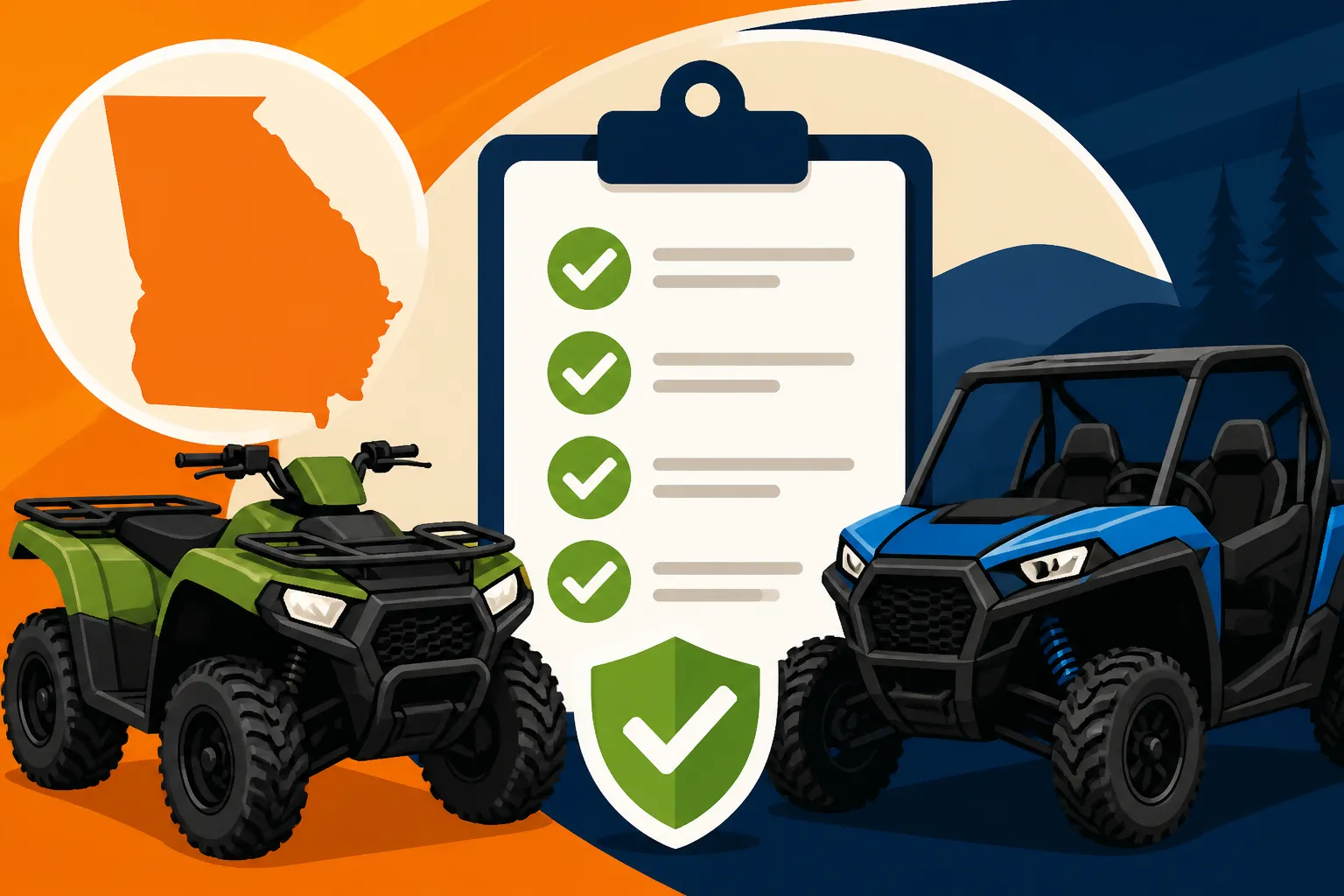
To help you organize your trip to the tag office, use this comprehensive checklist summarizing paperwork, physical standards, and mandatory hardware.
Master Side-by-Side Registration Checklist Summary
| Category | Item Required | Purpose / Notes |
|---|---|---|
| Documentation | Form MV-OHV | Primary state application for off-highway registration. |
| Documentation | MSO or Detailed Bill of Sale | Proves ownership chain; bill of sale should list full VIN and sale price. |
| Documentation | Valid Georgia ID & Proof of Address | Confirms identity and residency in the specific county. |
| Documentation | Proof of Sales Tax Paid | Dealer invoice or tax payment made at counter. |
| Machine Criteria | Steering Wheel & Non-Straddle Seats | Bench/bucket seating and wheel control (no handlebars). |
| Machine Criteria | Dimensions & Weight Caps | Max 80″ width, 350+ lb payload, under 4,000 lbs gross weight. |
| Machine Criteria | Speed Rating | Factory manufactured capability of 25 mph to 65 mph. |
| Equipment | Safety Belts & Mirror | Installed seat belts for all seats plus a functional rearview mirror. |
| Equipment | Lights & Reflectors | Working headlights, taillights, foot-activated brake lights. |
| Compliance | Form T-22B (If Needed) | Physical VIN verification signed by a certified Georgia peace officer. |
| Compliance | Active Liability Insurance | Minimum state liability coverage transmitted to state system. |
Knowing Where Your Registered Side-by-Side Can Ride
Receiving your metal Georgia MPOHV tag is an exciting milestone, but understanding its legal limits is essential to avoid costly traffic citations. An MPOHV registration does not make your side-by-side fully street-legal on every public road across the state.
An MPOHV plate grants permission to operate your utility vehicle exclusively on designated county-maintained dirt or paved roads within counties that have authorized off-highway access. It does not allow travel on state highways, interstates, or municipal city streets unless explicitly authorized by local ordinances. Always review Georgia MPOHV Road Rules: County Roads Only before planning a trip, and keep in mind the broader legal framework detailed in Georgia’s ATV Road Law Explained to ensure you stay within lawful riding zones.
Disclaimer
This article is for general informational purposes only and does not constitute professional advice. Laws, prices and regulations vary by location and change over time. Consult a qualified professional for guidance on your specific situation.