Houston Valley After a Heavy Rain
Heavy rain can turn a planned ride at Houston Valley into a muddy, risky day—or leave you driving to a trail system that is closed. The tricky part is that rainfall alone does not tell you what conditions are like on the ground. This guide explains how to check access, judge whether to ride, prepare your machine, and make a safer call after a storm.
What Heavy Rain Changes at Houston Valley
Houston Valley OHV Trail System is in north Georgia, near Dalton, and its mountain terrain can change quickly when rain moves through. Water runs downhill, collects in low spots, and cuts across trail surfaces. A route that seemed manageable on a dry visit may become slick, deeply rutted, or difficult to exit after a storm.
Rainfall totals are only one part of the decision. The timing and intensity of the rain, soil saturation from earlier storms, temperature, and drainage all matter. A short shower after a dry stretch may have a very different effect from overnight rain falling on already-wet ground. For general trail context, see Houston Valley's 25 Miles in North Georgia.
Expect slick clay, ruts, and changing traction
Wet red clay can feel deceptively firm until your tires start sliding. On a slope, the machine may drift sideways rather than track where you point it. In a rut, a tire can follow the groove even when you are trying to steer out. Those surprises are especially unnerving for newer riders, and they can happen at low speeds.
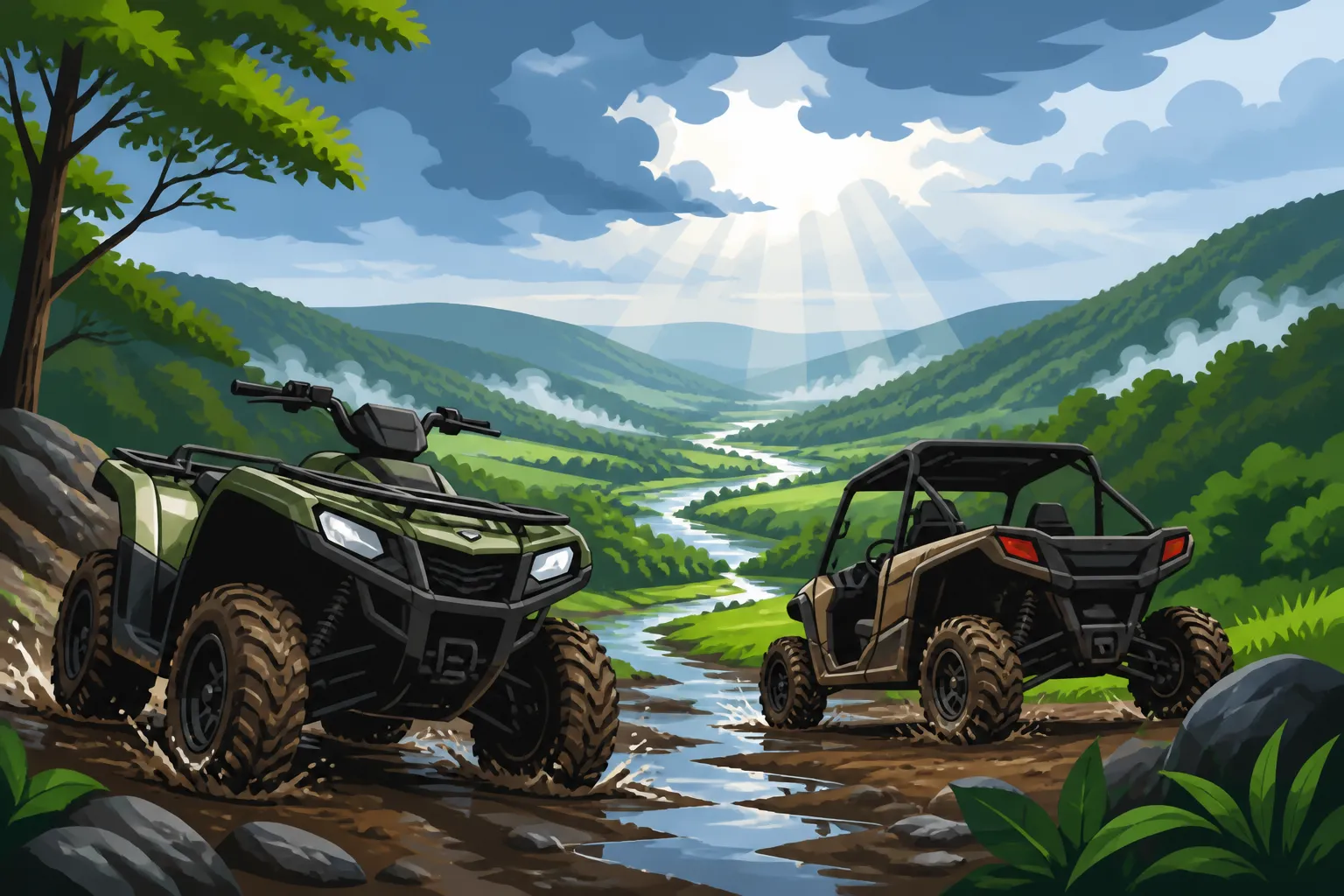
A mud hole also may be deeper than it looks. Water can hide a rut, a rock, or a soft edge, while churned-up mud can make it hard to tell where the trail actually runs. Do not assume that a puddle is shallow just because another rider has passed through it. If you cannot see the bottom or a clear way around, stop and assess rather than charging in.
The ground can also be damaged by repeated traffic when it is saturated. Tires may widen ruts, push soil off the trail, or create channels that carry more water during the next storm. If a route looks like it is deteriorating, turning around is often the better choice for both your group and the trail. [Tread Lightly on Erodible Clay] offers useful context for why riding gently matters.
Water crossings and low spots deserve extra caution
A crossing that looks tame from the seat can conceal a soft bottom, a washed-out edge, or a strong current. Water depth and speed are difficult to judge, especially when rain is still falling upstream. Never enter moving water if you cannot confidently see the route and understand the surface beneath it.
Low areas can also collect runoff after the rain has stopped. That means a clearing sky is not proof that the trail has become safer. If water is flowing across a trail, the bank is undercut, or the surface is breaking away, do not attempt to cross. Turn around if it is safe to do so and report a serious hazard through the appropriate land-management channel.
Check Trail Access Before You Drive
A wet trail and a closed trail are not the same thing. Houston Valley may be open while particular sections are difficult or unsafe, or access may be restricted after weather-related damage. The only useful plan is one that accounts for both official status and what you observe when you arrive.
Check the official trail status before leaving, then look for signs or notices at the trailhead. Conditions can change between the time you check at home and the time you reach the system. If you are coming from Dalton, Chatsworth, or farther away, that extra check can save a long trip with a machine you cannot ride.
Use official status information first
Start with the Forest Service’s trail or district information and look for alerts about closures, storm damage, or wet-weather restrictions. If the status is unclear, contact the relevant ranger district before setting out. A third-party map can help you understand where a route goes, but it should not be treated as confirmation that the route is open.
The same caution applies to social posts and old ride reports. A photo from last weekend does not tell you whether a storm has changed the trail since then. A rider may also have used a route that is not appropriate for your machine or experience. For a practical status-checking routine, see How to Check Georgia Forest Trail Status and Georgia Trail Conditions Before You Drive.
onX Offroad can help with route planning and understanding your position in the area, especially when you are comparing a planned route with the terrain around you. Use it as a navigation aid, not as the final word on closures or current trail conditions. Confirm access with official information and posted notices before riding.
Know the difference between open, restricted, and rideable
An open trail is not necessarily a comfortable trail for every rider or machine. A muddy climb may be manageable for an experienced rider with suitable tires but a poor choice for a new rider on a heavy, unfamiliar machine. Likewise, a route may be technically accessible while conditions make turning around or recovering a stuck vehicle difficult.
Pay attention to wording at the trailhead. A “dry riding only” notice should be taken seriously; do not interpret it as permission to try a route because the rain has stopped. If signage, an official notice, or staff guidance says to stay off a trail, follow that direction. What Dry Riding Only Means at a Trailhead explains why that wording matters, and Georgia Trails That Close After Rain discusses weather-related restrictions more broadly.
| What you find | A sensible response |
|---|---|
| Official closure or posted restriction | Do not ride the affected route |
| Trail is open, but water is flowing across it | Avoid the crossing and turn back if safe |
| Deep, unmarked mud or hidden holes | Do not enter unless the route is clearly safe |
| Slick slope or fresh, deep ruts | Reconsider the section, especially with a mixed-skill group |
| Conditions are unclear | Pause and verify rather than guessing |
Decide Whether Your Group Should Ride
A good rain-day decision is not just “Can the machine get through?” It is also “Can everyone ride this safely, and can we get out if conditions worsen?” An experienced rider may be comfortable turning around on a slippery section. A newer rider who is worried or struggling may feel pressured to continue just because the rest of the group is moving.
Before unloading, talk honestly about the conditions, the abilities in your group, and the plan if someone gets stuck. If the answers are vague, a shorter outing or a different activity may be the more enjoyable choice. There is no prize for making a difficult ride harder than it needs to be.
Use a conservative go-or-no-go check
At the trailhead, look at the ground rather than relying only on a weather forecast or what the drive in felt like. Check for fresh water channels, standing water, soft trail edges, and visible erosion. If you see vehicles returning with mud packed into the tread or hear that riders are turning around, treat that as information—not a challenge.
Consider the least experienced rider and the least capable machine in the group. A route that suits the most confident rider may not be suitable for everyone. Agree in advance that anyone can call for a turnaround without being mocked or rushed. That simple agreement can prevent a group from pushing deeper into conditions that are becoming unsafe.
Also account for the return trip. A trail that is manageable on the way in can become harder after more traffic churns up the mud or if rain resumes. If visibility is poor, water is rising, or the machine is struggling to maintain traction, do not continue just to finish a loop. A shorter ride with an easy exit is often the smarter choice.
Choose the route and pace for wet conditions
If the system is open and you decide to ride, keep your first section short and use it to evaluate traction. Avoid sudden throttle, hard braking, and sharp steering inputs on slick ground. Smooth control gives you more time to respond if a tire slips. Keep enough space between machines so the rider in front does not throw mud into your line of sight or leave you with no room to stop.
Do not follow another machine into a muddy obstacle just because it made it through. Its tires, weight, clearance, and driver skill may be different from yours. If you are unsure whether a section is safe, stop before the obstacle and choose a clear way around or turn back. A winch or tow strap is useful equipment, but it does not make every recovery situation safe.
Navigation can help you avoid getting turned around, but stay alert to what is physically in front of you. onX Offroad may help you keep track of your planned route and location; it cannot tell you whether a rut is newly washed out or whether a crossing is safe at that moment. Use a phone mount or offline map only in a way that does not distract from riding, and carry a backup plan for navigation.
Prepare for a Wet-Weather Ride or a Change of Plan
Wet-weather preparation is about more than keeping mud off the machine. A rider can get cold, lose visibility, or discover that a simple recovery takes much longer than expected. Plan for the possibility that you will ride less than you intended—or decide not to unload at all.
Before you go, confirm the system’s access requirements and make sure every operator has the required permit. Georgia’s national forest OHV permit system is per operator, not simply per vehicle, so check the details for your group at [Georgia National Forest Permits Are Per Operator]. You can also review Georgia's Six National Forest OHV Systems if you are considering another riding area instead.
Pack for traction problems and delays
Bring weather-appropriate clothing, gloves that still work when damp, eye protection, drinking water, and a basic first-aid kit. Carry a charged phone, but do not count on having reliable service throughout a riding area. Let someone outside the group know where you plan to ride and when you expect to check in.
A tow strap can be helpful when used correctly, but recovery carries real risks. Attach it only to approved recovery points and keep people clear of the strap and the vehicles under load. Never improvise with a bumper, hitch ball, or another part that is not designed for recovery. If the machine is stuck in an unstable position, the ground is shifting, or water is moving nearby, stop and seek a safer option instead of pulling harder. [Carrying a Tow Strap in the Mountains] covers why this gear needs careful handling.
Also prepare for the possibility that the best plan is to leave without riding. Keep dry clothes and a towel in the tow vehicle, and know where you can safely wait or turn around. A spare set of gloves may make the drive home much more comfortable, even if you never leave the parking area.
Clean up carefully and reassess the machine
After a wet ride, inspect the machine before loading it. Look for mud packed around the radiator, damaged plastics, loose straps, and anything that may have been struck or pulled loose. Mud can hide problems, so take time to check the undercarriage and moving parts once the machine is parked safely.
Clean the machine without directing high-pressure water at seals, bearings, electrical connections, or other sensitive areas. Remove packed debris from the radiator area carefully, following the manufacturer’s guidance. If the machine has been submerged or is running differently, do not assume it is fine because it made it back to the trailer. Stop and inspect it before riding again.
Finally, leave the trailhead and surrounding area as you found it. Do not widen a path to go around a muddy section, cut a new route through vegetation, or bypass a closure. If you encounter significant damage or a safety hazard, note the location as clearly as you can and pass the information to the responsible land manager. Those small choices help protect access and reduce the damage the next group will face.
Disclaimer
This article is for general informational purposes only and does not constitute professional advice. Laws, prices and regulations vary by location and change over time. Consult a qualified professional for guidance on your specific situation.