Georgia WMA Riding Only on Hunt Days
Georgia WMA riding is not a general invitation to explore on an ATV or UTV. In many cases, access is limited to specific hunt days, routes, hours, and operators. The key is to confirm the rules for the particular wildlife management area before you plan a ride, since a valid hunting day alone does not make every road or trail open.
What “Only on Hunt Days” Means
A wildlife management area, or WMA, is managed for activities such as hunting and wildlife conservation. It is not automatically an off-road recreation area. Where a WMA allows ATV or UTV use, that permission can be limited to designated roads and particular dates connected to hunting.
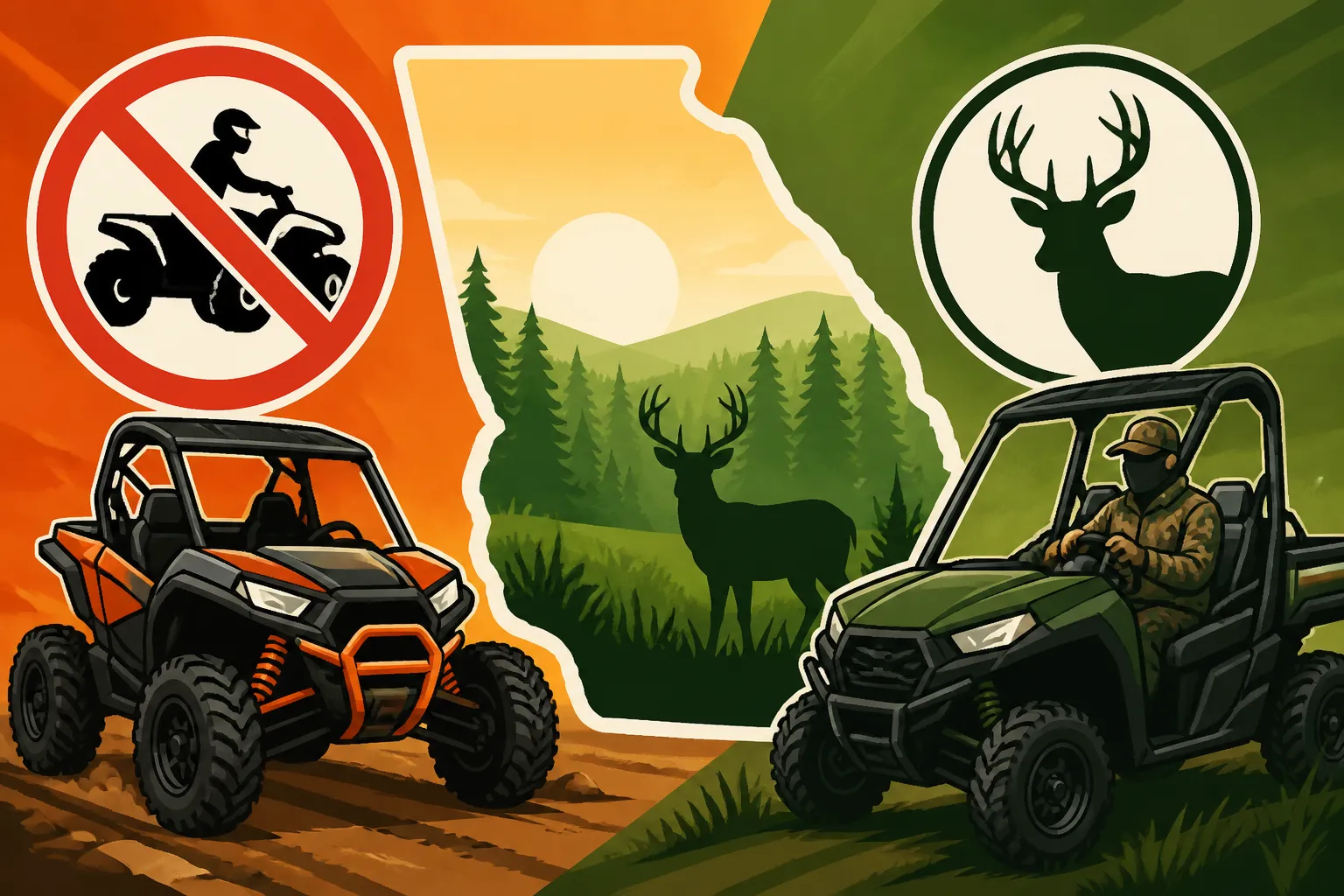
“Only on hunt days” means you should not assume you can ride on any day that the WMA is open to visitors. The dates that count as hunt days depend on the specific area and the applicable hunting season or special hunt. A WMA may have a hunt scheduled on one date but not another, and access rules can differ between areas.
There is an important distinction between a legal hunt day and general access. A date may qualify as a hunt day, but that does not necessarily authorize every person to ride for recreation, every type of vehicle to enter, or travel on roads that are not designated for motor vehicles. Some area rules may also limit vehicle use to people taking part in a legal hunting activity. Check the WMA’s rules rather than treating “hunt day” as a blanket permit.
Georgia WMA access rules can also depend on who manages the property. Some WMAs are associated with national forest land, while others are managed under different arrangements. That can affect where motorized travel is allowed and whether additional requirements apply. Georgia WMA Rules for ATV Riders explains the broader distinction between riding on WMA property and riding a trail that is specifically open to ATVs.
A practical rule is to treat ATV or UTV access as an exception that must be confirmed, not as a default. Before setting out, establish all of the following:
- The exact WMA and the managing agency or land manager
- The dates when riding is allowed
- The roads or routes open to your vehicle
- The permitted riding hours
- The operator age and any supervision requirements
- Any hunting license, WMA authorization, permit, or vehicle tag that applies
If the area’s current rules do not clearly allow ATV or UTV use on your planned date and route, do not ride there until you have confirmed the answer with the appropriate land manager.
A hunt day is not the same as any open day
A WMA may be open for some kinds of public access while motorized riding remains restricted. For example, a road may be available to ordinary traffic but not to off-road vehicles, or vehicle use may be allowed only during a listed hunt. Conversely, an area may have hunt dates that do not permit ATV access on all of its roads.
Do not rely only on a calendar entry for a hunting season. Look for the WMA’s specific vehicle-use rules, including notes about dates, road access, and the activity permitted. Georgia WMA Riding Only on Roads covers why route limits matter even when the WMA itself is open.
Dates, Roads, and Riding Hours
The hunt-day restriction is only one part of the rules. Date, route, time, vehicle, and purpose can all matter at once. A ride is not automatically allowed because one part of the plan checks out.
| Rule to confirm | What to check before riding | Why it matters |
|---|---|---|
| Date | Whether ATV or UTV use is allowed on that specific day | A general season date may not match the area’s vehicle schedule |
| Route | Whether the road or trail is designated for motorized use | Open WMA land does not mean open cross-country riding |
| Hours | The permitted travel window, including sunrise and sunset limits | Riding outside the allowed window can violate area rules |
| Vehicle | Whether your machine and its width or type are accepted | A road open to one vehicle may not allow every off-road vehicle |
| Operator | Minimum age, license, and supervision rules | Requirements can depend on the operator and the area |
| Purpose | Whether access is tied to hunting or another approved activity | A hunt day does not necessarily authorize recreational riding |
| Extra requirements | Any tag, permit, license, or check-in procedure | A hunting authorization and a motorized-access permission may be separate |
Confirm the actual date
Use the current rules for the named WMA, not a general hunting calendar copied from another area or season. Some hunts have special dates, limited entry, or other conditions. If the rules say riding is allowed only during a particular hunt, confirm that your planned date is part of that hunt and that the vehicle rules apply to it.
If the WMA is on national forest land, check the relevant land-manager information as well as the WMA’s hunting rules. A WMA permission and a national forest trail or road designation are not necessarily interchangeable. [Georgia National Forest WMAs Need Designated Trails] explains why a route’s status can be decisive.
Stay on authorized roads
Permission to ride on a WMA does not mean permission to travel wherever the machine can go. Stay on roads or routes expressly approved for motorized use. Do not cut around a closed gate, use a footpath as a vehicle trail, cross a field to bypass a washed-out road, or create a new route to reach a hunting location.
A line on a general map does not always establish that a route is open to ATVs. A road may be closed seasonally, reserved for administrative use, or limited to vehicles that meet a particular definition. Look for the land manager’s map and any signs at the entrance or along the route. If a map and a gate sign appear to conflict, stop and get clarification rather than assuming the less restrictive interpretation applies.
The same caution applies to side-by-sides. A route that accommodates a narrow ATV may not be suitable or authorized for a wider UTV. Check the rules for your specific machine instead of assuming that all off-highway vehicles are treated alike.
Check the riding window
Some Georgia WMA riding rules set a window around sunrise and sunset. The applicable hours can depend on the area and the activity, so confirm them in that WMA’s current rules. Do not assume that the hours printed for hunting or firearm use automatically define the hours for vehicle travel.
Where the stated rule gives a window beginning before sunrise or ending after sunset, calculate your travel time carefully. The allowed period is not a reason to ride on a closed route, and a permitted route does not extend the hours. Georgia WMA Two-Hour Window Around Sunrise and Georgia WMA Riding After Sunset cover the time limits and the need to check the local rule rather than guess.
Plan to be off the WMA before the permitted period ends. That means allowing time for a slow return, a stuck machine, a flat tire, or a gate that takes longer to reach than expected. A schedule that only works if everything goes perfectly is not a safe plan.
Permits, Hunting Requirements, and Who May Ride
There is no single permission that answers every question about riding a WMA. A hunting license, a WMA-related authorization, an off-highway permit, and permission to use a road are different things. One does not necessarily replace another.
Think of access as a set of separate checks:
- The land manager allows the activity. Confirm that ATV or UTV travel is permitted on the named WMA, on the planned date, and on the route you intend to use.
- The hunt or access date is valid. Check the specific WMA schedule and any special conditions for that hunt.
- The rider meets operator rules. Confirm the minimum age, license, supervision, and safety requirements that apply.
- Required documents are in order. Check whether the rider needs a hunting license, area authorization, tag, permit, or other credential.
- The machine is permitted on that route. Make sure its type and dimensions fit the area’s rules and restrictions.
A forest OHV permit, where required, is not a substitute for WMA permission. It may apply to a designated national forest OHV system, but that does not automatically authorize travel on every road in a WMA. The reverse is also true: a WMA-related authorization does not necessarily satisfy a separate permit requirement for a designated OHV system. Georgia’s Day and Annual Forest OHV Permits explains the difference between an operator permit and access to a particular place.
Do not assume a hunting credential authorizes riding
A valid hunting license may be relevant to the activity, but it does not by itself open every road to an ATV or UTV. Some WMAs have extra authorizations, limited-entry hunts, or rules that tie vehicle access to a particular hunt. Others may require a vehicle tag or other area-specific step. Verify the requirement for the actual WMA and date, rather than relying on what was accepted elsewhere.
Also check whether the rule applies to the driver, the passenger, or both. An operator may need a particular credential even when a passenger does not, and a passenger may still be subject to age or safety rules. Georgia WMA Tags and When They Are Needed covers why a tag requirement can depend on the land and access program.
Age and supervision rules still apply
WMA vehicle rules can set a minimum age for operators. Do not assume that the age allowed on private property, a commercial riding park, or a family farm carries over to public WMA roads. Check the current WMA requirement and any conditions for a younger rider. Georgia WMA Age Rule for Operators addresses the age rule for operators.
A parent or adult riding along does not necessarily waive a minimum age or licensing requirement. If the rule is unclear about a young operator or passenger, ask the land manager before bringing the child and machine to the area. A denied entry at the gate is easier to prevent than to resolve after a long drive.
Reciprocity does not replace local permission
A permit or vehicle registration from another state should not be treated as automatic permission to ride a Georgia WMA. Reciprocity may be relevant to particular credentials, but the area’s own rules still control where and when motorized travel is allowed. Likewise, a Georgia forest permit or an out-of-state hunting license does not erase a hunt-day limit or open a closed road.
For a visitor, verify both the document rules and the land-access rules. If you are unsure whether an out-of-state credential is accepted, confirm with the agency responsible for that credential and with the WMA’s land manager. Georgia Visitors From Other States is useful for sorting out visitor requirements, but it cannot replace the regulations for the particular area you plan to visit.
How to Verify a WMA Before You Load the Machine
A short check before the trip can prevent a wasted drive or an avoidable violation. Use the WMA’s current official information, and keep a copy of the rules available while you travel.
- Identify the exact WMA. Similar names can refer to different properties or access points. Confirm the county, entrance, and land manager.
- Find its current rules. Check the official WMA or hunting-area information for vehicle restrictions, hunt dates, and special conditions. Do not use an old screenshot or a third-party calendar as your only source.
- Match the date to the rule. Verify that the planned date is a hunt day on which motorized access is allowed, not simply a day when hunting is in season somewhere in Georgia.
- Confirm the route. Identify the roads or trails specifically open to the type of machine you are bringing. Check for seasonal closures, gates, and width or vehicle-type limits.
- Check the hours. Record the allowed travel window and plan to finish before it closes.
- Review rider requirements. Confirm operator age, driver-license requirements if applicable, passenger conditions, hunting credentials, tags, and permits.
- Check for last-minute changes. Closures, weather, fire conditions, maintenance, or a special event can affect access. If the information is unclear, contact the responsible office before leaving.
- Carry what you need. Keep required documents, a current map, and the area rules accessible. A saved copy on your phone can help where reception is weak, but carry a backup if you can.
If the WMA is managed in cooperation with a national forest, consult both the WMA information and the forest’s motorized-route information. Georgia WMA Access for a Quad provides more context on how area access differs from riding an established OHV trail.
At the entrance and on the route
Read posted signs before unloading or passing a gate. A sign may state that the road is closed, restrict use to certain dates, or identify a route as open only to a specific class of vehicle. Follow posted closures and do not treat the absence of a sign as proof that an unmarked route is open.
Stay on the approved road even if it becomes muddy or rough. If your machine cannot continue safely, turn around rather than widening the road or driving around an obstacle. Avoid blocking gates, hunting access, or emergency routes when stopping.
Share the area carefully with hunters and other visitors. Keep speed under control, yield when appropriate, and avoid unnecessary noise near people, camps, and wildlife. Do not assume another rider’s behavior proves the route is open; they may be on a different authorization or may simply be making a mistake.
Common Mistakes and a Better Plan
The most common error is treating “hunt day” as the only condition. It is one part of a larger rule set. The machine still needs to be on an approved route, within the allowed hours, and operated by someone who meets the applicable requirements.
Other mistakes are easy to avoid:
- Using a statewide season calendar instead of the WMA schedule. Check the specific area’s dates and rules.
- Assuming a forest permit opens every WMA road. A permit for an OHV system does not automatically authorize travel elsewhere.
- Riding beyond a gate because the road looks passable. A closed road remains closed even when it appears usable.
- Leaving the designated route to reach a hunting spot. WMA motorized access is not permission for cross-country travel.
- Assuming an ATV and UTV have identical access. Width, vehicle type, or other limits may matter.
- Confusing access for hunting with recreational riding. If riding is limited to a hunting activity, being present on a hunt day may not be enough.
- Relying on a previous visit. Rules and closures can change, and another WMA may have different requirements.
- Arriving close to the end of the permitted hours. Leave enough time to return and exit legally.
When the rules are difficult to interpret, ask a specific question: “Is this machine allowed on this named road on this date, during these hours, and what documents must the operator carry?” That is more useful than asking whether ATVs are generally allowed on WMAs. It makes the date, vehicle, route, and paperwork clear.
If the answer cannot be confirmed, choose a designated riding area where the rules explicitly allow your vehicle and activity. WMA access is a privilege governed by area-specific conditions; it should not be treated as a substitute for an OHV trail system.
Frequently Asked Questions
Can I ride a Georgia WMA on any day during hunting season?
No. A hunting season being open does not automatically make every WMA road available to ATVs or UTVs. Check the specific area’s hunt dates and vehicle-access rules.
Does a hunt day let me ride anywhere on the WMA?
No. Hunt-day access does not mean cross-country travel or unrestricted trail use. Stay on roads or routes specifically authorized for your vehicle.
Does a forest OHV permit give me access to a WMA?
Not by itself. A forest OHV permit and WMA access are separate questions. Confirm both the permit rules and the WMA’s date and route restrictions.
Can I ride for recreation if I am on the WMA during a hunt?
Do not assume so. Some rules may connect vehicle access to a legal hunting activity. Check the specific WMA’s current conditions before riding.
What should I do if the WMA rules are unclear?
Contact the land manager or responsible office and ask about your exact WMA, date, machine, route, hours, and required documents. If permission is not clear, do not ride there.
Disclaimer
This article is for general informational purposes only and does not constitute professional advice. Laws, prices and regulations vary by location and change over time. Consult a qualified professional for guidance on your specific situation.