Georgia Fire Restrictions in Dry Months
Dry weather can turn a routine Georgia ATV or UTV ride into a fire-risk problem, especially near dry grass, leaves, timber, and roadside brush. Restrictions are not always the same from one county, trail system, or private park to another. Here’s how to check the rules, reduce ignition risks, and change your ride plan when conditions are dangerous.
Why fire restrictions vary across Georgia
There is no single fire rule that automatically answers every question for every place you might ride. The rules can depend on who manages the land, where it is, what kind of activity you plan, and whether a temporary restriction is in effect. A county burn notice, a national forest restriction, and a private park’s posted rules may address different activities.
That distinction matters because a restriction on outdoor burning does not necessarily mean the same thing as a ban on every campfire, stove, or vehicle. The wording and scope matter. One notice may prohibit burning yard debris; another may restrict campfires or other open flames on public land. Do not assume that a rule permitting one activity means another is allowed.
Before you head out, identify the land manager and the specific place where you intend to ride. Check the relevant county or local government notices, the land manager’s current alerts, and the trail operator’s rules. If the notice is unclear, contact the office or park directly rather than relying on a general statewide summary or an old social media post.
Public land, county land, and private parks
On public land, the agency responsible for the property sets or communicates its rules. A trail system in a national forest may have restrictions or closures that do not apply to a private off-road park nearby. Conditions can also differ between trail systems, so checking a general forest page may not settle the question for your specific route. For location-specific riding information, review Georgia’s Six National Forest OHV Systems and How to Check Georgia Forest Trail Status.
County rules may apply to activities away from a managed riding area, including burning on private property. They are not a substitute for a trail operator’s rules, and they may not address all fire risks associated with riding. Private parks can set their own restrictions, including limits on campfires, smoking, parking, or riding during unusually dry conditions. Follow posted instructions and any direction from staff.
These categories can overlap. A trailhead may sit within a county while also being part of land managed by a state or federal agency. In that situation, a county notice may not be the only rule that applies. Check with the authority responsible for the riding area and follow the more restrictive applicable instruction if there is a conflict or uncertainty.
Temporary restrictions can change quickly
Fire danger can rise after a dry spell, strong winds, or a change in local conditions. Restrictions and closures can be issued or updated accordingly. A trail that was open when you made plans may have a new restriction by the time you arrive.
Check again shortly before departure, especially if the ride includes an overnight stay, a campfire, or travel through forested areas. Also look for notices about trail closures after storms, wind damage, or other conditions; Georgia Trail Closures After a Storm explains why access information can change for reasons beyond fire danger. A current status check is more useful than assuming that a trail is open because it was open on your last visit.
| What to check | Why it matters | Where to verify |
|---|---|---|
| Current fire or burn restriction | The rule may cover specific activities, locations, or dates | The county or land manager responsible for the area |
| Trail and road status | A fire-related closure may restrict access even if riding itself is normally allowed | The trail system’s official status information |
| Campfire and cooking rules | A fire ban may treat open flames, charcoal, and stoves differently | Posted notices and the operator’s current rules |
| Vehicle and equipment requirements | Spark-arrestor or other equipment rules may apply separately from a temporary fire restriction | The applicable land manager and Georgia Spark Arrestor Requirements |
| Overnight rules | Camping, fire use, and vehicle access may have separate conditions | The campground or land manager |
Reduce ignition risks before and during the ride
A restriction is not the only reason to be careful. Even when no ban is posted, dry vegetation and hot vehicle parts can make a small spark or contact event more serious. A UTV or ATV may travel through grass, leaves, and brush that can collect around hot components. The safest plan is to prevent avoidable ignition sources and leave no fire unattended.
Start with the machine. Check for dry leaves, grass, or mud packed around the exhaust, engine area, skid plates, and other hot parts. Clear debris before riding and during breaks if the machine has picked up more material. Follow the manufacturer’s maintenance guidance, and do not ride a machine with an exhaust problem or obvious damage that could increase heat or spark risk.
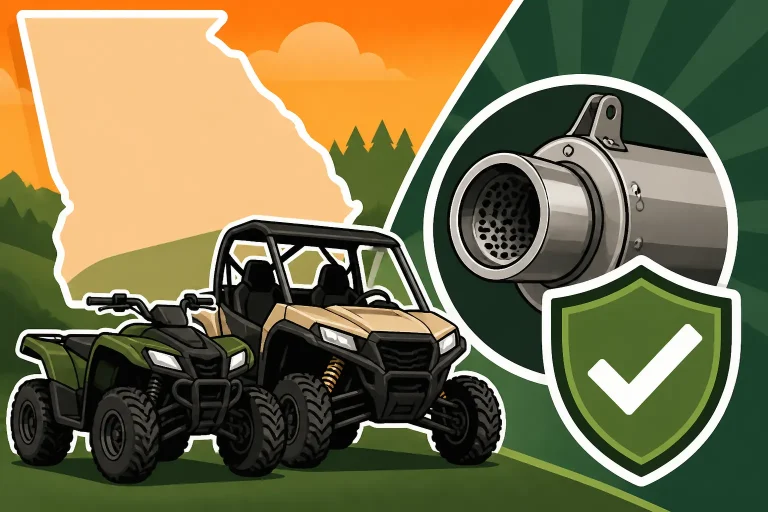
A spark arrestor may be required on some riding areas. Requirements can vary by land manager and location, so do not rely on a general assumption that a stock or modified exhaust automatically meets the rule. Confirm the equipment requirement for the specific trail, and keep any relevant documentation available if the operator asks to inspect the machine. The details in Georgia Spark Arrestor Requirements can help you understand what to check.
Watch for common sources of heat and sparks
Pay attention to where and how you park. Avoid stopping in tall, dry grass when the machine is hot, especially near the exhaust. Choose a cleared, designated parking area where possible. Do not leave a running machine unattended, and avoid letting it idle over dry vegetation.
Dragging metal can create sparks. Check that a tow strap, chain, or other equipment is secured so it cannot scrape along the ground. If you are towing another machine, make sure the connection is properly set up and does not trail. Keep trailers and vehicles in designated areas rather than pulling off into dry brush.
Smoking and open flames also need attention. Follow the specific restriction and posted rules, including instructions about smoking, camp stoves, charcoal, or other heat sources. Do not discard cigarette ends or matches. If a notice does not clearly say whether a particular device or activity is permitted, treat it as unconfirmed and ask the land manager before using it.
Treat a small fire as an emergency
If you see smoke or a fire, do not assume it is a controlled burn or someone else’s responsibility. Move away from immediate danger, alert the appropriate emergency service or land manager, and give a clear location. If the fire is near a trail, tell the operator or ranger as well. Do not put yourself or others at risk by trying to fight a fire that is spreading, producing heavy smoke, or blocking your escape route.
Keep a phone charged and know the name of the trail system, access road, or nearest landmark. Cell coverage can be unreliable in some riding areas, so agree on a meeting point and emergency plan with your group before setting off. Carrying basic supplies is useful, but equipment should not create a false sense that a rider can safely control a wildfire. For a broader trail-day checklist, see What Every Rider Carries on a Georgia OHV Trail.
Plan around restrictions instead of trying to work around them
If a riding area has a fire-related closure or restriction, follow it. Do not enter a closed route by using a side road, private access, or an unmarked trail. A closure can be in place because of nearby fire activity, high risk, limited emergency access, or other conditions that are not obvious from the trailhead. Riding around a closure can put your group and responders at risk.
If the restriction rules out your planned activity, adjust the plan. You might choose a different open riding area, skip the campfire, stay for a shorter day, or postpone the trip. Confirm that the alternative location is actually open and has its own requirements. A permit does not override a closure or authorize an activity that the land manager has prohibited. For permit basics, see Georgia’s Day and Annual Forest OHV Permits.
A simple pre-ride check
Use this routine before leaving home and again before entering the riding area:
- Name the exact destination. Identify the specific trail system, park, campground, or property rather than checking only the nearest town.
- Check the responsible authority. Look for current notices from the land manager, county, or private operator. If multiple authorities have relevant rules, check each one.
- Read the actual restriction. Confirm what activities, places, and dates it covers. Do not assume that a general burn notice automatically answers whether a camp stove or vehicle use is allowed.
- Verify access and equipment rules. Check trail openings, machine requirements, and posted instructions. A fire restriction and a trail closure are related concerns, but they are not necessarily the same rule.
- Prepare the machine. Remove debris from hot areas, secure towing gear, and confirm that required equipment is installed and working.
- Make a backup plan. Decide what the group will do if the trail closes or the rules change before arrival.
This check also helps avoid wasted travel. A permit or a valid reservation may cover access under ordinary conditions, but it should not be treated as a guarantee that every trail, campsite, or fire-related activity is available that day. Review Georgia Trail Conditions Before You Drive before setting out, and follow new instructions posted at the entrance.
Dry conditions do not always mean a trail is closed, and an open trail does not mean every fire-related activity is allowed. Keep those questions separate: confirm that riding access is open, then confirm what the current rules allow for flames, cooking, smoking, and other heat sources. If you cannot verify an activity, leave it out of the plan.
Disclaimer
This article is for general informational purposes only and does not constitute professional advice. Laws, prices and regulations vary by location and change over time. Consult a qualified professional for guidance on your specific situation.