Georgia Trail Fees Paid at a Kiosk
A trailhead kiosk can look like a quick stop before riding, but it is easy to arrive unsure which permit to buy, whether every rider needs one, or whether the machine accepts your payment method. This guide explains how Georgia forest OHV fees work, what to check before leaving home, and how to avoid reaching a trail gate without the right proof.
What a Georgia trail kiosk fee usually covers
Forest OHV permits are not the same as general trailhead charges
Georgia’s designated national forest OHV trail systems use operator permits. The permit is tied to the person operating the machine, not simply to the ATV or UTV. That distinction matters when you are riding with a spouse, friend, or family member: one machine carrying two possible operators does not necessarily mean one permit covers both people.
The state’s forest OHV systems include Houston Valley, Beasley Knob, Whissenhunt, Town Creek, Oakey Mountain, and Davenport Mountain. A permit intended for one of these systems is not automatically a general admission ticket for every riding destination in Georgia. Private parks, county facilities, and other recreation areas can have their own entry fees, waivers, age limits, and payment procedures.
For the difference between a day option and an annual option, see [Georgia's Day and Annual Forest OHV Permits]. If you are riding at a private park instead, check that park’s own admission and waiver rules; [Georgia Private Park Waivers and Rules] covers the separate considerations.
A kiosk may be one way to buy a permit, not a guarantee
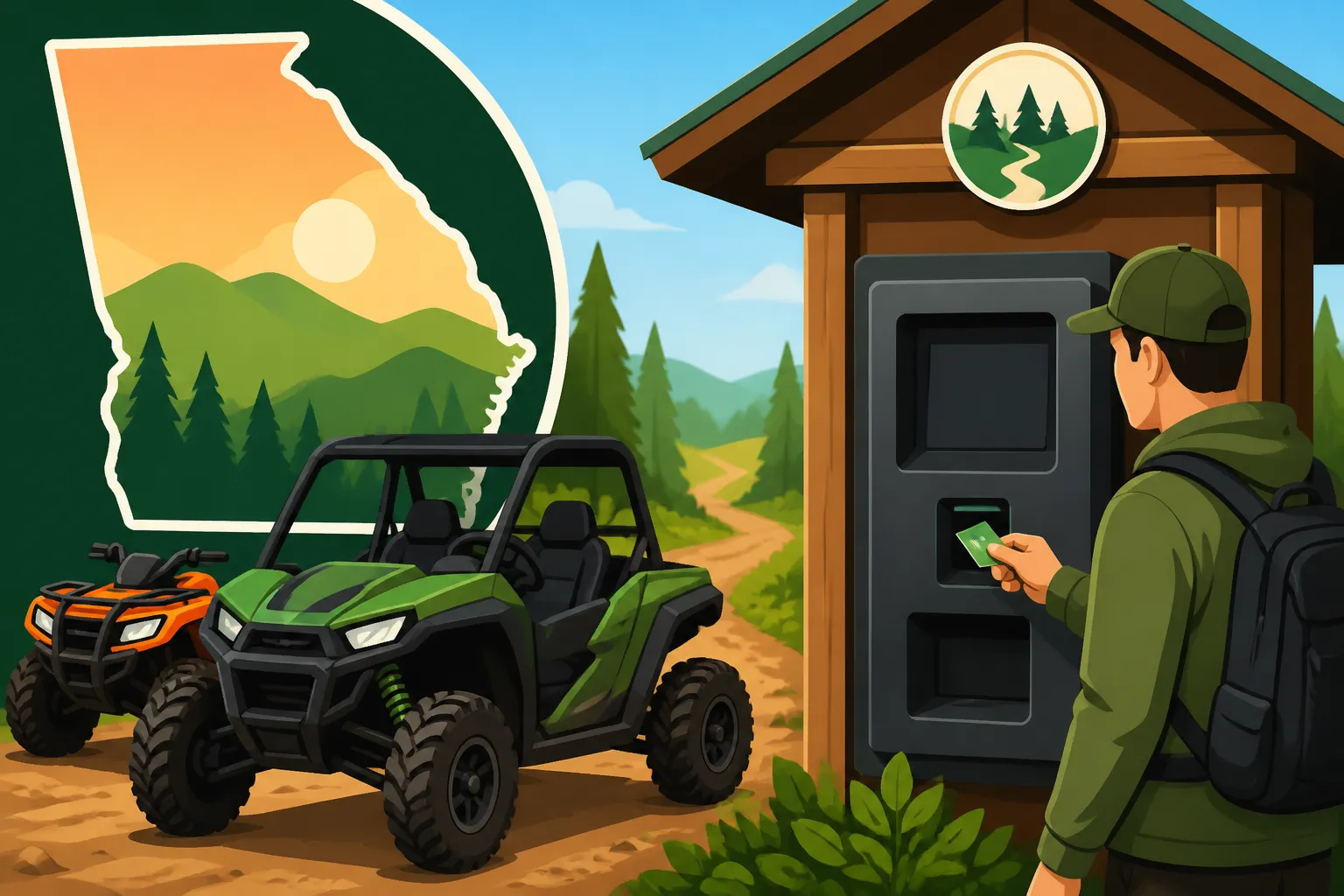
A kiosk is convenient when it is available and working, but do not assume every trailhead has one or that every kiosk sells the same permit. Kiosk availability, payment methods, and instructions can differ by location. Some permits may instead be obtained through an online channel or at a ranger district office. Before you drive to a trailhead, confirm the accepted purchase options for the specific system you plan to visit.
This is especially useful if you are heading to a remote trail area after a long drive from Atlanta, Macon, or Savannah. A kiosk that is out of service, a phone with no signal, or a payment method the machine does not accept can turn a planned ride into a frustrating search for another way to comply. Check [Where Georgia Riders Buy a Forest Permit] and [Georgia Permits on Recreation.gov] when deciding how to purchase before your trip.
| What you are paying for | What to check before riding |
|---|---|
| A forest OHV operator permit | Whether each person who will operate needs a permit |
| A day permit | Whether it covers the date and riding system you have planned |
| An annual permit | Which designated forest OHV systems it applies to |
| Private-park admission | The park’s separate entry fee, waiver, and operating rules |
| A kiosk transaction | Whether a kiosk is available and which payment methods it accepts |
The permit is not permission to ride anywhere
Buying a permit does not open every road, trail, or piece of public land to ATV and UTV use. It applies within the relevant permit program, while access still depends on designated routes, closures, operating hours, and local conditions. A nearby forest road may be closed to motorized recreation even when an OHV trail system is open.
This is where planning can prevent an expensive mistake. Use a map to understand the area, then confirm the official access rules and closures for the trail system. onX Offroad can help you review routes and orient yourself before the trip, but treat it as a planning aid rather than proof that a trail is open or that a permit is valid there. Check current official notices before unloading.
How to pay at a kiosk without getting caught out
Confirm the kiosk and payment instructions before the drive
If you expect to pay at a kiosk, look for instructions tied to the exact trail system or recreation site—not just a general reference to “Georgia trails.” Confirm whether the kiosk is actually available at your intended entrance and whether the listed payment options fit what you will bring. Do not assume a machine accepts cash, cards, or mobile payment unless the posted instructions say so.
It also helps to arrange a backup before leaving. If online purchase is an option, decide whether you would rather buy ahead or use the kiosk. If you plan to buy on arrival, save the relevant purchase instructions on your phone or write down the steps. Cell coverage can be unreliable in mountain recreation areas, so it is unwise to depend on loading a webpage at the gate.
If you are planning a one-day trip, [Buying a Day Permit the Morning You Ride] can help you think through the timing. The key is to avoid treating “I’ll sort it out when I get there” as a plan until you know the kiosk is available and usable.
Keep proof accessible after payment
After completing a purchase, follow the permit instructions for carrying or displaying proof. Keep any confirmation, permit, or receipt available to show if requested. If the proof is digital, make sure you can open it without relying on a weak signal; saving the confirmation or taking a permitted screenshot before arriving can be helpful. If the instructions call for a printed document or another form of display, follow those instructions rather than assuming a payment receipt alone is enough.
Take a moment to check the details before you leave the kiosk: the date, permit type, and information associated with the purchase should match your plans. A small error is much easier to address while you are still at the purchase point than after you have driven into the riding area.
Permits may have terms that affect changes or refunds, so read those before paying. [Georgia Permits Are Non-Refundable] and [Georgia Permits Are Non-Transferable] are useful reminders to confirm your plans and the correct operator before completing a transaction.
Make sure every intended operator is covered
A common mix-up is counting vehicles instead of people. If one rider drives the UTV while another rides as a passenger, the operator-permit rule is different from a group where both people will take turns driving. Think through who may operate during the ride, including if you expect to switch drivers at a break.
For a family or group, make a short list of operators before purchasing. If two people plan to drive separate machines, each person should check their own permit requirement. If a passenger will not operate, do not guess whether they need a permit; verify the program’s rules for the activity and their role. [Georgia OHV Permit for a Passenger] and [Georgia's Per-Operator Permit, Not Per Vehicle] address common questions around who a permit follows.
A simple pre-ride plan for Georgia OHV fees
Choose the right system and purchase option
Start by deciding where you intend to ride. A trip to Houston Valley near Dalton is not interchangeable with a visit to Beasley Knob near Blairsville, and each system may have its own access information, trail conditions, and practical approach. Confirm that your machine is allowed on the trails you plan to use, especially if width or trail designation could be an issue.
Then choose the permit purchase method. If a kiosk is your plan, verify its availability and instructions. If you want to purchase online or through a ranger district, check the applicable official process and make sure you understand what proof to bring. Do not rely on an old note from a previous trip: access conditions and purchasing arrangements can change.
A route app such as onX Offroad can be useful for reviewing the general layout, finding your way around, and keeping track of your planned ride. Still, use official forest information for permit requirements, closures, and current access rules. A map line by itself is not authorization to ride a road or trail.
Prepare for a signal-free arrival
Before departing, save directions, permit information, and any confirmation you will need. Charge your phone and, if the permit instructions allow it, keep an offline copy available. Bring a backup payment option when practical, but do not assume that having multiple cards solves every kiosk problem; a machine may be unavailable or may follow a specific process.
Let someone in your group know the purchase plan. For example, if one person is buying permits for several operators, make sure everyone understands which permits are assigned to whom and how each person will show proof. That avoids sorting out confusion while other riders wait at the entrance.
Check the trail’s operating status before you tow. Weather, maintenance, and seasonal closures can affect whether the ride you planned is possible. [Georgia Trail Conditions Before You Drive] is a useful next step, particularly if heavy rain has recently affected North Georgia trails. onX Offroad may help you orient yourself and compare route options, but confirm the final access decision through official notices.
Use the trailhead stop as a final compliance check
Once you arrive, read the posted signs before unloading. Confirm that you are at the intended riding area, that the route is open, and that your machine fits the system’s restrictions. If a sign conflicts with your earlier plan, follow the current posted direction and seek clarification from the responsible office rather than assuming the map or a prior visit takes precedence.
Keep permit proof easy to reach, but do not leave it where it can fall out or get damaged during the ride. If the system requires a particular display or documentation, follow that requirement. A photo of a receipt may be useful for your records, but it is not a substitute for the stated permit instructions.
A quick final review can prevent a needless stop later. [What a Ranger Checks at a Georgia OHV Trailhead] explains why it is sensible to be ready to show the required information, while [Georgia Permits Are Non-Transferable] is worth remembering if riders in your group swap machines or take turns driving. The permit follows the operator rules, not simply the vehicle being used.
Common kiosk and fee mistakes to avoid
Assuming one payment covers the whole group
When several people arrive together, it is easy to assume that one transaction covers the entire party. Check the permit structure instead. Forest OHV permits are generally organized around operators, so count the people who will actually drive—not only the machines on the trailer.
Before paying, agree on who is purchasing for whom and confirm each operator has the correct proof. This is particularly helpful for groups where riders rotate between machines. If the purchasing process does not clearly explain a group purchase, ask the responsible office rather than trying to infer the answer from the kiosk screen.
Confusing a forest permit with a private park fee
A forest OHV permit does not replace admission at a private riding park. Likewise, a private park’s gate payment does not automatically cover a national forest OHV permit. The systems are separate, and so are their rules. Verify the fee and permit requirements for each place on your itinerary, even if two destinations are close together.
This distinction can matter on a weekend that combines a public forest trail ride with a private park visit. Budget for each location separately, check whether a waiver is required, and read any restrictions on passengers, age, or machine size. Avoid assuming that a fee paid at one location grants access somewhere else.
Treating map details as official permit information
Route apps and trail maps are valuable for getting oriented, but they may not show every temporary closure, fee change, or purchase instruction. Use onX Offroad to help plan your route and understand the surrounding area, then verify fees and access with the relevant official source. That small extra check is worth it when the trailhead is a long way from the nearest convenient place to get help.
The most reliable routine is straightforward: identify the specific riding area, verify its current access and permit instructions, buy the correct permit for each operator, and keep proof available. Doing those things before you unload makes the kiosk stop—or the ride without one—far less stressful.
Disclaimer
This article is for general informational purposes only and does not constitute professional advice. Laws, prices and regulations vary by location and change over time. Consult a qualified professional for guidance on your specific situation.