Georgia Trails Near Atlanta
Atlanta riders have several worthwhile options, but “nearby” can mean anything from a local private park to a mountain trailhead that takes most of the morning to reach. The tricky part is matching your ATV or UTV to the trail, then confirming access, width limits, permits, and weather closures before loading up. This guide helps you plan that trip with fewer surprises.
How to choose a trail near Atlanta
A good destination depends on more than driving distance. Think about your machine’s width, the kind of riding you enjoy, who is coming along, and how much time you want to spend hauling. A tight forest trail can be a poor fit for a wide side-by-side, while a private park may suit a group that wants varied terrain and facilities.
Match the riding area to your machine
Before you pick a destination, check the trail system’s vehicle rules. Some routes are intended for narrower machines, and a side-by-side that fits one trail may be excluded from another. Confirm the limit for the specific trail you plan to ride, not just for the general recreation area. A width restriction can turn a promising day trip into a long drive to a trailhead you cannot use.
This matters especially in North Georgia, where forest trails can be narrow, rocky, and hemmed in by trees. Riders bringing a wider machine should investigate the limits for individual systems and routes. For example, Houston Valley has a 50-inch width restriction, so it is not a general-purpose destination for every UTV. Review Georgia Trails That Allow Side-by-Sides alongside the land manager’s trail information before committing to a route.
Also consider the experience of the least confident rider in your group. A technical trail with steep climbs may be a poor first outing for a new rider, even if the machine is suitable. For a broader overview of terrain and difficulty, see Best Georgia ATV Trails for Beginners.
Decide between public forest trails and private parks
Public forest trails and private riding parks offer different kinds of days out. National Forest OHV systems often give riders a more natural setting, but can have narrower trails, seasonal closures, limited facilities, and specific permit rules. Private parks may offer more varied terrain or amenities, but each property sets its own rules, admission process, and operating schedule.
Ask what “a day of riding” means to your group. If you want to explore forest roads and mountain scenery, a public OHV system may be the better fit. If your group wants several kinds of terrain in one place, or you are traveling with riders who prefer different levels of challenge, a private park may offer more flexibility. Either way, do not assume that an ATV or UTV is allowed just because a place is described as an off-road park.
A route-planning app such as onX Offroad can help you compare trail locations and map your drive, but it should be one part of your planning, not the final word on access. Check current information from the land manager or park before you leave. For an overview of nearby public options, Georgia's Six National Forest OHV Systems is a useful starting point.
Public forest OHV options within reach of Atlanta
North Georgia’s National Forest OHV systems are popular with riders making a day trip from Atlanta. The drive can be manageable, but mountain roads, trail conditions, and access rules make it important to plan beyond the map distance. Check which trails are open, whether your machine fits, and what permits are required.
Town Creek and the Dahlonega-area systems
Town Creek, Oakey Mountain, and Whissenhunt are among the public OHV areas riders may consider for a North Georgia outing. Their locations make them candidates for a day trip from the Atlanta area, although the actual drive depends on where you start, traffic, and the road route. They are not interchangeable: each system has its own trail layout, access details, and conditions.
A practical first step is to identify the exact trailhead rather than entering only the recreation area name into navigation. Then confirm the access road and whether the system is open for the day you intend to ride. Mountain roads can be slower than the distance suggests, and rain can affect both trail conditions and access. Read Georgia Town Creek OHV Trails, Georgia Oakey Mountain OHV Trails, and Georgia Whissenhunt OHV Trails before choosing one.
These forest systems are a better fit for riders who enjoy a more natural, less predictable experience than a managed private park. Expect to plan for changing terrain and to carry what you need for a day away from town. Bring water, basic repair supplies, a first-aid kit, and a way to contact your group if riders become separated. Cell service can be inconsistent in mountainous areas, so agree on a regrouping plan before you start.
Beasley Knob and Houston Valley
Beasley Knob and Houston Valley are also worth considering, but they require the same careful checks as the other forest systems. Beasley Knob is in the North Georgia mountains, while Houston Valley is farther west in the Dalton area. From Atlanta, either can take more planning than a quick local ride, especially if you are hauling a trailer and have a firm return time.
Trail dimensions and closures can make a major difference to the day. Houston Valley’s 50-inch limit is particularly important for owners of wider UTVs. Beasley Knob also has seasonal access restrictions, so do not assume that a trail system is open simply because it appears on a map. Check the land manager’s latest notices before leaving home and again if weather has changed since you planned the trip. See Georgia Houston Valley OHV Trails and Georgia Beasley Knob OHV Trail System in Georgia.
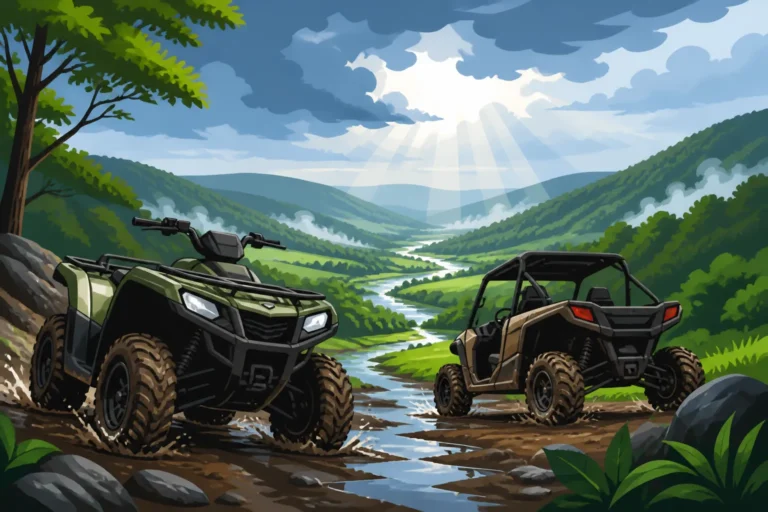
Mountain trails can become challenging after heavy rain. Georgia’s red clay may be slick when wet, and water can obscure rocks, ruts, and washouts. If conditions are uncertain, postpone the outing or choose a more suitable destination rather than trying to force a ride. The articles Georgia Trails That Close After Rain and Georgia Trail Conditions Before You Drive can help you build weather checks into your plan.
| Destination type | Best fit | What to verify before you go |
|---|---|---|
| Public forest OHV system | Riders who want a natural trail setting | Open status, machine width, permits, weather closures, and trailhead access |
| Private off-road park | Groups seeking varied terrain or park-specific amenities | Operating days, vehicle rules, admission process, age rules, and available facilities |
| Narrow mountain trail | Smaller machines and riders comfortable with changing terrain | Width limit, difficulty, recent rain, and recovery options |
| Wider UTV route | Side-by-sides that may not fit narrow trails | Explicit UTV access and the route’s width restriction |
Private riding parks and managed destinations
A private riding park can be a convenient alternative when public trails are closed, too narrow for your machine, or not the style of ride your group wants. It can also be easier for mixed-experience groups because a managed property may offer multiple kinds of riding areas. Still, park rules are not universal, and operating details can change.
Highland Park near Cedartown
Highland Park Off-Road Resort in Cedartown is one private destination Atlanta-area riders may consider. The location can make it practical for a day trip, depending on where in metro Atlanta you are starting and how much time you want to spend on the road. Before making plans, confirm that the park’s current offerings include the type of machine you intend to bring.
Private properties set their own admission, operating, and safety requirements. Check whether reservations are needed, what documents or waivers are required, whether passengers are permitted on your machine, and whether there are minimum-age rules. Ask about trail difficulty and whether the park has areas appropriate for beginners. A family that arrives expecting easy routes may have a very different day if the available trails are more demanding than expected.
If you are bringing more than one machine, confirm that each one is allowed and suitable for the routes your group wants to use. A park’s general description is not a guarantee that every vehicle can ride every trail. Review Georgia Private Off-Road Parks Compared to help think through the trade-offs between managed parks and public forest systems.
What to check before choosing a private park
Start with the practical details: opening days, check-in instructions, payment methods, fuel availability, parking, and whether the property has food, water, or restrooms. These small checks matter when a group is driving a long way with a trailer. If a park does not have a service you need, plan to bring it rather than assuming it will be available at the gate.
Then ask about riding rules. Some parks may have requirements for helmets, protective gear, passenger seating, spark arrestors, noise, or machine condition. A rider who is used to informal riding on private land may be surprised by a park’s check-in rules. Read the property’s own policies and make sure every member of the group understands them before arrival. Georgia Private Park Waivers and Rules offers more context on the types of requirements riders may encounter.
Finally, have a backup plan. A park may close or change access after severe weather, and a machine problem can cut a day short. Keep the park’s direct contact details handy, check for any notice before you depart, and avoid treating a third-party map as confirmation that the property is open. onX Offroad can help with route planning, but use the park’s own communications for access and operating information.
Permits, closures, and ride-day preparation
The easiest way to lose time on a riding trip is to arrive without the right permit or discover that the trail is closed. These issues are avoidable if you check them early, then confirm them again close to departure. Requirements depend on the land or park you plan to ride.
Check permits and access rules
National Forest OHV systems can have permit requirements that differ from those at private parks. Find out whether a permit is needed, who must hold it, and whether it applies to an operator, a vehicle, or another part of the outing. Do not assume that a permit for one property or trail system is valid everywhere in Georgia.
The distinction between a registration and an OHV permit can be confusing. A machine’s paperwork does not automatically give you permission to ride a particular trail. Likewise, a forest permit does not establish that your vehicle meets the system’s width or access rules. For more detail, see Georgia OHV Permits: What You Need Before You Ride and Georgia's Day and Annual Forest OHV Permits.
If you are riding on a private property, contact the park directly for its own rules. A public-land permit will not substitute for a park’s admission process, and a private-park pass does not grant access to National Forest trails. Keep any required documents accessible, and make sure every operator in the group understands what they need to carry.
Prepare for changing trail and weather conditions
Check trail status and weather before loading the trailer. A forecast for Atlanta may not reflect conditions in the mountains, where rain and temperature can differ. Look for land-manager updates about closures, restrictions, or damage, especially after a storm. Avoid riding around a closed gate or entering a route that is marked as closed.
Pack for a day that may take longer than expected. Carry drinking water, food, a first-aid kit, a basic tool kit, a tire repair option suited to your machine, and recovery gear appropriate for the terrain. Make sure your machine is in good working order before departure. Check tires, lights, fuel, battery, belts where relevant, and any equipment needed to secure the vehicle to the trailer.
Route planning is useful, but offline preparation matters too. Before you lose reception, save the route information you need and agree on where to meet if the group splits up. onX Offroad may help you view a route and understand the surrounding area, but confirm that your intended path is open and permitted through the responsible land manager. For trail etiquette and one-way systems, Georgia Trail Etiquette on One-Way Loops is worth reviewing before the ride.
Planning a smoother Atlanta-area riding trip
A little organization can make the difference between a relaxed day and a frustrating one. The most useful plan is not necessarily the most ambitious plan. Choose a destination that fits your machine and group, allow extra travel time, and have a second option in case weather or access changes.
Build a simple trip plan
A few days before you leave, decide which trail system or park best suits your vehicle. Check width limits, eligibility, operating details, and permit requirements. Look at the weather for the destination, not only your home address. If you are riding with children or first-time operators, verify age and supervision requirements with the park or land manager.
The night before, confirm that the trail or park is open and that your machine is ready. Load the trailer carefully, secure the machines, and keep essential paperwork and safety gear where you can reach them. Give someone who is not riding with you a general idea of where you are going and when you expect to return. That is especially helpful when you are heading into an area with limited cell reception.
On the day, take time at the trailhead to review signs and rules. Start at a pace that lets the group adjust to the terrain. If someone is uncomfortable or the conditions are worse than expected, turn around or choose an easier route. A good outing is one where the group gets home safely, not one where every planned trail has to be completed.
Choose the right kind of outing
For a first trip, a managed park may feel simpler because you can contact the property directly about its rules and available riding. For experienced riders who enjoy mountain terrain and are comfortable checking trail conditions, a National Forest OHV system may be a better match. Neither choice is automatically easier; the right option depends on the machine, the riders, and the day’s conditions.
If you are unsure whether your UTV will fit, do not guess based on how it looks next to another machine. Measure it properly and compare that measurement with the published route limit. If you cannot confirm access, select another system rather than risking a wasted drive. See Measuring Your Machine Before You Tow for a practical reminder to check dimensions before leaving.
Finally, remember that “near Atlanta” covers a wide area. A trail that is convenient from the northern suburbs may be a long haul from south or west Atlanta, particularly with a trailer and weekend traffic. Compare the full drive, expected riding time, and return trip—not just the mileage. Check the map, confirm access with the land manager, and keep a backup destination in mind. That small amount of planning makes it easier to spend the day riding instead of troubleshooting at the trailhead.
Disclaimer
This article is for general informational purposes only and does not constitute professional advice. Laws, prices and regulations vary by location and change over time. Consult a qualified professional for guidance on your specific situation.