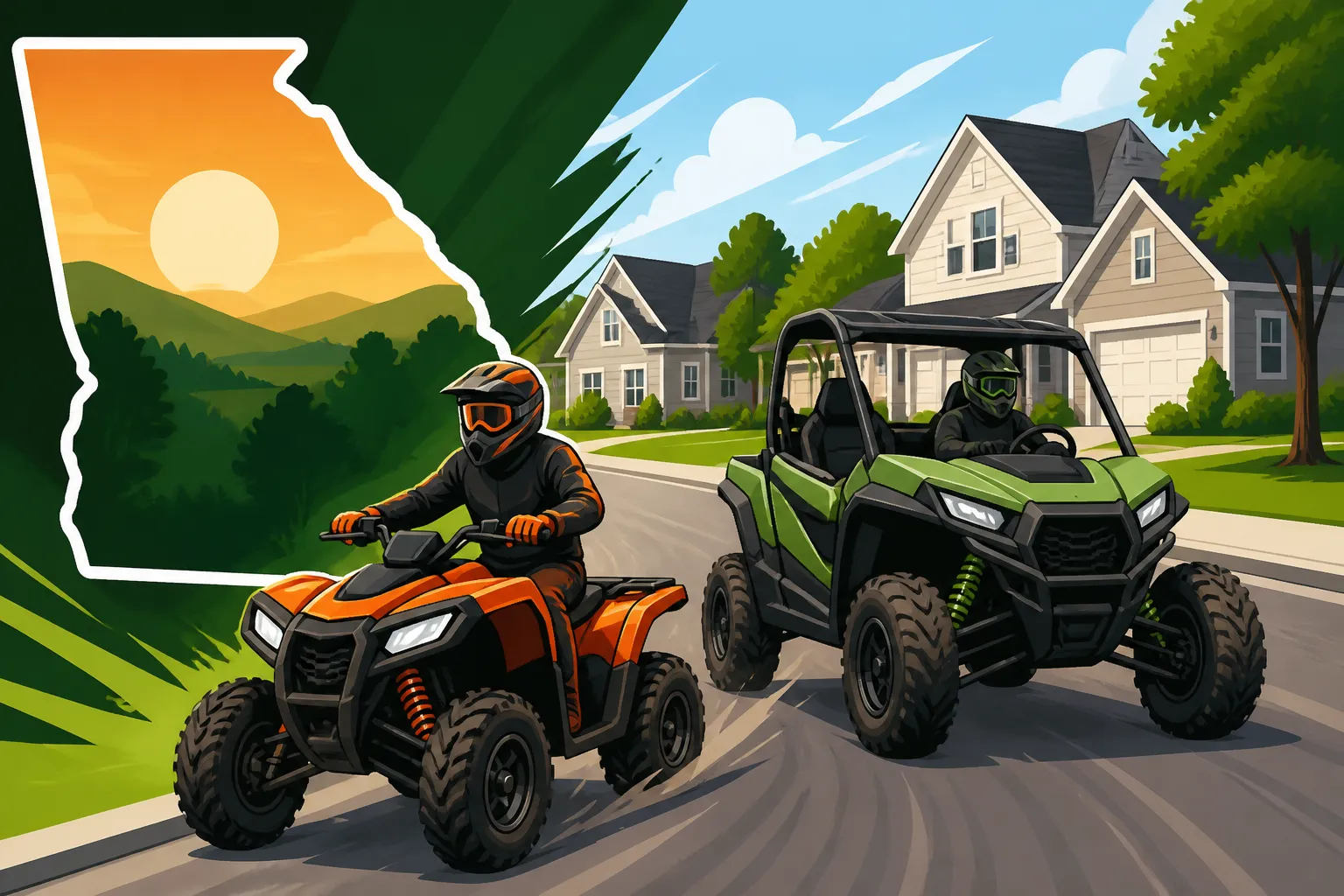
Georgia Subdivision Streets and Quad Riding
It’s a scenario many Georgia ATV and UTV owners find themselves in: you’ve just unloaded your machine from the trailer after a great day of trail riding, or maybe you just need to run it a short distance to a neighbor’s house, and the subdivision streets right outside your door seem like the perfect solution. The frustration is real when you realize that what looks like a convenient shortcut could actually land you in a lot of trouble. This guide will cut through the confusion and explain exactly why riding your quad or side-by-side on Georgia subdivision streets is generally prohibited, what exceptions might exist, and how to enjoy your machine legally and safely.
The Lure of the Neighborhood Ride: Why It's Tempting (and Often Illegal)
We all get it. You love your ATV or UTV, and it feels natural to just hop on and cruise down the street, especially if it’s a short distance within your own neighborhood. The convenience is undeniable, bypassing the hassle of loading it onto a trailer just for a quick errand or a visit to a friend a few blocks away. For many, the lines blur between a private driveway, a rural county road, and a paved subdivision street, leading to honest misunderstandings about where it’s truly permissible to operate these machines.
The Convenience Factor and Misconceptions
The allure of using your ATV or UTV for short trips within a subdivision is powerful. You might think, "It's just a few streets, what's the harm?" or "My neighbors all do it, so it must be okay." This often stems from a misconception that if a road isn't a major highway, it's fair game for any vehicle. In reality, subdivision streets, even those that seem quiet and residential, are almost always considered public roads under the jurisdiction of a municipality or county, and they have specific rules for what can legally operate on them.
This common misbelief leads many riders to make assumptions that can result in citations or worse. The convenience of a quick ride around the block often overshadows the critical legal distinctions that classify ATVs and UTVs differently than street-legal vehicles. For a broader understanding of why ATVs are generally not considered road legal in Georgia, you might find [Georgia ATV Road Law Explained] insightful. It dives into the state's foundational stance on these vehicles and their place on public thoroughfares.
Noise, Dust, and Neighborhood Concerns
Beyond the legal aspect, there are practical and neighborly considerations that often contribute to the prohibition of ATVs and UTVs on subdivision streets. The distinct sound of an off-road machine, especially when revving or operating at higher RPMs, can be a significant source of noise pollution in a quiet residential area. This isn't just a minor annoyance; for some residents, it disrupts peace and quiet, especially during evenings or early mornings.
Additionally, if your subdivision has unpaved sections or if you’re riding on dirt shoulders, ATVs and UTVs can kick up a considerable amount of dust. This dust can settle on homes, cars, and landscaping, creating a nuisance and potentially impacting air quality for those nearby. These factors can quickly sour neighborly relations and lead to complaints to homeowners' associations or local law enforcement. Many communities have specific rules or covenants regarding vehicle use and noise, and these often clash with the presence of off-road vehicles. Understanding [Georgia HOA Rules About Side-by-Sides] can shed more light on how these community guidelines interact with state laws.
Georgia's Stance on Off-Road Vehicles on Public Roads
Georgia law draws a clear distinction between vehicles designed for off-road use and those intended for public road travel. This fundamental difference is key to understanding why your ATV or UTV typically cannot be legally operated on subdivision streets. While there have been some recent changes to accommodate certain utility-focused side-by-sides, these changes come with very specific conditions that most subdivision streets do not meet.
The Core Prohibition: ATVs Are Not Road Legal
At its heart, Georgia law generally classifies ATVs as off-road vehicles, designed for unpaved terrain, trails, and private property. They lack many of the safety features and registration requirements of traditional street-legal vehicles like cars and trucks. For instance, a typical ATV doesn't have a title in Georgia, nor can it be registered for general road use. This is a critical distinction, as without a title and proper registration, the machine cannot legally operate on most public roads.
The reasons for this prohibition are rooted in safety and regulation. ATVs are often designed with high centers of gravity, knobby tires, and handlebars that make them less stable on paved surfaces, especially when encountering other vehicles or navigating turns at speed. They also frequently lack proper turn signals, rearview mirrors, or DOT-approved lighting required for road use. For a deeper dive into the specifics of why these vehicles don't qualify for street legality, exploring [Why a Four-Wheeler Cannot Be Registered in Georgia] offers a comprehensive explanation. The state's stance is unequivocal: traditional ATVs are meant for off-road environments.
The MPOHV Exception and Subdivision Streets
Now, this is where it gets a little nuanced. Georgia has introduced a specific category for Multi-purpose Off-Highway Vehicles (MPOHVs), which primarily applies to many side-by-sides (UTVs). These machines, if they meet a very strict eight-point eligibility test, can be voluntarily registered and operated on county roads. However, and this is a huge "however," this allowance does not automatically extend to subdivision streets, especially those within a city's incorporated limits.
The critical distinction here is between a "county road" and a "municipal street" or a "subdivision street" that might be maintained by a city or a private entity. Most subdivisions, especially newer ones, have streets that are either dedicated municipal streets or are privately owned and maintained by an HOA. Even if a subdivision street feels like a county road, it rarely is. The MPOHV law specifically grants access to the "county road system," meaning roads that are under the direct jurisdiction of the county government. You'd be surprised how often seemingly identical roads fall under different legal classifications. To understand the intricacies of this registration process and where you can legally ride these eligible machines, delve into [Georgia MPOHV Registration Explained] and [Georgia County Road Systems and Where They Run]. It's crucial to confirm the legal classification of your specific subdivision streets before assuming MPOHV registration grants access.
Understanding Local Ordinances and PTVs
Adding another layer of complexity is the power of local municipalities to create their own ordinances regarding certain types of vehicles. You've likely seen golf carts freely cruising through communities like Peachtree City or on designated paths. These are often allowed under "Personal Transportation Vehicle" (PTV) ordinances, which permit low-speed vehicles like golf carts on specific city streets or paths. However, it’s vital to understand that this typically does not apply to ATVs or UTVs.
While some cities might have very specific, localized rules that allow certain types of utility vehicles on a select few streets, these are rare and highly conditional. General ATV or UTV operation on subdivision streets, even if they appear similar to golf carts, is almost never covered by these PTV ordinances. The design and safety standards for PTVs are often quite different from those of even eligible MPOHVs. The core message remains: don't confuse golf cart privileges with ATV/UTV rights. If you're curious about the rules governing golf carts, [Georgia Golf Cart Laws and PTV Ordinances] provides excellent insight. It's important to know that [Georgia City Streets Open to Carts but Not Quads] is a common reality across the state.
The Consequences of Riding Illegally on Subdivision Streets
Ignoring Georgia's laws regarding ATV and UTV operation on subdivision streets can lead to a host of unpleasant and expensive repercussions. Many riders mistakenly believe that if they're just on a quiet street, law enforcement won't bother them. This is a dangerous assumption, as local authorities are often quite vigilant about enforcing these rules, especially when complaints from residents start coming in.
Fines, Impoundment, and Legal Troubles
The most immediate consequence of riding an ATV or UTV illegally on subdivision streets is the risk of being stopped by law enforcement. This can result in significant fines, potentially running into hundreds of dollars, especially if multiple violations are stacked (e.g., no registration, no insurance, operating an off-road vehicle on a public road). Beyond the financial penalty, officers have the authority to impound your machine. Imagine having your valuable ATV or UTV towed away, incurring impound fees, daily storage charges, and the hassle of arranging its retrieval – all on top of your fine.
These types of violations can often lead to misdemeanor charges, requiring a court appearance and potentially affecting your driving record. It’s far more than just a slap on the wrist. The state takes these regulations seriously, and ignorance of the law is rarely an excuse. For a clearer picture of what you might face, understanding [Georgia Penalties for an Unregistered Road Machine] can be sobering. If your machine is impounded, the process to get it back can be complicated and costly; learn more about [Georgia Impound Rules After a Violation] to prepare for such an unfortunate event.
Insurance Complications and Liability
Another often overlooked but critically important consequence is the impact on your insurance. Most ATV and UTV insurance policies are specifically designed for off-road use, private property, or designated trail systems. If you have an accident while operating your machine illegally on a public subdivision street, your insurance company may deny coverage for damages to your vehicle, medical expenses, or — even more concerning — liability for injuries or property damage caused to others.
This means you could be personally responsible for significant financial costs. Imagine hitting a parked car, injuring a pedestrian, or causing damage to someone's property while riding illegally. Without insurance coverage, you could face lawsuits that could financially cripple you for years. Even if you have liability coverage, operating outside the terms of your policy (e.g., using an off-road vehicle on a public road where it's prohibited) could render that coverage null and void. Before even considering street use, consult your insurance provider to understand your policy's limitations. For those who can legally register their MPOHV for county road use, it's essential to understand [Georgia UTV Insurance Minimums] to ensure you're adequately covered.
Safety Risks and Damage to Community Relations
Aside from legal and financial repercussions, riding off-road vehicles on paved subdivision streets presents genuine safety hazards. ATVs and UTVs are not engineered for the same handling characteristics as street vehicles. Their suspension, tire tread, and steering systems are optimized for dirt, mud, and uneven terrain, not hard, flat asphalt. This can lead to reduced traction, unstable braking, and unpredictable handling, especially at higher speeds or during emergency maneuvers. The risk of rollover is also significantly higher on paved surfaces than on trails. Moreover, mixing these vehicles with cars, delivery trucks, and children playing can lead to dangerous collisions, as off-road machines are often less visible and their operators less accustomed to navigating traffic.
Finally, illegal riding in your neighborhood damages community relations. Persistent noise, dust, and safety concerns can erode goodwill between neighbors and lead to direct complaints to you or to local authorities. It creates a negative perception of ATV and UTV enthusiasts, making it harder for responsible riders to gain acceptance or advocate for legal riding opportunities. Respecting your neighbors and adhering to local laws is crucial for fostering a positive environment for everyone. To truly understand the potential impact, reflecting on [Georgia Rules for Riding Through a Subdivision] can provide valuable perspective.
Finding Legal Places to Ride Near Your Georgia Neighborhood
While the rules might seem restrictive when it comes to subdivision streets, Georgia offers plenty of legal avenues to enjoy your ATV or UTV responsibly. The key is knowing where those opportunities lie and making a conscious effort to pursue them, rather than risking illegal rides close to home. This often means embracing the spirit of adventure that off-roading is truly about.
Private Property with Permission
The simplest and most universally accepted legal place to ride your ATV or UTV is on private property with the landowner's explicit permission. This could be your own land, a friend's property, or even leased hunting land. Always make sure you have clear, preferably written, permission from the landowner. This protects you from trespassing charges and ensures everyone is on the same page about where and when you can ride.
If you're riding on private land, you still have a responsibility to ride safely and respect the environment. Avoid excessive noise that might disturb neighbors, and be mindful of your impact on the land itself. Remember, even on private property, operating your machine safely and responsibly is paramount. For insights into what constitutes legal riding on private grounds, consider reading [Georgia Rules for Riding a Pasture] and definitely familiarize yourself with [Georgia Trespass Law for ATV Riders] to ensure you stay on the right side of the law.
Designated Off-Road Parks and Trails
For the ultimate ATV and UTV experience, nothing beats a dedicated off-road park or trail system. Georgia is home to several fantastic options, ranging from national forest trails to privately owned resorts. These locations are specifically designed for off-road vehicles, offering diverse terrain, challenging obstacles, and a community of fellow enthusiasts. They provide a safe and legal environment where you can push your machine's limits without fear of breaking the law or disturbing residents.
Many parks and trail systems offer amenities like camping, wash stations, and even on-site repair services. Brands like SuperATV offer a huge range of aftermarket parts, lift kits, and protective gear that can enhance your machine's performance and durability for these dedicated trails. Equipping your machine with robust skid plates, A-arm guards, or a strong winch from SuperATV can make your trail riding experience safer and more enjoyable, preparing you for the kind of terrain you’ll find in these legal riding areas. Places like [Iron Mountain Resort: Georgia's Biggest Private Park] offer hundreds of miles of trails, or you can explore the various trail systems within the [Chattahoochee-Oconee National Forest Riding] areas. Always check the specific rules and permit requirements before you go, as some trails have width restrictions or require an OHV permit.
Exploring Legitimate County Road Access (for eligible MPOHVs)
If you own a side-by-side that qualifies as an MPOHV under Georgia law and you've successfully registered it, you do have access to legitimate county roads. However, it’s absolutely crucial to re-emphasize that "county roads" are not the same as "subdivision streets," especially those within municipal limits. Before you venture out, you need to verify that the specific road you intend to travel on is indeed classified as a county road. Your local county road department or tag office can often provide maps or clarification on road classifications.
Even on eligible county roads, remember that MPOHVs must follow all rules of the road that apply to motor vehicles, including speed limits, traffic signs, and operating sober. You also need to meet all the equipment requirements, such as seat belts, headlights, brake lights, and mirrors, as outlined in the MPOHV eligibility test. This allows for utility use or access to certain areas but is not a license for recreational cruising through residential neighborhoods. Ensuring your machine passes [Georgia MPOHV Eligibility: The Eight-Point Test] is the first step towards this limited legal road access.
Here's a quick comparison of vehicle types and their general legality on subdivision streets in Georgia:
| Vehicle Type | Typical Subdivision Street Legality (Paved) | Primary Legal Use | Common Frustration |
|---|---|---|---|
| Traditional ATV | No (generally illegal on public roads) | Private land, designated off-road trails | Wanting to use it for short, convenient trips around the neighborhood |
| MPOHV (Side-by-Side) | Generally No (unless explicitly a county road and machine is registered & compliant) | Private land, designated off-road trails, eligible county roads (if registered) | Confusion with golf cart rules; difficulty distinguishing county roads from municipal streets |
| Golf Cart / PTV | Yes (if local municipal ordinance allows on designated streets/paths) | Designated local PTV paths, specific low-speed streets as per local ordinance | Assuming all subdivision streets are open; lack of clarity on local regulations |
Navigating the rules for riding your ATV or UTV can be tricky, especially when it comes to the streets closest to home. While the convenience of a quick spin around the subdivision is tempting, the legal and safety risks far outweigh the momentary ease. By understanding the distinctions between off-road vehicles, MPOHVs, and PTVs, and by knowing where the law draws its lines, you can avoid costly fines, ensure your safety, and maintain good relations with your neighbors. Embrace the many fantastic legal riding opportunities Georgia offers, whether on private land or at a dedicated off-road park, and keep your machines where they belong.
Disclaimer
This article is for general informational purposes only and does not constitute professional advice. Laws, prices and regulations vary by location and change over time. Consult a qualified professional for guidance on your specific situation.