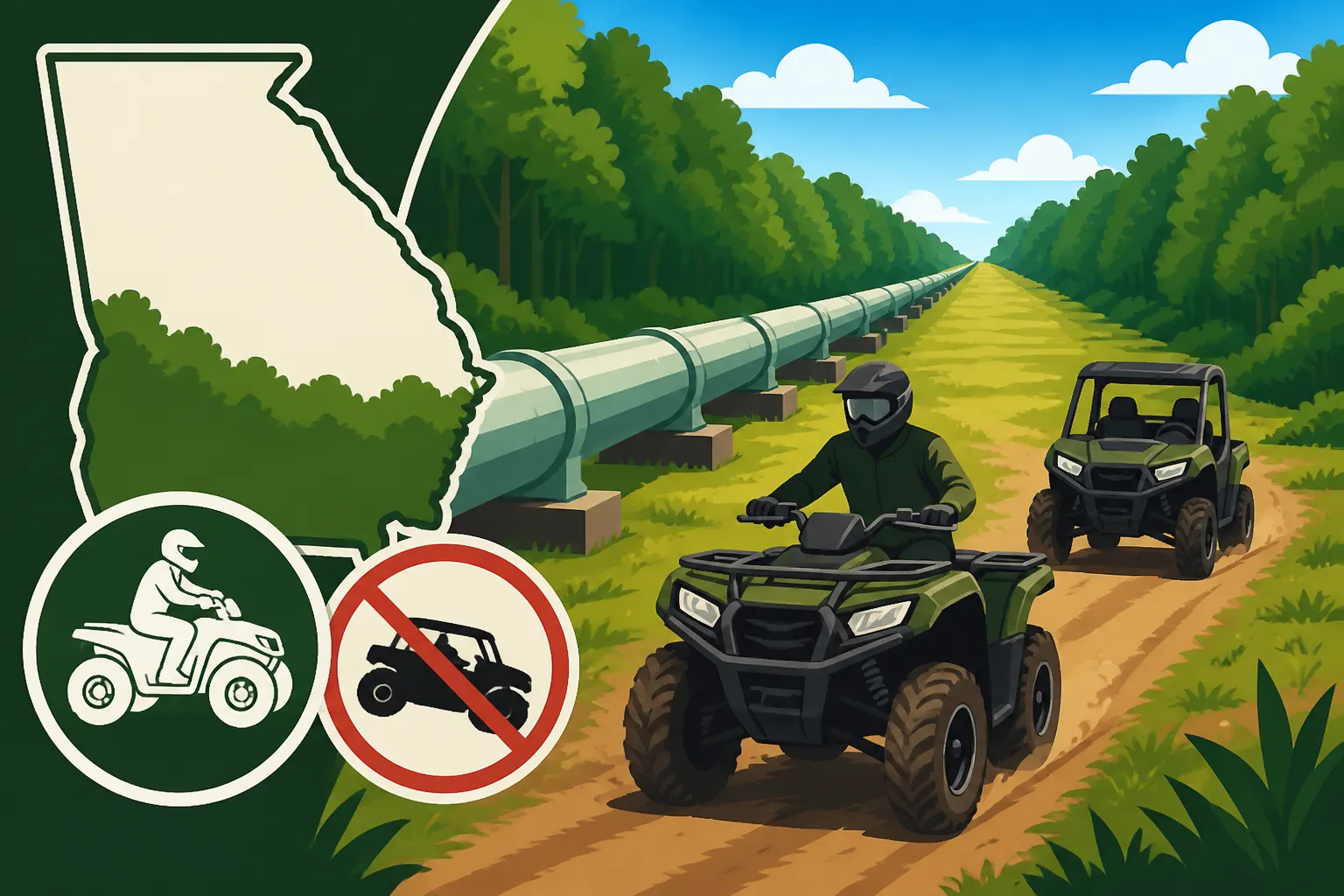
Georgia Rules for Riding a Pipeline Right of Way
For many ATV and UTV enthusiasts across Georgia, the allure of a long, open stretch of land can be incredibly strong, especially when you spot what looks like an old logging road or a clear cut path that winds through the natural landscape. Often, these paths are pipeline rights-of-way, and while they might seem like an open invitation for a ride, the legalities and practicalities are far more complex than they appear. This guide aims to clear up the confusion and help you understand the specific Georgia rules regarding riding your machine on a pipeline right of way.
Understanding Pipeline Rights of Way in Georgia
Let's start by defining what we're actually talking about when we say "pipeline right of way." It’s not simply a strip of land owned by a pipeline company. In most cases, these companies don't own the land outright. Instead, they hold what's called an "easement" over private property. An easement grants them the right to use a specific portion of land for a particular purpose – in this case, to construct, maintain, and operate a pipeline. The actual landowner still owns the property, but their rights are subject to the pipeline company's easement. This distinction is crucial for understanding who has the authority to grant permission for recreational use.
The Nature of Easements and Land Ownership
Imagine you own a beautiful tract of land in rural Georgia, maybe near Rome or Statesboro. A pipeline company comes along and wants to run a natural gas line right through your back forty. You, the landowner, are compensated for this, and you grant them an easement. This easement typically dictates that the company needs clear access to the pipeline for inspections, maintenance, and repairs. This means keeping the area free of structures, large trees, and sometimes even deep-rooted crops. The company maintains this clear strip, which is why it often looks like a perfect trail for your side-by-side or quad.
However, the fact that the pipeline company maintains the strip does not automatically mean it's public land, or even land that the company wants recreational riders on. The underlying land still belongs to the private property owner. The pipeline company's rights are specific to the pipeline itself, and generally do not include inviting the public to recreate on the easement. This is a common misconception, and it's where many riders accidentally run into trouble. Always remember that even if it looks like a road, it might just be someone's backyard with a utility line running through it.
Why Pipeline Companies Maintain These Clear Paths
There are several critical reasons why pipeline companies diligently maintain their rights of way. First and foremost is safety. Pipelines carry volatile substances like natural gas or petroleum, and any damage could lead to catastrophic consequences. A clear path allows for visual inspections from the air or ground to spot leaks, erosion, or third-party damage. It also provides unimpeded access for emergency crews if there's ever a rupture or leak. Imagine trying to get heavy equipment to a pipeline emergency if the path was overgrown with kudzu and hardwoods; it would be nearly impossible.
Beyond safety, there's also the matter of operational efficiency and regulatory compliance. Regular maintenance, often involving mowing, brush clearing, and sometimes herbicide application, ensures the integrity of the pipeline and adherence to federal and state regulations. The clear cut also helps prevent trees or structures from encroaching on the pipeline, which could damage the line or hinder future access. While this maintenance creates a tempting pathway for riders, it's essential to recognize that its primary purpose is industrial and safety-related, not recreational.
The Legal Landscape: Permission and Trespass
Here's the stark truth for Georgia ATV and UTV riders: riding on a pipeline right of way without explicit permission is, in most cases, considered trespassing. It doesn't matter if there are no "No Trespassing" signs or if it looks like everyone else is doing it. The land beneath the easement is private property, and the utility company's easement does not automatically extend recreational access to the public. Understanding this distinction is key to staying out of legal trouble.
The Role of the Private Landowner
The private landowner who holds the deed to the property has the primary say in who can access their land, even if a pipeline easement crosses it. If you want to legally ride an ATV or UTV on a pipeline right of way in Georgia, your first and best course of action is to seek explicit permission from the actual landowner. This isn't always easy to figure out, as property lines can be obscure, and a pipeline might cross dozens of different parcels. But making the effort to identify and ask the landowner is the only way to guarantee you're not breaking the law.
Think about it from their perspective. They have granted an easement for a very specific purpose. When recreational riders come through, they might be worried about litter, noise, property damage, or even liability if someone gets hurt on their land. Many landowners are fiercely protective of their property, and rightly so. Approaching them respectfully, explaining what you want to do, and perhaps even offering to help maintain the area (like clearing brush or picking up trash) might go a long way. But without that clear "yes," assume the answer is no. This falls under the general [Georgia Trespass Law for ATV Riders] and [Georgia ATV Rules on Private Property].
Can the Pipeline Company Grant Permission?
This is where it gets a little murky, but generally, no. A pipeline company typically cannot grant you permission to ride on the easement because they don't own the land. Their rights are limited to the operation and maintenance of the pipeline. Some pipeline companies even explicitly prohibit recreational use on their rights of way due to safety concerns and liability issues. They don't want the added risk of riders being injured near their infrastructure, nor do they want to deal with property damage claims from landowners if riders tear up the easement.
In some rare instances, a pipeline company might own small parcels of land outright, or have specific agreements with landowners that could allow for limited access. However, this is exceptionally uncommon for general recreational riding. You should never assume that because a company maintains the path, they are giving you a green light. Always seek confirmation directly from the company and, more importantly, the underlying landowner. If you're considering riding on what appears to be a [Georgia Rules for Riding a Utility Easement], the burden of proof for permission is on you.
Potential Consequences of Trespassing
Riding on a pipeline right of way without permission carries several risks. First, and most obviously, you could face trespassing charges. In Georgia, trespassing can result in fines and, in some cases, even jail time, depending on the specifics and whether any damage occurred. Law enforcement officers, especially those in rural areas, are often aware of problem spots and may patrol them. A landowner has every right to call the sheriff if they find you on their property without permission.
Beyond legal penalties, there's also the risk of your machine being impounded, or having to deal with civil lawsuits if you cause any damage to the property, the pipeline, or if someone else is injured. Furthermore, it tarnishes the reputation of all responsible ATV and UTV riders, making it harder for legal access points and trails to be established. No one wants to be "that rider" who gives the entire community a bad name. Remember, what might seem like a harmless joyride can quickly turn into a costly and stressful legal headache.
Practical Considerations for Riding a Pipeline ROW
Even if, by some stroke of luck, you've managed to secure explicit permission from both the landowner and the pipeline company, there are still a host of practical considerations that make riding on a pipeline right of way different from a dedicated trail system. These paths are not designed for recreational use, and they come with unique challenges and potential hazards.
Hidden Hazards and Terrain Challenges
Pipeline rights of way are not maintained with recreational riders in mind. This means you might encounter various hidden hazards. Old stumps can be overgrown but still present a hard obstacle. Exposed rocks, dips, and washouts can appear suddenly, especially after heavy rains. Maintenance crews might leave behind equipment or materials that aren't visible until you're right on top of them. The ground itself can be uneven, rutted, or severely eroded. [Georgia Riding in Spring Mud] or [Georgia Riding After Heavy Rain] can turn these paths into treacherous bogs.
Furthermore, these paths often run through varied terrain, including steep grades, creek crossings, and areas with poor drainage. While your UTV might be capable, the conditions can change rapidly. Unlike purpose-built trails that are often graded and marked, a pipeline ROW offers no such assurances. For instance, the terrain could be fine for a mile, then suddenly drop into a deep, hidden ditch meant for drainage, catching an unsuspecting rider off guard. Having robust aftermarket protection, like skid plates from SuperATV, might save you from costly repairs if you do encounter hidden obstacles.
Interaction with Maintenance Crews and Equipment
Since pipeline rights of way are actively used for industrial purposes, you should always be prepared to encounter maintenance crews and heavy equipment. You might round a bend to find a bulldozer, a large mowing tractor, or a crew of workers performing repairs or inspections. These crews are focused on their work, and they might not be expecting recreational traffic. This creates a significant safety risk.
If you do encounter maintenance personnel or equipment, slow down, give them plenty of space, and be courteous. They have a job to do, often a dangerous one, and your presence could be a distraction or an impedance. Respect their space and follow any instructions they give you. Remember, their vehicles and machinery will always have the right of way. Being aware of your surroundings and using proper [Georgia Night Riding on a County Road] etiquette (even if it's daytime here) can prevent collisions.
Environmental Impact and Erosion
Riding ATVs and UTVs on sensitive terrain, especially unmanaged paths like pipeline rights of way, can have a negative environmental impact. Pipeline easements are often on slopes or near waterways, making them prone to erosion. The repetitive action of tires can break down soil, leading to ruts and washouts, which can then funnel rainwater and accelerate erosion, sending sediment into streams and rivers. This isn't just bad for the environment; it can also destabilize the ground around the pipeline itself, creating an even greater hazard.
Responsible riding includes being mindful of your environmental footprint. If you have permission, try to stay on established paths and avoid creating new ones, especially in wet or muddy conditions. Pack out anything you pack in, and avoid disturbing wildlife. Showing respect for the land is not only good stewardship but can also help maintain good relationships with landowners who might be hesitant to grant permission for fear of damage to their property.
Risks and Responsibilities for Riders
Even if you're one of the fortunate few with explicit, written permission to ride on a pipeline right of way, the responsibility for your safety and actions falls squarely on you. These are not regulated trails, and the inherent risks are higher. Knowing what you're getting into and how to mitigate those risks is crucial.
Lack of Emergency Services Access
Imagine you're far out on a pipeline right of way, enjoying the ride, and then something goes wrong. Maybe your UTV breaks down, or worse, someone gets injured. The remote nature of many of these paths means that emergency services – ambulances, fire trucks, or even tow trucks – might have extreme difficulty reaching you quickly. There are no mile markers, no clear trailheads, and often, no cell service. This can turn a minor incident into a life-threatening situation.
Before you venture out, especially into unknown territory, always let someone know where you're going and when you expect to return. Carry a fully charged cell phone (understanding that service might be spotty), a first-aid kit, water, and basic repair tools. Consider a GPS device or a satellite messenger for emergencies. This preparation is a fundamental part of [What Every Rider Carries on a Georgia OHV Trail], even if you're not on a designated trail system.
Liability and Insurance Considerations
Liability is a massive concern for anyone riding on private land, even with permission. If you get hurt on a pipeline right of way, who is responsible? Generally, if you have permission, the landowner might have some protection under Georgia's recreational use statutes, but this isn't a guaranteed shield. If your machine causes damage to the pipeline or the landowner's property, you could be held liable.
This is where your ATV or UTV insurance comes into play. You should ensure you have adequate liability coverage for off-road use. Check with your insurance provider to understand what your policy covers, especially when riding on non-designated private land. Standard auto insurance often doesn't cover off-road vehicles. While [Georgia Liability Insurance Tied to Registration] is a factor for road-legal MPOHVs, off-road machines still need coverage. Having a good policy from a reputable provider, along with durable parts like those from SuperATV, can help protect you financially. Also, be aware of [Georgia Accident Reporting for a UTV Crash] should an incident occur.
The Dangers of Unsupervised Riding
Finally, remember that pipeline rights of way are not supervised recreational areas. There are no park rangers, no designated safety patrols, and no posted rules for conduct. This means you might encounter other riders who are not as responsible as you are, or even illegal activity. Alcohol or drug use can impair judgment, leading to dangerous situations. Always ride sober and responsibly, and be aware that you are sharing an unsupervised space.
It's also crucial to remember that the pipeline itself poses a danger. Digging or disturbing the ground near a pipeline can be incredibly hazardous. Never attempt to dig, tamper with, or drive heavy objects over a pipeline. These are critical infrastructure, and any damage could lead to environmental disaster and serious injury or death. This is why [Georgia DUI Law and Off-Road Machines] applies everywhere, not just on public roads.
To summarize the key distinctions and responsibilities:
| Feature | Pipeline Right of Way (with permission) | Dedicated OHV Trail System (e.g., National Forest) |
|---|---|---|
| Land Ownership | Private land, utility company holds easement | Public land (Forest Service), specific recreational use |
| Primary Purpose | Utility access, maintenance, safety | Public recreation, managed for OHV use |
| Maintenance | Utility company for pipeline integrity only | Forest Service/Park management for trail safety & sustainability |
| Hazard Marking | None, hazards are common and unmarked | Trails often marked for difficulty, hazards, and directions |
| Emergency Access | Very limited, remote, slow response | Often better, designated access points, planned routes |
| Supervision | None | Forest Rangers, park staff present or patrol |
| Legal Access | Requires explicit, written permission from landowner AND possibly utility | Clearly defined rules, permits (e.g., Georgia Day and Annual Forest OHV Permits) may be required |
| Environmental Impact | High risk of erosion if unmanaged riding occurs | Managed to minimize impact, often with closures for restoration |
| Recommended Gear | Extra self-sufficiency gear, robust protection | Standard riding gear, often specific helmet rules for [Georgia Under-18 Helmet Rule on Private Land] |
In conclusion, while the idea of riding a pipeline right of way in Georgia might seem appealing due to their open nature and winding paths, the reality is fraught with legal complexities, hidden dangers, and significant responsibilities. Always err on the side of caution, prioritize legal access, and ride safely and responsibly.
Disclaimer
This article is for general informational purposes only and does not constitute professional advice. Laws, prices and regulations vary by location and change over time. Consult a qualified professional for guidance on your specific situation.