Georgia MPOHV Registration Started December 2023
For years, many of us in Georgia have felt the frustration of owning a perfectly capable side-by-side or utility terrain vehicle (UTV) but being largely restricted to private land or dedicated off-road parks. We've watched golf carts cruise down local streets, wondering why our more robust and practical machines couldn't do the same, especially when they're so handy for farm chores, hunting excursions, or just navigating rural property. Well, that changed significantly in December 2023 when Georgia finally introduced a formal registration process for Multi-Purpose Off-Highway Vehicles (MPOHVs), opening up new possibilities for legal county road access. This guide will walk you through everything you need to know about this new process, from eligibility to the actual steps at your local tag office.
The Frustration Before December 2023: Why We Needed a Solution
Before late 2023, the legal landscape for UTVs in Georgia was a bit of a wilderness itself – confusing, restrictive, and often leading to more questions than answers. Owners of these versatile machines often found themselves in a bind, unable to fully utilize their investment beyond the confines of their own land or a paid-access trail system.
The Long-Standing "Off-Road Only" Dilemma
Imagine investing thousands in a brand-new side-by-side, perfect for hauling feed to the back forty, checking fences across sprawling acreage, or quietly getting to your deer stand deep in the woods. These machines are built for utility, for navigating tough terrain, and for making work easier. Yet, for the longest time, if you needed to cross a county road to get from one section of your property to another, or even just drive a short distance to a neighbor's house, you were technically breaking the law. This wasn't just an inconvenience; it was a genuine limitation that curtailed the practical value of these vehicles for many rural Georgians. We understood the need for safety regulations, but the complete exclusion from any public road access felt like an oversight, especially given the clear utility these machines offered beyond pure recreation.
The Confusion Around Golf Carts and ATVs
Part of the frustration stemmed from the inconsistent rules applied to different types of small vehicles. On one hand, you had traditional ATVs – the straddle-seat, handlebar-steered machines – which were clearly defined as off-road vehicles with very limited, if any, road privileges. On the other, you had golf carts, which, under various local ordinances and even state law, could often be driven on certain public roads, especially in planned communities like Peachtree City. Where did UTVs fit in? They weren't ATVs, with their bench seats and steering wheels, and they were far more robust and capable than most golf carts. This gray area created immense confusion for owners and law enforcement alike. Many UTV owners felt caught in the middle, their machines too capable for golf cart rules but too distinct from ATVs to fall under their restrictions. The lack of a clear category meant a lack of clear permission, leading to a constant guessing game about what was legal and what wasn't.
What "MPOHV Registration" Actually Means for You
The arrival of MPOHV registration in December 2023 marked a pivotal moment for side-by-side owners across Georgia. It created a specific legal pathway, acknowledging the unique nature of these vehicles and offering a much-desired solution to the road access dilemma.
Understanding the "Multi-Purpose Off-Highway Vehicle"
So, what exactly is an MPOHV in Georgia's eyes? It stands for Multi-Purpose Off-Highway Vehicle, and it's essentially the state's way of categorizing and regulating those utility and sport side-by-sides that fall outside the traditional ATV or golf cart definitions. Think of your Polaris Ranger, Can-Am Defender, John Deere Gator, or Yamaha Viking – these are the types of machines the state is looking to include. The key here is the "multi-purpose" aspect, recognizing that these vehicles are often used for work, recreation, and everything in between. It differentiates them from dirt bikes and three-wheelers, which are specifically excluded, and from vehicles that are clearly designed as golf carts. This new designation finally gives a legal identity to countless machines that were previously in limbo. For a deeper dive, check out [What MPOHV Actually Stands For].
The Voluntary Nature and Its Benefits
One crucial point to understand is that [Georgia MPOHV Registration Is Voluntary]. You are not required to register your side-by-side if you only plan to ride it on private property, closed courses, or dedicated off-road trails. However, if you have any intention of operating your machine on a public county road, even for a short distance, then this registration becomes absolutely essential. The benefits are clear: peace of mind, legal road access, and expanded utility for your vehicle. No more worrying about fines or citations just for crossing the street or taking a gravel road shortcut to your hunting lease. It legitimizes your machine for limited road use, allowing you to seamlessly integrate it into your daily tasks or recreational activities that involve brief stints on public thoroughfares. It's about opening up possibilities for responsible use, providing a pathway that many Georgians have long advocated for.
Diving Into the Eligibility Checklist: What Your Machine Needs
Just like with any vehicle registration, your side-by-side isn't automatically eligible for an MPOHV plate. There's a comprehensive list of criteria your machine must meet, designed to ensure safety and conformity with the new regulations. It's not enough to just own a UTV; it needs to have certain characteristics.
Key Physical Requirements for Your UTV
Georgia has put in place several specific physical requirements to ensure that only suitable machines are registered for limited road use. First, your MPOHV cannot exceed [Georgia's 80-Inch Width Limit for Registration]. This is a critical measurement, typically taken from the widest point of the vehicle, excluding mirrors. Next, there are weight limits: the machine's gross vehicle weight rating cannot exceed [Georgia's 4,000-Pound Gross Weight Ceiling], and it must have a minimum payload capacity of [Georgia's 350-Pound Payload Requirement]. These figures help ensure the vehicle is robust enough for various tasks but isn't an oversized industrial machine.
Speed is another significant factor. Your MPOHV must be capable of a minimum speed of [Georgia's 25 to 65 mph Speed Requirement]. This means it can't be a slow-moving golf cart, nor can it be a high-performance race vehicle that exceeds typical county road limits. Owners of popular models like a [Georgia Registration for a Polaris Ranger], [A John Deere Gator on Georgia's Eligibility List], or a Can-Am Defender will want to check their manufacturer's specifications carefully. These are not arbitrary numbers; they're in place to ensure that when your machine is on a county road, it can keep up with traffic to a reasonable degree and isn't a hazard due to excessive speed.
Essential Safety Features
Beyond physical dimensions and performance, your MPOHV must be equipped with a range of safety features that are standard on most road-going vehicles. Crucially, the machine must have a [Georgia Requires a Steering Wheel, Not Handlebars]. This immediately disqualifies traditional ATVs, which are ridden with a straddle seat and handlebars, from MPOHV registration. It's a clear distinction, emphasizing the side-by-side nature of the MPOHV. Your UTV also needs proper [Georgia Requires Seat Belts on a Registered Machine] for all seating positions, ensuring occupant safety in the event of an incident.
Visibility is paramount. This means your machine must be equipped with functioning [Headlights, Brake Lights and Mirrors on the Checklist]. Specifically, you'll need at least one rearview mirror, and often side mirrors, to provide adequate visibility of your surroundings while on the road. Finally, there's a build date cutoff: machines built before [Machines Built Before 2000 and Georgia Registration] are generally not eligible. This ensures that vehicles meeting modern safety and emission standards are the ones gaining road access. It's a comprehensive list, but most modern, factory-built side-by-sides are designed with many of these features already in place, making the transition to registration a smoother process for many owners.
The Application Process: Getting Your Plate
Once you've confirmed your side-by-side meets all the eligibility criteria, the next step is navigating the actual registration process. While it might seem daunting, breaking it down into manageable steps makes it much clearer. The process involves gathering documents, visiting a specific government office, and paying the necessary fees.
Gathering Your Paperwork
Before you even think about heading to the tag office, you'll need to compile a specific set of documents. The absolute cornerstone is proof of ownership. For a new machine, this will typically be a manufacturer's certificate of origin (MCO) and a bill of sale. If you're buying a used machine, you'll need a clear bill of sale and possibly other documents proving the chain of ownership. Remember, [Proving You Own an ATV in Georgia Without a Title] is crucial since these machines don't typically have traditional titles. It's always a good idea to ensure your bill of sale is comprehensive and clear, and a template from a service like LawDepot can help ensure all necessary details are included.
You'll also need a valid Georgia driver's license or state ID, as well as proof of Georgia residency. Last but not least, you'll need proof of liability insurance. This isn't just a suggestion; it's a mandatory requirement for any MPOHV operated on Georgia's public roads. Additionally, you'll need to fill out the Georgia Form MV-OHV, which is an affidavit specifically for MPOHV registration. Take your time with [Georgia Form MV-OHV and What It Asks] to ensure all fields are accurately completed to avoid delays.
The Role of the County Tag Office
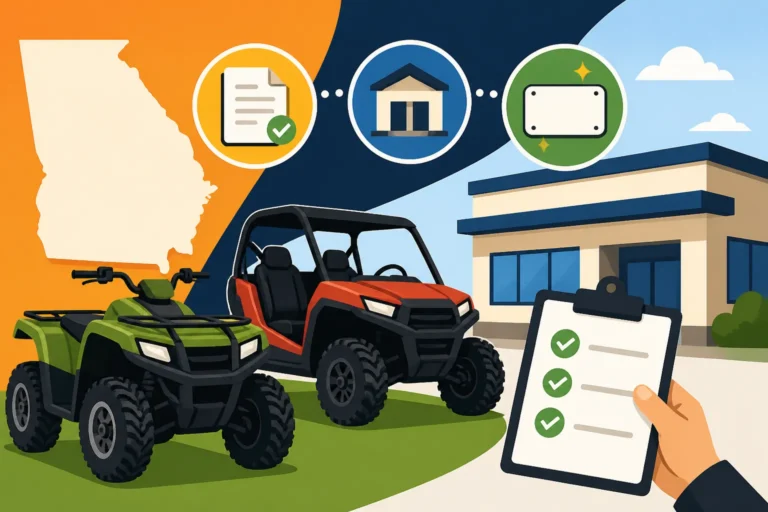
With your documents in hand, your destination will be your local county tag office – specifically, the one in the county where you reside. This is [Where the County Tag Office Fits In] and where all official vehicle registrations for Georgia take place. The staff there are the experts in processing these applications, and they'll review all your paperwork to ensure everything is in order. Be prepared for them to scrutinize your documents, especially the proof of ownership and the MV-OHV affidavit. They'll also verify that [Georgia Sales Tax Paid Before Registration] has been accounted for. If you purchased your machine from a dealer, they likely handled the sales tax for you. If it was a private sale, you'll be responsible for paying the sales tax at the tag office. In some cases, a T-22B inspection certification might be required, particularly for machines that don't have a clear manufacturer's identification or if there are questions about the VIN. Understanding [T-22B and When You Need It] can save you a trip. Going through the [Georgia County Tag Office Steps for an MPOHV] can be smooth if you're well-prepared.
What to Expect: Plate, Decal, and Renewal
Once your application is approved and fees are paid, you'll receive your MPOHV plate and a registration decal. The plate is specifically designed for these machines and will need to be properly displayed on your side-by-side. For details on placement, you can refer to [Georgia Plates for Off-Highway Vehicles]. The registration decal, typically a small sticker, will also be provided and should be affixed as instructed. This plate and decal are your official permission to operate your MPOHV on designated county roads.
It's important to remember that this isn't a one-time process. Like with any other vehicle, your MPOHV registration will need to be renewed annually. Understanding [Georgia MPOHV Renewal Each Year] is crucial to ensure you stay compliant. You'll typically receive a renewal notice, reminding you to pay the annual fee and confirm your insurance coverage. Staying on top of your renewals ensures uninterrupted legal access to Georgia's county roads for your side-by-side.
The Road Ahead: Where You Can (and Can't) Ride
Getting your MPOHV registered is a huge step, but it's equally important to understand the specific rules of the road. This registration grants you access, but it's not a free pass to drive anywhere and everywhere. Georgia has clear limitations on where MPOHVs can be operated.
Navigating Georgia's County Roads
The most important rule to remember is that [Georgia MPOHV Road Rules: County Roads Only]. This means you are permitted to operate your registered side-by-side on public roads maintained by a county government. These are typically the smaller, often unpaved or less-traveled roads that weave through rural areas. It's absolutely crucial to understand the distinction between these and other types of roads. [Why Georgia State Highways Stay Off Limits] is a key point: state routes (those numbered highways like GA-1, GA-17, or US-19) are generally off-limits for MPOHVs. You cannot legally cruise down a state highway on your side-by-side. Similarly, interstates are completely out of the question.
However, the law does allow for crossing state routes at designated points. This means if your route on a county road requires you to briefly traverse a state highway to get to another county road, you may be permitted to do so, but only at proper intersections and not for extended travel. These are [Georgia Crossings at Designated Points], and you should always exercise extreme caution and yield to all other traffic during such maneuvers. Knowing your local county road system is key to staying compliant and safe.
Critical Road Rules and Operator Requirements
Operating an MPOHV on public roads comes with responsibilities, mirroring those of driving any other motor vehicle. First and foremost, the operator must possess a valid Georgia driver's license. [Do You Need a License to Drive a UTV in Georgia?] The answer is a resounding yes if you're on a public road. A learner's permit might allow some operation with a licensed adult, but generally, a full license is required. Additionally, your registered MPOHV must maintain minimum liability insurance coverage. Law enforcement can, and often will, ask for proof of insurance, so make sure you understand [Georgia UTV Insurance Minimums] and carry your proof with you.
For riders under the age of 18, the [Georgia ATV Helmet Law for Riders Under 18] still applies, even on county roads. While side-by-sides have seat belts and roll cages, the helmet requirement for minors remains a critical safety regulation. Finally, there's an important date to keep in mind: [Georgia's July 2027 Sunset on Road Access]. This means the current legislation allowing MPOHV road access is set to expire unless renewed or amended. It's a temporary window that currently allows for this freedom, so staying informed about potential legislative changes as that date approaches will be important for all MPOHV owners. For now, enjoy the newfound access, but always ride responsibly and within the bounds of the law.
MPOHV Eligibility at a Glance
To help you quickly check if your machine might qualify, here's a summary of the core physical and safety requirements. Remember, this is a quick reference, and you should always verify all current requirements with the Georgia Department of Revenue or your local tag office.
| Feature | Requirement | Notes |
|---|---|---|
| Max Width | Not to exceed 80 inches | Measured at the widest point, excluding mirrors. |
| Gross Weight | Not to exceed 4,000 pounds | Total weight of vehicle + cargo + passengers. |
| Payload Capacity | Minimum of 350 pounds | The amount of weight it can carry, including passengers and cargo. |
| Min/Max Speed | Capable of 25 mph, but not exceeding 65 mph | Ensures it can keep pace but isn't a high-speed vehicle. |
| Steering | Steering wheel | Excludes all handlebar-steered ATVs. |
| Seating | Non-straddle seating (e.g., bench seats) | Another point excluding traditional ATVs. |
| Seat Belts | Factory-installed seat belts for all positions | Must be functional and in good repair. |
| Lighting | Headlights, brake lights, taillights | All must be operational. |
| Mirrors | At least one rearview mirror | Often includes side mirrors for better visibility. |
| Build Date | Manufactured on or after January 1, 2000 | Excludes older machines from eligibility. |
| Legal Documentation | Proof of ownership, ID, insurance | Comprehensive bill of sale (LawDepot can assist with templates). |
| Operator Requirements | Valid Georgia Driver's License | Required for operation on public roads. |
| Insurance | Minimum liability coverage | Mandatory for public road use. |
This article is for general informational purposes only and does not constitute professional advice. Laws, prices and regulations vary by location and change over time. Consult a qualified professional for guidance on your specific situation.