Registering a Side-by-Side in Georgia
Trying to figure out how to properly register your side-by-side in Georgia can feel like navigating a maze blindfolded, especially with all the new rules that have emerged. For years, owners have grappled with the lack of clear guidelines, often resorting to private land use or risking citations on public roads. This comprehensive guide is here to untangle that confusion, walking you through every step of the Georgia MPOHV registration process so you can confidently hit eligible county roads.
Understanding Georgia's MPOHV Classification for Side-by-Sides
For many years, side-by-sides, UTVs, and even some larger utility vehicles existed in a legal grey area in Georgia when it came to road use. They weren't cars, and they certainly weren't typical ATVs in the traditional sense. This ambiguity often led to frustration for owners who wanted to use their machines for practical purposes, like accessing hunting land or moving around rural properties, without trailering them everywhere. Thankfully, Georgia has introduced a specific classification to address this: the Multi-Purpose Off-Highway Vehicle, or MPOHV.
What "MPOHV" Actually Means for Your Machine
The term "MPOHV" isn't just bureaucratic jargon; it's the key to understanding how your side-by-side fits into Georgia's vehicle laws. Essentially, an MPOHV is a vehicle designed for off-highway use but, under specific conditions, can be registered for limited operation on certain public roads. This distinct classification sets it apart from traditional ATVs, which generally remain restricted from public road use, and even from golf carts, which have their own set of rules. The MPOHV designation acknowledges that many modern side-by-sides are built with features that make them safer and more practical for occasional road use than a standard quad. When you apply for [Georgia MPOHV Registration Explained], you're telling the state that your machine meets these specific criteria and you intend to operate it responsibly on eligible roads.
Why Side-by-Sides Are Different From ATVs in Georgia
It's crucial to understand that while both are off-highway vehicles, Georgia draws a very clear line between a traditional ATV (All-Terrain Vehicle) and an MPOHV, which most side-by-sides fall under. A typical ATV is designed for a straddle-seat riding position, often with handlebars for steering, and is generally intended for recreational use on trails and private land. The state of Georgia, for a long time, offered no pathway for ATV road registration, and for good reason—they simply weren't designed for it. This is why you'll often hear that [Why a Four-Wheeler Cannot Be Registered in Georgia]. Side-by-sides, on the other hand, usually feature a non-straddle seat (like a car bench or bucket seats), a steering wheel, and often come equipped from the factory with basic safety features like seat belts, headlights, and brake lights. These differences are fundamental to why one can be registered for limited road use and the other generally cannot. The MPOHV rules were specifically crafted to accommodate the design and utility of modern side-by-sides.
The Voluntary Nature of MPOHV Registration
One of the most important things to grasp about Georgia's MPOHV registration is that it's completely voluntary. This isn't a mandate that every side-by-side owner must register their machine. Instead, it's an option provided for those who wish to legally operate their MPOHV on Georgia's county roads. If your side-by-side is used exclusively on private property, within a hunting club lease, or solely transported via a trailer to designated off-road parks, then MPOHV registration isn't necessary for you. However, if you plan to drive your machine on any public county road, even just to get from one section of your property to another, or to access a store down the road, then obtaining the MPOHV registration becomes vital for legal compliance and peace of mind. Without it, you could face penalties for illegal road use. This is why [Georgia MPOHV Registration Is Voluntary] for many, but a necessity for others.
The Eight-Point Eligibility Test: Does Your Side-by-Side Qualify?
Before you even think about gathering paperwork or heading to the tag office, your side-by-side must first pass Georgia's rigorous eight-point eligibility test to be considered an MPOHV. This isn't just a formality; it's a set of concrete mechanical and design requirements that ensure the machine is reasonably safe for limited road use. Many owners get excited about the prospect of registration only to find their beloved machine falls short on one or more of these crucial points. Taking the time to verify each item against your specific side-by-side before starting the process will save you a lot of time and potential heartache.
Key Mechanical Requirements for Your Machine
Georgia's MPOHV definition is quite specific about the fundamental design of your side-by-side. These aren't just suggestions; they are hard requirements. First and foremost, your machine must have a steering wheel, not handlebars. This immediately disqualifies most traditional ATVs and dirt bikes. Next, it must have a non-straddle seat, meaning you sit in it, not on it like a motorcycle or quad. This rules out any machine where the rider straddles the engine or frame.
Beyond the seating and steering, there are critical dimensional and performance limits:
- Width: Your machine cannot exceed 80 inches in width. This is a common measurement that many larger, modern side-by-sides might push, so it's vital to measure from the widest points, including tires.
- Gross Vehicle Weight (GVWR): The vehicle's gross weight must not exceed 4,000 pounds. This includes the weight of the vehicle itself plus its maximum cargo and passenger capacity.
- Payload Capacity: It must have a minimum payload capacity of 350 pounds. This ensures the vehicle can carry a reasonable load, reflecting its "multi-purpose" utility.
- Speed: Your side-by-side must be capable of speeds between 25 mph and 65 mph. A machine that tops out below 25 mph (like many golf carts) or exceeds 65 mph (like some high-performance sport UTVs) will not qualify.
Understanding [Why Georgia's MPOHV Rules Demand a Non-Straddle Seat] and [Why Georgia Will Not Register an Ordinary Quad] comes down to these fundamental design and performance criteria. Make sure to check your owner's manual for factory specifications, or measure carefully if modifications have been made.
Equipment That Must Be Present
Even if your side-by-side meets the mechanical criteria, it also needs specific safety equipment to be eligible for MPOHV registration. These features are designed to enhance visibility and safety when operating on public roads, even if only for short distances.
- Headlights: Your machine must have working headlights. These are standard on virtually all side-by-sides, but ensure they are fully functional.
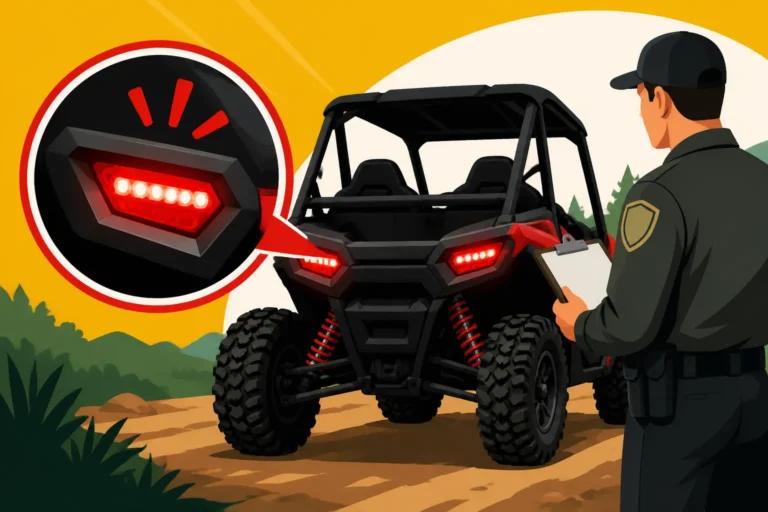
- Brake Lights: Operational brake lights are a must. This is crucial for signaling your intentions to other drivers on the road.
- Rearview Mirrors: You need to have rearview mirrors, typically at least one on the driver's side, though many come with a center mirror as well. These are vital for situational awareness in traffic.
- Seat Belts: Your side-by-side must be equipped with factory-installed seat belts for all designated seating positions. This emphasizes passenger safety, akin to a traditional automobile.
These equipment requirements are non-negotiable. If your machine is missing any of these items, or if they are not in proper working order, you will need to address them before your trip to the tag office. The county tag office will inspect these features, and if they are not compliant, your application for [Georgia MPOHV Registration Explained] will be denied.
The Build-Date Cutoff (Pre-2000 Machines)
There's one more crucial point in the eligibility test that often catches owners of older machines off guard: the manufacture date. To be eligible for Georgia MPOHV registration, your side-by-side must have been manufactured on or after January 1, 2000. This means that if your machine rolled off the assembly line in 1999 or earlier, it will not qualify for an MPOHV plate, regardless of how perfectly it meets all the other seven criteria. This rule is in place to ensure that registered machines meet more modern safety and emissions standards. If you own a cherished vintage machine, this cutoff might mean it's destined for private land use only. Always double-check your vehicle's VIN plate or manufacturer's sticker to confirm its exact build date before you embark on the registration journey. This is a common point of confusion, so be aware of [Machines Built Before 2000 and Georgia Registration].
Gathering Your Essential Paperwork for Registration
Once you've confirmed your side-by-side meets all the eligibility criteria, the next crucial step is compiling the necessary documentation. This part of the process can be the most intimidating, especially if you're not accustomed to dealing with vehicle registration or if your machine lacks a traditional title. The key is preparation: having every required form and piece of evidence correctly filled out and readily available will make your visit to the county tag office much smoother and increase your chances of a successful registration on your first try.
Proof of Ownership Without a Title
Unlike cars and trucks, most side-by-sides are not issued a title from the manufacturer in Georgia, which can be a major source of confusion for owners. The state understands this and has created a pathway for proving ownership without a traditional title. The primary documents you'll need are:
-
Bill of Sale: This is arguably the most important document. If you purchased your side-by-side new from a dealer, they should have provided you with a detailed bill of sale. If you bought it from a private seller, you'll need a comprehensive bill of sale that includes:
- The full names and addresses of both the buyer and seller.
- The date of sale.
- The purchase price.
- A complete description of the side-by-side, including make, model, year, and the all-important Vehicle Identification Number (VIN).
- Signatures of both the buyer and seller.
- While not always strictly required for private sales, having the bill of sale notarized can add an extra layer of authenticity and peace of mind for both parties and the tag office. You can find templates for bills of sale through resources like LawDepot to ensure all necessary fields are covered.
-
Affidavit of Ownership (Form MV-OHV): If you don't have a perfect bill of sale, or if you've owned the machine for a long time and the original paperwork is lost, you'll likely need to complete Georgia Form MV-OHV, which serves as an affidavit of ownership for your MPOHV. This form requires you to attest under penalty of perjury to your ownership of the vehicle. It's a critical document for [Proving You Own an ATV in Georgia Without a Title] and for the entire registration process.
-
Proof of Previous Sales Tax Paid (if applicable): If your machine was purchased before June 30, 2024, Georgia law presumes that sales tax has already been paid, or that the owner is exempt. For purchases after that date, you'll need to show proof of sales tax payment.
Having these documents ready and accurately completed is paramount to demonstrating legitimate ownership to the state.
The Georgia Form MV-OHV: Completing It Accurately
The Georgia Department of Revenue Form MV-OHV, titled "Application for Multi-Purpose Off-Highway Vehicle (MPOHV) Registration and Certificate of Title," is central to the entire process. Even though most side-by-sides don't get a traditional title, this form serves as your application for the MPOHV registration and the branded certificate of registration. It's essential that you fill out every section completely and accurately. This includes:
- Your Personal Information: Name, address, driver's license number, and contact information.
- Vehicle Information: Make, model, year, VIN, engine size, and the odometer reading. Double-check the VIN against your actual vehicle to prevent any discrepancies.
- Eligibility Attestation: You'll need to check boxes confirming your machine meets the eight-point eligibility test we discussed earlier (steering wheel, non-straddle seat, dimensions, speed, equipment, and build date).
- Ownership Details: How you acquired the vehicle (purchase, gift, etc.), the date of acquisition, and the name of the previous owner.
- Lienholder Information: If your side-by-side is financed, you'll need to provide your lienholder's information.
Take your time filling out [Georgia Form MV-OHV and What It Asks]. Any errors or omissions can lead to delays or rejection of your application. If you have questions about specific sections, it's always best to call your county tag office before your visit.
Sales Tax Confirmation and What It Entails
Sales tax is another critical component of the registration process that can be confusing, especially since MPOHVs don't fall under Georgia's Title Ad Valorem Tax (TAVT) system. For MPOHV registration, you will need to demonstrate that the applicable 4% state sales tax, plus any local sales taxes, has been paid on the purchase of your side-by-side.
Here’s how it generally works:
- Dealer Purchases: If you bought your side-by-side new from a Georgia dealer, the sales tax would typically have been collected at the time of purchase and remitted by the dealer. Your bill of sale from the dealer should clearly show this.
- Private Sales: If you purchased your machine from a private seller, you are responsible for remitting the sales tax yourself. You'll need to pay this tax to the Department of Revenue before you can complete your MPOHV registration at the county tag office. The date of purchase on your bill of sale will determine when this tax was due.
- Machines Owned Before June 30, 2024: For machines owned by a Georgia resident prior to June 30, 2024, the law presumes that sales tax has already been paid or that the owner is exempt. In this scenario, you typically won't need to provide additional proof of sales tax payment. However, it's always good to have any existing purchase documentation available just in case.
Failing to demonstrate proper sales tax payment is a common reason for registration delays. Ensure you understand the requirements for [Georgia Sales Tax Paid Before Registration] that apply to your specific purchase scenario.
The Registration Process at Your County Tag Office
With all your paperwork in hand and your side-by-side meeting the eligibility criteria, the next step is a visit to your local Georgia County Tag Office. This is where your application will be reviewed, your vehicle inspected, and, if all goes well, you'll walk out with a shiny new MPOHV plate and registration. It's not always a quick process, so mentally prepare for a bit of a wait, and remember that being polite and organized goes a long way.
Locating Your Local Tag Office and What to Expect
In Georgia, vehicle registrations are handled at the county level, meaning you'll need to visit the tag office in the county where you reside. A quick search for "[Your County Name] County Tag Office" will give you their address, hours of operation, and often a list of services provided.
When you arrive, expect a process similar to registering a car, but with some specific MPOHV-focused steps:
- Take a Number: Many tag offices operate on a queuing system, so grab a number and be prepared to wait. Weekdays are generally busier than mid-week, mid-day.
- Bring Everything: Have all your documents – your completed MV-OHV form, bill of sale, proof of insurance, driver's license, and any other supporting paperwork – neatly organized and readily accessible. It helps to have copies, but they'll need the originals for verification.
- Be Ready for Questions: The clerk will review your documents and may ask clarifying questions about your side-by-side or its history. Answer honestly and refer to your paperwork.
- Payment: Be prepared to pay the registration fees. While I can't give specific current costs, expect an annual fee for the MPOHV plate. Ensure you know the accepted payment methods for your specific tag office (cash, check, card). The [Georgia MPOHV Registration Cost] is usually a yearly fee.
Remember, the staff at the tag office are there to help, but they also have strict rules to follow. Being prepared makes their job, and your experience, much easier.
The VIN Inspection and Stolen Vehicle Check
A critical part of the MPOHV registration process involves a physical inspection of your side-by-side, specifically focused on its Vehicle Identification Number (VIN), and a background check to ensure it's not reported stolen.
-
VIN Inspection: The county tag office will require verification of your side-by-side's VIN. This might happen in one of a few ways:
- On-site inspection: Some tag offices have an area where you can pull your side-by-side for a physical VIN verification by a staff member.
- Law Enforcement Certification: In other cases, especially if your machine doesn't have a clear chain of ownership or is a homemade build, you might need a [Georgia T-22B Inspection Certification] completed by a law enforcement officer. This form, officially known as the "Serial Plate Inspection," verifies the VIN exists and matches your paperwork.
- T-22B: The T-22B form is essentially a certification from a law enforcement officer that they have visually inspected the VIN on your machine and confirmed it matches the paperwork you're submitting. This can sometimes be done at the tag office if a law enforcement officer is present, or you may need to visit a local sheriff's office or police department to have it completed beforehand.
-
Stolen Vehicle Check: During the application process, the VIN will also be run through national and state databases to ensure the side-by-side has not been reported as stolen. This is a standard security measure to protect buyers and prevent the registration of illegally obtained vehicles. If your machine is flagged as stolen, the process will halt immediately, and further investigation will occur. Always ensure you perform your own [Georgia Stolen Vehicle Check Before Registration] when buying a used machine privately.
Understanding Branded Certificates of Registration
When your side-by-side successfully completes the MPOHV registration process, you won't receive a traditional title like you would for a car or truck. Instead, Georgia issues a "Branded Certificate of Registration." This is a significant distinction that many owners overlook.
What does "branded" mean in this context? It means the certificate of registration carries specific notations or "brands" that indicate the unique nature of the MPOHV. Common brands might include:
- "OFF-ROAD USE ONLY" (or similar language): Even though you're registering it for limited road use, the underlying nature of the vehicle is still an off-highway machine.
- "NO TITLE ISSUED": This explicitly states that a traditional title, which denotes absolute ownership for cars and trucks, does not exist for this vehicle in Georgia.
- "LIMITED ROAD USE": This brand reinforces that the registration permits operation only on specific county roads, not on all public roadways.
These brands are important because they provide a clear warning to future buyers about the vehicle's history and its legal limitations. If you ever sell your registered MPOHV, the buyer will receive this branded certificate. It's vital for both sellers and buyers to understand [What a Branded Registration Warns You About] and the implications of this documentation. This branded certificate is your official proof of registration and ownership for MPOHV purposes in Georgia.
What a Georgia MPOHV Registration Means for You
So, you've jumped through all the hoops, gathered your paperwork, passed the inspection, and walked out of the county tag office with your new MPOHV plate and branded certificate. Congratulations! But what exactly does this registration buy you? It's crucial to understand both the privileges and the limitations that come with MPOHV registration in Georgia to ensure you're always operating within the bounds of the law. This isn't a free pass to drive your side-by-side anywhere a car can go; it's a specific authorization for limited use.
Where You Can Legally Ride Your Registered Side-by-Side
The primary benefit of registering your side-by-side as an MPOHV in Georgia is the legal ability to operate it on county roads. This is a specific and important distinction. You are generally permitted to drive on paved or unpaved roads maintained by the county. This opens up opportunities for recreational riding on designated county roads, accessing hunting properties, or simply traveling short distances between points in rural or semi-rural areas.
However, the "county roads only" rule comes with significant restrictions:
- No State Highways: You are expressly prohibited from operating your registered MPOHV on state highways (those typically numbered with "GA" or "US").
- No Interstates: Interstate highways are completely off-limits, even for short distances or crossings.
- Crossing State Routes: You may be allowed to cross a state route at designated intersections if no safer alternative exists, but you cannot drive along a state route. This is a point of frequent confusion and strict enforcement.
- Local Ordinances: While state law permits county road use, individual counties or municipalities may have their own ordinances that further restrict or even prohibit MPOHV use on their roads. Always check with your local county sheriff's office or city hall to understand any hyper-local rules.
Understanding [Georgia UTV Road Rules by County] is essential. Operating your registered MPOHV outside of these permitted areas can still result in fines, citations, and even impoundment, effectively negating the benefit of your registration.
The Importance of Liability Insurance
Just like any other vehicle legally operating on public roads in Georgia, your registered MPOHV must be covered by liability insurance. This is not an optional extra; it's a mandatory requirement to maintain your registration and legally drive on county roads. The purpose of liability insurance is to protect you financially in case you cause an accident that results in injury to another person or damage to another person's property.
The Georgia Department of Revenue will require proof of insurance when you register your MPOHV, and you'll need to maintain continuous coverage to keep your registration active. If your insurance lapses, your registration can be suspended, and you could face penalties for driving an uninsured vehicle.
- Minimum Coverage: Georgia sets minimum liability coverage limits. While I can't provide specific figures, these generally include bodily injury liability per person, bodily injury liability per accident, and property damage liability.
- Where to Get It: Many major insurance providers offer policies for side-by-sides and UTVs. It's wise to shop around and get quotes from several companies to ensure you're getting adequate coverage at a competitive rate.
- Why It Matters: Beyond the legal requirement, having liability insurance is simply smart. Accidents happen, even at low speeds or on seemingly empty roads. The financial consequences of an uninsured accident can be devastating, making that annual insurance premium a worthwhile investment. This is why [Georgia Liability Insurance Tied to Registration] is non-negotiable.
Annual Renewal and Keeping Your Registration Current
MPOHV registration in Georgia is not a one-time event; it's an annual renewal. Just like your car's tag, your MPOHV registration will expire each year, and you'll need to renew it to remain legal on public roads.
- Renewal Notices: The Department of Revenue typically sends out renewal notices as your expiration date approaches. Ensure your address is current with the tag office to receive these.
- Renewal Process: Renewing is usually simpler than the initial registration. Often, you can renew online, by mail, or in person at your county tag office. You'll need to pay the annual renewal fee and confirm you have valid liability insurance.
- Late Penalties: Be mindful of your renewal date. Operating an unregistered or expired MPOHV on public roads can lead to fines and penalties. There are often late renewal fees if you miss the deadline.
- Continuous Insurance: Remember, maintaining continuous liability insurance is tied to your renewal. If your insurance lapses, you'll face issues renewing until new coverage is secured. [Georgia MPOHV Renewal Each Year] is a simple, but crucial, part of owning a registered side-by-side.
Staying on top of your annual renewal ensures you can continue to enjoy the benefits of legal road access without unnecessary hassle or legal trouble.
Common Hurdles and How to Overcome Them
Even with the clearest guidelines, the path to MPOHV registration isn't always perfectly smooth. Many side-by-side owners encounter specific challenges, especially when dealing with machines that have a less-than-perfect history or come from out of state. Anticipating these common hurdles and knowing how to navigate them can save you a significant amount of frustration and repeated trips to the tag office.
Buying a Used Side-by-Side Without Full Paperwork
One of the most frequent dilemmas for buyers and sellers of used side-by-sides in Georgia is the absence of a complete paper trail, especially a traditional title. Since Georgia doesn't title ATVs or MPOHVs in the same way it does cars, relying solely on a title is often not an option. This can make proving ownership a challenge.
- The Importance of a Robust Bill of Sale: When buying privately, insist on a comprehensive bill of sale, even if it's a simple, handwritten one. It should include the buyer's and seller's full names and contact info, the date, the price, the vehicle's VIN, make, model, and year. Both parties should sign and date it. Consider using a template from a service like LawDepot to ensure all legal bases are covered. This is critical for [Buying a Used Side-by-Side in Georgia].
- Seller's Documentation: Ask the seller for any and all documentation they have, even if it's just old sales receipts, maintenance records, or previous registration documents (if from another state). Any proof of their ownership helps establish a chain of custody.
- Affidavit of Ownership (Form MV-OHV): If you purchase a machine with minimal paperwork, you will almost certainly need to complete Georgia Form MV-OHV as an affidavit of ownership. Be prepared to swear to your ownership under penalty of perjury.
- VIN Verification: A VIN inspection (and potentially a T-22B form from law enforcement) becomes even more critical for used machines with questionable paperwork to ensure the vehicle isn't stolen or has a problematic history.
- Sales Tax Records: Confirm if sales tax was paid by the previous owner. If not, be prepared to pay it yourself based on the purchase price you paid.
It's always safer to walk away from a deal if the seller cannot provide any credible proof of ownership, as you could end up with a machine you can't legally register.
Addressing Out-of-State Machines and New Residents
Bringing a side-by-side into Georgia, either as a new resident or after purchasing it from another state, adds another layer of complexity to the registration process. Different states have different rules regarding titles and registration for off-highway vehicles.
- Out-of-State Titles: Some states do title side-by-sides. If your machine has an out-of-state title, bring it to the Georgia tag office. The tag office will review it. Since Georgia doesn't issue traditional titles for MPOHVs, they will likely use the out-of-state title as strong proof of ownership to issue your Georgia Branded Certificate of Registration.
- Out-of-State Registration, No Title: If your machine was registered in another state but never titled, bring all your previous registration documents and a bill of sale. This will function similarly to having a machine from Georgia without a title, requiring the MV-OHV form.
- New Georgia Residents: If you're a new resident moving to Georgia, you generally have a grace period to register your vehicles. However, it's wise to initiate the MPOHV registration as soon as possible, especially if you plan to use it on county roads. You'll follow the same MPOHV eligibility and paperwork requirements as long-time residents, often needing your out-of-state ownership documents to prove your case. This is crucial for [Georgia MPOHV Registration for a New Resident].
- Sales Tax Consideration: Be aware of Georgia's use tax rules if you purchased the machine out-of-state and bring it into Georgia. You may be required to pay Georgia sales/use tax if you haven't paid equivalent taxes in another state.
Always compile all documentation from the previous state of registration or purchase, as the Georgia tag office will want to see a clear ownership history.
Navigating Homemade or Modified Machines
For those who are handy and have built a side-by-side from scratch or heavily modified a pre-existing machine, the MPOHV registration process presents unique challenges, particularly regarding VIN assignment and compliance with the eight-point test.
- VIN Assignment: Homemade machines will not have a factory VIN. In this scenario, you will need to apply for a state-assigned VIN. This usually involves a rigorous inspection by a Georgia Department of Revenue agent or law enforcement to verify the components and ensure it's not made from stolen parts. This process can be lengthy and requires significant documentation of all parts used.
- Proof of Components: For homemade machines, you'll need bills of sale or receipts for all major components used in its construction (engine, frame, axles, etc.). This helps establish legitimate ownership of the parts that make up the vehicle.
- Meeting Eligibility: Even if homemade, the machine must still pass the exact same eight-point eligibility test. This means ensuring it has a steering wheel, non-straddle seat, meets all dimension and weight requirements, and has the necessary safety equipment. Designing a homemade machine to fit these criteria from the outset is far easier than trying to modify it later.
- Heavily Modified Machines: If you've heavily modified a factory side-by-side, ensure that your modifications haven't inadvertently disqualified it from the MPOHV criteria. For example, widening the machine beyond 80 inches, increasing its top speed beyond 65 mph, or removing essential safety equipment would make it ineligible.
For homemade or significantly modified machines, it is highly recommended to contact the Georgia Department of Revenue's Motor Vehicle Division directly for specific guidance before you invest heavily in the build or try to register it.
Beyond Registration: Understanding Georgia's Road Rules
Obtaining your MPOHV registration is a huge step, but it's only half the battle. Just as important as getting the registration is understanding the rules that govern how and where you can operate your side-by-side on public roads in Georgia. Misunderstanding these regulations can lead to costly citations, impoundment of your vehicle, and potentially severe accidents. Responsible ownership means knowing and abiding by all applicable laws.
County Roads Only: The Limits of Road Access
The golden rule for registered MPOHVs in Georgia is "county roads only." This is not merely a suggestion; it's a strict legal limitation that you must always adhere to. A "county road" is generally defined as any road that is maintained by the county government, often distinguished by specific road signs or markings, or the absence of state route numbers.
- What This Means in Practice: You can use these roads for direct travel, whether to access a hunting lease, visit a neighbor, or travel between different parts of your property. It allows for practical utility that was previously unavailable to most side-by-side owners.
- Identifying County Roads: In rural areas, many paved and unpaved roads fall under county jurisdiction. If you're unsure, consult a local county road map or contact your county's road department or sheriff's office. When in doubt, assume a road is not a county road until you confirm otherwise.
- The Fines: Operating a registered MPOHV on a prohibited roadway is a violation of state law. Fines can be significant, and repeated offenses could lead to more severe penalties. Law enforcement officers are increasingly aware of the MPOHV rules and are enforcing them. This is critical for [Georgia MPOHV Road Rules: County Roads Only].
Always prioritize safety and legality. If a road doesn't explicitly look like a county road, or if you see state route signage, avoid it.
Why State Highways and Interstates Are Off-Limits
For many, the distinction between a county road and a state highway or interstate can seem subtle, especially in rural areas where state routes might resemble smaller local roads. However, the legal distinction is absolute, and the prohibition against MPOHVs on state highways and interstates is firm.
- Higher Speeds and Traffic Volume: State highways and interstates are designed for higher speeds and carry significantly more traffic. MPOHVs, despite their registration, are not designed for sustained high-speed travel or to safely integrate with such traffic volumes.
- Safety Concerns: The difference in size, speed, and protective features between an MPOHV and a typical car or truck makes mixing them on high-speed roads incredibly dangerous. The state's intent with MPOHV registration is for low-speed, localized travel, not inter-city or major thoroughfare use.
- Crossing vs. Traveling: A common question is about crossing state routes. Generally, you may cross a state route at a designated intersection if it's the only practical way to continue on a county road. However, you cannot drive along a state route for any distance. The goal is to minimize the time an MPOHV spends on higher-speed roads. [Georgia Crossings at Designated Points] are permitted, but caution is paramount.
- Interstates are Never an Option: Under no circumstances are MPOHVs permitted on interstate highways. These are federal roads designed for high-speed, controlled-access travel, and MPOHVs are completely incompatible with their design and traffic flow.
Respecting these prohibitions is not just about avoiding a ticket; it's about personal safety and the safety of everyone else on the road.
Helmet and Driver's License Considerations
Even with MPOHV registration, there are specific requirements for operators and passengers, especially concerning helmets and driver's licenses. These rules are in place to ensure a basic level of safety for all occupants.
- Driver's License: Any person operating a registered MPOHV on a public county road in Georgia must possess a valid Georgia driver's license. A learner's permit is generally not sufficient unless accompanied by a licensed driver, similar to car laws. This rule ensures that operators have demonstrated basic driving proficiency and knowledge of road rules. This is a key part of [Georgia Driver's License Rules for MPOHV Operators].
- Helmet Law for Under 18: If you or any passenger on your MPOHV is under the age of 18, they are required to wear an approved helmet when operating or riding on a public road. This includes children and teenagers. This rule reflects a broader state concern for the safety of minors on off-road vehicles. While many adults might choose to wear a helmet, for those under 18, it's a legal mandate. This rule also applies on private land in some contexts, as covered by [Georgia ATV Helmet Law for Riders Under 18].
- Passenger Rules: Ensure your MPOHV is only carrying the number of passengers for which it was designed, and that all passengers use available seat belts. Overloading or allowing passengers to ride in unsafe positions is a violation and a serious safety risk.
Adhering to these safety requirements is essential for legal operation and, more importantly, for protecting yourself and your passengers. Operating outside these rules not only carries legal penalties but also significantly increases the risk of injury in the event of an accident.
Disclaimer
This article is for general informational purposes only and does not constitute professional advice. Laws, prices and regulations vary by location and change over time. Consult a qualified professional for guidance on your specific situation.