Georgia’s WMA Vehicle Rule in Plain English
Georgia’s Wildlife Management Area vehicle rule is easy to misread: being allowed to enter a WMA does not mean you can ride an ATV or UTV wherever you like. The practical rule is to use only routes and times the specific area permits, and to check its current access conditions before unloading.
The basic rule: use only an open, permitted route
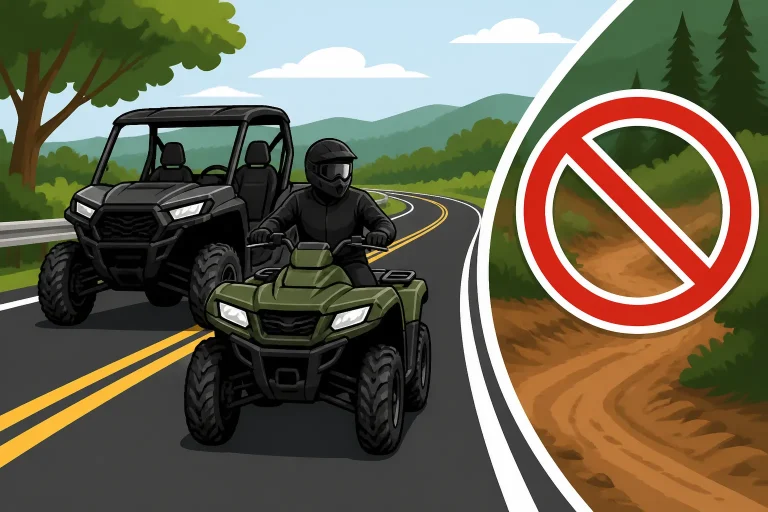
On a Georgia WMA, an ATV or UTV is not a free-roaming way to cross public land. Vehicle use is generally limited to roads that are open to vehicles, and the rules for a particular WMA may be narrower. A route that appears on a map, crosses a hunting area, or has tire tracks is not automatically open to motorized use.
The distinction matters because WMA access can change with the area, season, hunt, and road status. A gate, closure notice, or map designation may limit where you can drive. Do not go around a closed gate or onto a trail simply because your machine can fit. When in doubt, treat the route as closed until the managing agency confirms otherwise.
For a useful overview of how the restrictions fit together, see Georgia WMA Riding Rules Explained. The specific area’s current regulations and map should be your final check before a ride. Pay attention to the exact route names and boundaries, not just the general statement that a WMA allows vehicle use.
A few plain-English points help prevent the most common mistakes:
- A WMA is not a general ATV trail system. Road access does not authorize riding through woods, fields, wildlife openings, or along informal tracks.
- An open road is not necessarily open to every vehicle at every time. Dates, hunt schedules, gates, signs, and area-specific rules can restrict access.
- Permission to hunt and permission to ride are not the same thing. A hunting opportunity does not automatically let you drive off-road or use a closed road.
- A vehicle pass or permit does not override a closure. It cannot make an unauthorized route legal.
- Rules can differ between WMAs. Never assume that a route allowed on one area is allowed on another.
The safest starting point is Georgia WMA Riding Only on Roads: understand that vehicle use is route-limited, then check the conditions for the particular WMA and date you plan to visit.
| Situation | Practical rule of thumb |
|---|---|
| The road is signed or mapped as open | Stay on the road and follow posted restrictions |
| A gate is closed or a sign says no vehicles | Do not enter, even if the road looks usable |
| A two-track is not identified as an open road | Do not assume it is an authorized ATV route |
| A WMA allows access only during specified dates | Ride only within those dates and any stated hours |
| The area is part of a national forest | Check whether vehicle use is limited to designated trails or roads |
| You have a hunting license or access pass | That alone does not authorize riding anywhere on the WMA |
Dates, daylight, and hunt-day limits
Time limits are a frequent source of confusion. Some WMA vehicle access is tied to the area’s scheduled hunts and may be available only on hunt days or the day before a hunt. Other areas may have different opening dates, seasons, or restrictions. The practical answer is not to assume that a WMA road is open for ATV use every day of the year.
Check the specific area’s calendar and vehicle-use notices before traveling. A general hunting season does not necessarily mean every WMA is open to vehicle use, and an open WMA does not necessarily mean every road is open. If a date is not clearly included in the applicable access schedule, confirm it rather than relying on a past visit or another rider’s recollection. Georgia WMA Riding Only on Hunt Days explains why the hunt schedule can determine whether a road ride is allowed.
Hours can also be limited. In some WMA situations, the permitted window is described in relation to sunrise, rather than as unrestricted access throughout the day. Check the rule for the WMA you intend to visit and apply the stated time window exactly. Do not assume that a road open for a hunt permits riding at any hour. For the sunrise-related timing, see Georgia WMA Two-Hour Window Around Sunrise.
A simple pre-trip check can save a long drive and help you avoid entering a closed area:
- Find the current regulations and map for the exact WMA.
- Confirm the dates when vehicle use is allowed, including any connection to hunt days.
- Check the permitted hours and whether they are tied to sunrise or another schedule.
- Identify the authorized roads or designated trails on the map.
- Look for temporary closures, seasonal notices, and gate restrictions.
- Recheck before unloading, especially if weather or hunting activity could have changed access.
This is particularly important if you are planning a ride around a hunting trip. A WMA can have separate rules for hunting access and ATV use, so do not treat one as proof of the other. Georgia Hunting Access by ATV is useful for separating the two questions.
If you arrive and find a posted closure that conflicts with an older map or an online discussion, follow the closure and contact the area’s managing office for clarification. A past ride, a social-media post, or an open-looking gate is not a dependable substitute for current instructions.
Who may ride and where national forest rules differ
Age limits are another condition to check. Georgia WMA vehicle guidance includes a minimum operator age, and the listed rule is that an operator must be at least 16. Confirm the current requirement for the specific WMA before taking a younger rider. A passenger being old enough to ride along does not necessarily mean they can operate the machine. See Georgia WMA Minimum Age of 16 for the age rule and its practical implications.
The vehicle rules can be different when a WMA is on national forest land. In those areas, an ATV or UTV may be restricted to designated trails rather than allowed on every road that looks usable. That is a separate land-management constraint, not a detail to work out after reaching the trailhead. Check whether the route is specifically designated for the type of machine you are bringing. Georgia National Forest WMAs Need Designated Trails covers this distinction.
This is why a broad statement such as “ATVs are allowed on that WMA” is not enough to plan a ride. You still need to establish:
- Whether the area is open to vehicle use on your chosen date.
- Whether you must be participating in a qualifying hunt or visiting during a specified access period.
- Which roads or trails are authorized for your machine.
- Whether the area is subject to national forest trail designations.
- Whether the operator meets the applicable age requirement.
- Whether the WMA requires a tag or other access credential for the activity.
Tags and access credentials are not a replacement for route authorization. If the WMA requires a tag, carry or display it as directed, but continue to obey road, date, and hour restrictions. The details are covered in Georgia WMA Tags and When They Are Needed.
If you are looking at a route that crosses from a WMA onto adjacent national forest land, do not assume the same rule applies on both sides of the boundary. A public road, forest road, designated OHV trail, and WMA access road can each have different conditions. Read the signs at the boundary and verify the route on the relevant maps.
A practical checklist before you unload
A little preparation is better than guessing at a gate. Save or print the current WMA map, note the permitted access dates, and identify the exact route you plan to use. If access depends on a particular hunt schedule, check that schedule rather than relying on the broad season dates. If the rules are unclear, contact the managing office before making the trip.
Use this checklist:
- Confirm the place. Make sure the map and rules apply to the exact WMA, not a nearby area with a similar name.
- Confirm the date and hours. Check any hunt-day condition, day-before access, seasonal opening, or sunrise-related window.
- Confirm the route. Stay on the roads or designated trails identified as open to your machine.
- Check boundaries. A road may enter land managed under a different set of rules.
- Check age and credential requirements. Verify the operator age rule and any required tag or access document.
- Look for current closures. Follow gates and notices even when an older map suggests the route is usually open.
- Keep the ride within the stated purpose. If access is provided for a specific activity, do not treat it as a general recreation pass.
If you are not sure whether a road is open, stop before entering and ask the relevant agency. Do not follow another vehicle onto a questionable route: the other rider may have permission, may be mistaken, or may simply be breaking the rule. The same caution applies to private land next to a WMA; a public boundary does not grant permission to ride across neighboring property. For a separate look at access away from WMA roads, see Georgia Landowner Permission Forms.
The short version is straightforward: on a Georgia WMA, ride only where the current area rules expressly allow vehicle use, and only during the authorized dates and hours. Treat maps, signs, gates, hunt schedules, age rules, and any required tags as parts of the same check. If one of them says no, do not ride that route.
Disclaimer
This article is for general informational purposes only and does not constitute professional advice. Laws, prices and regulations vary by location and change over time. Consult a qualified professional for guidance on your specific situation.