Georgia Spark Arrestor Requirements
Georgia ATV and UTV spark arrestor rules can be confusing because the answer depends on where you ride, not just what machine you own. Forest roads, off-highway trails, private parks, and temporary fire restrictions may have different requirements. Here’s how to check what applies, recognize a suitable arrestor, and avoid arriving at a trailhead with equipment that isn’t ready.
Where Georgia Spark Arrestor Rules Apply
There is no single spark arrestor rule that automatically covers every place where an ATV or UTV might be ridden in Georgia. The land manager sets the rules for the property, and temporary fire restrictions can add further limits. Before a ride, identify who manages the route or property and check that manager’s requirements.
On National Forest System land, spark arrestors are an important equipment and fire-prevention concern. Forest rules and restrictions may govern engines and equipment that can emit sparks. For riders, the practical approach is to have a properly installed, effective spark arrestor and confirm the current requirements for the specific area. Georgia’s National Forest OHV systems include different riding areas, so do not assume a rule or trail condition at one system applies to another. The overview of Georgia’s Six National Forest OHV Systems can help you identify the area you plan to visit.
Private off-road parks set their own entry and equipment rules. A park may require a spark arrestor even when a general statewide requirement does not apply to your particular ride. It may also have separate noise limits, inspection procedures, or rules about modified exhaust systems. Check the park’s current rules before loading up; Georgia Private Park Waivers and Rules explains why private-park requirements deserve a separate check.
| Riding area | What to check before you go |
|---|---|
| National Forest OHV trail or road | Forest rules, trail-specific restrictions, fire notices, and any equipment requirements |
| Other public land | The managing agency’s rules for that property and route |
| Private off-road park | The park’s current admission, equipment, noise, and inspection rules |
| Private property | The owner’s permission and any applicable local or temporary restrictions |
A spark arrestor does not give an ATV or UTV permission to ride on a route that is otherwise closed to it. Forest trails and roads can have vehicle, width, seasonal, or weather-related limits. Review the Georgia National Forest Trail-Only Rule and check the specific system’s access information before deciding that a machine can use a particular route.
The same separation applies to permits. A permit or pass covers the access it is intended for; it does not certify that your exhaust equipment meets a land manager’s requirements. If you are planning a National Forest ride, read Georgia’s Day and Annual Forest OHV Permits as well as the current rules for the trail system.
What Counts as a Spark Arrestor
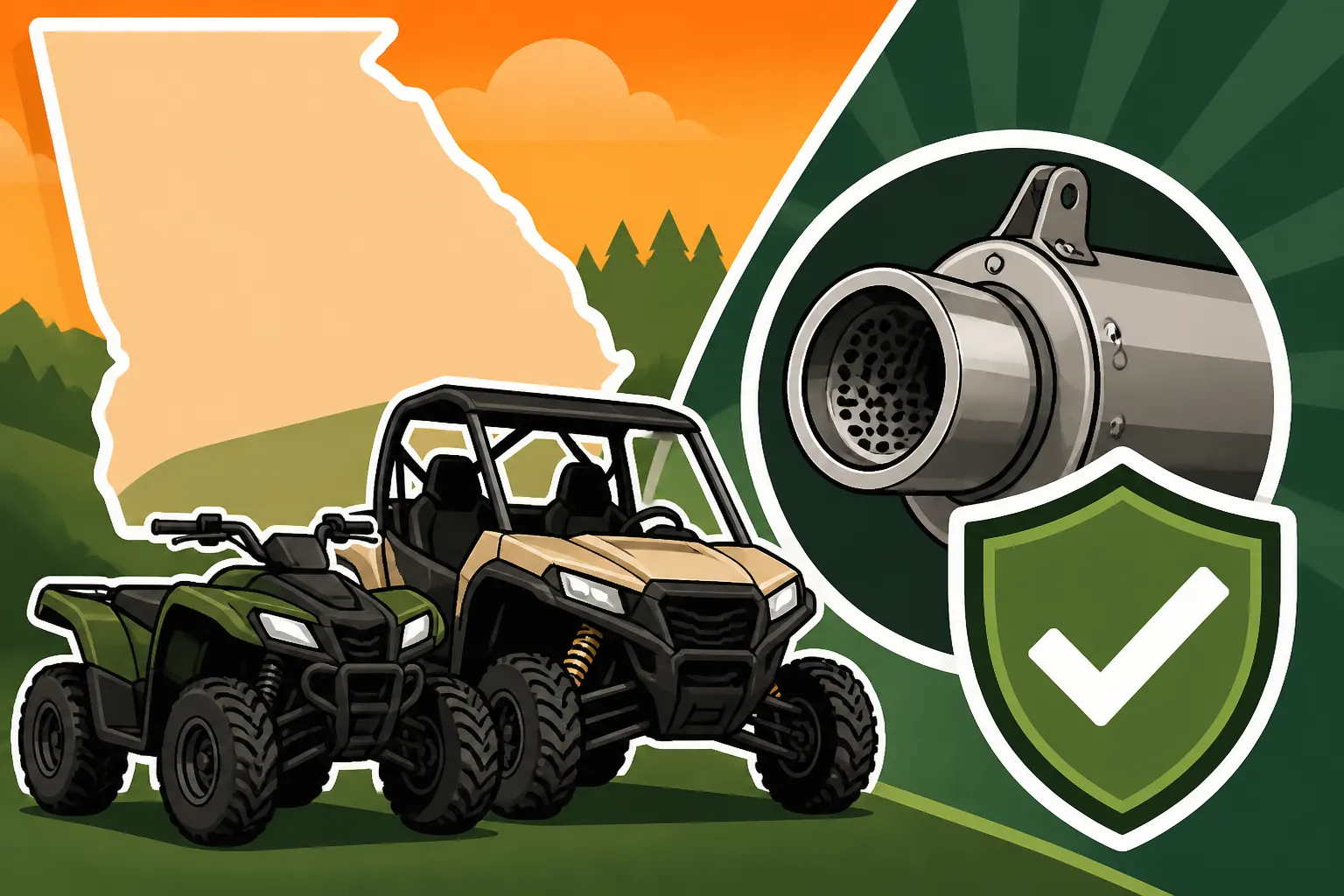
A spark arrestor is a device designed to reduce the chance that hot particles from an engine exhaust will escape and start a fire. On an ATV or UTV, it is commonly built into the muffler or exhaust assembly. Some devices use a screen or other internal components to trap or cool particles before they leave the exhaust.
A muffler and a spark arrestor are not automatically the same thing. A quiet exhaust may still lack a spark-arresting component, while an exhaust with a spark arrestor may not satisfy a park’s separate sound limit. Likewise, a decorative end cap, a generic screen, or a piece of mesh added to the outlet should not be assumed to qualify.
Look for a device intended for your machine and the riding rules you need to meet. Useful evidence may include the manufacturer’s documentation, markings on the part, or confirmation from the exhaust or machine manufacturer. The exact standards and acceptance process can depend on the land manager, so ask if the documentation is unclear. Do not rely on a seller’s broad claim that a product is “trail legal” unless it addresses the rule for the place you are visiting.
Changing an exhaust can make compliance less straightforward. A replacement muffler may remove a factory-installed arrestor, and an aftermarket exhaust may require a separate compatible component. If you have modified the exhaust, check the part numbers and instructions rather than assuming that the original configuration still applies. When ordering a replacement through a retailer such as Amazon, match the part to the machine’s make, model, and year, and confirm its intended use with the manufacturer or seller. A product listing alone is not a substitute for verifying that it meets the riding area’s requirements.
A spark arrestor also needs to remain in working condition. A device that is missing, damaged, incorrectly installed, or clogged with carbon may not perform as intended. Don’t remove an insert to improve exhaust flow or sound unless the machine manufacturer and the riding area’s rules clearly allow the resulting setup.
How to Check and Maintain Your Machine
A quick inspection before a trip is more useful than finding an exhaust problem at the staging area. Start with the machine’s owner information and exhaust documentation, especially if the exhaust has been replaced or modified.
- Identify the riding area. Confirm the trail, road, park, or property you intend to use. A general destination name may cover more than one access point or managed area.
- Check the current rules. Review the land manager’s information and look for temporary fire restrictions, closures, and equipment notices. For National Forest riding, trail status can change with conditions; use How to Check Georgia Forest Trail Status and Georgia Trail Conditions Before You Drive as part of your planning.
- Confirm the exhaust configuration. Check the owner’s manual and part documentation to see whether the installed muffler or exhaust assembly includes a spark arrestor. If it was changed, verify the replacement parts rather than relying on the original machine specifications.
- Inspect for damage or tampering. With the engine off and cool, look for loose connections, missing fasteners, cracks, or parts that appear to have been removed. Follow the manual for any inspection that involves opening the exhaust.
- Clean and service it as directed. Some arrestors require periodic cleaning. Follow the machine or component manufacturer’s instructions, and use the correct tools and procedure. Avoid drilling, cutting, or otherwise altering the device.
- Carry useful documentation. Keep the manual, part information, or manufacturer confirmation available if a land manager asks what is installed. Documentation does not override a rule, but it can help explain the equipment.
If you are unsure whether a particular exhaust setup is accepted, contact the land manager or park before you travel. Give them the machine details and the exact exhaust or arrestor part information. A vague question such as “Is my ATV legal?” may not produce a useful answer; specific information makes it easier for staff to respond.
Do not confuse spark arrestor maintenance with sound compliance. A machine can have a functional arrestor and still be too loud for an area with a sound limit. Conversely, replacing a muffler to quiet the machine does not establish that it has an effective arrestor. Check both issues separately, including Georgia Sound Limits on Forest Land.
Fire Restrictions, Access, and Common Mistakes
Spark arrestors reduce one potential ignition risk; they do not make riding risk-free during dry conditions. Land managers can impose temporary restrictions or close areas when fire danger, weather, maintenance, or other conditions warrant it. A machine that meets equipment requirements may still be barred from a particular route during a closure.
Before departing, check for current notices from the relevant land manager and confirm the trail is open. See Georgia Fire Restrictions in Dry Months for the role that changing fire conditions can play. Recheck close to the ride rather than relying on a saved map or a previous visit.
Common mistakes include:
- Assuming the state registration or permit proves equipment compliance. Registration, permits, and exhaust requirements serve different purposes.
- Treating every muffler as an arrestor. A muffler primarily reduces exhaust noise; it may or may not include a spark-arresting component.
- Installing an unverified screen. A screen that fits the outlet is not necessarily an approved or effective device.
- Assuming a stock machine is still stock. Previous owners may have changed the muffler or removed components.
- Using one property’s rules everywhere. A private park’s policy does not establish the rules for public land, and a Forest Service rule does not automatically set a private park’s admission policy.
- Ignoring temporary notices. A route may be closed or subject to restrictions even if the machine is properly equipped.
- Relying only on an old forum post or product listing. Rules and conditions can change, and a seller’s description may not address a particular trail system.
Riders visiting from outside Georgia should follow the rules for the area where they ride. Having an out-of-state registration, permit, or equipment sticker does not automatically satisfy a land manager’s requirements. Check access and equipment rules separately, and make sure each operator has any required permit. The permit overview Georgia OHV Permits: What You Need Before You Ride can help distinguish access paperwork from machine equipment.
A practical final check is simple: know who manages the riding area, confirm that it is open, verify that your exhaust has an intact spark arrestor accepted for that location, and check any separate sound or fire restrictions. If any part of the setup is uncertain, resolve it before you arrive. That avoids a wasted trip and helps reduce the chance that a preventable equipment problem contributes to a fire.
Disclaimer
This article is for general informational purposes only and does not constitute professional advice. Laws, prices and regulations vary by location and change over time. Consult a qualified professional for guidance on your specific situation.