Why Georgia Has No State Safety Course
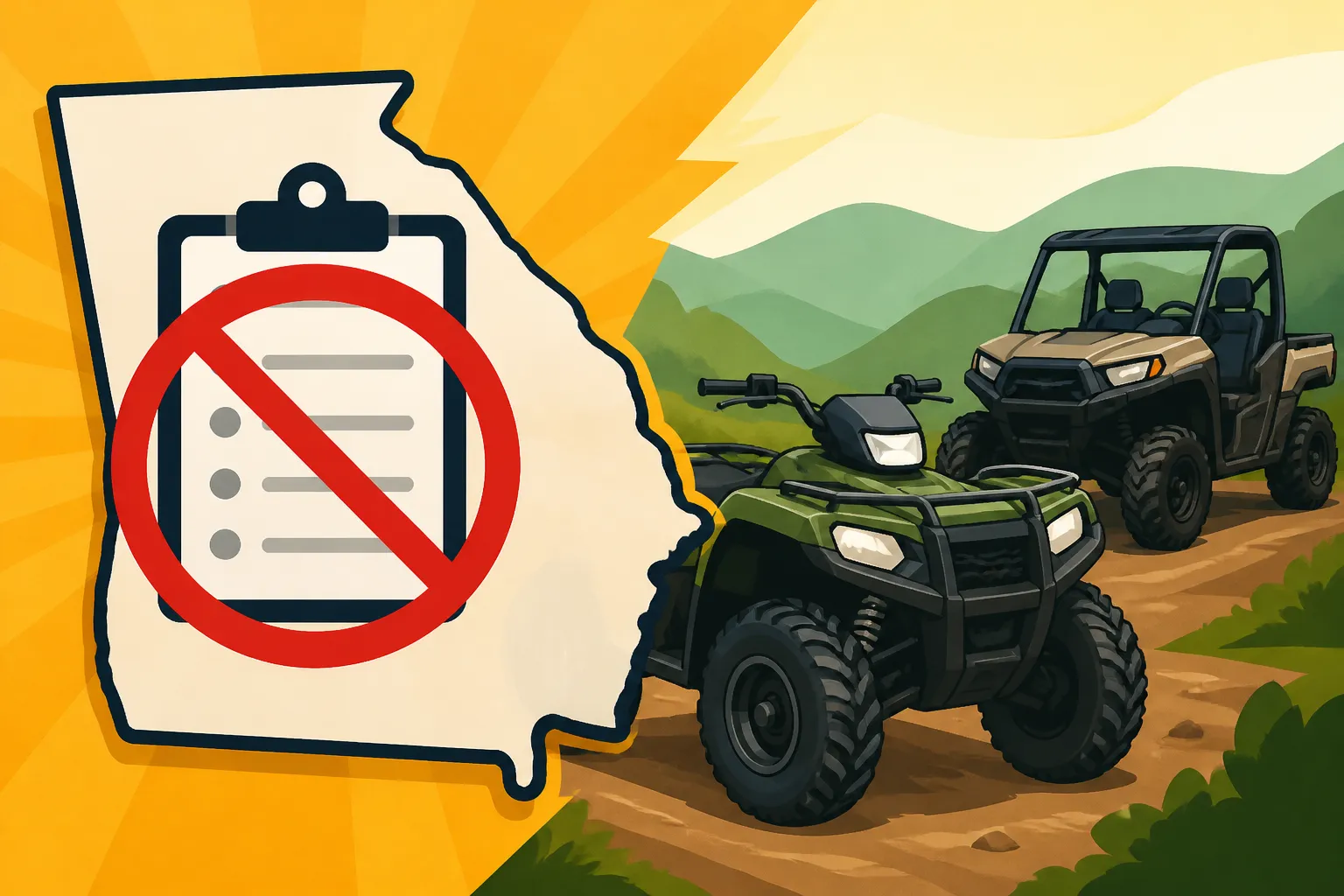
Georgia does not require every ATV or UTV rider to carry a state safety-course card, but that does not mean every ride is unrestricted. The key is to separate training from permits, land-access rules, age limits and equipment requirements. Knowing which rules apply to your riding location helps you avoid treating an optional course as a substitute for actual permission to ride.
What Georgia’s lack of a state safety course means
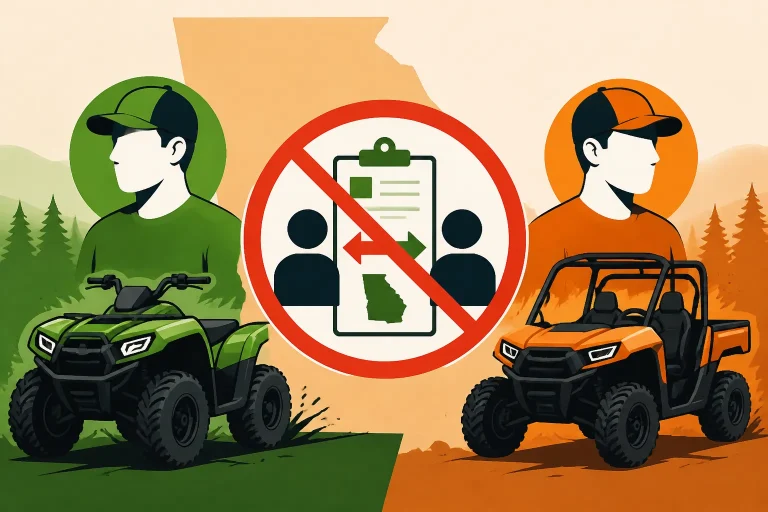
Georgia does not set a general statewide requirement that every ATV or UTV operator complete a state safety course before riding. There is no universal Georgia ATV safety card that all riders must obtain simply to operate an off-highway machine.
That answer is narrower than it may sound. It does not mean training is unavailable, that every rider is automatically allowed on every trail or road, or that a private park or other land manager must accept the same rules as the state. It means a statewide safety-course requirement is not the default legal hurdle for all ATV riding in Georgia.
It also helps to distinguish a course requirement from other kinds of requirements. A rider may still need an access permit, permission from a landowner, a machine that meets the relevant requirements, or compliance with rules for age, helmets and passengers. Those requirements depend on where and how the machine is being used.
| Question | What the answer generally tells you |
|---|---|
| Does Georgia require a statewide ATV safety-course card for every rider? | No general statewide course requirement applies to every rider. |
| Can a forest or trail system require a permit? | Yes. Access permits and safety-course requirements are separate issues. |
| Can a private park set its own rules? | Yes. Check the park’s current rules before travelling. |
| Does a voluntary course make a ride legal? | No. Training does not replace permits, permission or operating rules. |
| Can an out-of-state rider assume their home-state rules apply? | No. Check the requirements for the specific Georgia riding area. |
A voluntary course can still be useful. It can help a new rider understand safe operation, learn how to choose a suitable machine and practice basic skills before entering a trail system. But completing a course does not automatically authorize access to land or override a rule set by a park, permit program or property owner.
For a closer look at the difference between an optional course and Georgia’s legal requirements, see Georgia Safety Course Options That Exist. The useful takeaway is simple: do not search only for a Georgia safety card. First identify the land or facility where you plan to ride, then check the rules that apply there.
What still determines whether you can ride
The absence of a statewide course requirement does not settle whether a particular ride is permitted. Georgia riding rules vary by setting, and access rules can apply to the rider, the vehicle or both.
National forest OHV trails
Some Georgia National Forest OHV systems require an OHV permit. That permit is an access requirement, not proof that the operator has completed a safety course. Check the current rules for the trail system you plan to use, including whether it is open, which vehicle types it accepts and what permit each operator must carry.
Georgia’s forest OHV permit system is described as applying per operator rather than per vehicle. In practical terms, do not assume that one permit covers everyone in a group just because they are travelling on one machine. Review Georgia’s Per-Operator Permit, Not Per Vehicle and confirm current permit details before setting out.
The permit itself also has limits. It does not necessarily authorize riding on every road or trail in a forest, remove vehicle-width restrictions or guarantee that a particular route is open. The official area information and signs at the site matter. A rider who has a permit but enters a closed route may still be breaking an access rule.
Wildlife Management Areas
Wildlife Management Areas can have their own access conditions. ATV use may be limited to designated roads or allowed only during specified times or hunting-related periods. These are access rules, not safety-course requirements. A completed training course does not make riding permitted outside the allowed conditions.
Before taking a machine onto a WMA, check the rules for that specific area and the dates of your visit. A broad assumption such as “it is public land, so riding is allowed” can lead to trouble. Georgia WMA Rules for ATV Riders explains why the particular area, route and timing matter.
Private land and private parks
On private land, the owner or operator can set conditions for access. A landowner may require permission, limit where machines can travel or prohibit riding altogether. A commercial riding park may have its own minimum ages, waiver process, helmet rules, vehicle restrictions or check-in requirements.
These policies can be stricter than the statewide baseline. They may also change, so check with the park directly instead of relying on an old post, a friend’s recollection or a rule from another facility. See Georgia Private Park Age Minimums for one example of a park-level rule that is distinct from a statewide course requirement.
Public roads and registration
Road use is a separate issue from trail riding. Some machines are not eligible for certain forms of registration, and a registration does not automatically make every road available to an ATV or UTV. Road access depends on the vehicle and the applicable road rules, not on whether the operator has taken a training class.
If your plan involves public roads, verify whether the machine is eligible, whether registration and insurance apply, and whether that particular road is open to it. Are Side-by-Sides Street Legal in Georgia? addresses the difference between registration and permission to use a road.
This distinction is important because riders sometimes treat safety training as the main legal checkpoint. It is not. A trained operator can still ride on a prohibited road, enter a closed trail or fail to obtain a required permit. Conversely, the absence of a statewide training-card requirement does not mean a rider should skip preparation.
When a course, waiver or proof of experience may still matter
Even without a statewide course mandate, a rider may encounter a local or private requirement that affects a specific activity. Do not assume that all riding locations use identical rules.
A private park may require riders to sign a waiver, meet a minimum age, use designated safety gear or follow a briefing before riding. A rental operator may set conditions for who can operate a machine, whether passengers are permitted and what supervision is required. These policies are set by the business or land manager; they are not the same thing as a statewide Georgia safety-course law.
An organized event may also have its own participation rules. An organizer could require a rider briefing, proof of eligibility, a waiver or compliance with event-specific safety procedures. If you are joining a group ride, ask the organizer what to bring and what conditions apply rather than assuming that the regular trail rules answer every question.
Parents and guardians should make a separate check for young riders. Age limits, supervision expectations and helmet rules are not all resolved by asking whether a course is required. A child who has taken a course may still be too young for a particular machine, trail or facility. Review Georgia Supervision Rules for Minors and Georgia Under-18 Riders and the Helmet Rule for related topics, then confirm the rules that apply to the exact setting.
Insurance and landowner policies can add another layer. A property owner or park may impose conditions for access, and an insurer may have policy terms that affect coverage. Neither issue should be confused with a state course card. If you are riding a borrowed or rented machine, make sure you understand who is responsible for the machine, who is covered and what restrictions apply.
A practical way to handle this is to ask the facility or organizer direct questions before the trip:
- Is a course certificate required, or is a safety briefing enough?
- Are there minimum ages for operators and passengers?
- Is a helmet or other protective gear required?
- Are there vehicle-size, width or type restrictions?
- Does each rider need a permit, or does one permit cover the group?
- Are waivers or proof of permission needed?
- Are there restrictions on passengers, alcohol, riding hours or trail direction?
Get the answer from the organization responsible for the place or event. A rule that applies at one private park may not apply at another, and an event may have conditions beyond the everyday access rules.
How to choose useful voluntary training
A voluntary course can be worthwhile even when no Georgia state card is required. The value depends on the rider’s experience, the machine and the kind of terrain involved. A first-time operator may benefit from practical instruction more than an experienced rider who is simply moving to a different model.
When comparing training options, look for instruction that covers more than basic controls. Useful material should address how to prepare the machine, manage speed, carry passengers safely when the vehicle is designed for them, read terrain and respond when conditions change. The course should make clear whether it is online-only or includes supervised practice.
Online instruction can introduce safety concepts and help a rider think through common decisions. It cannot fully substitute for controlled practice operating the actual type of machine. If a rider has never used an ATV, hands-on instruction can help with throttle control, braking, turning, body position and stopping safely. A side-by-side also has different controls and handling characteristics from a straddle-seat ATV, so training should match the vehicle wherever possible.
Before choosing a course, consider these questions:
- Does the content match the machine? Training for one vehicle type may not cover the handling and passenger issues of another.
- Does it include practice? A knowledge lesson is useful, but hands-on instruction can help build control skills.
- Does it address the conditions you expect? Trail riding, farm work and steep or muddy terrain present different challenges.
- Is the provider clear about what the certificate means? A certificate may show course completion without satisfying a separate park, employer or land manager rule.
- Can you verify the course requirement with the place you plan to ride? If someone says a certificate is mandatory, ask which organization requires it and what form of proof is accepted.
A course can also help experienced operators spot habits that have become risky. Familiarity with a machine can lead riders to underestimate changing terrain, carry more weight than the vehicle is designed for or ride faster than visibility allows. Training is most useful when it changes decisions, not when a certificate is treated as a substitute for judgment.
For an overview of the subjects a rider may encounter, see What a Course Teaches a New Rider. Topics such as inspecting the machine, using protective equipment and riding within your abilities are practical regardless of whether a course is mandatory.
A practical checklist for Georgia riders and visitors
If you are planning to ride in Georgia, sort out access and operating conditions before you pack the trailer. Use this sequence to avoid relying on the wrong rule.
- Choose the riding location first. Identify the exact trail system, WMA, private park or property. “Riding in Georgia” is too broad to determine access rules.
- Check whether the location is open. Confirm closures, seasonal limits, weather-related restrictions and any route-specific conditions.
- Identify the permit or permission needed. Find out whether an access permit is required, who must hold it and whether landowner permission is necessary.
- Confirm vehicle eligibility. Check that the machine type and dimensions are accepted. A safety course does not make an ineligible machine fit a trail system.
- Ask about age, supervision and passenger rules. Pay particular attention when a minor will operate or ride as a passenger.
- Check equipment and protective-gear rules. Do not assume that a rule for one setting automatically applies at another.
- Ask whether training is required at that location. If a park, rental business or event says it is, confirm the required course or briefing and acceptable proof.
- Carry the documents the location requests. These might include a permit, proof of permission or a completed waiver. A course certificate is not a substitute for any of these.
- Recheck shortly before the ride. Closures, access conditions and business policies can change.
Visitors from another state should not assume that a card or permit from home automatically satisfies Georgia access rules. A home-state certificate may show training, but that does not necessarily replace a Georgia trail permit or the rules of a private facility. Similarly, having an out-of-state registration does not itself answer whether a machine may be used on a particular Georgia road or trail. See [Georgia Rules for an Out-of-State Plate] and Do Visiting Riders Need a Georgia Forest Permit? when planning a trip.
For forest riding, keep the permit question distinct from the course question. The permit is about the access program; training is about rider preparation. Read Georgia’s Day and Annual Forest OHV Permits for a separate explanation of permit options, and confirm the current requirements through the responsible land manager before travelling.
The same approach works for local riders. If you ride only on private land, ask the owner what permission and safety conditions apply. If you use a commercial park, check its policies. If you intend to use a public road, research road access, vehicle eligibility, registration and insurance separately. There is no single training card that clears all of those hurdles.
Frequently Asked Questions
Does Georgia require an ATV safety course before I ride?
Georgia does not have a general statewide requirement for every ATV or UTV operator to complete a safety course. A specific park, event, rental business or land manager may set its own requirements, so check before riding.
Does a forest OHV permit prove that I completed safety training?
No. A permit and a course are different things. A permit relates to access under the applicable program; it does not automatically certify training or authorize use outside the permit’s rules.
Can a private riding park require a course even if Georgia does not?
A private facility can set its own participation conditions. Contact the park directly to confirm whether it requires a course, briefing, waiver, age qualification or specific equipment.
Should a new rider take a course if it is optional?
It can be a good idea, especially for a first-time operator or someone unfamiliar with the machine or terrain. Look for instruction that matches the vehicle and includes practical riding skills when available. A course improves preparation but does not replace permits, permission or local rules.
Disclaimer
This article is for general informational purposes only and does not constitute professional advice. Laws, prices and regulations vary by location and change over time. Consult a qualified professional for guidance on your specific situation.