Machines Built Before 2000 and Georgia Registration
Many Georgia ATV and UTV owners find themselves scratching their heads when they discover their beloved older machine might not be eligible for the state's new MPOHV registration. If your quad or side-by-side rolled off the assembly line before January 1, 2000, you're facing a specific challenge, and this guide will break down exactly why and what your options are.
Understanding Georgia's MPOHV Registration Launch and the Age Cutoff
When Georgia introduced its new Motorized Play Vehicle (MPOHV) registration program, it opened up a world of limited public road access for many side-by-sides and qualifying ATVs. However, it also drew a clear line in the sand, creating a hard cutoff date for a machine's eligibility. This date is critical for anyone hoping to take their off-road vehicle from the trails to certain county roads.
The January 1, 2000 Build-Date Cutoff: What It Means
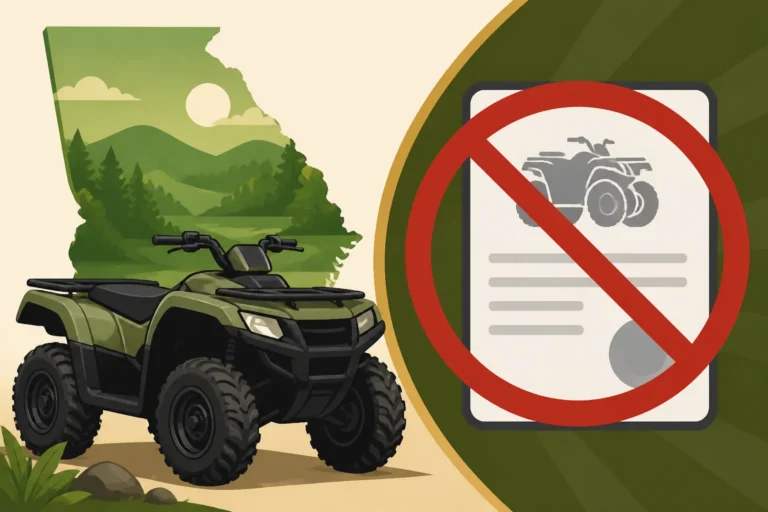
One of the most significant, and often frustrating, criteria for Georgia's MPOHV registration is the manufacturing date of your machine. The rule is unambiguous: only machines built on or after January 1, 2000, can even be considered for registration. This means that if your ATV or UTV has a manufacturing date of December 31, 1999, or any date prior, it is automatically disqualified. It doesn't matter how well-maintained it is, how many upgrades you've made, or how perfectly it meets other criteria like speed or width. That specific build date acts as an insurmountable barrier.
Imagine finding a classic utility ATV from 1998 in impeccable condition, perhaps even still sporting its original tires and paint. You might think, "This is perfect for running errands down the county road!" Only to discover that because of its age, it simply cannot obtain a [Georgia Plates for Off-Highway Vehicles]. This can be a huge disappointment, especially for enthusiasts of older models or those who simply aren't in the market for a brand-new machine.
Why This Specific Date Matters for Older Machines
The establishment of the January 1, 2000, cutoff date isn't arbitrary. It often reflects a legislative decision to align with evolving industry standards, safety regulations, and manufacturing practices that became more prevalent around the turn of the millennium. Newer machines are generally designed with a different set of safety features and engineering considerations that make them more suitable for even limited public road interaction. This includes advancements in braking systems, chassis integrity, and occupant protection.
By setting this specific date, Georgia aims to ensure a baseline level of modern design and inherent safety for any off-highway vehicle seeking a registration plate. It acknowledges that while older machines might be perfectly capable and safe for their intended off-road environment, they may not possess the attributes considered necessary for shared road use, even on less-trafficked county routes. It's a foundational aspect of the [Georgia MPOHV Eligibility: The Eight-Point Test], which every potential registrant must clear.
The Challenges of Registering a Pre-2000 Machine in Georgia
Owning an ATV or UTV manufactured before the year 2000 presents a unique set of obstacles when it comes to Georgia's MPOHV registration program. These challenges extend beyond just the age, impacting how owners can legally utilize their machines on public thoroughfares.
The Inherent Disqualification for Road Use
The most significant challenge, as we've established, is the inherent disqualification due to the manufacturing date. If your machine's birth certificate reads any date before January 1, 2000, it cannot be registered in Georgia for road use, full stop. This isn't a rule that can be circumvented by adding turn signals, seatbelts, or other modern accessories. The fundamental "date of manufacture" criterion as described in [A 1998 Machine and What It Cannot Do] is a pass/fail point that cannot be modified.
This means that while your older side-by-side might be powerful and reliable, capable of hauling feed across a farm or navigating tough trails, it cannot legally traverse a public county road in Georgia, even for short distances. This can be particularly frustrating for owners in rural areas who might have previously used their machines for quick trips to a neighbor's house or to access different parts of their property that are bisected by a county road. The MPOHV registration was designed to offer this limited flexibility, but only to those machines that meet the stringent eligibility criteria, with the build date being a non-negotiable first hurdle.
Limited Options for Documentation on Vintage ATVs/UTVs
Beyond the hard build-date cutoff, older machines often come with their own unique set of documentation challenges. Unlike newer ATVs and UTVs that typically come with a Manufacturer's Certificate of Origin (MCO) and clear bills of sale, machines manufactured in the last century often have a less defined paper trail. Many were purchased directly for farm use or recreational riding on private land, where formal titling was not a common practice or requirement in Georgia.
This historical lack of formal titling for ATVs in Georgia for many years further complicates the chain of ownership for very old machines. While the state's MPOHV program now requires detailed proof of ownership, such as a bill of sale or an affidavit, the ability to provide these documents for a 1995 model that has changed hands multiple times can be difficult. Even if an owner were to clear every other hurdle for MPOHV registration, which they cannot due to the age, the lack of robust historical paperwork would present another significant barrier. This situation is why the general advice for [Proving You Own an ATV in Georgia Without a Title] is so critical, even if it won't allow for road registration in this specific case.
What if You Own a Machine From 1999 or Earlier?
If you're the proud owner of an ATV or UTV manufactured before January 1, 2000, the news about MPOHV registration might be a letdown. However, this doesn't mean your machine is without purpose or value. It simply means its purpose remains strictly off-road, and there are still important considerations regarding its ownership and use.
Focusing on Private Land and Designated Trails
The inability to register your pre-2000 machine for public road use in Georgia does not, by any stretch, render it useless. Its primary function as an off-road utility or recreational vehicle remains completely intact. Many Georgians rely on these older, often robust, machines for demanding tasks on farms, timberland, or large private properties. They are indispensable for hauling supplies, checking fences, or navigating challenging terrain far from paved roads.
Furthermore, a significant portion of ATV and UTV enjoyment in Georgia happens on designated trails and at private off-road parks. Your vintage machine is perfectly legal and welcome on [Georgia ATV Trails: Where You Can Legally Ride] within the state's national forests (with the proper permits) or at various [Georgia Private Off-Road Parks Compared]. These venues are specifically designed for off-road adventure and accommodate a wide array of machines, regardless of their year of manufacture or road-legal status. Always ensure you have permission when riding on private land and are familiar with [Georgia Trespass Law for ATV Riders] to avoid any legal issues.
Exploring Alternatives for Proof of Ownership for Older Machines
Even without the possibility of MPOHV registration, establishing clear proof of ownership for your pre-2000 machine is incredibly important. This documentation is crucial for several reasons: it aids in recovery if your machine is stolen, can be required by insurance providers, and is essential if you ever decide to sell the machine privately. Since these older machines typically lack a formal title, you'll need to rely on other forms of documentation.
A comprehensive bill of sale, even for a very old machine, is the gold standard for proving a legitimate purchase. It should include detailed information about both buyer and seller, the date of sale, the price, and, most importantly, the machine's make, model, year, and its unique Vehicle Identification Number (VIN) or serial number. If you've inherited a machine or the original paperwork has been lost over time, an ownership affidavit becomes a vital alternative. This is a sworn legal statement attesting to your ownership, often notarized to add legal weight. If you find yourself needing to create a formal declaration of ownership, especially if you're trying to clear up a chain of custody for a very old machine, online legal document services like LawDepot offer templates for affidavits and bills of sale that can be incredibly helpful. These resources empower you to create a clear paper trail, offering peace of mind even for machines that will only ever be ridden on private land.
The Intent Behind Georgia's MPOHV Age Restriction
The decision by Georgia's lawmakers to impose a January 1, 2000, manufacturing date cutoff for MPOHV registration was not arbitrary. It stems from a broader policy intent aimed at balancing recreational access with public safety and modern regulatory standards. Understanding this rationale can help owners grasp why their older machines, despite their condition, are excluded from the program.
Safety Standards and Evolving Machine Design
One of the primary drivers behind the age restriction is the significant evolution in safety standards and machine design that has occurred over the past few decades. Off-road vehicles manufactured before the year 2000 typically predate many of the advanced safety features and engineering principles that are now common. For instance, modern UTVs often incorporate more robust Roll Over Protective Structures (ROPS), improved seatbelt systems, and better-designed occupant compartments to enhance safety in the event of an accident. ATVs have also seen advancements in braking, suspension, and overall stability.
When a state like Georgia considers allowing these machines onto public roads, even with limitations, it has a responsibility to public safety. Older designs may not meet contemporary crashworthiness standards or incorporate the same level of occupant protection as their newer counterparts. The cutoff date serves as a practical way to ensure that any machine granted limited road access adheres to a more modern baseline of safety, reducing potential risks to both the operator and other road users. This proactive approach helps to mitigate the challenges faced by [Georgia Sheriff Enforcement on County Roads] when monitoring compliance.
Distinguishing Recreational Use from Road-Legal Compliance
Another key intent behind the age restriction is to maintain a clear distinction between purely recreational or utility off-road use and limited public road-legal compliance. Georgia's MPOHV registration program was not designed to make all off-road vehicles street legal. Instead, it carved out a specific, regulated niche for certain machines that met a strict set of criteria, enabling them to cross or briefly traverse specific county roads. The age cutoff helps to reinforce this distinction.
Machines built before 2000 are, in the eyes of this law, firmly categorized as traditional off-road vehicles. Their design and intended use align with private property or dedicated trail riding, which remain entirely permissible activities. By limiting road registration to newer machines, the state can better control the characteristics of vehicles sharing public thoroughfares, even if those thoroughfares are secondary county roads. This framework is part of the comprehensive set of rules outlined in [Where Georgia's MPOHV Rules Are Written Down], aiming to create a structured and safe environment for both off-road enthusiasts and the broader public.
Navigating Ownership Records for Pre-2000 Machines
Even though machines manufactured before the year 2000 cannot be registered for road use in Georgia, establishing and maintaining clear ownership records remains critically important. Without a formal title, these documents are your primary proof of possession, invaluable for personal records, insurance, and future private sales.
The Importance of a Strong Bill of Sale for Older Purchases
For any transaction involving a pre-2000 ATV or UTV, a comprehensive bill of sale is not just recommended; it's absolutely essential. Since there is no state-issued title for most of these older off-road machines in Georgia, the bill of sale serves as your strongest legal document proving transfer of ownership. A well-drafted bill of sale acts as a contract, protecting both the buyer and the seller.
A robust bill of sale should clearly list the full legal names, addresses, and contact information for both the buyer and the seller. It must specify the date of the sale and the agreed-upon purchase price. Crucially, it needs to include a detailed description of the machine itself: its make, model, year of manufacture, and its unique Vehicle Identification Number (VIN) or serial number. Both parties should sign and date the document, and it's highly advisable to have it notarized for added legal weight, especially for higher-value transactions. Always be wary if a seller is reluctant to provide a detailed bill of sale, as this could indicate potential issues such as a stolen machine or undisclosed liens. Services that provide templates for [Bills of Sale That Hold Up at a Tag Office] can be a useful resource here, even if your machine won't be registered.
Creating an Ownership Affidavit for Machines Without Paperwork
Sometimes, the original paperwork for an older machine has been lost over decades, or perhaps the machine was a gift or inherited, meaning a traditional bill of sale was never generated or kept. In these scenarios, an ownership affidavit becomes a critical tool. An affidavit is a formal, sworn written statement of facts, made under oath or affirmation, and typically signed before a notary public.
For ownership, this affidavit would detail how you came into possession of the machine, when, and from whom (if known). It would affirm that you are the rightful and sole owner of the machine, identifying it by its make, model, year, and VIN/serial number. While an [Georgia Ownership Affidavit for an MPOHV] is typically used for eligible machines needing registration, the concept of an ownership affidavit is broadly applicable. It creates a formal, legal document where previously there was none, solidifying your claim to the machine. This is particularly valuable for insurance purposes or to present to potential buyers in a private sale. Services like LawDepot can assist individuals in drafting legally sound affidavits that comply with basic requirements, ensuring that even machines with a fragmented paper trail have documented proof of ownership, providing a crucial layer of protection.
| Feature | Bill of Sale (New Purchase) | Ownership Affidavit (Existing Machine) |
|---|---|---|
| Purpose | Records transfer of ownership, proves sale details | Sworn statement of ownership where no prior record exists |
| When Used | Every time a machine is sold/bought | When original purchase documents are missing or never existed |
| Key Information | Buyer/Seller names, date, price, machine details, VIN | Owner's name, how machine was acquired, machine details, VIN |
| Notarization | Recommended, but not always strictly required | Highly recommended, often required for legal weight |
| For Pre-2000 Machines | Essential for proving legitimate purchase | Crucial for establishing a legal claim without a title |
| Road Registration | Does not grant eligibility for pre-2000 machines | Does not grant eligibility for pre-2000 machines |
| Legal Templates | Available through services like LawDepot and others | Available through services like LawDepot and others |
Looking Ahead: The Future for Older Off-Road Machines in Georgia
While the news about Georgia's MPOHV registration for machines built before 2000 might restrict their use on public roads, it certainly doesn't diminish their overall value or utility. These machines have a long-standing place in Georgia's outdoor and agricultural landscape, and that role continues to be vital. Understanding the ongoing context of their use is key for owners.
Continuing the Tradition of Private Land Riding
For generations, ATVs and UTVs have been indispensable tools for landowners, hunters, and outdoor enthusiasts across Georgia. Machines manufactured before the year 2000 are part of this rich tradition. Their ruggedness, simpler mechanics, and often lower acquisition costs make them incredibly practical for their original intended purposes. These older machines continue to be perfectly legal and highly effective for hunting excursions, completing farm chores, navigating timber tracts, or simply exploring the vast expanse of private property.
The vast majority of off-road riding in Georgia still takes place on private land or within the extensive networks of dedicated trails at state and private parks. Owners of pre-2000 machines can continue to enjoy their vehicles without any issues in these environments. Whether it's a trusty quad used to check deer stands or an old workhorse side-by-side for feeding livestock, these machines retain their full utility and value where they belong: off the pavement.
Understanding the Voluntary Nature of MPOHV Registration for Eligible Machines
It's important to remember that even for machines that do meet all of Georgia's MPOHV eligibility criteria, including the January 1, 2000, build date, the registration itself is entirely voluntary. This means owners of qualifying newer machines have the choice to register if they wish to gain limited access to county roads. If they primarily use their machine on private property or designated trails, they may opt not to register, as outlined in [Georgia MPOHV Registration Is Voluntary].
However, for machines built before 2000, the conversation about voluntary registration is moot. They are simply not eligible to begin with, meaning the choice to register or not doesn't even enter the picture. Their status is fixed: purely off-road, private land, or designated trail use only. This distinction highlights that the age cutoff is a fundamental eligibility barrier, completely separate from the owner's choice to participate in the MPOHV program for qualifying machines. The rules are clear, and while they may be disappointing for some, they aim to create a consistent framework for all off-highway vehicles in the state.
Disclaimer
This article is for general informational purposes only and does not constitute professional advice. Laws, prices and regulations vary by location and change over time. Consult a qualified professional for guidance on your specific situation.