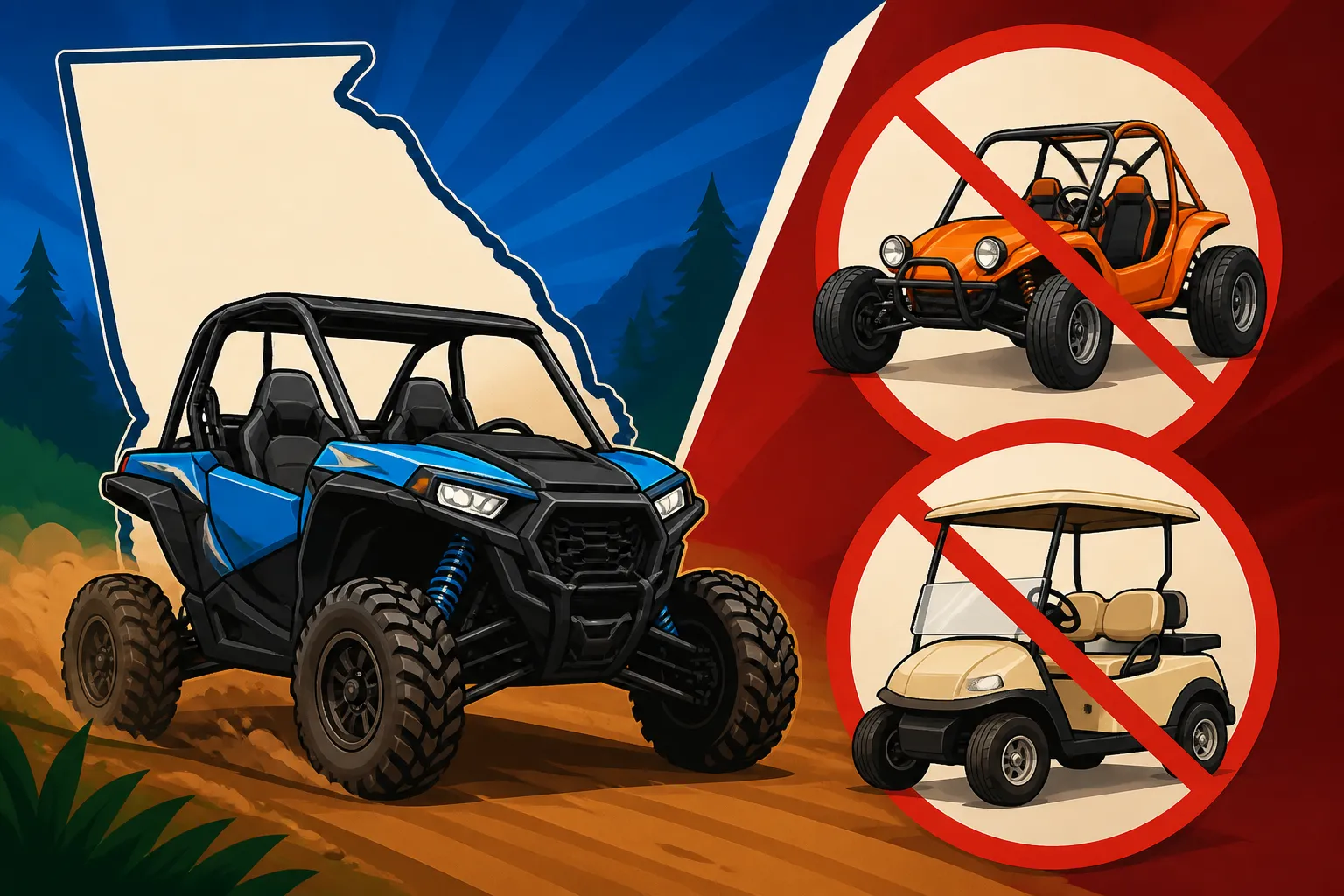
Georgia Dune Buggies and Golf Carts Are Excluded
It's incredibly frustrating when you see some folks cruising their side-by-sides down a Georgia county road with a shiny new plate, and you're left wondering why your perfectly good golf cart or awesome dune buggy can't get the same treatment. Many owners feel like they're in a confusing maze, especially with all the new rules. This guide is here to clear up that confusion and explain exactly why the Georgia MPOHV registration system excludes dune buggies and golf carts, helping you understand the specific criteria that keep these popular machines off the MPOHV list.
The Core Distinction: What Georgia's MPOHV Law Covers (and Doesn't)
Georgia's approach to allowing certain off-highway vehicles (OHVs) on county roads isn't a blanket invitation to every machine that leaves the pavement. The state created a very specific category, the Multipurpose Off-Highway Vehicle, or MPOHV, with a clear intent and strict guidelines. This distinction is crucial to understanding why some vehicles get a plate while others, like your beloved golf cart or dune buggy, don't quite fit the mold.
Understanding "Multipurpose Off-Highway Vehicles" (MPOHV)
When Georgia enacted its MPOHV registration law, it wasn't trying to make every golf cart or vintage dune buggy street-legal. The legislative intent was quite focused: to provide a pathway for certain types of utility-focused side-by-sides, commonly used for hunting, farming, or other work, to legally traverse county roads for short distances. Think of it as a nod to practicality for machines that spend most of their lives off-road but occasionally need to cross a paved county road to get from one section of land to another, or access a trailhead.
An MPOHV, in Georgia's eyes, is a four-wheel, off-road vehicle that is not designed for farming and that meets very specific criteria. It's meant to bridge the gap between private property use and limited public road access, primarily for machines that resemble the modern UTV or side-by-side. The law outlines a detailed set of physical and operational characteristics that define what an MPOHV is, and by extension, what it isn't.
Why Specific Criteria Are So Important
The Georgia MPOHV law isn't vague; it spells out an "eight-point test" that every machine must pass to qualify for registration. This isn't just a suggestion; it's a mandatory checklist that your local county tag office will scrutinize. Each of these eight points acts as a gatekeeper, ensuring that only machines meeting a certain safety and design standard for road interaction can get a plate.
The reason for such strict criteria is multifaceted. It's about public safety, ensuring that vehicles sharing public roads have basic features like proper steering and restraint systems. It's also about maintaining a clear distinction between these utility-focused machines and traditional motor vehicles, as well as recreational vehicles that might be less suited for shared road use. Unfortunately, many golf carts and dune buggies, while fantastic in their own right, simply don't tick all the boxes on this very precise list. You can dive deeper into [Georgia MPOHV Eligibility: The Eight-Point Test] to see the full rundown.
Why Golf Carts Don't Make the Cut
Golf carts are incredibly popular in Georgia, especially in communities with extensive path networks. They're fantastic for short trips, neighborhood cruising, and, of course, their namesake sport. However, despite their utility, they almost universally fail to meet the specific requirements for Georgia MPOHV registration. It really comes down to their fundamental design and purpose.
Speed Limits and Design
One of the most significant hurdles for golf carts is their operating speed. Georgia's MPOHV law specifically requires that a registered machine be capable of speeds between 25 miles per hour (mph) and 65 mph. This is a critical range, designed to allow MPOHVs to blend somewhat with slower county road traffic without being a hazard, but also to exclude machines that are too fast for casual road use.
Most traditional golf carts are designed to top out well below 25 mph. They are engineered for low-speed, controlled environments like golf courses, campgrounds, or planned communities with dedicated paths. While some modern "personal transportation vehicles" (PTVs) or souped-up golf carts might push past this, the vast majority simply don't have the engine power or gearing to consistently maintain the minimum 25 mph requirement. This alone is often enough to disqualify them from MPOHV registration.
Safety Features and Structure
Beyond speed, golf carts often lack the structural integrity and specific safety features mandated for MPOHV registration. While many modern golf carts have seat belts and even headlights, they are generally not built to the same standards as a side-by-side or a traditional motor vehicle. The MPOHV criteria often implicitly or explicitly require features like a robust roll-over protection structure (ROPS) or specific types of restraint systems.
The enclosed cab structure, or at least a substantial frame, common on UTVs, is typically absent on an open-air golf cart. While some golf carts have roofs and windshields, they may not offer the same level of occupant protection envisioned by the MPOHV law. These design differences are fundamental and distinguish a golf cart from the type of machine Georgia intends to see registered for limited county road use. For specific details on how Georgia classifies these, you might find [Georgia Golf Cart Laws and PTV Ordinances] helpful, as it explains the separate rules that do apply to them.
Why Dune Buggies Are Also Excluded
Dune buggies, with their often custom-built, open-air charm, represent another category of off-highway vehicle that typically falls outside Georgia's MPOHV registration framework. The term "dune buggy" itself can be quite broad, encompassing everything from modified Volkswagen Beetles to custom tube-frame creations, but for the purposes of MPOHV, they often hit similar roadblocks as golf carts, plus a few unique to their design.
Defining "Dune Buggy" in this Context
When we talk about "dune buggies" in the context of Georgia's MPOHV law, we're generally referring to recreational vehicles designed primarily for off-road fun, often characterized by their lightweight construction, open chassis, and sometimes custom-built nature. These aren't your typical factory-produced side-by-sides. Many are home-built or assembled from kits, and while some might be engineered to be street-legal as traditional cars (requiring full title and registration as such), they rarely fit the narrow definition of an MPOHV.
The key here is that an MPOHV is a specific category of off-road vehicle defined by Georgia law. Just because something is "off-road" and "multipurpose" in a general sense doesn't mean it aligns with the state's very particular MPOHV checklist. This is where the broader "dune buggy" definition clashes with the precise legal language.
The "Straddle Seat" and "Handlebar" Problem
A major disqualifier for many traditional dune buggies, particularly older models or those designed for a single operator, can be the seating and steering configuration. Georgia's MPOHV law explicitly states that the machine must have a non-straddle seat and a steering wheel. This immediately rules out any machine where the operator sits astride the engine, like a motorcycle or ATV, or where the machine is controlled by handlebars.
While many modern dune buggies or side-by-side-style sand rails might have bucket seats and a steering wheel, some classic or smaller dune buggies, especially those based on ATV chassis or designs, may feature straddle seats or handlebars. Even if they meet other criteria, failing on these two points alone is enough to prevent MPOHV registration. Understanding [Why a Straddle Seat Disqualifies a Machine] and [Why Handlebars Disqualify a Machine] really helps clarify these specific exclusions.
Weight, Width, and Payload Considerations
Beyond the seat and steering, dune buggies can also run into trouble with the MPOHV's size and capacity requirements. The law sets specific limits: an MPOHV must have a gross vehicle weight rating (GVWR) of 4,000 pounds or less, a payload capacity of 350 pounds or more, and a maximum width of 80 inches. These figures are tailored for typical utility-grade side-by-sides.
Some very large, heavily built dune buggies or those with extensive roll cages and accessories might exceed the 4,000-pound GVWR, making them too heavy. Conversely, very light, minimalist sand rails might struggle to meet the 350-pound payload capacity requirement if they are primarily designed for speed and agility rather than hauling. The width limit, [Georgia's 80-Inch Width Limit for Registration], can also be an issue for some custom-built, wider machines, or conversely, very narrow ones. These specific dimensions are precisely what the tag office looks for.
The Eight-Point Test: Where These Machines Fall Short
To truly understand why golf carts and dune buggies are left out of Georgia's MPOHV registration, we need to revisit the infamous eight-point test. This isn't just a guideline; it's the legal framework. Each point is non-negotiable, and failing even one means no MPOHV plate for your machine. Let's break down where these specific vehicles typically hit a wall.
Seat Configuration and Steering
This is often the first and most obvious point of failure for many off-highway vehicles, though not always for golf carts. The Georgia MPOHV law demands a "non-straddle seat" and a "steering wheel." This immediately puts vehicles like dirt bikes and traditional ATVs out of contention, as they have straddle seats and handlebars.
For golf carts, they usually pass this hurdle: they have bench or bucket seats you don't straddle, and a steering wheel. So, while this isn't their primary issue, it's a critical point for understanding the overall spirit of the law. Dune buggies, depending on their build, might struggle here if they incorporate motorcycle-style seating or handlebar controls. The intent is clearly for machines that operate more like a small car than a two-wheeler or a traditional quad. You can see more about [Why a Georgia Sportsman Cannot Be Registered] for a related example of this rule in action.
Speed Range and Build Date
Another major barrier for both golf carts and often for older or highly specialized dune buggies is the mandated speed range: a machine must be capable of traveling at least 25 miles per hour but no more than 65 miles per hour. As discussed, most golf carts can't consistently hit that 25 mph minimum. This isn't just about how fast it can go on a good day; it's about its designed operational speed.
On the other hand, some high-performance dune buggies, especially those built for racing or extreme off-road speeds, might exceed the 65 mph upper limit. Even if they don't, this particular criterion highlights the type of vehicle the state is targeting: not too slow to impede traffic, but not so fast as to encourage highway use. Lastly, the MPOHV law includes a build date cutoff: the machine must have been manufactured on or after January 1, 2000. Many classic dune buggies, beloved as they are, often predate this cutoff, immediately disqualifying them regardless of their other features. [Machines Built Before 2000 and Georgia Registration] explains this in more detail.
What Options Remain for Golf Cart and Dune Buggy Owners in Georgia
Just because your golf cart or dune buggy can't get an MPOHV plate doesn't mean you're out of luck. There are still legitimate and enjoyable ways to operate these machines in Georgia, whether it's navigating local community paths or exploring private land. The key is understanding the different regulatory pathways and their limitations.
Local Ordinances for Golf Carts
While MPOHV registration isn't an option for golf carts, many communities in Georgia have embraced them through specific local ordinances, allowing them to operate on certain public roads or designated paths. These are often referred to as Personal Transportation Vehicle (PTV) ordinances. Cities like Peachtree City are famous for their extensive golf cart path networks, allowing residents to use their carts for daily errands.
These local rules are entirely separate from the state's MPOHV law. They typically involve specific speed limits for carts, sometimes require local registration or permits, and designate exactly which roads or paths are permissible. If you own a golf cart, your best bet is to check with your specific city or county government to see if they have such ordinances in place. For instance, [Peachtree City Golf Cart Rules in Georgia] is a great example of a community that has tailored its local laws to accommodate these vehicles. Always remember, just because you can ride in one city doesn't mean you can do it in the next town over without checking their specific rules.
Street Legal Conversion for Dune Buggies (and the Challenges)
For some dune buggy owners, particularly those with more robust, custom-built machines, the idea of making them fully "street legal" as a motor vehicle might arise. This is a very different, and often much more complex, undertaking than MPOHV registration. Converting a dune buggy to be a fully street-legal car means meeting all the safety, emissions, and equipment standards that apply to any passenger car on Georgia's roads.
This process would involve inspections, potentially extensive modifications (e.g., DOT-approved lighting, windshields, bumpers, emissions controls if applicable), and then full vehicle registration and titling with the state, not MPOHV registration. It's a significant investment in time and money, and not always feasible depending on the base vehicle's design. However, if you're engaging in such a project, or even just buying or selling a custom dune buggy, ensuring you have proper documentation is crucial. Tools like LawDepot can be incredibly helpful for drafting legal documents such as a bill of sale, ownership affidavits, or even lease agreements for custom vehicles or trailers, ensuring that even without MPOHV registration, your ownership and transaction details are clear and legally sound.
Private Property Use and Designated Trails
Perhaps the most straightforward and universally applicable option for both golf cart and dune buggy owners is to enjoy their machines on private property. Whether it's your own land, a friend's farm, or a leased hunting property, these vehicles excel in off-road environments where public road rules don't apply (though always respect private property boundaries and obtain permission). This is, after all, what many of these machines are primarily designed for.
Additionally, Georgia boasts a number of excellent private off-road parks that cater to various types of vehicles. While some parks have restrictions on width or type, many have dedicated trails or areas where golf carts and dune buggies can be operated safely and legally. These parks often have their own rules regarding safety gear, age limits, and vehicle types, so always check their specific guidelines before you go. Exploring [Georgia Private Off-Road Parks Compared] could give you a great starting point for finding a suitable place to ride.
Comparing MPOHV Eligibility to Golf Cart and Dune Buggy Characteristics
To truly illustrate why golf carts and most dune buggies don't qualify for MPOHV registration in Georgia, let's look at a side-by-side comparison of the key MPOHV eligibility requirements against the typical characteristics of these excluded vehicles.
| MPOHV Eligibility Requirement | Typical Golf Cart Characteristics | Typical Dune Buggy Characteristics (Recreational OHV) | Why Excluded from MPOHV |
|---|---|---|---|
| Non-Straddle Seat | Usually has bench or bucket seats (meets) | Varies: often bucket seats (meets), but some may have straddle seats (fails) | Golf carts usually pass. Some dune buggies fail if they have straddle seats. |
| Steering Wheel | Always has a steering wheel (meets) | Often has a steering wheel (meets), but some may have handlebars (fails) | Golf carts pass. Some dune buggies fail if they have handlebars. |
| Speed: 25-65 mph | Typically 15-25 mph (fails minimum) | Varies: some below 25 mph or above 65 mph (likely fails) | Golf carts fail the minimum speed. Many dune buggies fail either the minimum or maximum speed requirement. |
| Width: Max 80 inches | Typically 48-60 inches (meets) | Varies: most under 80 inches (meets), but some custom builds may exceed (fails) | Most pass. Some custom, wider dune buggies could fail. |
| Payload: Min 350 pounds | Typically 200-500 pounds (may meet, but often close to minimum for 4-seater) | Varies: some very light builds may be under 350 pounds (fails) | Golf carts are often borderline. Very lightweight dune buggies may not meet this. |
| Gross Weight: Max 4,000 pounds | Typically 900-1,200 pounds (meets) | Most under 4,000 pounds (meets), but heavily built ones may exceed (fails) | Most pass. Some heavily armored or customized dune buggies might exceed. |
| Manufactured Jan 1, 2000+ | Most modern carts meet (meets) | Many older or custom builds predate 2000 (fails) | Many older dune buggies fail this; not usually an issue for modern golf carts. |
| Headlights, Brake Lights, Mirrors | Often have some, but not always DOT-compliant (may fail) | Varies: custom builds may or may not have compliant lights/mirrors (may fail) | While often present, they may not meet specific MPOHV or DOT standards for road use. |
This table clearly highlights the specific points of divergence. While golf carts might pass the seat and steering requirements, their speed and sometimes payload capacity are often their downfall. Dune buggies, being more varied, can run into issues with seats, handlebars, speed, and especially the build date. These are the nuances that county tag office personnel will check against.
Disclaimer
This article is for general informational purposes only and does not constitute professional advice. Laws, prices and regulations vary by location and change over time. Consult a qualified professional for guidance on your specific situation.