Georgia ATV Trails for Kids
Georgia has family-friendly riding options, but “kid-friendly” does not automatically mean easy, legal for every machine, or safe for a new rider. A rocky mountain trail can overwhelm a small quad, while a route that suits an experienced teen may be a poor fit for a young child. This guide explains how to choose a Georgia riding area, match trails to your family, and plan a safer first outing.
How to choose Georgia ATV trails for kids
Start with your child, not the trail map
A trail marked easy may still feel intimidating to a young rider. It might include steep slopes, loose rocks, deep ruts, tight turns, water crossings, or narrow sections with limited room to stop. Consider your child’s age, experience, confidence, strength, attention span, and ability to follow directions before you choose a destination.
A child who is learning throttle control on a small quad may do best in a supervised practice area or on private land where riding is permitted. That setting gives them room to practice stopping, turning, and looking ahead without the pressure of keeping up with a group. A confident teen with experience on similar terrain may be ready for a managed trail system, but should still begin with the least demanding route that fits the machine.
Think about the whole family, too. A ride that is technically within a child’s ability can still become a miserable day if the route is long, the weather is hot, or there is no convenient place to take a break. Short, manageable rides with frequent check-ins are often more enjoyable than trying to cover as much ground as possible.
Match the machine to the trail and the rider
A child should ride a machine sized for them, not simply one that happens to be available. They need to reach the controls comfortably, operate the brakes, and maintain a stable riding position. A machine that is too powerful or heavy can be difficult to manage when a child needs to stop on uneven ground. A responsible adult should assess the child’s skill and the machine before the outing, rather than assuming that age alone determines readiness.
The type of machine matters when choosing a trail. Some public off-highway vehicle routes have width restrictions or are designed for specific types of machines. A full-size side-by-side may not fit on a trail intended for narrower vehicles, even if the family is comfortable with its difficulty. Check the route’s posted restrictions before loading the trailer. For an overview of machine access, see Georgia ATV Trails That Allow Side-by-Sides.
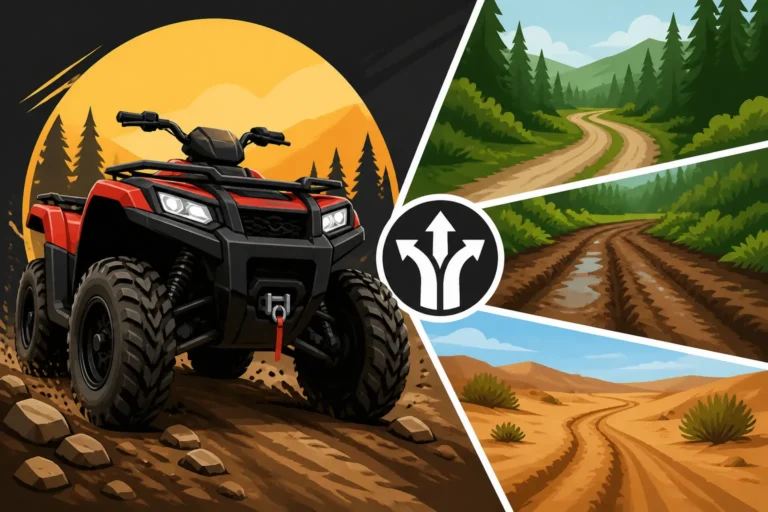
Trail labels also need context. A beginner rating does not mean a route is flat, free of hazards, or suitable for a young child riding alone. Read [Georgia Trail Ratings and What They Mean], then look for descriptions of elevation, surface, obstacles, and route length. When available, use a trail map to plan a short out-and-back or loop with an easy place to turn around.
Separate legal access from family suitability
Georgia offers several kinds of places to ride, including public trail systems, private off-road parks, and private property where the owner allows riding. Each has its own access rules and operating expectations. A trail shown on a map is not necessarily open to the public, and permission to ride does not mean every machine or rider is allowed there.
Before you leave home, check the land manager’s current rules for operating hours, trail closures, vehicle type, permits, age requirements, supervision, and equipment. Public-land rules and private-park rules can differ, and a park may set stricter age or helmet requirements than a family expects. The broader guide Georgia ATV Trails: Where You Can Legally Ride can help you understand the difference between riding areas.
| Riding option | What families may appreciate | What to check before going |
|---|---|---|
| Public OHV trail system | Marked routes and a defined riding area | Closures, permits, machine limits, trail difficulty, and operating hours |
| Private off-road park | Park-specific rules and managed facilities | Minimum ages, required gear, supervision, waivers, and permitted machines |
| Private property | Potentially familiar surroundings and flexible practice | Explicit landowner permission, hazards, boundaries, and local restrictions |
Georgia riding areas families can investigate
Public forest OHV systems in North Georgia
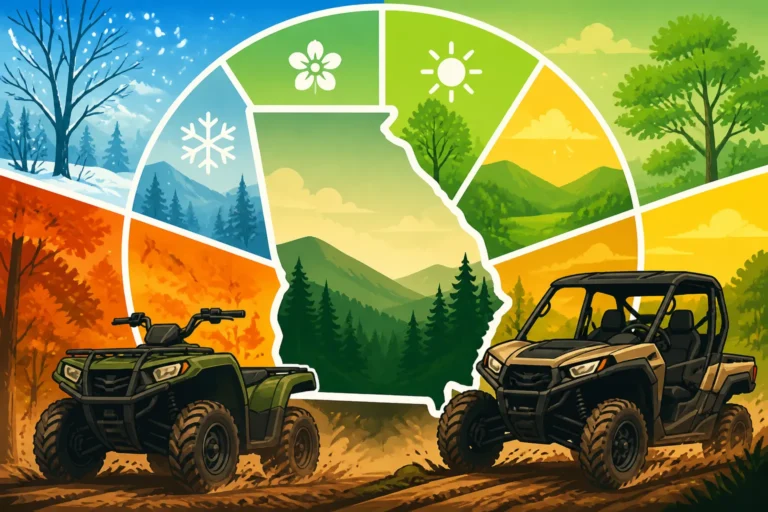
Georgia’s public forest OHV systems include areas in the North Georgia mountains, such as Houston Valley, Beasley Knob, Whissenhunt, Town Creek, Oakey Mountain, and Davenport Mountain. These are not all interchangeable family destinations. Terrain, vehicle access, trail difficulty, facilities, and seasonal availability can differ from one system to another. Review Georgia's Six National Forest OHV Systems before settling on a destination.
Mountain terrain can be demanding even on routes described as easier. A trail may climb or descend over uneven ground, and recent rain can change traction dramatically. If your child is new to riding, treat a public forest trail as a step up from a practice area—not as the place to learn basic throttle and braking skills for the first time.
Houston Valley is one example where vehicle fit deserves particular attention: its trail system has a narrow-machine limit, so many side-by-sides are not appropriate there. Check the applicable width and machine rules before you travel. Likewise, do not assume that a trail system’s name or map symbol tells you whether it is open, easy, or suitable for your family on the day you plan to visit.
Private off-road parks and managed riding areas
A private park may be a better match for some families because its rules, routes, and facilities are set by the operator. But “private” does not necessarily mean simple or risk-free. Parks can include challenging trails, and they may have rules about minimum rider ages, passenger ages, supervision, protective equipment, waivers, and which machines can use particular routes.
Call ahead or review the park’s official rules before making the drive. Ask specific questions: Can a child ride their own machine? Are there easier areas for a beginner? Are passengers allowed in the family’s side-by-side? Is a parent expected to ride alongside the child? Are there trails the park recommends avoiding after rain? Clear answers are more useful than relying on a broad “family-friendly” label.
If a child will be a passenger rather than the operator, check that the machine is designed for passengers and that the child can sit securely and reach any required handholds or restraints. Do not carry a child on a machine that is not built for a passenger. For a wider starting point, compare Best Georgia ATV Trails for Beginners with the individual park’s rules and trail descriptions.
Use maps as planning tools, not permission slips
A digital map can help you visualize route length, nearby roads, trail connections, and possible turnaround points. Some families use onX Offroad to plan a route and keep track of where they are, especially when visiting an unfamiliar riding area. Treat any app as a planning aid, not the final authority on whether a route is open or legal for your machine.
Before relying on a route, compare it with the land manager’s official information and posted signs. An old route line may not reflect a closure, a changed access rule, or a temporary restriction. Save the official trail information and a backup map before you leave, particularly if you expect limited cell service.
With kids, choose a route that gives you options. Mark a short starting loop, a place to stop, and a clear way to return to the trailhead. If the first section is rougher than expected, turn back rather than pushing forward because the map suggests the loop is nearly complete. onX Offroad can help with route planning, but your family’s comfort and posted access rules should guide the decision.
Prepare children and machines before the ride
Set clear safety expectations
Before starting the engine, explain a few rules in plain language: stay behind the lead adult, leave space between machines, stop when asked, and never ride beyond the agreed boundary. Children need to know what to do if they lose sight of the group or the machine in front slows down. Establish a simple stop signal everyone understands, and make sure each child knows where to wait if the group separates.
A properly fitted helmet is essential safety gear for young riders. Add eye protection, gloves, long sleeves, long pants, and sturdy over-the-ankle footwear appropriate to the machine and riding conditions. Check the park or land manager’s requirements, too. Georgia-specific requirements can vary by situation, so review [Georgia Helmet Rules for Riders Under 18] and follow any stricter site rules. Even where a particular item is not required, protective equipment may still be a sensible choice.
Keep the first outing short and calm. A child who is tired, overheated, frightened, or frustrated is less able to make good decisions. Take breaks before they are needed, bring water, and be willing to end the ride early. Finishing with a child feeling safe and eager to ride again is a better outcome than completing every planned mile.
Check the machine and the ride-day conditions
Inspect each machine before loading or starting the ride. Check tires, brakes, throttle operation, steering, lights where applicable, fluid leaks, and any safety equipment required by the manufacturer or riding area. Confirm that the machine is suitable for the child and that it is in good working order. A small mechanical problem can become more difficult to manage on a remote trail with a tired child.
Weather and surface conditions can change a route’s difficulty. Rain can make Georgia clay slick and deepen ruts; dry conditions can mean dust and reduced visibility behind other riders. Check Georgia Trail Conditions Before You Drive, along with official closure notices, before leaving. If storms, heavy rain, or extreme heat are expected, consider rescheduling rather than treating the plan as fixed.
Pack for a longer day than you expect, but keep the group’s route modest. Bring drinking water, snacks, basic first-aid supplies, a charged phone, and any tools or recovery equipment appropriate to your machines and experience. Tell someone at home where you plan to ride and when you expect to check in. If using onX Offroad for navigation, download or save what you need in advance and bring a backup plan in case a phone battery runs low or reception drops.
Check permits, access rules, and supervision requirements
Public riding areas may require permits, and a child who operates a machine may be treated differently from a child who rides as a passenger. Read the rules for the specific system rather than assuming one permit covers every person or machine. The guide [Georgia OHV Permits Are Per Operator, Not Per Vehicle] explains an important distinction families should confirm before heading to a public OHV area.
Private parks can have their own permit, waiver, age, and supervision policies. A parent’s presence does not automatically override a park’s minimum age or machine restrictions. If the child is riding a youth machine, ask whether the park permits that class of vehicle on its trails and whether there are designated areas for new riders.
Georgia does not have one universal set of family rules that makes every trail suitable for every child. Read the site’s requirements, follow signs at the trailhead, and ask a ranger or park staff member when a rule is unclear. If staff identify a route as unsuitable for your child’s machine or experience, choose another route or another riding area.
Make the first family ride manageable
Plan a simple route and a clear turnaround
For a first visit, choose a route that can be shortened without leaving the legal trail system. Avoid building the day around a long loop with no easy exit. Agree on a turnaround point before starting, and make it clear that any rider can ask to stop if the terrain, weather, or pace feels uncomfortable.
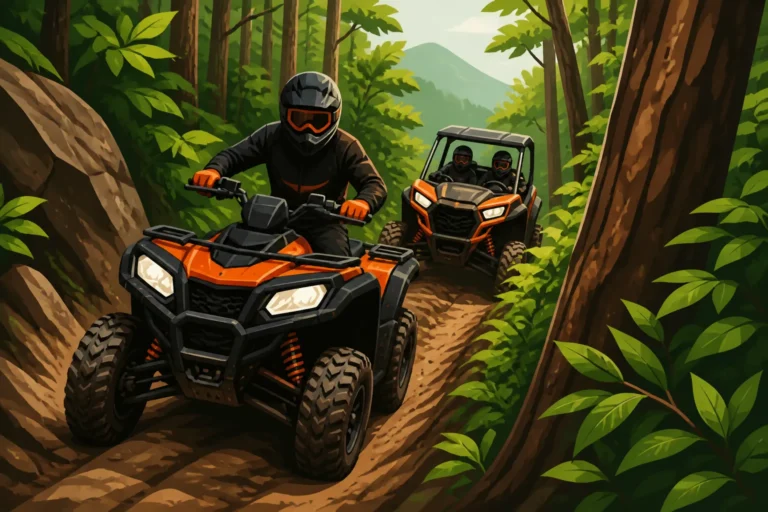
Keep the group small enough that adults can supervise effectively. One adult can lead while another follows behind the youngest or least experienced rider, if your group has enough adults. This makes it easier to notice a child falling behind, struggling with a section, or becoming fatigued. Avoid letting a child ride out of sight or pressuring them to keep pace with more experienced riders.
If a child is riding a separate machine, leave enough room between vehicles to avoid dust and give each rider time to react. Do not let children bunch up at obstacles or attempt a hill simply because another rider made it through. Stop in a safe place, explain the route choice, and turn around when the section is beyond the child’s ability.
Make the day about confidence, not distance
Children often remember how a ride felt more than how many miles they covered. Build in time to learn the trailhead routine, practice starting and stopping, and take breaks. Praise careful decisions—slowing down, asking for help, or choosing not to attempt an obstacle—rather than only celebrating speed or bravery.
If your child becomes uneasy, take that seriously. A frightened rider may freeze, make abrupt movements, or stop paying attention to the trail. Move to a safe spot, give them time, and decide together whether to continue. Turning back is not a failed outing; it is good judgment.
After the ride, talk through what went well and what felt difficult. Maybe the child was comfortable on gentle gravel but not on rocky climbs, or enjoyed riding as a passenger more than operating a machine. Those observations help you choose a better next outing. With careful preparation, the right machine, and a willingness to adjust the plan, Georgia ATV trails can become a rewarding family activity without making the ride more challenging than it needs to be.
Disclaimer
This article is for general informational purposes only and does not constitute professional advice. Laws, prices and regulations vary by location and change over time. Consult a qualified professional for guidance on your specific situation.