Georgia WMA Riding Only on Roads
Georgia WMA riding rules can be confusing because a road may look rideable but still be closed to ATVs and UTVs. The practical starting point is simple: a WMA is not an open riding area. Use only routes the area’s current rules authorize, and check the dates, hours, and vehicle restrictions before unloading.
What “roads only” means on a Georgia WMA
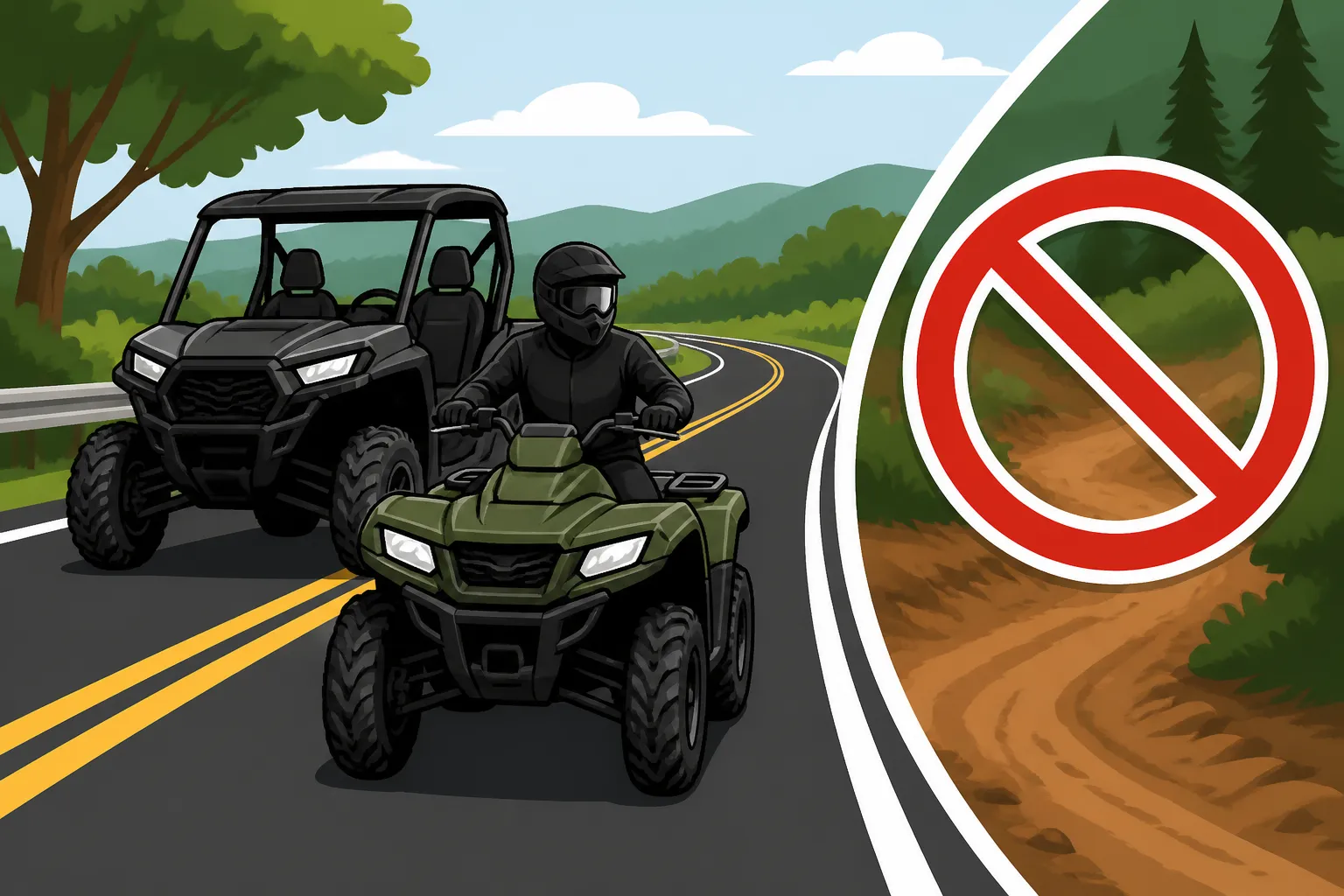
When WMA rules limit ATV or UTV travel to roads, that does not mean you can ride anywhere that looks like a road. It means you must stay on routes that are open to the type of motor vehicle you are operating under the rules for that WMA.
A visible track through the woods may be an old logging road, a closed service route, a trail for another use, or a path on land outside the WMA. Its appearance does not establish that it is open to motorized use. Look for the area’s official map, posted notices, and current rules. If they do not show or authorize the route, do not assume it is permitted.
Road-only access also does not give riders permission to leave the route to reach a hunting spot, campsite, creek, or other destination. Riding around a gate, through a field, along a power-line cut, or between sections of road can violate the same restriction even if the detour seems short.
| Route or location | What to check before riding |
|---|---|
| Road shown as open on the current WMA map | Confirm the WMA rules allow your vehicle and that the road is open on the day of your visit |
| Road with a gate or closure notice | Do not ride past it unless an official notice clearly authorizes access |
| Unmarked track or old logging road | Treat it as closed until current WMA information confirms it is open |
| Designated off-highway trail | Check whether it is open to your vehicle type, and whether a separate permit applies |
| Path, field, creek bed, or woods beside an open road | Do not use it as a shortcut or riding area unless the rules expressly allow it |
| Route crossing onto private or other public land | Check the rules for that land separately; WMA permission does not carry across boundaries |
The distinction between an open road and an open riding area matters. A road can allow access through part of a WMA without allowing recreational loops, trail exploration, or off-road travel. The WMA’s map and regulations—not the road’s appearance or condition—are the useful references.
For an overview of the restrictions that apply across these areas, see Georgia WMA Rules for ATV Riders. That overview can help you identify the issues to check, but the rules for the specific WMA and date of your trip still control.
Check the WMA’s conditions, not just the road
Road access is only one part of the rules. A route can be open to motor vehicles and still be unavailable to you because the date, hours, operator requirements, or purpose of your visit do not meet that WMA’s conditions.
Rules can vary between WMAs and may change with seasons, hunts, closures, or management needs. Check the current regulations for the exact area you plan to visit rather than relying on a rule you remember from another WMA. Pay particular attention to the following.
Dates and hunting activity
Some WMA riding access is restricted to certain hunt days or periods. A road that is available to an ATV during an authorized hunt may not be open for casual riding on a non-hunt day. Do not treat a WMA as a general-purpose trail area simply because it is open to visitors.
If the rules tie vehicle use to a hunt, check what counts as an eligible hunt and whether the operator needs to be participating. The details may depend on the WMA and the applicable season. Georgia WMA Riding Only on Hunt Days explains why the date on the calendar can be as important as the road itself.
Hours
A WMA may limit when motor vehicles can be used. The relevant hours may be connected to sunrise and sunset, a particular hunt, or other area-specific conditions. Do not assume that hours allowed on one WMA apply to another.
Confirm the permitted window for the day you plan to ride, including whether the rule refers to the time before sunrise, after sunset, or both. Allow time to reach the entrance and leave the area within the permitted period. See Georgia WMA Two-Hour Window Around Sunrise for a closer look at how a time restriction can affect access.
Operator age and supervision
Age restrictions may apply to ATV or UTV operators on a WMA. Check the minimum age and any supervision requirements before bringing a younger rider. Do not assume that a child who can legally operate a machine on private land can also operate it on a WMA road.
The rules may differ from a private park’s policies or the rules for riding on private property. For the WMA-specific age issue, see Georgia WMA Minimum Age of 16.
Permits, licenses, and other required documents
A hunting license, WMA authorization, vehicle tag, or off-highway permit may be required depending on the area and the activity. One document does not automatically replace another. For example, permission to hunt does not by itself establish that your ATV may use every road, and a forest recreation permit does not turn a closed road into an open one.
Some requirements are tied to the land manager or to the type of WMA. Check the current area information and any posted instructions before you go. Georgia WMA Tags and When They Are Needed discusses when a tag may be part of the requirements.
How to confirm a road is open before you ride
A little route checking before departure can prevent a wasted trip or an avoidable violation. Use current, area-specific information and make sure you can identify the road on the ground.
- Identify the exact WMA. Confirm the area’s full name and boundary. Nearby roads, trailheads, and forest land may be managed under different rules.
- Open the current WMA regulations and map. Look for motor-vehicle restrictions, eligible dates, hours, permitted vehicle types, and any closure notices.
- Trace the intended route. Check that the route is identified as open for the vehicle you plan to use. Do not rely solely on an old map, an online route recording, or a track left by another rider.
- Check the land manager. Some WMAs overlap or adjoin national forest land. In those places, WMA rules and federal land rules may both apply.
- Check for changes close to your trip. Temporary closures, weather, fire conditions, hunting activity, or maintenance can affect access. Recheck official notices before leaving.
- Save the relevant map and rules. Cell service may be limited. Keep a copy on your phone and, if practical, an offline map or printed backup.
- Turn around when the route is unclear. A missing sign is not proof that a road is open. If you cannot confirm the route’s status, do not continue on it.
On a WMA within or connected to a national forest, do not assume that a state WMA road rule is the only rule that matters. The Forest Service can restrict motor vehicles to designated routes and may require an additional permit for specific OHV systems. Review [Georgia National Forest WMAs Need Designated Trails] and check the relevant Forest Service map and notices for the land you will enter. Forest OHV permits apply to the areas and activities covered by their rules; they are not blanket permission to ride every WMA road.
If maps or signs leave you uncertain, ask the land manager about the particular WMA, entrance, and road. A broad question such as “Can I ride here?” may not provide enough detail. Give the name of the WMA, the date, your machine type, and the route you intend to use. Asking a DNR Office About a Specific WMA covers how to get a useful answer.
Ride the authorized route and respect closures
Once you are on an approved road, stay on it. Do not widen the route by riding around muddy sections, cutting corners, passing another machine in the woods, or creating a parallel track. These shortcuts can damage soil and vegetation and may take you outside the area where motorized travel is allowed.
Gates and closure signs should be treated as real boundaries, not as obstacles to work around. A gate may be closed to protect habitat, prevent damage during wet conditions, limit access during a hunt, or mark a boundary. Do not bypass it because the road beyond appears passable. Georgia WMA Roads Closed by a Gate explains why a closed route remains closed even when no one is stationed at the entrance.
Keep these practices in mind:
- Follow posted signs and any temporary closure notices.
- Stay on the route shown or identified as open for your vehicle.
- Do not ride around a gate, barrier, or road closure.
- Avoid blocking entrances, gates, parking areas, and other authorized traffic.
- Yield carefully to hunters, land-management vehicles, and other road users.
- Keep speed appropriate for sight lines, road conditions, and people nearby.
- Do not assume that a road open to one kind of vehicle is open to every ATV or UTV.
- Leave the area as you found it and take rubbish with you.
Roads on WMAs may be rough, narrow, muddy, or shared with vehicles that are not expecting recreational riders. A machine that can physically fit through a route may still be prohibited from using it. Likewise, a route that appears dry and quiet can be subject to a seasonal or temporary closure.
If you encounter another rider leaving the road, do not treat that as evidence that the shortcut is allowed. Other people’s behavior is not a reliable source of permission. Use the map, regulation, and posted instructions.
Common misunderstandings and safer alternatives
A frequent mistake is treating “road” as a description of the ground rather than a designation in the area’s rules. A worn track can look like a road without being open to motor vehicles. Conversely, an authorized route may be rough or unmarked in places but still be identified on the official map. Confirm the route instead of judging it by appearance.
Another mistake is assuming that a WMA is managed like a private off-road park. It is not. A WMA is managed for wildlife and public access under rules that can limit when and how vehicles are used. Road access does not necessarily provide a place to ride continuously for recreation, and there may be no legal loop that starts and ends at the same parking area.
Riders can also confuse these different permissions:
| Permission or document | What it may allow | What it does not automatically allow |
|---|---|---|
| WMA access or hunting authorization | Access or participation under the applicable WMA rules | Riding on every road, trail, or off-road area |
| Forest OHV permit | Use of the covered forest OHV routes under permit conditions | Use of a closed WMA road or an undesignated route |
| Vehicle registration | Registration-related privileges under the applicable rules | General road access on a WMA |
| A road shown on a map | A route that may be open under stated conditions | Access at all times or for every vehicle type |
| Permission for another nearby property | Access under that property owner’s rules | Permission to cross or ride within the WMA |
If the riding you want involves trail loops, mud, or unrestricted off-road routes, choose a designated trail system or private riding park that explicitly allows your machine. Check the route’s vehicle-width limits, hours, permit requirements, and closures before going. A trail system designed for OHV riding is a better fit than trying to turn a WMA access road into a recreational trail.
If your aim is to reach a hunting location, plan a route that stays on authorized roads and check whether the WMA permits vehicle access for that hunt. If the road ends short of your destination, do not continue off-road unless the rules explicitly allow it. Make a different plan or contact the land manager for clarification.
When rules conflict or seem incomplete, take the more restrictive route until you get a clear answer. Do not rely on a forum post, a friend’s recollection, or an old map as a substitute for current rules. Georgia WMA Rules for ATV Riders and [Georgia National Forest WMAs Need Designated Trails] can help you sort out the main rule layers, but the official information for your specific area remains the final check.
Frequently Asked Questions
Can I ride an ATV anywhere on a Georgia WMA if I stay on a dirt road?
No. The road must be open to your vehicle under that WMA’s current rules. An old logging road or visible track is not automatically authorized for motorized use.
Can I ride off the road to get around mud or a gate?
No, not unless the area’s rules specifically authorize that route. Going around a closure or leaving the road can put you outside the permitted area.
Does a WMA permit mean I can ride any road there?
No. A permit or authorization may satisfy one requirement, but it does not override road closures, vehicle limits, dates, hours, or other WMA restrictions.
Do national forest rules matter if the land is also a WMA?
They can. Where WMA access and national forest land overlap, check the applicable rules and designated-route map for both. A route must be authorized under the rules that apply to that land.
Disclaimer
This article is for general informational purposes only and does not constitute professional advice. Laws, prices and regulations vary by location and change over time. Consult a qualified professional for guidance on your specific situation.