Tires That Work on Red Clay
Red clay can turn a familiar Georgia trail into a slick, tire-packing mess after rain, and the wrong tread may leave you spinning instead of moving. Choosing tires for red clay means balancing grip, self-cleaning, machine fit, and the kind of trails you actually ride. This guide explains what to look for, how to adjust your setup, and what to do when conditions change.
What red clay does to ATV and UTV tires
Why wet clay feels so slippery
Georgia’s red clay can be firm and predictable when dry, then become slick once it is wet. Moist clay smears across the ground and can coat your tread, reducing the edges and gaps that help a tire bite. On a hill, in a rut, or around a muddy turn, that loss of grip can happen quickly.
The problem isn’t only the surface. Clay can build up between tread lugs until the tire behaves more like a smooth roller than a set of gripping blocks. A tire that works well on dry forest roads might struggle when clay fills its tread, while a more open design may keep clearing itself as the wheel turns.
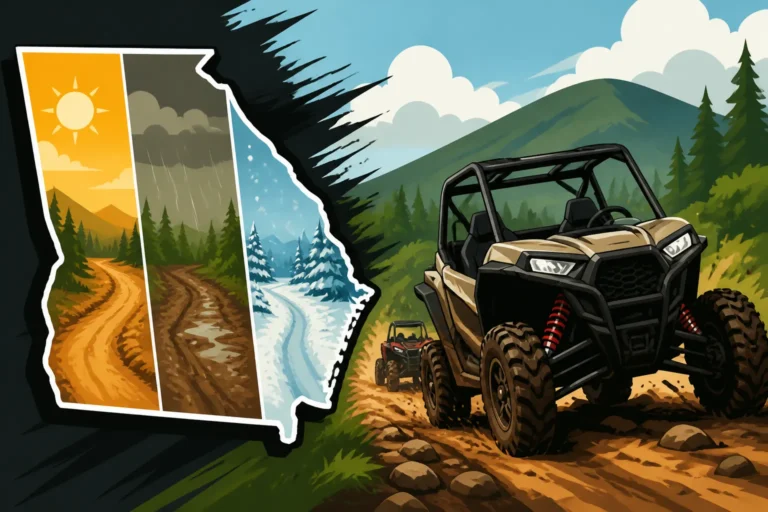
Not every Georgia trail has the same conditions. A route in the North Georgia mountains can have clay, rock, roots, and water crossings in the same ride. Trails around the Piedmont may feel different from sandy or gravelly routes farther south. Before choosing tires for a specific outing, check the route, current conditions, and machine-width rules. Georgia Red Clay and What It Does to a Machine offers more background on how clay affects both traction and cleanup.
How tread design affects traction
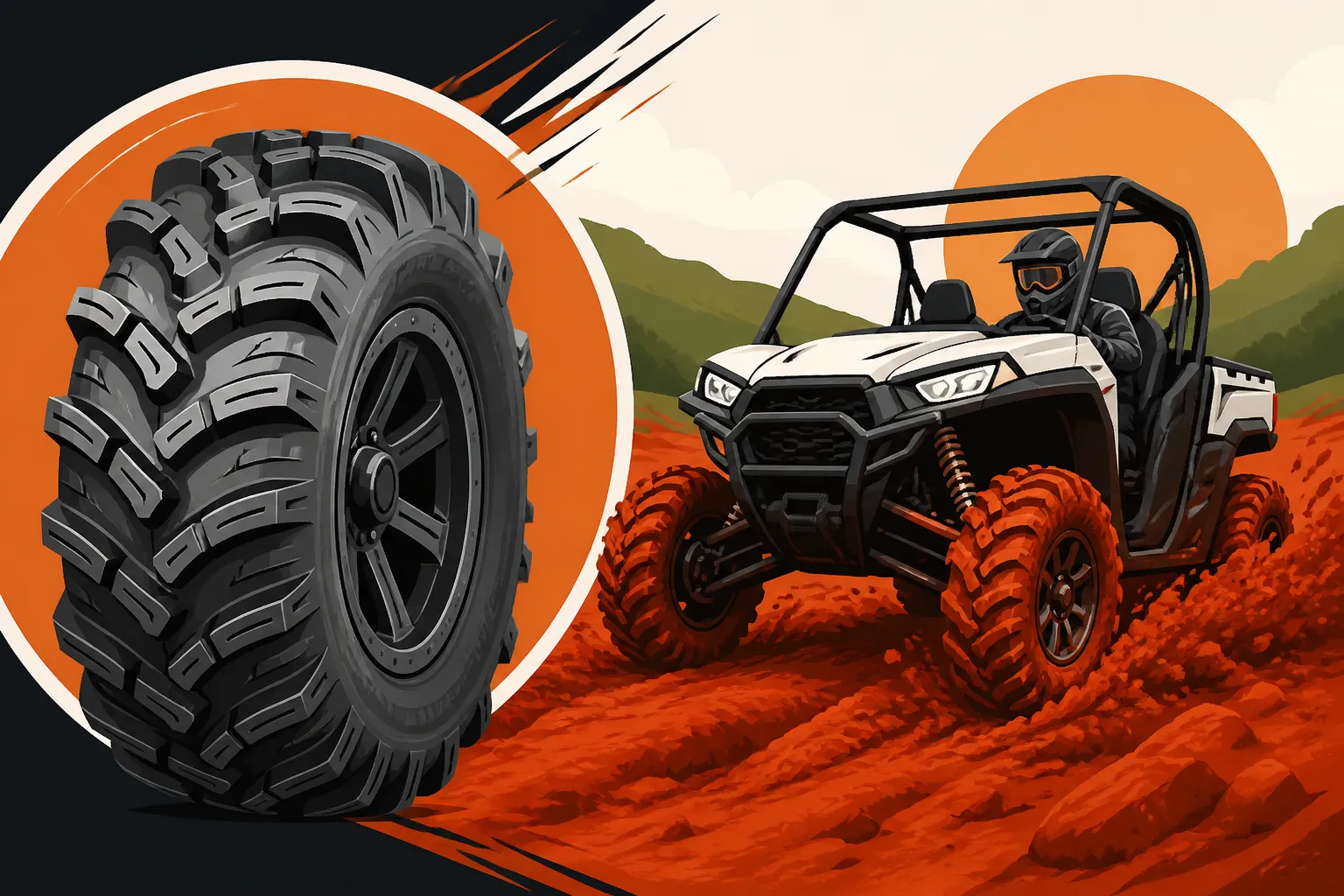
Tread pattern is one of the biggest differences between tires intended for hard-packed trails and those built for mud. A tire with closely spaced lugs can roll smoothly on firm ground, but narrow gaps may clog more readily in sticky clay. More widely spaced lugs can provide room for mud to escape, helping the tire regain traction as it rotates.
That doesn’t mean the most aggressive mud tire is automatically the best choice. Tall, widely spaced lugs can offer useful bite in deep, soft sections, but may feel less settled on hard-packed stretches or exposed rock. They can also make the ride harsher or noisier, depending on the tire and machine. If your usual route includes long stretches of hard trail between muddy spots, an extreme mud pattern may be more tire than you need.
Look closely at lug depth, spacing, and the shape of the tread blocks. A pattern that has open channels and sturdy edges can be a practical middle ground for mixed Georgia trails. For a closer look at the local conditions that change the ride, see Georgia Riding in Spring Mud and Georgia Trails That Close After Rain.
Match the tire to the terrain you ride most
Think about your typical ride, not just the worst muddy patch you might encounter once a season. If you mostly ride maintained forest roads and firm trails, a moderate all-terrain pattern may offer a more comfortable, predictable experience. If you regularly encounter deep mud, steep clay climbs, or wet ruts, a more open pattern may help—but it won’t remove the need for careful line choice and controlled throttle.
Also consider the machine. A tire that suits a lightweight ATV may not be the best match for a heavier side-by-side carrying passengers, tools, or hunting gear. Extra load affects how the tire contacts the ground and how the machine responds. Check the tire and vehicle manufacturers’ guidance for load capacity and compatibility rather than assuming a visually similar tire will work the same way.
| Tire characteristic | Potential benefit on Georgia clay | Possible tradeoff |
|---|---|---|
| Open, widely spaced lugs | More room for clay to clear from the tread | Can feel less comfortable on hard-packed ground |
| Moderate all-terrain tread | Useful balance for mixed surfaces | May not dig as effectively in deep mud |
| Closely spaced tread blocks | Can feel composed on firm trails | May pack with sticky clay more easily |
| Correct load rating | Helps match the tire to the machine and its cargo | Requires checking vehicle and tire specifications |
| Correct fitment | Helps preserve intended handling and clearance | A larger tire can create clearance or handling issues |
Choosing and setting up tires for Georgia trails
Check fitment before buying
Start with the tire size and load requirements recommended for your ATV or UTV. A tire that is too large, too wide, or otherwise incompatible can affect clearance, steering, suspension travel, and how the machine behaves. On a side-by-side, a size change can also matter when accessing narrow trails. Before you buy, compare the tire dimensions with your machine’s requirements and inspect the space around the wheel wells and suspension.
Width deserves special attention if you ride designated trail systems. Some routes have machine-width limits, and the tire’s listed size does not tell the whole story about the total width of your vehicle. Measure your machine as required by the trail manager, including any accessories that affect its overall width. Measuring Your Machine Before You Tow and Georgia Trail Widths and What Fits can help you think through fit and access before heading out.
It’s also worth checking whether the trail you plan to ride allows your machine type and tire setup. A wider tire or altered stance does not automatically make a machine ineligible, but the complete vehicle must meet the rules for that riding area. Use onX Offroad to review route details and plan a trip, then confirm current access and restrictions with the official land manager. A mapping app is useful for planning, but it should not be your only source for closures or rules.
Set tire pressure for the machine and conditions
Tire pressure affects how much tread contacts the ground, how the tire flexes, and how the machine responds. It’s tempting to lower pressure for more grip, but there is no single pressure that suits every ATV, UTV, tire, load, and trail. Too little pressure can increase the risk of bead problems, tire damage, or unstable handling. Too much can reduce the tire’s ability to conform to uneven ground.
Use the vehicle and tire manufacturers’ recommendations as your starting point. Account for the load you’re carrying, including passengers and cargo, and make changes only within guidance appropriate for your setup. If you’re unsure, ask a qualified tire or powersports professional to help interpret the specifications for your machine and intended use.
Check pressure before the ride, ideally when the tires are cool, and bring a gauge that works with your valve stems. Recheck after a significant temperature change or if you suspect a leak or impact. A slow puncture can be easy to miss in a group ride until the machine starts steering differently or feels unstable.
Keep the rest of the setup in mind
Tires are only one part of traction. A machine that enters a wet clay hill too fast can slide even with an aggressive tread pattern. Smooth throttle, a steady line, and avoiding sudden steering inputs can make a meaningful difference. If a climb looks slick, pause to assess it rather than charging in and digging deep ruts.
Your machine’s weight and cargo matter too. A heavy load changes how the tires press into the surface and can make recovery more difficult if you get stuck. Secure tools and gear, stay within the vehicle’s capacity, and avoid carrying unnecessary weight on a muddy ride. If you use a winch, inspect the equipment and choose a safe anchor point rather than relying on a tire to pull through every situation.
Before leaving, plan where you’ll ride and how you’ll respond if a trail is too wet. onX Offroad can help you organize a route and identify nearby access points, but check official trail updates and posted signs before riding. Georgia Trail Conditions Before You Drive and How to Check Georgia Forest Trail Status are useful companion reads when conditions may have changed since your last visit.
Getting better traction without damaging the trail
Choose a line that gives the tires a chance
On clay, the best line is often the one that avoids the deepest, slickest rut rather than the one that looks shortest. Look for firm ground, a gradual route around a muddy pocket, or a surface with roots and rocks that may provide more texture. Avoid steering sharply while climbing, since a sudden change in direction can make the tires lose their grip.
If you reach a steep or churned-up section, don’t assume more throttle will solve it. Spinning tires can polish the clay into a slick surface, deepen ruts, and make the obstacle harder for the next rider. Ease off, reassess, and turn around if the route is beyond your machine or your comfort level. Turning back is a sensible riding decision, not a failure.
That restraint matters most after heavy rain. Trail managers may close routes to prevent erosion or damage, and a trail that appears passable at the entrance may still be vulnerable farther in. Check Georgia Trails That Close After Rain and follow gates and posted notices. When a route is marked closed, choose another legal riding area rather than trying to work around the closure.
Use throttle and momentum carefully
A steady, controlled pace can help maintain movement across a slick section. Rapid throttle changes may spin the tires, while stopping mid-climb can leave you with little traction to restart. Approach obstacles slowly enough to assess them, then use smooth inputs appropriate to the machine and terrain. Avoid carrying more speed than you can safely manage.
For a hill, look for a route that lets you climb in a straight, controlled line. If you’re unsure about the surface, have a passenger remain seated and keep hands and feet inside the vehicle. Don’t let anyone stand directly below or beside a machine attempting a climb. If the tires begin to spin, reduce the throttle instead of digging a deeper hole.
On a group ride, leave enough space between machines to avoid dust, flying debris, and sudden stops. It also gives the rider ahead room to choose a line without pressure. If someone gets stuck, agree on a recovery plan before pulling or winching; never wrap a recovery strap around a person or use an unsuitable anchor. For more on responsible wet-weather riding, see Tread Lightly on Erodible Clay and Georgia Trail Etiquette on One-Way Loops.
Clean and inspect tires after a clay ride
Clay that dries on a tire can be difficult to remove, and packed mud may hide cuts, punctures, or damaged tread. Rinse the tires and wheel wells after riding, paying attention to the spaces between lugs. Remove buildup carefully so you can inspect the tread and sidewalls without damaging the tire.
While cleaning, look for sharp stones, embedded sticks, sidewall cuts, missing tread blocks, and objects lodged near the bead. Check that the wheels are not packed with mud, which can affect balance. If you notice a damaged tire or a pressure change, address it before the next ride rather than hoping it will hold up on the trail.
Clay can also hide damage to other parts of the machine. Inspect the brakes, suspension, and underbody, and follow the manufacturer’s maintenance guidance after muddy riding. Washing Clay Off Before It Sets covers why prompt cleanup can make post-ride maintenance easier.
A practical red-clay tire plan
Before you leave home
A little planning can prevent the most frustrating tire problems. Confirm your tire size and pressure against the manufacturer’s guidance, inspect the tread and sidewalls, and make sure your load is within the machine’s limits. If you recently changed tires, take time to test the setup on familiar ground before committing to a long, remote ride.
Check weather and trail status, and make sure the route allows your machine. Use onX Offroad as a planning aid for organizing a route and locating riding areas, then verify closures, permits, and restrictions with the land manager. Carry a tire gauge and basic repair supplies appropriate for your machine. If riding with others, agree on how you’ll communicate and what to do if someone needs help.
Avoid treating a map line as proof that a trail is open or suitable. A route may cross land with different rules, and weather can change surface conditions quickly. Planning with onX Offroad alongside official trail information helps you avoid arriving at a closed entrance or discovering too late that a route is unsuitable for your vehicle.
What to do when the trail turns slick
If the clay becomes more slippery than expected, slow down and reassess. Look for a safer route, avoid unnecessary wheelspin, and don’t follow another machine into a rut just because it made it through. A different vehicle may have a different weight, tire setup, ground clearance, or driver experience.
If you’re stuck, stop before repeated spinning makes the situation worse. Clear mud from around the tires only if it is safe to do so, and use recovery equipment according to its instructions. Keep bystanders clear of straps and cables, and avoid attempting a recovery from an unstable position. If conditions make safe travel doubtful, turning back may be the best option.
The right tire can improve how your ATV or UTV handles Georgia clay, but no tread pattern makes every trail safe in every condition. A sensible setup, measured inputs, careful route planning, and respect for closures work together. For broader planning, Georgia ATV Trails: Where You Can Legally Ride and Georgia ATV Trails That Allow Side-by-Sides can help you explore options that fit your machine and riding plans.
Disclaimer
This article is for general informational purposes only and does not constitute professional advice. Laws, prices and regulations vary by location and change over time. Consult a qualified professional for guidance on your specific situation.