Riding Near a Hunting Camp
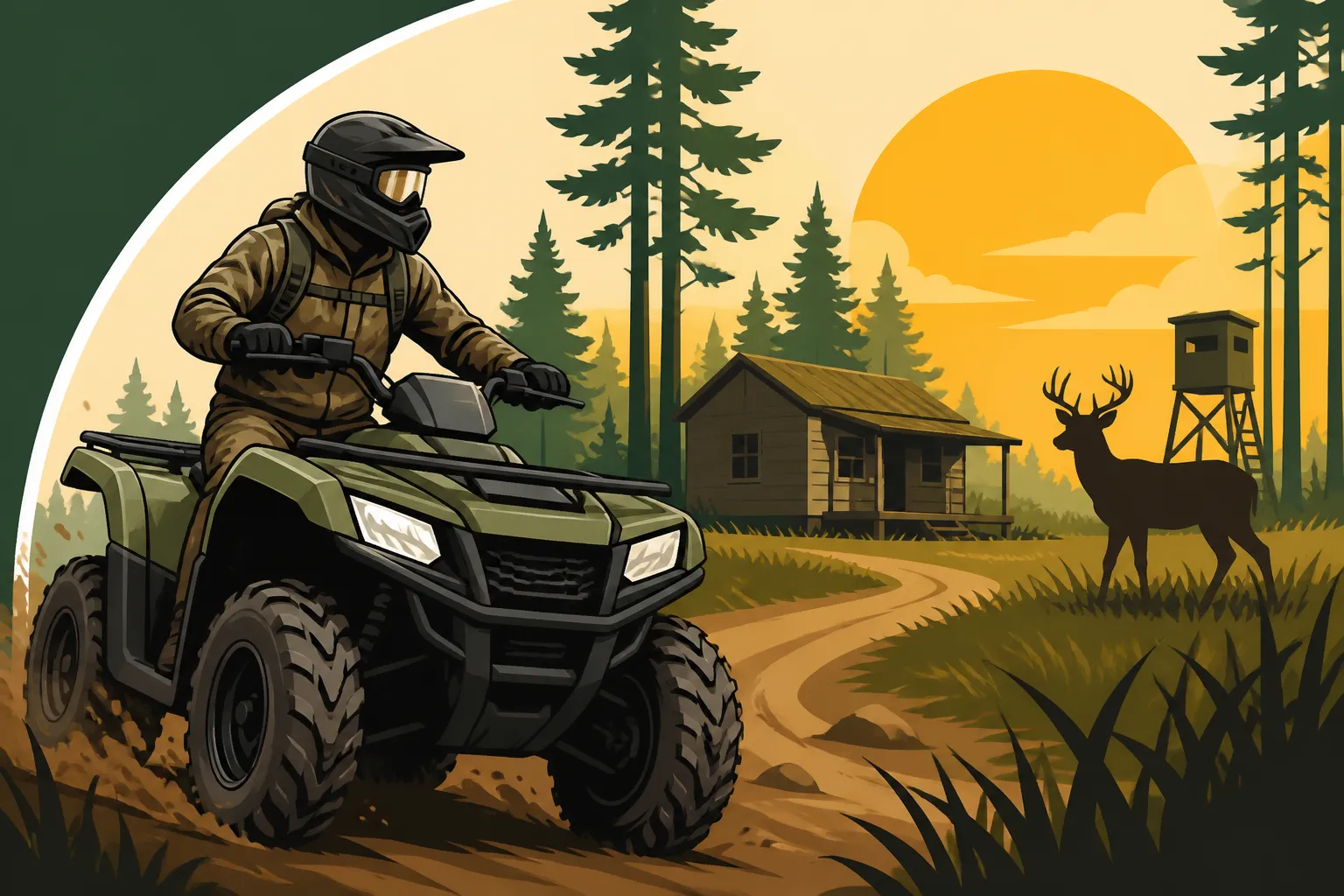
A ride near a hunting camp can go wrong fast if a trail crosses private land, a closed forest road, or an area where hunters are set up. In Georgia, the camp’s location alone does not tell you where you may ride. This guide explains how to check access, avoid disturbing hunters, and plan a safer route before unloading your ATV or UTV.
Confirm who owns and manages the land
A hunting camp does not automatically mean public access
A hunting camp might sit on private property, leased timberland, a wildlife management area, or land managed by a public agency. A visible cabin, gate, or established dirt track does not tell you whether riders have permission to use it. Even a road that looks open may serve only the landowner, leaseholders, hunters, or authorized workers.
This distinction matters around Georgia’s timber country, where a hunting club may lease land from a timber company without owning it. Permission from one club member might not cover every parcel, road, or machine. Before riding, ask the landowner or lease manager which routes are approved, whether guests are allowed, and whether any sections are closed during hunting activity. For more on lease access, see Hunting Club Leases and Machine Use.
If you cannot confirm access, do not treat the camp road as a shortcut to a trail. Turn around and use a route with clearly authorized access. A small detour is easier to deal with than a confrontation, a trespassing complaint, or damage to a gate or planted field.
Check the land category before choosing a route
On Georgia public land, rules can depend on the managing agency and the specific property. A wildlife management area is not a free-roaming ATV area: vehicle use is generally limited to permitted roads and may be subject to hunting-season and access restrictions. Check the rules for the particular WMA before you go. Georgia WMA Riding Only on Roads explains why a road being physically passable does not necessarily make it an approved riding route.
National forest land has its own distinctions. Some roads may be open to motor vehicles while other routes are designated trails, seasonal roads, or closed areas. An OHV trail is not interchangeable with a forest road, and neither should be assumed to lead through a hunting camp. Review Georgia National Forest Trail-Only Rule and National Forest Roads and Designated Trails when planning a ride in the Chattahoochee-Oconee National Forest.
A mapping app such as onX Offroad can help you compare your planned route with mapped roads, trails, and property boundaries. Treat the map as a planning aid, not permission to enter land or proof that a route is currently open. Confirm access and closures with the land manager or property owner, especially where a road meets a gate, a lease boundary, or a camp entrance.
| Where the camp or route is | What to confirm before riding | Safer approach |
|---|---|---|
| Private land or a hunting lease | Permission from the owner or authorized lease contact, plus approved routes | Stay on the route they specifically approve |
| A wildlife management area | Current WMA vehicle rules, allowed roads, and applicable hunting-day restrictions | Use only routes confirmed as open to your machine |
| National forest land | Road or trail designation, vehicle access, seasonal closures, and any permit rules | Check the managing agency’s current information before departure |
| A public trail near private property | Whether the trail crosses or borders private land and where access ends | Stay on the marked route and turn back at an unclear boundary |
Plan around hunters, hours, and activity
Avoid riding through an active hunting area
A camp can be busy even when no one is standing beside the cabin. Hunters may be walking to a stand, retrieving equipment, moving a game animal, or waiting quietly nearby. Engine noise can disrupt a hunt, and a fast-moving ATV or UTV may surprise someone who is focused on the terrain rather than expecting traffic.
If you see a parked hunting vehicle, people carrying gear, a temporary sign, or a gate that has been closed, slow down and reassess. Do not ride toward a blind, stand, parked truck, or group of hunters to ask a question. If you have permission to be on the property, contact the designated person by phone or wait at a safe, visible location away from the hunting activity.
Some WMA riding access is tied to specific hunting-day rules and time windows. Those rules can differ by area, so don’t rely on another rider’s experience at a different WMA. Check the details for your destination and review Georgia WMA Two-Hour Window Around Sunrise if that timing rule may apply. When you cannot establish whether riding is allowed at a particular time, choose a different route rather than guessing.
Give camps and access roads room
A hunting camp is a work and gathering space, not a trailhead or public turnaround unless the owner or managing agency says it is. Do not park a trailer in front of a gate, block a narrow road, or use a camp driveway to turn around. If a road is too narrow for your group to pass safely, stop in a suitable place well before the camp and let the other party decide how to proceed.
Noise carries farther in quiet woods than it does on a busy road. Ease off the throttle near cabins, campsites, homes, and parked vehicles. Avoid revving, repeated passes, and unnecessary idling. If a hunter signals you to stop, stop at a safe distance, keep your hands visible, and speak calmly. Do not assume that a disagreement about access will be settled by pointing to a GPS screen.
A useful route-planning tool is onX Offroad, particularly for noticing that a ride approaches a parcel boundary or a mapped access point. Still, boundaries and trail conditions can change, and the app cannot grant permission. Pair it with posted signs, official land-manager information, and direct permission where land is privately controlled.
Ride with care near a camp
Use a simple approach when you encounter a hunter
If you unexpectedly come across hunters, slow down well before reaching them. Keep your group together, avoid sudden turns, and do not pass close to people, equipment, or a hunting dog. If the route is narrow, stop where you are visible and leave room for others to move safely.
A calm, brief exchange usually works better than an argument. You might say that you are checking whether the route is open to riders and ask which way to turn back. If someone tells you the area is private or closed, leave by the route you used to enter, provided that doing so is safe. Don’t continue deeper into the property to look for another exit.
For a group ride, give the lead rider responsibility for checking signs and communicating with people near the camp. Riders behind should not crowd the person speaking or accelerate past the group. If the lead rider stops, everyone should stop in a controlled way and wait for directions. A riding group that stays orderly is less intimidating and easier to turn around.
Keep equipment and riding behavior predictable
Wear your required protective gear and make sure your machine is in good working order before approaching a camp or shared road. Check your brakes, lights, tires, and steering. Carry a phone, but do not rely on cell coverage in remote areas. Tell someone where you plan to ride and when you expect to return.
Keep to the established route rather than cutting around muddy spots, parked vehicles, or a closed gate. Riding around an obstruction can widen a trail, damage vegetation, or carry you onto land where you have no permission. On a marked trail, follow its direction and posted rules; Georgia Trail Etiquette on One-Way Loops covers habits that help reduce conflicts with other users.
Carry out your trash and avoid disturbing gates, signs, stands, feeders, or other hunting equipment. Do not approach wildlife or a harvested animal, and keep children and pets close. A hunting camp may have firearms present, so calm, predictable movement and respectful distance matter more than squeezing in one last pass.
Prepare a route you can defend and follow
Verify access before you leave home
Use a short checklist before loading your machine:
- Identify the exact land area, not just the nearest town or trail system.
- Confirm whether the route is on private land, a lease, a WMA, or national forest land.
- Check the current rules for that property, including vehicle access, operating hours, and closures.
- Get direct permission for private or leased land and ask which roads are approved.
- Save a legal alternate route in case a gate is shut or hunting activity blocks your plan.
- Share your route and expected return time with someone who is not riding with you.
For a public trail destination, start with Georgia ATV Trails: Where You Can Legally Ride and then verify the particular trail system’s current access information. A general trail guide can help identify possible areas, but it cannot confirm that every connecting road is open on the day you arrive.
If your planned ride includes hunting access, review Georgia Hunting Access by ATV as well. Hunting-related travel rules are not a blanket authorization to ride wherever you want. The machine, road, property, timing, and purpose can all affect whether access is allowed.
Know when to turn around
Turn around if you find a locked gate, a posted closure, an unmarked fork that leads toward a camp, or a boundary you cannot confidently identify. Also stop if you encounter hunters who ask you to leave, a road blocked by equipment, or signs that active work or hunting is underway. Taking a different route is the prudent choice even if the route appears on a map.
onX Offroad may be useful for checking your position and comparing the route with mapped access information, but keep a backup plan. Download or save what you need before heading into an area with weak service, and bring enough information to retrace your route. Do not ride across a property line merely because the map display is unclear or a trail appears to continue.
The safest ride near a hunting camp is one where access is settled before the engine starts. Confirm the land manager or owner, follow posted directions, give hunters space, and turn back when the route is uncertain. Those habits protect your group, respect the people using the land, and help keep Georgia’s riding areas available to others.
Disclaimer
This article is for general informational purposes only and does not constitute professional advice. Laws, prices and regulations vary by location and change over time. Consult a qualified professional for guidance on your specific situation.