Georgia Riding Areas Reachable Without a Truck
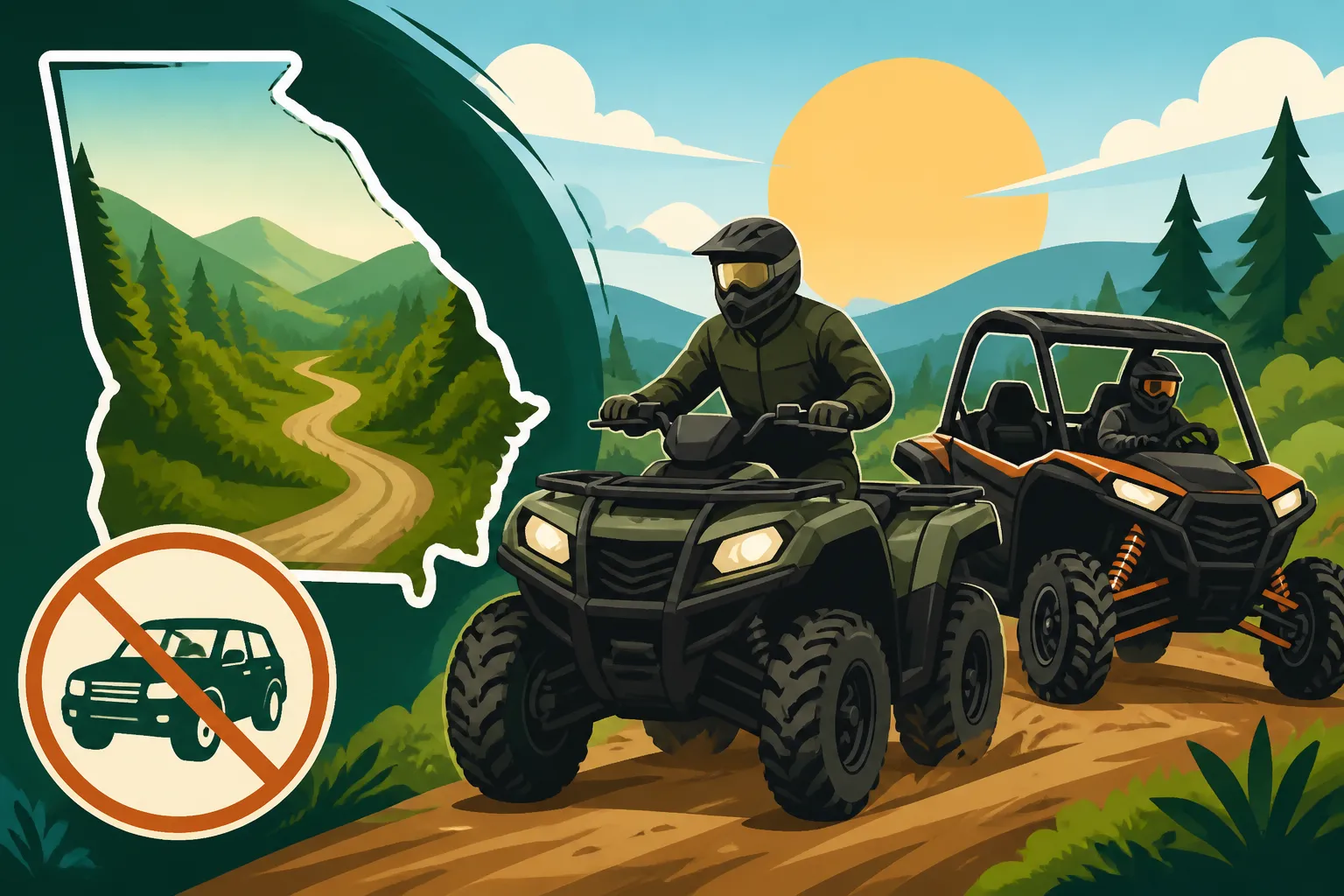
A Georgia trailhead may look easy to reach on a map, but getting an ATV or UTV there without a pickup can be the harder part. A small car, SUV, rental machine, or ride-sharing plan may work in some situations—but riding an off-highway vehicle on public roads to bridge the last few miles usually isn’t a safe or legal shortcut. This guide helps you plan the practical options.
What “reachable without a truck” really means
Getting yourself to the trailhead is different from getting your machine there
Many Georgia riding areas are reachable by ordinary passenger vehicle, but that does not mean you can ride your ATV or UTV from a nearby town or campground to the trail. The route may use public roads, private property, or forest roads that are closed to motorized recreation. Access rules vary by road and land manager, so don’t assume that a machine can legally cover the last stretch just because the trailhead is close.
For national forest riding, the distinction matters especially. Your car may be able to reach a designated staging area, while the ATV or UTV must be transported there on a trailer. Start by identifying the legal riding area and the designated trailhead, not just the nearest town. [Georgia ATV Trails: Where You Can Legally Ride] is a useful place to begin sorting out riding areas from roads or land where riding is not allowed.
A map app can help you plan a drive, but it is not a substitute for checking access rules. If you use onX Offroad to explore routes and trail locations, compare what you see with the land manager’s current information before setting out. A mapped line does not necessarily mean a road is open to your vehicle, your off-highway machine, or both.
The main choices when you do not own a pickup
If you already own a machine, you’ll usually be deciding between a properly matched car-and-trailer setup, borrowing a vehicle or trailer, or choosing a different riding plan. If you do not own a machine, renting one near a riding area may be an option—but availability, pickup arrangements, age rules, and permitted riding locations need to be confirmed directly with the rental business.
| Your situation | Possible plan | What to check before you commit |
|---|---|---|
| You own an ATV and a suitable car or SUV | Tow a compatible trailer | Vehicle tow rating, trailer weight, hitch and wiring, loading access, and parking |
| You own a machine but no trailer | Borrow or rent an appropriate trailer and tow vehicle | Whether the vehicle and hitch are suitable, insurance, and secure loading |
| You have neither a machine nor a trailer | Look for a rental arrangement near a riding area | Machine transport, allowed riding area, reservation terms, and rider requirements |
| You are visiting with friends | Travel as a passenger and share a machine or rental plan | Passenger rules, seating capacity, helmets, and who is responsible for the machine |
| You only want an easy day outdoors | Choose a walkable, cycling, or other non-OHV destination | Whether the area offers activities that do not require bringing an ATV or UTV |
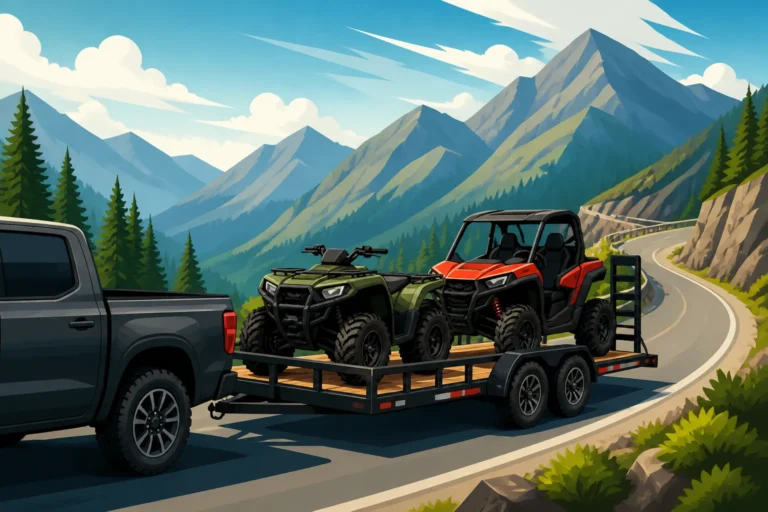
“Small trailer” does not mean “safe behind any car.” Add the trailer’s weight and the machine’s weight, then check those figures against the vehicle and hitch limits. Also consider how you will load the machine, where you will park, and whether you can safely turn around at the destination. A setup that works on a flat driveway may be stressful on a steep gravel approach.
Georgia riding areas to consider
National forest trail systems in North Georgia
Georgia’s national forest OHV areas are a natural starting point for riders looking at the North Georgia mountains. Systems such as Houston Valley, Beasley Knob, Whissenhunt, Town Creek, Oakey Mountain, and Davenport have different trail layouts and access conditions. They are not interchangeable: a trail system may have machine-width restrictions, seasonal closures, or rules that affect which vehicle can ride there.
For many visitors, the practical question is less “Can my car reach the area?” and more “Can I get my machine there, park the trailer, and meet the requirements for riding?” Before you leave, confirm the trail system’s status, the machine types permitted, permit requirements, and the condition of the route to the trailhead. [Georgia's Six National Forest OHV Systems] gives you a starting point for comparing the designated systems, and [Georgia ATV Trails That Allow Side-by-Sides] can help if you are deciding whether a particular route suits a UTV.
A car may be enough to transport you and your gear to the region, but it does not eliminate the need to transport the ATV or UTV separately. If you are planning a trip near Dalton, Blairsville, Suches, Dahlonega, or Ellijay, identify the exact staging area first. Then check whether the final approach and parking arrangement make sense for your vehicle and trailer. [Georgia Trails Near Chattanooga] may help travelers approaching from northwest Georgia, while [Georgia Trails Near Atlanta] is useful when planning from the metro area.
Private parks and rental possibilities
Private off-road parks can be worth investigating when you lack a truck, particularly if you are also looking for a machine rental. However, do not assume that a park rents vehicles, provides transportation, or allows rentals on every trail. Rental policies and access arrangements can change, and a rental may require you to meet specific age, safety, or supervision rules.
Call or message the park before building your trip around a rental. Ask whether the machine is collected at the property, whether it can be used on the trails you intend to ride, what equipment you must bring, and whether you need to book ahead. [Georgia Riding Areas That Rent Machines] can help you identify rental-oriented options to investigate. Treat it as a starting point for questions, not confirmation that a particular machine or date is available.
If you own a machine and are considering a private park instead, ask about trailer parking, machine-width limits, trail difficulty, and whether the park has a designated check-in process. A park that is easy to reach by car may still be inconvenient if there is nowhere to leave a trailer or if the access road is unsuitable for your setup. For a wider look at destination types, see [Georgia Private Off-Road Parks Compared].
How to transport an ATV or UTV without a pickup
Check the entire towing combination, not just the car
Some cars and many SUVs can tow certain trailers, but suitability depends on the specific vehicle, hitch, trailer, machine, and load. Look up the vehicle manufacturer’s towing guidance and account for the loaded trailer weight—not only the trailer’s advertised empty weight. Include fuel, tie-downs, tools, and accessories when estimating what you are carrying.
The machine’s dimensions matter too. A trailer may have enough rated capacity but still be too narrow or short for the ATV or UTV. A side-by-side can also be too wide for the trailer, the access road, or the trail system itself. Measure before reserving equipment or making a purchase. [Measuring Your Machine Before You Tow] and [Georgia Trail Widths and What Fits] can help you think through the fit before the day of the ride.
Do not overlook the driving experience. Towing changes braking, acceleration, turning, and backing up. If you are new to towing, practice in an open, quiet place before taking a loaded trailer into a busy trailhead lot or along a narrow mountain road. If the vehicle feels unstable, the trailer is difficult to control, or the setup exceeds a listed limit, change the plan rather than trying to make it work.
Plan loading, parking, and the return trip
Before you leave home, have a clear loading plan. Use equipment designed for the machine and trailer, secure the machine at appropriate points, and check that ramps are stable before loading. Keep loose gear from shifting, and make sure lights and the trailer connection work. If you are unfamiliar with loading or securing an ATV or UTV, ask an experienced operator to walk you through it before your first trip.
Think beyond the drive to the trailhead. Can you park and unload without blocking traffic? Is there enough space to turn around? What will you do if the staging area is full or a road is closed? Those questions matter at mountain trailheads, where a cramped approach can make a simple arrival feel like a juggling act. Check [Georgia Trailheads With Trailer Parking] when comparing destinations, and confirm details directly with the relevant land manager or park.
Finally, plan for the ride back. Mud, wet gear, and a machine that has developed a mechanical issue can complicate loading. Bring the basic tools and supplies you need for your vehicle and trailer, and have a backup plan if the machine cannot be driven onto the trailer. [Georgia Trail Conditions Before You Drive] is worth reviewing before a trip, particularly when recent rain could affect trail access or make cleanup and loading more difficult.
Make the trip easier with a few checks before departure
Confirm access, permits, and machine fit
A smooth trip usually starts with a few separate checks rather than one general search. Confirm that the riding area is open, that your machine type is allowed, that the route is suitable for your vehicle, and that you know where to stage. Check permit requirements for the place you plan to ride, and make sure every operator understands the rules that apply there.
If you are considering using a public road to reach a trail, stop and verify whether that exact road is open to your vehicle and machine. Georgia’s road-access rules are not a blanket permission to ride any quad or UTV from one location to another. [Georgia MPOHV Road Rules: County Roads Only] and [Are Side-by-Sides Street Legal in Georgia?] explain why registration or a road-use provision should not be treated as permission to use every public road.
Use onX Offroad or another mapping tool to plan the general route, note likely trailheads, and keep track of alternatives. Then verify the route and closures with official land-management information. This two-step habit can prevent a frustrating surprise: arriving at a gate, finding a road unsuitable for your trailer, or discovering that the route you planned is not open to your machine.
Choose a plan that fits the group
For a first outing without a pickup, it may be simpler to travel with someone who already has an appropriate tow vehicle and trailer, or to investigate a confirmed rental arrangement. If you are organizing a group, decide ahead of time who is transporting each machine, who has the required documents, and what happens if a vehicle or trailer is delayed. A little coordination avoids the familiar trailhead scramble of searching for tie-downs while everyone else is ready to ride.
If you cannot confirm a safe way to transport your machine, choose a destination or activity that does not require bringing it. That may feel disappointing when you have already picked out a trail, but it is better than overloading a car, improvising an unsafe trailer setup, or riding illegally along a road to reach the start. A realistic plan is the one that gets you there, lets you ride where permitted, and gets everyone home safely.
Before departure, make one final check of the trail’s operating status, the weather, your route, and your parking plan. OnX Offroad can be useful for organizing the map side of that preparation, but pair it with the latest access information from the relevant park or land manager. [Georgia Trail Conditions Before You Drive] is also a helpful reminder that a destination’s usual status does not guarantee that every route will be open on the day you go.
Disclaimer
This article is for general informational purposes only and does not constitute professional advice. Laws, prices and regulations vary by location and change over time. Consult a qualified professional for guidance on your specific situation.