Riding Near a Poultry Operation
A quiet dirt lane beside a poultry farm can look like an invitation to keep riding, especially when it connects two familiar stretches of trail. But a road’s appearance does not tell you who owns it or whether access is allowed. This guide explains how to ride responsibly near Georgia poultry operations, protect farm biosecurity, and avoid trespass and road-access problems.
Why riding near a poultry operation calls for extra care
Farm roads are not automatically public roads
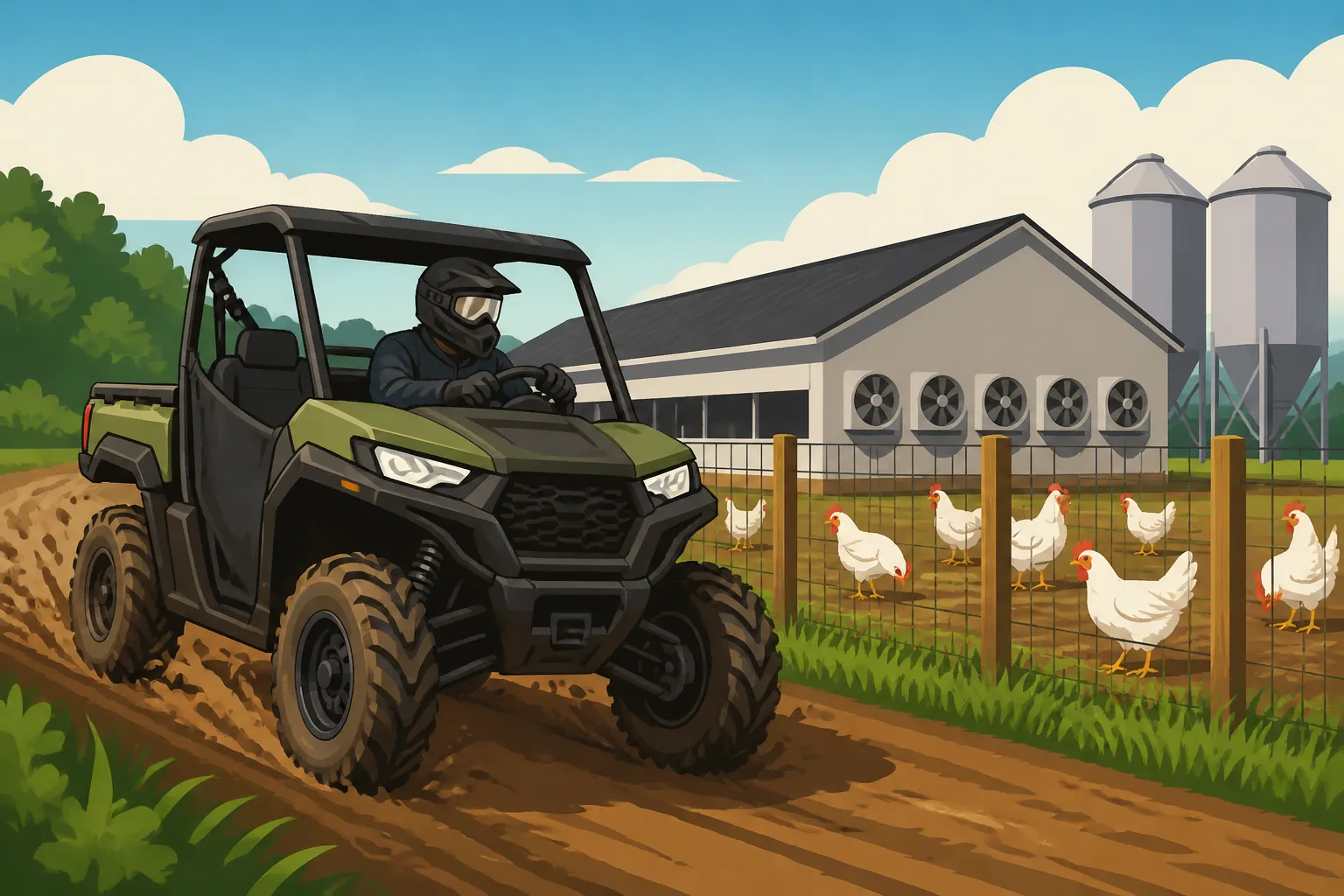
A gravel or dirt road near a chicken house may look much like a county road, but it could be a private farm lane, a shared access road, or a public road running beside the property. A registration plate, permission to ride elsewhere on the farm, or a familiar route does not automatically give you the right to use every road you encounter.
If you are unsure, stop somewhere safe and confirm who controls the route before continuing. Do not ride around a closed gate, follow a truck through an entrance, or assume that a road is open because there is no “No Trespassing” sign. Georgia property boundaries and permissions can be easy to misread from a machine, particularly where a farm driveway meets a public road. For more on access and permission, see [Georgia Trespass Law for ATV Riders] and [Georgia Rules for Riding a Chicken House Road].
This distinction matters on a route that passes through a working farm. A landowner might allow you to ride a designated trail but prohibit access to the poultry houses, feed storage, loading areas, or connecting service roads. Get permission for the specific route and conditions—not just a general “you can ride here.”
Poultry farms need controlled access
Poultry operations have good reason to limit unnecessary traffic. People, vehicles, tires, and equipment can carry dirt and organic material from one place to another. Farms may use specific entry procedures to reduce the risk of spreading disease or contaminants among flocks. A side-by-side that has just traveled through mud, another farm, or a busy riding area can bring debris into places the operator is trying to keep controlled.
The safest approach is to stay outside the poultry operation unless the owner or farm manager has explicitly invited you in and explained what rules apply. Do not enter a chicken house, drive through a farmyard, or stop beside equipment and buildings to take a look. Even if the area appears quiet, the site may be operating on a schedule you cannot see from the road.
For riders in poultry-producing areas—including parts of northeast Georgia around Gainesville and Hall County—this is a practical consideration, not just a matter of manners. A farm’s access rules may change with its operations or health precautions. When in doubt, keep your machine on a route you have clear permission to use.
How to plan a route and avoid access problems
Confirm the route before you ride
A little planning can prevent an awkward conversation—or a more serious trespass complaint—when a trail passes near chicken houses. Before setting out, ask the landowner, club, or riding-area operator which routes are approved and whether any farm roads are off-limits. If permission comes with conditions, such as avoiding certain entrances or staying away during deliveries, make sure every rider in your group understands them.
Use this checklist when a route borders or crosses farm property:
- Identify whether the road is public, private, or part of a permitted trail system.
- Ask who controls access and get permission for the exact route you plan to use.
- Check for closed gates, signs, temporary restrictions, or instructions from the owner.
- Agree on where riders may stop, turn around, or park.
- Make sure the whole group knows not to enter poultry buildings or restricted work areas.
A map can help with orientation, but it cannot establish permission by itself. If a route seems unclear on the ground, do not treat a map line or a worn tire track as proof of access. Articles such as [Georgia Rules for Riding a Timber Road] and [Georgia Rules for Riding a Pasture] explain why different types of rural land and routes can have different access rules.
Know the difference between a county road and a farm lane
If a route connects to a public road, take a moment to verify what kind of road it is and whether your machine may use it. Georgia road-access rules for ATVs and UTVs depend on factors beyond whether the road is paved or gravel. County rules, road classifications, signs, and the machine’s legal status may all matter. A public road beside a poultry farm is not the same as the farm’s private driveway, and permission to ride on private land does not make a public road legal for your machine.
Before relying on a road connection, review [Georgia UTV Road Rules by County] and [Georgia County Road Systems and Where They Run]. Do not assume that a route open to one type of vehicle is open to an ATV or UTV. A registered machine is not automatically street legal, and a road that appears lightly traveled is still subject to applicable rules.
| Route or location | What to confirm | Safer approach |
|---|---|---|
| Public county road beside a poultry farm | Whether your machine may use that road and whether local restrictions apply | Check the applicable road-access rules before riding |
| Farm driveway or service lane | Who owns or controls it and whether you have permission | Do not enter without explicit permission |
| Marked trail near a chicken house | Whether the trail is open and where its boundary runs | Stay on the designated route |
| Gate or farm entrance | Whether access is authorized and whether the gate must remain closed | Do not bypass a gate or follow another vehicle through |
| Unclear dirt road | Whether it is public, private, or temporarily restricted | Stop safely and ask before proceeding |
Protect farm biosecurity and keep a respectful distance
Keep tires and gear out of restricted areas
Mud, manure, plant material, and dust can cling to tires, fenders, boots, and recovery gear. The farm owner is best placed to tell you whether there are cleaning or access steps for an approved visit. Without that permission and direction, do not drive into farm areas or handle gates, equipment, hoses, or other items.
If you are riding between separate properties or near more than one agricultural operation, consider where your machine has been before arriving. Cleaning visible dirt from your machine and gear can be a sensible precaution, but it is not a substitute for the farm’s own biosecurity procedures. Do not claim that a quick rinse makes a machine safe to enter a restricted facility. The important decision is whether you have permission to be there at all.
Riders who carry recovery equipment should keep it secured and away from farm infrastructure. A winch line or strap can snag a gate or damage equipment if it is used carelessly. If you use accessories from a brand such as SuperATV, treat them as riding equipment—not as a reason to pull open a gate, cross a barrier, or recover a machine from restricted ground. Ask the property owner how to proceed if your vehicle becomes stuck near an operation.
Slow down and avoid creating a nuisance
Poultry facilities may have workers, delivery vehicles, feed trucks, contractors, and farm equipment moving in and out. Dust, noise, and unexpected traffic can create hazards for both riders and farm staff. Slow down near entrances and occupied work areas, leave room for larger vehicles, and never block a driveway or loading area. If you see workers or a truck approaching, stop in a safe place and let them pass.
The same courtesy applies to sound and dust. Avoid unnecessary throttle bursts near buildings or homes, and do not spin tires on a dry farm lane. If you ride after dark, visibility and noise become even more important; review [Georgia Rules for Riding After Dark] before planning an evening route. A quiet-looking stretch of road can still be part of a busy worksite.
If you want to stop for a conversation or ask for directions, pull over only where you are allowed to be and where your machine will not obstruct farm traffic. Do not assume that an open yard, wide shoulder, or spot near a chicken house is public parking. A courteous call or conversation before the ride is usually better than surprising someone at their workplace.
What to do if you encounter a gate, sign, or problem
Respect barriers and turn around when access is unclear
A locked or closed gate is a clear reason not to continue. Even an open gate may mark controlled access rather than an invitation to enter, especially when it leads toward buildings or active work areas. Do not move a barrier, squeeze around it, or follow a vehicle through unless the person responsible for the property has told you that you may do so.
If you discover that your planned route crosses private land without permission, turn around safely and use a route you know is authorized. Avoid making a new trail around a gate or across a field. That can damage property, disturb farm operations, and make a simple navigation mistake look like deliberate entry.
For public-road questions, do not rely on a rider’s informal advice alone. A local route may have restrictions that do not apply elsewhere in Georgia. If you are uncertain whether a road is open to your machine, check the relevant local rules and look for posted instructions. [Georgia Sheriff Enforcement on County Roads] offers related context on riding where road access is restricted.
If your machine gets stuck or a farm worker approaches
A breakdown near an operation can be stressful, especially if a machine is stuck in mud or blocking a narrow lane. First, move yourself and your group to a safe location away from moving vehicles and equipment. If you are on private property, contact the landowner or farm manager and explain where you are. Do not drive farther into the property to find help, and do not use a winch on a gate, fence, utility pole, or farm equipment.
If a worker asks you to leave, stay calm, follow the instruction, and take the shortest authorized route out. Do not argue at the entrance or assume that having ridden the route before gives you continuing permission. A landowner can set conditions for access, and farm operations can change.
Before using a recovery strap or winch, confirm that the recovery point is suitable and that your actions will not damage property or create a hazard. SuperATV recovery accessories, like equipment from other manufacturers, still need to be used carefully and only where you have permission to operate. If the machine cannot be moved without entering a restricted area, ask the owner or an appropriate recovery provider for help rather than improvising.
Make access questions part of the ride briefing
When riding in a group, one person’s permission or knowledge may not reach everyone. Before leaving, tell the group which roads and trails are approved, where the route stops, and what to do if someone gets separated. Make it clear that nobody should enter a farmyard, chicken-house area, or closed road to catch up with the group.
A short briefing can also prevent confusion about public-road connections. Explain where riders must turn around, where stopping is allowed, and who should be contacted if access is uncertain. This matters on mixed routes where a lawful trail may meet a private farm lane or a road with different rules.
Riding near poultry operations is manageable when you treat the farm as a working site, not a shortcut. Confirm access, stay out of restricted areas, protect the owner’s biosecurity practices, and turn around whenever the route is unclear. Those habits help keep your ride safer and preserve good relationships with the people who live and work nearby.
Disclaimer
This article is for general informational purposes only and does not constitute professional advice. Laws, prices and regulations vary by location and change over time. Consult a qualified professional for guidance on your specific situation.