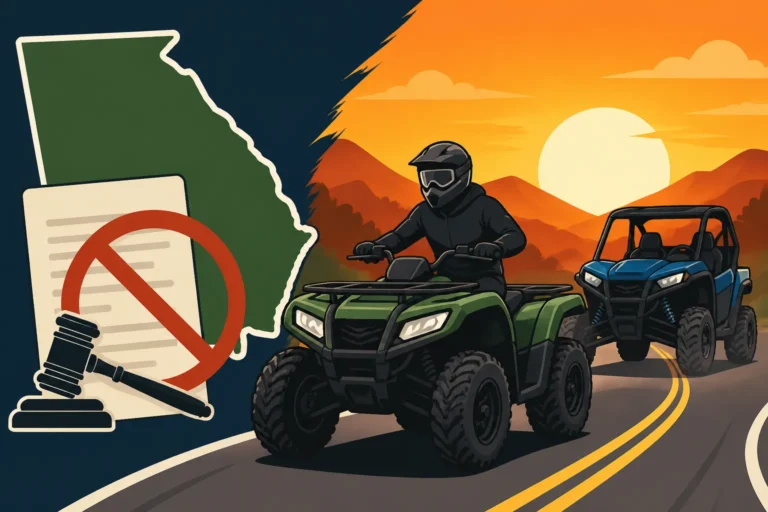
Georgia Rules Once the Sunset Date Arrives
The idea of taking your utility terrain vehicle (UTV) or side-by-side out on a Georgia county road has brought a lot of freedom and convenience for many, especially those who use their machines for work, hunting, or simply getting around their rural communities. However, a big question mark looms over the horizon: what happens when Georgia's MPOHV (Multipurpose Off-Highway Vehicle) road access law sunsets? It's a real frustration to finally get something put in place, only to have a ticking clock attached to it. This guide is here to help you understand exactly what that sunset date means for you and your machine, what will change, and where you'll still be able to ride legally in Georgia.
Understanding the July 1, 2027 Sunset Date
When the state of Georgia passed legislation allowing for the registration of MPOHVs for limited road use, it was a significant step forward for many off-road enthusiasts and working folks. For years, the question of [Are Side-by-Sides Street Legal in Georgia?] was met with a resounding "no," so this change was a breath of fresh air. However, this legislation came with a built-in expiration date, and understanding what that means is crucial for any owner.
What is the Sunset Clause, Anyway?
The "sunset clause" isn't some mystery. It was a deliberate part of the original House Bill 121, passed in 2023, which created the MPOHV registration category. Essentially, the Georgia legislature decided to allow MPOHVs to be registered and operated on designated county roads for a trial period. This means that the law enabling this specific type of road access has a built-in end date: July 1, 2027. It's not that the law is suddenly being repealed; it was designed from the beginning to simply cease to be effective for this particular provision at that point.
Think of it like a temporary permit or a pilot program. The state wanted to see how it would work, what the impact would be, and if it was something that should be made permanent or allowed to expire. While many of us hoped it would become a permanent fixture, the initial framework explicitly set a time limit. This means that after July 1, 2027, the specific legal authority that permits registered MPOHVs to travel on county roads will no longer be valid under the current law. It's a temporary measure that simply runs its course, rather than being actively canceled.
What Changes for Registered MPOHVs After July 2027?
The most immediate and significant change for MPOHV owners after July 1, 2027, is the loss of the privilege to operate these registered machines on public county roads. If you've gone through the process of [Georgia MPOHV Registration Explained], filled out the [Georgia Form MV-OHV and What It Asks], and proudly displayed your Georgia off-highway plate, you've likely enjoyed the convenience of riding directly from your property to a hunting club, a neighbor's house, or even a local store in certain rural areas. This specific road access will no longer be permitted.
For instance, if you've been using your registered side-by-side to travel down a dirt county road to access your deer stand, that specific use case will become illegal after the sunset date. The legislative intent behind the MPOHV registration was to grant this limited road access, and when that particular section of the law expires, so does the permission. Your registration itself won't suddenly vanish, but the key benefit—the legal right to operate on county roads—will. This means that if you're pulled over on a county road after that date, even with a valid MPOHV registration plate, you could be cited for illegal operation. The plates themselves, while technically still active until their renewal date, will no longer confer the road-legal status for county roads. It’s important to know what the implications are for [What Happens to Registrations at Sunset] and plan accordingly.
The Future of Off-Road Vehicle Use in Georgia
With the sunset date approaching, it’s only natural to wonder where you can actually ride your ATV or UTV in Georgia. The good news is that the sunset clause specifically targets the county road access provision; it does not eliminate all forms of off-road riding or even restrict private land use. Many options will still be available for enthusiasts and those who rely on their machines for work or recreation.
Where Can You Still Ride After the Sunset?
Even after July 1, 2027, Georgia offers plenty of opportunities for off-road vehicle use, primarily on private property and designated trail systems.
- Private Land: This is the most straightforward answer. If you own land, or have explicit permission from a landowner, you can continue to ride your ATV or UTV on that private property without issue. This hasn't changed, and it won't change after the sunset date. Many folks enjoy their machines purely on their own acreage, hunting leases, or timber company land with permission. This remains a bedrock of off-road recreation.
- Designated Trail Systems: Georgia is fortunate to have a variety of designated off-road vehicle (OHV) trail systems, both public and private. These include areas within the Chattahoochee-Oconee National Forest, like Houston Valley and Beasley Knob, as well as private parks such as Iron Mountain Resort. These trails operate under their own specific rules and permitting systems, and their access is entirely separate from the MPOHV county road provisions. They were available before MPOHV registration and will remain available afterward. You’ll need to check specific park or forest regulations for permits, machine types allowed, and operating hours. For a comprehensive overview, you might want to read [Georgia ATV Trails: Where You Can Legally Ride].
- Wildlife Management Area (WMA) Roads: Georgia's Wildlife Management Areas (WMAs) often have specific rules regarding vehicle access, which can include ATVs and UTVs. Typically, access is limited to established roads within the WMA, often only on hunt days or for a specific window around sunrise and sunset. These rules are generally tied to hunting seasons and wildlife management, and they are distinct from the general county road access granted by MPOHV registration. So, while you might still be able to use your UTV on a WMA road during specific times and conditions, it’s crucial to consult the Georgia Department of Natural Resources (DNR) regulations for each specific WMA. These regulations are not affected by the MPOHV sunset clause, but they are highly specific and often restrictive. For more details, refer to [Georgia WMA Riding Rules Explained].
What About Registration and Insurance?
The sunset clause specifically affects the road access granted by MPOHV registration, not the ability to register the machine itself. [Georgia MPOHV Registration Is Voluntary], and it may continue to be an option for some owners even if the county road privilege is gone.
- Registration Post-Sunset: It's possible that the state may continue to offer MPOHV registration even after July 1, 2027. Why would someone bother if they can't ride on county roads? Primarily for proof of ownership. In Georgia, ATVs and UTVs do not have titles, making registration a valuable document to establish legal ownership, especially for theft recovery or private sales. While a bill of sale can suffice, an official state registration carries more weight. So, while the primary benefit of road access will be gone, some owners might still choose to register their machines for this administrative purpose. It will certainly be a topic of discussion for the Georgia ATV and UTV community.
- Insurance Implications: Many owners carry insurance on their ATVs and UTVs, whether for liability, theft, or damage. [Georgia Liability Insurance Tied to Registration] was a requirement for road-legal MPOHVs. After the sunset, if you're not riding on county roads, the need for that specific type of liability insurance tied to road use will diminish. However, insurance for theft, fire, or damage (comprehensive and collision) is still highly recommended, especially for expensive machines or those stored in vulnerable locations. Your insurance company can advise on policies tailored for off-road-only use that would cover your machine on private land or designated trails, regardless of its registration status.
| Feature / Date | Before July 1, 2027 | After July 1, 2027 |
|---|---|---|
| County Road Access | Permitted with valid MPOHV registration & insurance | No longer permitted under current MPOHV law |
| Private Land Use | Permitted (with owner permission) | Permitted (with owner permission) – Unchanged |
| Designated OHV Trails | Permitted (with relevant permits/fees) | Permitted (with relevant permits/fees) – Unchanged |
| WMA Roads | Permitted under specific WMA rules (hunt days, etc.) | Permitted under specific WMA rules (hunt days, etc.) – Unchanged |
| MPOHV Registration | Grants county road access & proof of ownership | May continue for proof of ownership, but no longer grants road access |
| Liability Insurance | Required for road use | No longer required for road use; off-road policies still recommended |
Navigating Local Ordinances and Other Exemptions
It's easy to lump all small, recreational, or utility vehicles into one basket, but Georgia law makes crucial distinctions. Understanding these differences is key, especially as the MPOHV road access sunset approaches. The rules for golf carts, Personal Transportation Vehicles (PTVs), and Low-Speed Vehicles (LSVs) operate under different statutes and local authorities, meaning they are not directly impacted by the MPOHV sunset.
Golf Carts, PTVs, and LSVs: A Different Category
One of the biggest misunderstandings often revolves around golf carts. While they might look somewhat similar to smaller UTVs, and both can be found on certain local roads, they are governed by entirely separate sets of laws. The MPOHV registration and its sunset clause specifically apply to MPOHVs—machines that meet certain criteria, like engine speed, weight, payload, and non-straddle seating. Golf carts, PTVs, and LSVs have their own definitions and regulations.
- Golf Carts and PTVs: Many Georgia cities and counties have adopted ordinances that permit golf carts and PTVs on specific public roads or designated path networks. Peachtree City, for example, is famous for its extensive golf cart path system, and has its own specific rules, including [Peachtree City Golf Cart Rules in Georgia]. These local ordinances are not linked to the state MPOHV law. Therefore, when the MPOHV road access sunsets, it will not affect the ability of golf carts or PTVs to operate where they are legally allowed by local ordinance. The rules for these vehicles are found in local codes and in other sections of state law, such as [Georgia Golf Cart Laws and PTV Ordinances], which remains distinct.
- Low-Speed Vehicles (LSVs): LSVs are defined by federal and state law as four-wheeled vehicles with a top speed between 20 mph and 25 mph, equipped with safety features like headlights, taillights, seat belts, and turn signals. They are factory-built to meet specific standards and are often titled and registered just like regular cars, allowing them to operate on roads with speed limits up to 35 mph. Again, LSVs are a distinct category with their own legal framework, completely separate from MPOHVs and their impending sunset. The expiration of MPOHV road access will not change the legal status or road access for LSVs.
This distinction is vital: the sunset affects only MPOHVs that were granted temporary county road access through HB 121 (2023). It does not suddenly outlaw golf carts on city paths or LSVs on neighborhood streets.
Farm and Commercial Use Exemptions
Beyond the general recreational and utilitarian road access for MPOHVs, Georgia law has long provided certain exemptions for vehicles used in bona fide agricultural or commercial operations. These exemptions generally allow for the use of off-road machines in specific contexts related to farming, logging, or other commercial activities, even on public roads, typically for short distances or to cross them.
For example, a farmer might be able to use their UTV to cross a county road to get from one field to another, or a logging company might use a side-by-side on a forest service road as part of their operations. These uses are usually tied to the purpose of the vehicle's operation and are often exempt from standard registration or licensing requirements when directly engaged in the specific exempt activity. For instance, there's an [Agricultural Work and the Helmet Exemption] that highlights how farm-related uses can sometimes fall outside general rules.
It's crucial to understand that these farm and commercial exemptions are generally narrow and purpose-specific. They typically do not grant general permission to joyride down a county road or commute to a non-farm-related destination. They are also separate from the MPOHV registration process. Therefore, the sunset of MPOHV road access will likely not directly impact these long-standing agricultural or commercial exemptions, as they exist under different legal provisions. However, anyone relying on such an exemption should be absolutely sure they meet all the criteria and understand the limitations, as enforcement can be strict.
Preparing for the Change and Advocating for Future Access
The approaching sunset date for MPOHV road access in Georgia is a significant shift for many side-by-side and UTV owners. It means that the convenience of running to the store or accessing your hunting land via county roads will come to an end, barring new legislation. It's a good time to start thinking about how this will impact your riding habits and what steps you might want to take.
What Actions Should Current MPOHV Owners Consider?
As July 2027 draws closer, it's wise for registered MPOHV owners to consider their options and adapt their plans.
- Review Riding Habits and Destinations: If you currently use your registered MPOHV on county roads, start thinking about alternative routes or transportation methods. This might mean trailering your machine to a designated riding area, focusing more on private land, or sticking to the specific rules for [Georgia WMA Riding Rules Explained]. Planning ahead can prevent accidental violations once the law changes. For example, if you frequently crossed a state highway on a county road, know that [Georgia Crossing a Georgia State Highway on a UTV] will become a much more legally ambiguous action if not outright prohibited for MPOHVs without registration for road use.
- Stay Informed About Potential Legislative Changes: While the current law has a sunset clause, that doesn't mean new legislation couldn't be introduced in the future to reinstate or modify road access for MPOHVs. Legislative sessions in Georgia happen annually, and advocacy groups may work to extend or alter the current rules. Keeping an eye on developments from state representatives and off-road associations can keep you ahead of any new changes. Remember, the original MPOHV law in 2023 changed the game; new laws can always do so again.
- Adapt Your Machine for Off-Road Use: If your primary use will revert to strictly off-road, private land, or designated trail systems, you might consider enhancing your machine's capabilities for those environments. Companies like SuperATV offer a wide range of aftermarket parts—from heavy-duty suspension components to winches and skid plates—that can improve your UTV's performance and durability in rugged conditions. Adapting your machine for more challenging terrain can open up new riding opportunities even if county roads are off-limits. For example, adding robust A-arm guards or a winch can be invaluable on remote trails.
- Understand Registration Implications: If you decide not to continue voluntary MPOHV registration (should it remain an option) after the road access expires, understand that you'll lose that specific form of state-issued proof of ownership. Make sure you have other solid forms of documentation, such as a strong bill of sale, to prove your ownership. If you consider canceling your registration, you should be familiar with [What Georgia Does With a Registration You Cancel].
The Role of Advocacy and Future Legislation
The original passage of the MPOHV law in Georgia was a direct result of advocacy from the off-road community, landowners, and legislative champions who saw the need for this type of vehicle access. As the sunset date approaches, it highlights the ongoing importance of civic engagement.
If you believe that MPOHV county road access is vital and should be continued, then actively engaging with your local and state representatives is the most effective way to voice your opinion. This could involve writing letters, making phone calls, or supporting organizations that lobby on behalf of off-road enthusiasts. Lawmakers respond to their constituents, and a collective voice can certainly make an impact. The question of [Can a Georgia County Close Its Roads to UTVs?] even before the sunset, shows the local authority has always been a factor, and continued conversations at both state and local levels will be necessary to shape any future policies. Ultimately, while the current law is set to expire, the legislative process is dynamic. The future of MPOHV road access in Georgia will depend heavily on continued discussion, data from the trial period, and the collective will of the community and its elected officials.
Disclaimer
This article is for general informational purposes only and does not constitute professional advice. Laws, prices and regulations vary by location and change over time. Consult a qualified professional for guidance on your specific situation.