Georgia Penalties for Riding the Wrong Road
It's tempting to hop on your ATV or UTV and just go, especially when you're looking for an easy way to get from point A to point B or just explore some backroads. But in Georgia, taking your off-highway vehicle onto the wrong stretch of pavement can lead to a world of trouble, from hefty fines to impoundment. This guide is here to shed light on exactly what constitutes an "illegal" road for your machine and the real-world penalties you could face, helping you understand how to keep your adventures on the right side of the law.
Understanding Georgia's MPOHV Law and Limited Road Access
Before we dive into the penalties for riding on the wrong road, it's crucial to understand what the state of Georgia considers the right road, or at least, the permissible roads under specific circumstances. The state introduced specific legislation to allow certain types of off-highway vehicles (OHVs) to gain limited road access, primarily focusing on Machines Permitted for Off-Highway Vehicle Use, or MPOHVs. This isn't a blanket "street legal" status; it's a carefully defined set of rules.
The Specifics of MPOHV Registration
Georgia's MPOHV registration system, which began in late 2023, is entirely voluntary. Riders aren't forced to register their machines, but doing so is the only way to gain even limited road access. This means if you choose not to register your machine, it has absolutely no legal standing to be on any public road, period. The whole point of the registration is to permit use, so without it, you're always on the wrong road if you're not on private property or a designated trail.
To even qualify for MPOHV registration, your machine has to pass a pretty strict eight-point test. This isn't just about having an engine; it's about the very design and features of your UTV or side-by-side. For instance, the law is very clear that the machine must have a non-straddle seat, meaning you sit in it like a car, not on it like a motorcycle or traditional ATV. It also needs a steering wheel, not handlebars. Beyond these fundamental design elements, there are specific dimensions and performance metrics that must be met, such as not exceeding 80 inches in width, having a payload capacity of at least 350 pounds, and gross vehicle weight under 4,000 pounds. Your machine also needs to be able to go at least 25 mph but no more than 65 mph. These rules ensure that only certain utility-focused side-by-sides typically qualify, leaving out most traditional sport ATVs and dirt bikes. [Why Georgia's MPOHV Rules Demand a Non-Straddle Seat] and [Georgia's 80-Inch Width Limit for Registration] explain these in detail.
Designated Road Use: Where You Can Legally Ride
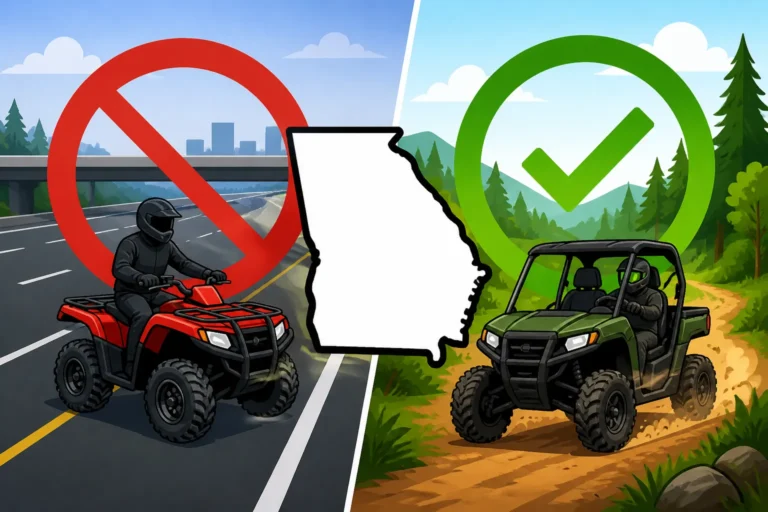
So, once your machine is properly registered as an MPOHV and you've got your Georgia plate, where can you actually ride? The answer is very limited: county roads only. It’s critical to understand that this does not mean all public roads. The law specifically states that MPOHVs can operate on the improved shoulder of a county road or the unpaved portion of a county road. The key here is "county road." You can use these roads to get from one section of your property to another, or to access designated trails, but it’s not for joyriding across the state.
The statute also permits crossing state routes or even federal highways, but only at an intersection and only when it's the most direct route to another county road or private property. This is a very narrow exception, not a loophole. You cannot ride down the state route; you can only cross it. This distinction is paramount, as misinterpreting it is a common way riders find themselves in trouble. [Georgia MPOHV Road Rules: County Roads Only] outlines these specifics, helping you grasp the boundaries.
Equipment and Driver Requirements for Registered Machines
Even with a registered MPOHV and on a permissible county road, you're not done with the rulebook. The state has stringent requirements for the machine's equipment and the operator's qualifications. Your machine must have functional headlights, brake lights, and at least one rearview mirror. Factory-installed seat belts are also a must, which further reinforces that traditional ATVs are out of the picture. These aren't just suggestions; they are prerequisites for legal operation on public roads. Many riders turn to aftermarket suppliers like SuperATV to ensure their machines are equipped with compliant mirrors, turn signals, and robust lighting systems, as well as sturdy windshields for added safety.
As for the driver, you need a valid Georgia driver's license. This isn't a suggestion; it's a hard rule. You can't let your unlicensed teenager take the side-by-side on a county road, even if they're experienced on private land. Furthermore, anyone under 18 operating or riding on a registered MPOHV on a public road must wear a helmet. This helmet rule extends to private property as well for minors, with some specific exemptions for agricultural or commercial work. Ignoring these requirements, even on an otherwise "legal" county road, can still lead to penalties. [Headlights, Brake Lights and Mirrors on the Checklist] and [Georgia Requires Seat Belts on a Registered Machine] delve into the necessary equipment.
Identifying the "Wrong Roads" for Your ATV or UTV in Georgia
Now that we've covered where you might be able to ride legally, let's get down to the brass tacks: what roads are definitively off-limits for your ATV or UTV in Georgia? This is where many riders get into hot water, often unknowingly, simply because they don't fully grasp the distinctions between different types of public thoroughfares. It's not always as simple as paved versus unpaved.
The Absolute No-Go Zones: State Routes and Interstates
Without a doubt, the most forbidden territories for ATVs and UTVs in Georgia are state routes, U.S. highways, and especially interstates. These are the main arteries of the state, designed for high-speed, conventional vehicle traffic. There is no legal way to operate an off-highway vehicle on these roads, period. While the law allows for crossing a state route at an intersection when moving between county roads, this is a quick, direct traversal, not a segment of travel along the state road. The idea of taking your UTV down I-75 or even a busy state highway like GA-400 is not only illegal but incredibly dangerous.
Law enforcement officers are particularly vigilant about enforcing these prohibitions. They understand that mixing slow-moving, unprotected off-highway vehicles with fast-moving trucks and cars is a recipe for disaster. If you're caught riding on a state route or interstate, even for a short distance, expect immediate enforcement action. The intent behind these rules is to protect both OHV riders and the general motoring public, and deputies won't hesitate to pull you over. [Why Georgia State Highways Stay Off Limits] and [Interstates and Why They Are Never an Option] clearly outline these critical boundaries.
Navigating County Roads: Understanding What's Permitted and What's Not
Even on county roads, which are generally the only permissible public access points for registered MPOHVs, there are nuances that can trip up an unsuspecting rider. The law specifies use on the "improved shoulder" or "unpaved portion" of a county road. This means that if a county road is fully paved with no shoulder, or if the shoulder is narrow and unimproved, simply riding in the main travel lane is still generally prohibited. The spirit of the law is to keep these machines off the primary flow of traffic.
Furthermore, while the state law permits MPOHV use on county roads, individual counties and municipalities retain the authority to pass their own ordinances. Some counties might have stricter rules, or specific local prohibitions that override the general state allowances. For example, a county might designate specific county roads as off-limits for MPOHVs due to traffic volume, safety concerns, or residential complaints. It's a huge burden, but as a rider, it falls on you to be aware of any local ordinances in the specific county you're riding in. Just because it's a "county road" doesn't automatically mean it's open season everywhere. [County Road Systems and Where They Run] can help clarify this complex patchwork of rules.
Other Restricted Areas and Off-Limit Spaces
Beyond the clear lines of state highways and interstates, there are many other places where your ATV or UTV simply doesn't belong. Sidewalks are a prime example. While golf carts might have specific ordinances allowing them on certain sidewalks or paths in a few planned communities like Peachtree City, ATVs and UTVs do not. Sidewalks are for pedestrians, and operating a motorized vehicle on them is a safety hazard and a violation.
Similarly, riding on private property without express permission from the landowner is trespassing. This includes fields, forests, power line easements, pipeline rights-of-way, railroad beds, and even abandoned logging roads if they are on private land. Just because a path looks inviting or remote doesn't mean it's public access. A common misconception is that "utility easements" are free-for-all zones, but these are typically private property with specific access rights granted to utility companies, not the general public for recreation. Ignorance of who owns the land is no defense, and property owners are increasingly vigilant about unauthorized vehicle access. [Riding a Quad on a Sidewalk] highlights one common misuse.
Immediate Penalties: Fines, Citations, and Vehicle Impoundment
When a law enforcement officer catches an ATV or UTV rider on the wrong road, the consequences are often immediate and impactful. These aren't just minor infractions; they come with tangible financial and logistical headaches that can quickly ruin your day, or even your month. Understanding these immediate penalties can certainly serve as a strong deterrent for those considering taking a shortcut on a forbidden road.
The Financial Hit: Fines and Court Costs
The most common and immediate penalty for riding an off-highway vehicle on a prohibited road in Georgia is a citation, which comes with a fine. While specific fine amounts can vary depending on the county and the exact nature of the violation, these aren't usually cheap tickets. A basic traffic infraction for an unauthorized vehicle on a roadway could range from a couple of hundred dollars to significantly more. If the violation is coupled with other infractions, such as reckless driving, operating an unregistered vehicle (if not an MPOHV), or even lacking required safety equipment, the fines can quickly stack up.
Beyond the initial fine, you'll also likely be responsible for court costs. Even if you simply pay the ticket and don't go before a judge, administrative fees are often added to the total. If you choose to contest the ticket, you'll be spending time and potentially more money on legal advice or taking time off work to appear in court. This financial burden can be a real sting, especially if you were just trying to "quickly" get somewhere or simply made an honest mistake about where you were allowed to ride. [Georgia Ticket Cost for Illegal Road Riding] gives a sense of the expense involved.
The Stress of Impoundment and Recovery
One of the most significant and frustrating penalties is the impoundment of your ATV or UTV. If a law enforcement officer deems your vehicle to be illegally on a public roadway, they have the authority to have it towed and impounded. This isn't a quick process. First, your machine will be loaded onto a tow truck, usually at your expense. Then it will be taken to an impound lot, where it will incur daily storage fees. These fees can add up very quickly, sometimes exceeding the initial fine itself.
To get your machine back, you'll typically need to pay all outstanding fines, court costs, towing fees, and daily storage charges. You'll also have to provide proof of ownership and perhaps even demonstrate how you plan to legally transport the machine away from the impound lot (i.e., you can't just drive it off the lot if it's not street-legal). This whole ordeal can be incredibly costly and time-consuming, turning a simple ride into a multi-day nightmare involving hundreds, if not thousands, of dollars. Losing access to your machine, especially if you rely on it for work or transportation on private property, can be a major disruption. [Georgia Impound Rules After a Violation] details this stressful process.
Insurance Ramifications and Liability Concerns
Getting a citation for illegal road use can also have a ripple effect on your insurance. While specific consequences vary by your insurer and policy, any violation recorded against you can potentially lead to increased premiums. Your insurance company might view you as a higher risk, especially if the infraction involved reckless behavior or significant safety concerns. If you have an MPOHV registered and insured for road use, a violation could jeopardize that specific coverage, or even lead to its cancellation.
Even more critically, if you are involved in an accident while illegally operating your ATV or UTV on a prohibited road, your insurance coverage might be denied entirely. Most off-road vehicle policies have clauses that specifically exclude coverage for incidents occurring during illegal activities or on unauthorized roadways. This means you could be personally liable for all damages, including medical expenses for anyone injured (yourself included), property damage to other vehicles, and legal defense costs. A moment of poor judgment could lead to a lifetime of financial hardship if a serious accident occurs without insurance backing. [Georgia Insurance After a Claim] underscores why maintaining a clean driving record is crucial.
Beyond the Ticket: Deeper Consequences of Illegal Road Use
While fines, impoundment, and insurance woes are certainly immediate headaches, the ramifications of illegally riding your ATV or UTV in Georgia can extend much further. These deeper consequences can impact your personal legal standing, community reputation, and even the future of off-road vehicle access for all riders in the state. Ignoring these potential outcomes would be a mistake for any responsible rider.
Legal Liabilities in the Event of an Accident
Perhaps the most severe consequence of illegally operating your off-highway vehicle on a prohibited road is the heightened legal liability in the event of an accident. If you're involved in a collision while on an unauthorized roadway, the simple fact of your illegal presence immediately places you at a significant disadvantage legally. Even if another party was partially at fault, your unlawful operation could be used to assign a greater degree of fault to you, limiting your ability to recover damages and increasing your exposure to lawsuits.
Consider a scenario where you're riding your UTV on a state route – a clear violation – and a car swerves to avoid you, crashing into another vehicle. Even if there was no direct contact, your illegal act could be deemed the proximate cause of the entire incident. You could face civil lawsuits for property damage, personal injury, and even wrongful death. Without the backing of insurance (which, as discussed, might deny coverage for illegal acts), you could be personally responsible for hundreds of thousands, if not millions, of dollars in damages. [Georgia Accident Reporting for a UTV Crash] highlights the seriousness of these incidents.
Escalation to Criminal Charges: When Situations Turn Serious
While many illegal road use cases start as simple citations, certain aggravating factors can quickly elevate the situation to criminal charges. For instance, operating an ATV or UTV while under the influence of alcohol or drugs is a serious offense that will result in DUI charges, just as it would in a regular car. A DUI on an OHV, even if it wasn't on a primary road, can carry the same severe penalties, including hefty fines, license suspension, jail time, and a permanent criminal record. [Georgia DUI Law and Off-Road Machines] explains these serious consequences.
Beyond DUI, reckless driving, fleeing or attempting to elude a law enforcement officer, or causing significant property damage or injury through your actions can all lead to criminal charges. If a fatality occurs, even if accidental, charges like vehicular homicide could be on the table. These are not minor traffic infractions; these are felonies that can irrevocably alter your life. The penalties can include years in prison, massive fines, and the loss of civil liberties. It's a stark reminder that operating these powerful machines carries immense responsibility, especially when you venture onto public roadways.
The Broader Impact on Off-Road Riding Access and Community Standing
Every time a rider illegally operates an ATV or UTV on a prohibited road, especially in a reckless or disruptive manner, it unfortunately casts a negative shadow on the entire off-road riding community. Residents who experience noise, dust, or perceived danger from illegal OHV use often complain to local law enforcement and elected officials. These complaints can fuel public sentiment against off-road riding, leading to stricter enforcement, new ordinances, and even the closure of legal riding areas or the tightening of MPOHV rules.
When county commissioners or state legislators hear repeated complaints about "those ATV riders breaking the law," it makes it much harder to advocate for expanded legal access or even to maintain existing privileges. The Georgia MPOHV law itself, with its July 2027 sunset clause, is a temporary measure. The future of road access for these machines will depend heavily on how responsibly riders behave between now and then. A few bad actors can jeopardize the riding opportunities for everyone else, leading to a loss of public support for off-road recreation. Maintaining good community relations is vital for the long-term health of our beloved pastime. [Georgia Penalties for an Unregistered Road Machine] emphasizes the importance of adherence to rules.
Proactive Steps to Avoid Penalties and Ride Responsibly
Nobody wants to deal with fines, impoundment, or worse, an accident. The good news is that avoiding these penalties for riding on the wrong road is entirely within your control. It requires a commitment to understanding the rules, ensuring your machine is compliant, and making responsible choices about where and how you ride.
Thoroughly Understanding Georgia's Laws and Local Ordinances
The first and most crucial step is education. You simply must know the laws that govern ATV and UTV use in Georgia. This means familiarizing yourself with the MPOHV registration requirements, understanding what constitutes a "county road," and knowing the strict prohibitions against state routes and interstates. Don't rely on hearsay or what a buddy told you; go directly to the source, which is the Georgia Department of Revenue's motor vehicle division website or consult with your local county tag office.
Beyond state law, remember that local ordinances can add another layer of complexity. Before riding in a new area, make an effort to check with the county sheriff's office or local government about any specific rules regarding MPOHV use on their county roads. Some counties might have specific restrictions, hours of operation, or even outright bans on certain roads. A quick phone call or visit to a county website can save you a lot of trouble. Being informed is your best defense against accidental violations. [Georgia MPOHV Registration Explained] is a great starting point for this learning journey.
Ensuring Your Machine Meets All Registration and Safety Standards
If you intend to utilize the limited county road access permitted for MPOHVs, your machine absolutely must meet all the eligibility criteria for registration. This includes having a non-straddle seat, a steering wheel, meeting the weight and width limits, and having the required speed capabilities. It also means ensuring your machine is equipped with all the necessary safety features like headlights, brake lights, and a rearview mirror. For machines that might be close to the edge of compliance, or if you simply want to upgrade for safety, aftermarket parts from reputable brands like SuperATV can help you meet or exceed these requirements, offering everything from heavy-duty mirrors to DOT-approved windshields and lighting kits.
Furthermore, ensure your MPOHV is properly registered with your county tag office and that you have a valid, unexpired registration plate affixed to your machine. Always carry proof of registration and proof of liability insurance when operating on public roads, as law enforcement will ask for these. An unregistered machine, even if it physically meets MPOHV standards, is still considered illegal on public roads. An important note: [Georgia Sales Tax Paid Before Registration] is a step that often trips people up; make sure that's handled first.
Embracing Designated Off-Road Trails and Private Property
The most straightforward way to avoid penalties for riding on the "wrong road" is to simply stick to the right places: designated off-road trails and private property where you have permission. Georgia is home to a fantastic network of trails within its national forests, such as Houston Valley and Beasley Knob, and several excellent private off-road parks like Iron Mountain Resort and Highland Park. These areas are specifically designed for ATV and UTV recreation, offering diverse terrain and a safe, legal environment to enjoy your machine.
Riding on private land with the owner's permission is also a completely legal and often preferred option. Many landowners, especially in rural areas, welcome responsible riders. Building relationships with private landowners or joining local hunting clubs that lease land can open up vast opportunities for legal off-road fun. These options allow you to push your machine to its limits (safely, of course) without the constant worry of state troopers or county deputies. Utilizing quality parts from SuperATV for durability and performance on these designated trails is a fantastic alternative to risking road violations, ensuring your machine is ready for any adventure. [Georgia ATV Trails: Where You Can Legally Ride] and [Georgia ATV Rules on Private Property] provide excellent resources for finding legal riding spots.
The Future Outlook: What Georgia Riders Need to Know About Road Access
While current Georgia law provides some limited road access for eligible MPOHVs, it's crucial for every rider to understand that this privilege is not permanent. The legislation allowing MPOHV road use contains a specific "sunset clause" that will significantly alter the landscape of riding opportunities in the very near future. Being informed about this upcoming change is essential for planning your rides and potentially advocating for continued access.
Understanding the July 2027 Sunset Provision
The Georgia law (specifically O.C.G.A. § 40-1-1) that permits MPOHVs on county roads is set to expire on July 1, 2027. This means that as of that date, unless new legislation is passed, the provisions allowing registered off-highway vehicles on county roads will automatically cease to exist. This isn't a hypothetical future; it's a confirmed date on the calendar. After July 1, 2027, without further legislative action, even a properly registered MPOHV with all the correct equipment will once again be considered an illegal vehicle on any public road, including county roads.
This sunset clause was built into the original legislation as a probationary period, allowing the state to assess the safety and impact of MPOHV road use before making it a permanent fixture. It's a critical deadline that will require a renewed push from the off-road community to either extend the current law, modify it, or establish a new framework for road access. Ignoring this date could lead to a rude awakening for many riders who have grown accustomed to their limited road privileges. [Georgia's July 2027 Sunset on Road Access] explains this crucial impending change in more detail.
Preparing for Changes and Advocating for Future Access
So, what does this sunset date mean for current and future MPOHV owners? Primarily, it means uncertainty. As the date approaches, riders need to be prepared for the possibility that road access will revert to its pre-MPOHV state, where no off-highway vehicle is legally allowed on any public road unless explicitly exempted (like for farm use crossing a road). This might influence purchasing decisions or how you plan to use your machine in the long term.
For those who value limited road access, the period leading up to July 2027 is a crucial time for advocacy. Getting involved with local and state off-road riding clubs, contacting your elected officials, and sharing your positive experiences with MPOHV road use (e.g., for commuting to work on rural roads, accessing hunting land, or supporting local businesses) can all contribute to a collective effort to influence future legislation. Demonstrating responsible riding and adherence to current laws is the best way to build a case for continued access. Showing that MPOHVs can safely share county roads is vital, while incidents of illegal road use only serve to undermine these efforts. [What Happens to Registrations at Sunset] is a must-read for anyone considering the long-term implications.
Here’s a quick overview of what we've discussed regarding road types and associated risks:
| Road Type | Legal for Registered MPOHV? | General Legal Status (Unregistered) | Typical Consequences of Illegal Use |
|---|---|---|---|
| County Roads (unpaved/improved shoulder) | YES, if MPOHV registered | NO | Fines, impoundment, insurance issues, possible criminal charges. |
| State Routes / U.S. Highways | NO (crossing permitted) | NO | Significant fines, impoundment, severe legal liability, criminal charges likely. |
| Interstates | NO | NO | Extreme fines, immediate impoundment, high risk of criminal charges/accidents. |
| City Streets | NO (unless local ordinance) | NO | Fines, impoundment, local ordinance violations. |
| Sidewalks | NO | NO | Fines, impoundment, pedestrian safety hazards. |
| Private Property (without permission) | N/A | NO | Trespassing charges, civil lawsuits, impoundment by owner (if local law allows). |
| Designated OHV Trails | YES | YES (if compliant with park rules) | None (if following park/forest rules). |
Disclaimer
This article is for general informational purposes only and does not constitute professional advice. Laws, prices and regulations vary by location and change over time. Consult a qualified professional for guidance on your specific situation.