Georgia Crossings at Designated Points
It's incredibly frustrating when you're out enjoying your side-by-side or UTV, cruising along a perfectly legal county road, only to be faced with a major state highway that seems to create an impassable barrier. You might need to get to another county road, reach your hunting land, or simply get home, but the thought of illegally traversing a busy state route can be a real headache, not to mention a safety hazard and a legal risk. This guide will walk you through exactly how and where you can legally cross Georgia state highways with your properly registered multipurpose off-highway vehicle (MPOHV), helping you navigate the rules with confidence and avoid unnecessary tickets or dangerous situations.
Understanding Georgia's Road Access Framework for ATVs and UTVs
Before we dive into the specifics of crossing, it's vital to grasp the foundational rules that govern MPOHV use on Georgia's public roads. Georgia has made strides in providing some limited road access for UTVs, but these allowances come with very specific stipulations designed to ensure safety and maintain the integrity of different road systems. The distinction between county roads and state highways is absolutely critical here.
The Core Restriction: Why State Routes Are Generally Off-Limits
The overarching rule in Georgia is that your MPOHV is generally not permitted to be operated on state highways. These are the major arteries that connect cities and regions, often with higher speed limits, greater traffic volumes, and less predictable conditions than rural county roads. The legislation allowing MPOHV use was never intended to open up these high-speed, high-traffic corridors to off-highway machines. The primary reasons for this restriction are rooted deeply in safety. MPOHVs, even those modified for some road use, are typically slower, less visible, and offer less protection in a collision compared to passenger vehicles designed for highway speeds. Imagine trying to merge a side-by-side onto an interstate exit ramp or navigate a busy four-lane state route; the speed differential alone creates an enormous risk. For a deeper understanding of the overall legal landscape, check out [Georgia ATV Road Law Explained].
State highways are engineered for different types of vehicles and different speeds. Their design often includes wide shoulders, multiple lanes, and complex interchanges that are simply not safe or appropriate for the dimensions and performance characteristics of most MPOHVs. This strict limitation helps protect both MPOHV operators and other motorists from potentially catastrophic accidents. Therefore, while you might be itching to take the "shortest route" across a highway, it's often explicitly prohibited for through travel. The focus is on getting you safely across and back onto an approved road, not allowing you to travel on the highway itself.
The MPOHV Exception: County Roads Only
In stark contrast to state highways, Georgia does allow properly registered MPOHVs to operate on county roads. This is a game-changer for many UTV owners, providing access to vast networks of rural and semi-rural roads that can connect trails, hunting lands, and neighboring communities. However, this privilege comes with the requirement that your machine meets specific criteria and is registered with the state. This means your UTV or side-by-side must pass a multi-point inspection to ensure it has the basic safety equipment needed for road use. We've got a whole article dedicated to this process: [Georgia MPOHV Registration Explained].
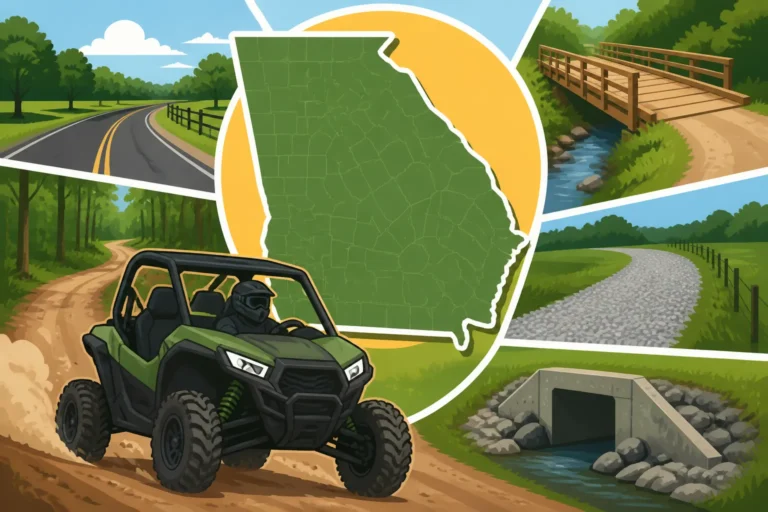
The intent behind this allowance is to provide utility and convenience for landowners, farmers, hunters, and recreational riders in areas where county roads are common and often less trafficked. It acknowledges the practical need for these machines to move between properties or access remote areas without requiring them to be trailered everywhere. To be clear, MPOHVs are distinct from traditional ATVs (quads), which are generally not permitted on any public roads in Georgia. If you're wondering if your specific machine qualifies, it's worth reviewing [Are Side-by-Sides Street Legal in Georgia?]. Understanding [Georgia County Road Systems and Where They Run] is also crucial, as it defines the very network of roads where you're allowed to operate your registered machine. This county road access is what makes the discussion of crossing state routes so relevant; you might be legally on one county road and need to get to another, with a state highway in between.
Defining "Designated Points" for Crossing State Routes
When the law talks about crossing state routes, it doesn't mean just anywhere. There are very specific circumstances and locations that qualify as "designated points," and understanding these is paramount to staying legal and safe. You can't just pick a random stretch of highway and dart across.
The Legal Basis for Crossing Intersections
The primary "designated points" for crossing a state route are at legitimate intersections with a public road or street. This is where different road systems naturally meet, and where traffic control devices, like stop signs or traffic lights, are typically present. These intersections are designed to manage the flow of traffic from multiple directions, including vehicles entering, exiting, and crossing. The law recognizes that sometimes, to get from one county road to another, or to access a property that fronts a state route, a direct crossing is unavoidable.
Think about a rural four-way stop where a county road meets a state highway. This is a prime example of a designated crossing point. The expectation is that you will treat this intersection like any other vehicle, obeying all traffic signals and signs. You'll stop, yield the right-of-way, and proceed safely across the state route to the other side. You are not meant to drive down the state route, even for a short distance; the goal is to traverse it as directly as possible. The presence of established infrastructure for managing traffic flow is what makes these points "designated" in the eyes of the law. They are predictable, often have clearer sight lines, and provide a moment of controlled traffic flow where a crossing can be performed more safely than mid-block.
The Importance of Right-Angle Crossings and Safety Protocols
When you do approach a designated intersection to cross a state route, the manner in which you execute that crossing is just as important as the location itself. The law implicitly (and often explicitly in traffic codes) expects you to make a direct, right-angle crossing. This means you should aim to cross the state route perpendicularly, going from one side straight to the other, rather than attempting to cut diagonally or make a wide, sweeping turn that effectively has you traveling on the state route for any appreciable distance. A right-angle crossing minimizes your time in the travel lanes of the higher-speed road and makes your intentions clearer to other drivers.
Safety protocols are non-negotiable here. This isn't the time to be casual. You must come to a complete stop, thoroughly check for oncoming traffic from both directions, and use your turn signals (if equipped and functional) to indicate your intent. If you have an MPOHV that uses aftermarket parts, make sure your lighting, like that offered by SuperATV, is bright and clearly visible to other drivers, especially if crossing near dawn, dusk, or in inclement weather. Yield to all traffic on the state route. Only proceed when you have a clear, safe gap in traffic that allows you to complete the crossing without impeding the flow of vehicles already on the highway. Hesitation or misjudgment can lead to extremely dangerous situations, given the speed of highway traffic. Always remember that your MPOHV, while legal for crossing, is still a smaller, lighter vehicle than most cars and trucks you'll encounter, and safety should always be your top priority.
Practical Considerations for Safe State Route Crossings
While the law provides the framework, successful and safe crossings also depend heavily on your machine's setup and your own attentiveness as an operator. It’s not just about where you cross, but how you prepare and execute it.
Equipment Requirements for Road-Legal Crossings
For your MPOHV to be legally able to make these crossings (and indeed, to be registered for county road use at all), it must meet certain equipment standards. These aren't just suggestions; they are mandates designed to make your machine visible and controllable in a mixed-traffic environment. Essential items include working headlights and brake lights. These are crucial for visibility to other drivers, especially at intersections where light conditions can vary or during low-light hours. Brake lights clearly signal your intentions to stop or slow down, which is critical when approaching an intersection with faster-moving highway traffic. You'll want to ensure your brake lights are bright and free of mud or debris that could obscure them. We touch on some of these vital elements in [Headlights, Brake Lights and Mirrors on the Checklist].
Additionally, rearview mirrors are required. These provide the operator with crucial awareness of traffic approaching from behind, allowing you to gauge gaps in traffic and make safe decisions before pulling out. Many UTVs come with some form of mirrors from the factory, but aftermarket options, perhaps from a brand like SuperATV, can often provide better visibility and durability. Some machines may also be equipped with turn signals, which, while not always explicitly required for MPOHVs in every scenario, are incredibly helpful for communicating your intentions to other drivers, especially when making a turn after crossing. Always do a quick pre-ride check to ensure all your lights and mirrors are clean and functional before embarking on any journey that involves public road crossings.
Operator Responsibilities and Licensing
Beyond the machine itself, the person behind the wheel carries significant responsibility. To operate an MPOHV on any public road in Georgia, including during a state route crossing, you must possess a valid driver's license. This isn't a leisure activity that bypasses standard licensing requirements. The state views you as a legitimate road user during these moments, and expects you to demonstrate the same knowledge of traffic laws and responsible driving behavior as someone in a car or truck. For detailed information on this, refer to [Georgia Driver's License Rules for MPOHV Operators]. A learner's permit, for example, typically won't cut it for unaccompanied operation on public roads.
Your responsibilities extend beyond just having a license. You must be fully aware of the traffic conditions, the speed of vehicles on the state route, and the specific rules of the intersection you're approaching. This includes understanding right-of-way laws, obeying traffic signals, and being prepared to yield to highway traffic. Complacency can be extremely dangerous. Always be sober, attentive, and focused when operating your MPOHV on any public road. Furthermore, carrying the appropriate liability insurance is not just a good idea for your protection; it's a legal requirement for registered MPOHVs operating on public roads. A deputy stopping you for any reason, including an observed unsafe crossing, will likely ask for proof of insurance. Our article on [Georgia Insurance Minimums for Road Use] outlines what you need to know about coverage. Just like with a car, you are accountable for your actions and any incidents that may occur.
Navigating Common Scenarios and Avoiding Penalties
The rules regarding crossings are in place to allow legitimate movement while preventing abuse. Understanding the difference between a permissible crossing and illegal road use is key to staying out of trouble.
Crossing to Access Private Property or Another County Road
The most common and legitimate reason for crossing a state highway with your MPOHV is to access either private property that directly borders the state route or to connect to another county road system on the opposite side. Picture this: you've been riding on a county road, and your hunting lease is just across a state highway, accessible via another county road on the other side. Or perhaps your farm is split by a state route, and you need to move equipment or livestock between fields using a designated intersection. These are precisely the types of scenarios the "designated points" rule is meant to accommodate.
The emphasis here is on the necessity and directness of the crossing. You are not meant to travel along the state route, even for a short distance, to reach a more convenient crossing point. The crossing should be at the first available, safe, designated intersection that allows you to continue your journey on an approved road or access your property. For instance, if a county road ends at a T-intersection with a state highway, and another county road continues directly opposite, that's your designated crossing. Do not make a right turn onto the state highway, drive a quarter-mile, and then make a left turn onto a county road, as that constitutes illegal operation on the state route. Always ensure you have permission to access any private land you're heading to, as [Georgia Trespass Law for ATV Riders] is strictly enforced, regardless of your vehicle type.
The Dangers of Unauthorized Road Use Beyond Crossings
It's tempting, when faced with a short stretch of state highway, to just "hop on for a minute" to bypass a longer county road route or to get to a gas station. This is where many MPOHV operators run into trouble. The distinction is absolutely crucial: a legal crossing is a quick, direct traverse from one side of a state highway to the other at an intersection. Any extended travel on the state highway, whether it's riding along the shoulder, driving in the lane of traffic, or using it as a bypass, is strictly prohibited and constitutes illegal operation. This applies even if you are only going a very short distance.
The consequences for unauthorized road use can be significant. First and foremost, you risk your safety and the safety of others. As mentioned, MPOHVs are not designed for highway speeds, and being hit by a car traveling at 55 mph or more can be fatal. Legally, you face potential citations, fines, and potentially even the impoundment of your vehicle. The penalties for driving an unregistered vehicle on roads, or operating a vehicle on prohibited roadways, can add up quickly. Our article [Georgia Penalties for an Unregistered Road Machine] details some of the financial consequences, and [Georgia Ticket Cost for Illegal Road Riding] illustrates the fines you might incur. Deputies patrolling state routes are well aware of the limitations on MPOHVs and will not hesitate to enforce the law if they see a machine operating where it shouldn't be. It's simply not worth the risk.
The Sunset Clause and Future Outlook for Road Access
One of the most critical aspects of Georgia's MPOHV road access law is its temporary nature. This isn't a permanent fixture on the books, and every MPOHV owner needs to be aware of the upcoming changes.
Understanding the July 2027 Expiration Date
The current law that allows registered MPOHVs to operate on county roads and make designated crossings of state routes is not permanent. It includes a specific "sunset clause" that dictates its expiration. As it stands, the law is set to expire on July 1, 2027. This means that unless new legislation is passed to extend, modify, or make these provisions permanent, the legal ability to ride your MPOHV on county roads and cross state routes will cease on that date. This can come as a shock to some owners who might assume these rules are indefinite. To stay current on this critical date, you might want to review [Georgia's July 2027 Sunset on Road Access].
Why was such a sunset clause included? Often, legislatures will implement pilot programs or temporary measures to assess their impact on public safety, traffic flow, and enforcement challenges before making them permanent. It allows for a trial period to gather data and feedback. For MPOHVs, it was likely an acknowledgment of the growing popularity and utility of these machines, while also exercising caution due to their distinct operating characteristics compared to traditional vehicles. This temporary status means that the state is actively observing how the MPOHV rules are working in practice, and come 2027, they will either reaffirm, adjust, or completely revoke the current allowances.
What Happens to Crossings After the Sunset Date?
The big question, of course, is what happens on July 1, 2027, if no further legislative action is taken. In theory, if the law simply sunsets, the default position would revert to the prior restrictions, meaning MPOHVs would no longer be permitted on any public roads, including county roads, and consequently, no designated crossings of state routes would be allowed. This would be a significant change for thousands of MPOHV owners who have grown accustomed to their current privileges. It would effectively mean that, short of private property or designated off-road trails, your UTV would be limited in its utility, requiring trailering for virtually all movements.
It's crucial for MPOHV owners to stay informed about any potential legislative discussions leading up to the 2027 deadline. Industry groups, enthusiast organizations, and local representatives will likely be involved in advocating for extensions or permanent solutions. However, there's no guarantee. If the law expires, previously issued MPOHV registrations would effectively become invalid for public road use, making any attempt to cross a state route (or even ride on a county road) illegal. We have an article that goes into more detail about the implications: [What Happens to Registrations at Sunset]. The landscape for MPOHV use on Georgia's public roads is dynamic, and while current crossing allowances offer convenience, they are not a given for the long term.
Here's a quick comparison of legal versus illegal road use scenarios:
| Scenario | Legal Status | Description |
|---|---|---|
| Crossing a State Route | Legal (with conditions) | At a designated intersection (with traffic control), directly from one approved public road to another, or to private property. Must obey all traffic laws. |
| Traveling on a County Road | Legal (with MPOHV registration) | For properly registered MPOHVs meeting all equipment and operator requirements. |
| Traveling on a State Highway | Illegal | Driving along a state highway, even for short distances, or on the shoulder, regardless of registration. |
| Crossing a State Route Mid-Block | Illegal | Attempting to cross a state highway anywhere other than a designated intersection, even if it seems clear. |
| Operating on Interstate Highways | Illegal | Never permitted on interstates, for any purpose, including crossing. [Interstates and Why They Are Never an Option] |
| Operating on Private Land (with permission) | Legal | No state registration required. However, local ordinances or HOA rules may apply. |
| Operating an ATV (Quad) on any Public Road | Illegal | Traditional ATVs are not classified as MPOHVs and are generally prohibited from all public road use in Georgia. [Georgia ATVs Are Not Road Machines] |
Disclaimer
This article is for general informational purposes only and does not constitute professional advice. Laws, prices and regulations vary by location and change over time. Consult a qualified professional for guidance on your specific situation.