Importing a Side-by-Side and Registering It in Georgia
Bringing a side-by-side or UTV into Georgia from another state can feel like navigating a maze, especially with our state's unique rules about off-highway vehicle registration. Many folks assume the process will be straightforward, only to hit unexpected roadblocks at the tag office. This guide is designed to cut through that confusion, walking you through everything you need to know to successfully register your imported machine here in Georgia.
Understanding Georgia's Unique Approach to Off-Highway Vehicle Registration
When you're bringing a side-by-side into Georgia from another state, one of the first things you'll realize is that Georgia handles these machines a little differently than many other places. Unlike cars or trucks, or even off-road vehicles in some neighboring states, Georgia generally doesn't issue a traditional title for ATVs and UTVs. This can be a huge point of confusion for new residents or those buying a machine from out of state, especially if it came with a title from its previous home.
The Georgia MPOHV Registration: What It Means for You
Instead of a title, Georgia offers a specific kind of registration for eligible side-by-sides, known as the Multi-Purpose Off-Highway Vehicle, or MPOHV, registration. This isn't just a formality; it's what allows your machine to legally operate on certain county roads within Georgia. Without it, your off-road vehicle is generally restricted to private land. For someone importing a machine, understanding that you're aiming for this MPOHV registration, rather than a traditional vehicle title, is step one. It’s a voluntary registration, meaning you don't have to do it if you only plan to ride on private property, but it opens up a lot of possibilities for enjoying Georgia's backroads. You can learn more about this by reading [Georgia MPOHV Registration Explained].
If your side-by-side was titled in its previous state, don't worry—that title can serve as excellent proof of ownership here in Georgia. The county tag office will primarily be interested in establishing a clear chain of ownership and then ensuring your machine meets Georgia's MPOHV eligibility criteria. They're not going to issue you a Georgia title; instead, they'll process the paperwork to get you a Georgia MPOHV certificate of registration and a license plate, provided everything checks out. The key is shifting your mindset from "titling" to "registering" in the Georgia context.
Why Georgia Does Not Title Off-Road Vehicles
The absence of a state-issued title for most ATVs and UTVs in Georgia is a fundamental difference that often catches people off guard. Historically, off-highway vehicles were primarily used for recreation or utility on private land, far from public roads. Therefore, the state legislature didn't deem it necessary to track ownership through a titling system like they do for on-road vehicles. This means when you bring in a machine that was titled in, say, Florida or South Carolina, that out-of-state title serves as your primary proof of ownership, much like a bill of sale would. The Georgia Department of Revenue, which oversees vehicle registrations, focuses on the MPOHV criteria for road access, not on creating a new title. You'll find more details on this topic in [Why Georgia Does Not Title an ATV].
This lack of a title also has implications for things like the TAVT (Title Ad Valorem Tax). Since Georgia doesn't issue a title for these machines, the TAVT, which is typically a one-time tax paid on titled vehicles, doesn't apply to your side-by-side. Instead, you'll pay regular state and local sales tax on the purchase price, if it hasn't already been paid in Georgia. This is a welcome distinction for many owners, as TAVT can be a significant cost. Just be prepared to demonstrate ownership and compliance with sales tax rules, which we'll get into shortly.
The Eligibility Checklist: Does Your Imported Machine Qualify?
So, you've brought your side-by-side across state lines, and now you want to hit some of Georgia's scenic county roads. Before you even think about heading to the tag office, you need to make absolutely sure your machine actually qualifies for Georgia's MPOHV registration. This isn't a "some rules apply" situation; it's an eight-point checklist, and if your machine fails even one point, it's not getting that Georgia plate. Many frustrations at the tag office stem from not understanding these strict requirements beforehand.
The Eight-Point Test: A Crucial Hurdle
Georgia's MPOHV eligibility is determined by a very specific set of criteria. Think of it as a gatekeeper for road access. Your imported side-by-side must pass all of these to get registered. This includes specifics on width, weight, speed capabilities, the type of steering, seating, and even safety features. For example, your machine needs to be wider than 25 inches but no more than 80 inches wide. It also needs to weigh less than 4,000 pounds and have a payload capacity of at least 350 pounds. Critically, it must have a steering wheel, not handlebars, and it cannot have a straddle seat—which means most traditional ATVs are immediately out. [Georgia MPOHV Eligibility: The Eight-Point Test] dives deep into each of these points, which is invaluable for pre-checking your machine.
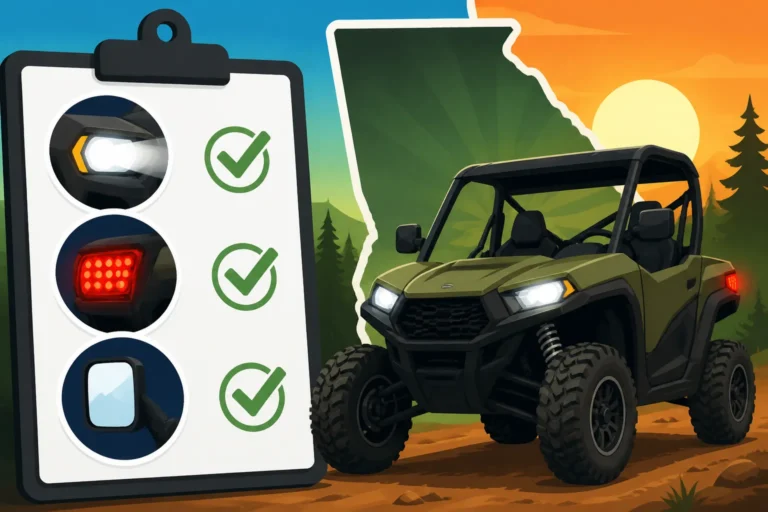
Beyond the physical dimensions and features, there are also performance requirements. Your side-by-side needs to be capable of traveling between 25 and 65 miles per hour. If it's a super-slow utility machine that tops out at 20 mph, or a souped-up racing machine that easily exceeds 65 mph on flat ground, it won't qualify. You also need factory-installed seat belts for every designated seating position, and it must have working headlights, brake lights, and at least one rearview mirror. Don't forget the date of manufacture: machines built before January 1, 2000, are generally not eligible for MPOHV registration in Georgia.
Safety Equipment and Design Requirements
The state isn't just looking at the size and speed; they're looking at specific safety equipment that aligns with what they consider safe for limited road use. Your side-by-side needs to have brake lights that illuminate when the brakes are applied, and functional headlights for visibility. The requirement for seat belts is non-negotiable, and they must be factory-installed, not aftermarket additions that weren't part of the original design. This often means that if you've got an older machine or one that was modified significantly, it might struggle to meet these criteria.
Another key design element is the steering wheel. Georgia explicitly requires a steering wheel, which immediately disqualifies any machine controlled by handlebars, like dirt bikes or traditional quads. The seating arrangement is equally important; it must have non-straddle seating, where you sit in the vehicle, not on it like a motorcycle. These are all critical checks to perform before you even gather your paperwork. A quick measure of your machine's width, a check of its owner's manual for weight and speed, and a visual inspection of its safety features can save you a wasted trip to the tag office.
| MPOHV Eligibility Criteria | Requirement | Why It Matters for Imported Machines |
|---|---|---|
| Width | >25" and <=80" | Critical for road sharing and vehicle classification. |
| Gross Weight | <=4,000 lbs | Impacts road surface wear and safety standards. |
| Payload Capacity | >=350 lbs | Ensures utility functionality and safe carrying capacity. |
| Speed Capability | 25-65 mph | Balances ability to keep pace with traffic and prevent excessive speed. |
| Steering Type | Steering Wheel | Distinguishes from ATVs/dirt bikes, promoting safer road control. |
| Seating Type | Non-Straddle | Requires occupants to sit in the vehicle, enhancing safety. |
| Seat Belts | Factory-Installed | Essential passive safety measure for all occupants. |
| Manufacture Date | 2000 or Later | Ensures modern safety and emissions standards are met. |
| Lights & Mirror | Headlights, Brake Lights, Rearview Mirror | Basic visibility and awareness for road operation. |
Paperwork and Process: Getting Your Out-of-State Side-by-Side Registered
Once you've confirmed your imported side-by-side meets Georgia's eligibility criteria, it's time to gather your documents and head to your local county tag office. This is where the rubber meets the road, so to speak, and having all your ducks in a row will make the process much smoother. The core challenge for an imported machine is proving ownership and ensuring all taxes are accounted for, even if the machine came from a state with different rules.
Proving Ownership for an Out-of-State Machine
When you're dealing with an out-of-state side-by-side, proving ownership is paramount. If the machine came with a title from its previous state, that's generally your best document. Make sure it's properly signed off by the previous owner, indicating the transfer of ownership to you. If your machine didn't have a title in its previous state, or if the seller didn't provide one, then a detailed bill of sale is crucial. This document needs to include the full names and addresses of both buyer and seller, the date of sale, a clear description of the side-by-side (make, model, year, VIN), and the purchase price. [Proving You Own an ATV in Georgia Without a Title] provides excellent guidance on what documents are acceptable.
Sometimes, especially with private sales, the paperwork might be a bit sparse. In such cases, you might need to create a more formal ownership affidavit. This is where tools like LawDepot can be incredibly useful. You can often generate legally sound documents, such as a bill of sale or a general affidavit of ownership, which can help bridge any gaps in your paper trail. Having a professionally crafted document, even for a private sale, adds a layer of credibility at the tag office. If you're buying a used machine from out of state, always insist on thorough paperwork. Don't be shy about needing a robust bill of sale. [Georgia MPOHV Registration Without a Bill of Sale] can give you an idea of the challenges if you don't have one.
Sales Tax and Residency Requirements
Another critical piece for an imported machine is addressing sales tax. If you purchased your side-by-side in Georgia, you would have paid Georgia sales tax at the time of purchase. However, if you bought it out of state and are now bringing it into Georgia, you'll generally be responsible for paying Georgia sales tax on the purchase price. The county tag office will collect this sales tax before they issue your registration. Be prepared to provide proof of the purchase price, usually from your bill of sale or the out-of-state title, so they can calculate the correct amount. [Georgia Sales Tax Paid Before Registration] has more information on this.
You'll also need to prove you are a resident of the county where you are applying for registration. This usually means providing a Georgia driver's license or ID card with your current address. If you've just moved to Georgia, make sure your license reflects your new address or bring other supporting documents like a utility bill in your name. You can only register your MPOHV in the county where you legally reside.
The Application Process at the County Tag Office
Once you have all your ownership documents and are ready to address the sales tax, you'll visit your local [Georgia County Tag Office Steps for an MPOHV]. You'll need to complete a Georgia Form MV-OHV, which is essentially an affidavit affirming that your machine meets all the eligibility requirements. Take your time filling this out, ensuring all information is accurate and matches your supporting documents. This form is where you certify, under penalty of law, that your side-by-side has the required width, weight, speed, steering, seating, and safety features.
Along with your ownership proof and the completed MV-OHV form, you'll need your Georgia driver's license or ID, and proof of Georgia liability insurance specifically for the MPOHV. While Georgia's MPOHV registration is voluntary, if you choose to register for road use, liability insurance becomes mandatory. The tag office will verify this insurance electronically. Be ready to pay any applicable sales tax, registration fees, and a plate fee. The county office will then process your application, issue you a Georgia MPOHV Certificate of Registration, and provide you with your new MPOHV license plate and a registration decal.
Common Roadblocks and How to Overcome Them
Even with all your preparation, bringing an out-of-state side-by-side to Georgia for registration can sometimes present unique challenges. It's smart to anticipate these hurdles so you can tackle them effectively without multiple frustrating trips to the county tag office.
Dealing with Incomplete Out-of-State Paperwork
One of the biggest headaches for imported machines can be incomplete or informal ownership paperwork from the original sale. If you bought your side-by-side from a private seller in another state and only received a handwritten note or no receipt at all, you might struggle to prove clear ownership at the Georgia tag office. They need a verifiable chain of custody. If the previous owner in the other state had a title and simply didn't sign it correctly, you'll likely need to track them down to get it properly endorsed.
If there was no title and the bill of sale is missing critical information (like the VIN, purchase price, or contact details for the seller), you might be asked to provide additional documentation. This could include a notarized affidavit from the seller if you can still reach them, or even a Georgia Ownership Affidavit for an MPOHV that you fill out yourself, explaining the situation and attesting to your ownership. Using a service like LawDepot to generate a comprehensive, professional bill of sale before you even bring the machine into Georgia, or to create a robust affidavit if issues arise, can save you a world of trouble. Think of it as proactive problem-solving.
Addressing Eligibility Discrepancies
Sometimes, an imported side-by-side might come close to Georgia's eligibility rules but fall short on one or two points. Perhaps its top speed is just under 25 mph, or it was manufactured in late 1999. There's generally no wiggle room on these rules. The tag office personnel are bound by state law and cannot make exceptions. If your machine doesn't pass the eight-point test, it simply cannot be registered as an MPOHV for road use in Georgia.
It's important to be realistic here. If your machine fails on a fundamental point like having handlebars instead of a steering wheel, or if it's an ATV with a straddle seat, it will not qualify. This is why a thorough pre-check using guides like [Georgia MPOHV Eligibility: The Eight-Point Test] is so important. If your machine doesn't meet the criteria, you'll need to decide whether to sell it and purchase an eligible machine, or restrict its use solely to private property. There's no appeal process for these statutory requirements.
Navigating Sales Tax Issues with Out-of-State Purchases
Another common point of confusion revolves around sales tax. If you paid sales tax in another state when you bought your side-by-side, you might wonder if you still owe Georgia sales tax. Generally, Georgia does allow a credit for sales tax paid to another state, which can reduce or eliminate what you owe here. However, you'll need clear proof of that payment—usually an itemized bill of sale or purchase agreement from the dealer or seller in the other state, showing the sales tax amount paid.
Without clear documentation of out-of-state sales tax payment, Georgia will assume the tax was not paid and will collect its full applicable state and local sales tax on the purchase price of the machine. This can sometimes lead to unexpected costs if you didn't budget for it. Always bring all original purchase documentation, including any receipts showing taxes paid, when you go to the tag office. If you bought the machine many years ago, and records are sparse, be prepared to explain the situation clearly and have any available ownership affidavits ready.
Disclaimer
This article is for general informational purposes only and does not constitute professional advice. Laws, prices and regulations vary by location and change over time. Consult a qualified professional for guidance on your specific situation.