Wildlife Management Area Road Riding
Riding an ATV or UTV on a Georgia Wildlife Management Area can seem straightforward until you encounter a locked gate, a road-use restriction, or a sign that changes what’s allowed. WMA access is not blanket permission to ride wherever a machine fits. This guide explains how to check where and when you may ride, what to confirm before unloading, and how to avoid treating a public-land road like an open trail.
Understand what WMA road riding allows
Stay on roads specifically open to motorized vehicles
The safest starting assumption is that a WMA is not an open ATV trail system. Where motorized riding is allowed, it is generally restricted to roads designated for vehicle use. A track visible on a map, a worn path through the woods, or an old logging road is not automatically an approved route.
That distinction matters on Georgia public land because roads can pass through areas with different management rules. A road may be open to a truck but closed to ATVs, open during one season but not another, or closed to all motorized traffic behind a gate. Follow posted signs and barriers, and don’t ride around a closure simply because tire tracks suggest someone else has done so.
Before leaving home, check the rules for the specific WMA you plan to visit. Start with Georgia WMA Rules Explained and Georgia WMA Riding Only on Roads. Those distinctions can help you understand why a designated road and an appealing woods trail are not interchangeable.
Check the WMA’s access dates and hours
WMA access can depend on more than the calendar date. Hunting seasons, scheduled hunt days, property-specific closures, and time-of-day rules may affect whether you can ride and which roads are available. A road you used during one visit may not be open under the same conditions on another visit.
Pay particular attention to rules tied to sunrise and sunset. Some WMA motor-vehicle rules use a defined window around sunrise rather than simply saying “daylight hours.” Don’t guess at the start or end of that window, and don’t assume the same schedule applies to every WMA. Check the current property regulations and any signs at the entrance before riding.
Planning a trip around a hunt day? Review Georgia WMA Riding Only on Hunt Days and Two Hours Before Sunrise: Georgia WMA Riding Hours. Treat those as prompts to verify the actual schedule for your destination, not as a substitute for its posted rules.
Check the property, route, and machine before you go
Confirm which roads are open on your destination
A road map can help you plan, but it doesn’t always show the latest closures or explain whether a particular route is open to an ATV or UTV. Before heading out, look for the WMA’s current access information, a property map, and any restrictions tied to the activity or season. If the route crosses land managed by more than one agency, check the rules for each section.
A navigation app can be useful for seeing roads and planning a route, especially when cell service is spotty, but a displayed line is not proof of legal access. Tools such as onX Offroad can help with route awareness and offline planning; compare what you see there with official property information and signs on the ground. Save maps before you leave, and keep a backup plan in case a road is closed.
| What you’re checking | Why it matters | What to do |
|---|---|---|
| Property-specific regulations | Access rules can vary between WMAs | Check the current rules for the exact property |
| Road designation | Not every visible track is open to ATVs or UTVs | Ride only where motorized use is allowed |
| Dates and hours | Seasons, hunt schedules, and time windows may apply | Confirm the permitted dates and sunrise-related rules |
| Gates and signs | Closures may be temporary or permanent | Obey the posted restriction; don’t go around barriers |
| Land manager | Rules can change where management boundaries meet | Check rules for each agency or property section |
| Machine and operator requirements | Age, permit, license, or equipment rules may apply | Verify requirements before you unload |
It’s also worth confirming whether a WMA road is open for the purpose of your visit. Hunting access, wildlife observation, fishing, and simply taking a recreational ride are not necessarily treated the same way. Don’t assume that permission to enter a WMA for one activity automatically means you may operate an ATV or UTV there.
For route planning, Georgia WMA Roads Closed by a Gate is a useful reminder that a gate is a meaningful access boundary, not just an inconvenience. If you’re unsure whether a route is open, choose a confirmed route or contact the relevant land manager before riding.
Verify permits, age rules, and vehicle limits
Requirements may depend on the property and the kind of riding. A Georgia forest OHV permit, for example, is not a universal pass for every WMA road. It applies under its own rules and does not override a WMA closure, authorize riding off designated routes, or replace a property-specific requirement.
Check age and supervision rules too, especially when a young rider is coming along. Some WMA rules set a minimum age for operating a vehicle, and requirements may differ from those at a private riding park or on private land. Review Georgia WMA Minimum Age of 16 and Georgia WMA Tags and When They Are Needed to identify details to confirm for your outing.
The machine itself can be an issue as well. A road may be too narrow, soft, steep, or rutted for a larger side-by-side, even if motorized access is allowed. If your route includes a separate National Forest OHV system, check its access and permit requirements independently; Georgia National Forest Trail-Only Rule explains why a WMA road and a designated forest trail should not be treated as the same kind of route.
Ride responsibly on public land
Share roads with hunters, workers, and other visitors
WMA roads may be used by hunters, wildlife staff, land managers, maintenance crews, and other visitors. A quiet morning ride can quickly become a shared-road situation around a blind curve, a gate, or a narrow bridge. Keep your speed low enough to stop within the distance you can see, and expect trucks, trailers, pedestrians, and wildlife.
If you encounter a parked vehicle or a person on foot, slow down and give them room. Avoid revving or accelerating past people, and don’t assume everyone can hear you approaching. Dust can also make a road unpleasant or unsafe for people nearby, so reduce speed when conditions are dry.
Be considerate around hunting activity. If you see hunters setting up, hear gunfire, or notice a marked area, give the location a wide berth and follow any closure signs. Riding through an active hunting area can create a safety risk even when a road appears passable. For more context on timing and hunting activity, see Hunt Days and the Day Before.
Protect the road and respect closures
Georgia’s red clay can turn a manageable road into a slick, deeply rutted mess after rain. A UTV that can power through a muddy section may also widen the damage, cut new ruts, and make the road harder for other users to travel. If the road is too wet or badly damaged, turn around rather than trying to force your way through.
Stay on the established road surface. Cutting a new line around a muddy patch can damage vegetation and expand the footprint of the route. Don’t cross a field, stream, or closed section to reconnect with a road farther ahead. A shortcut that seems minor from the seat can create a lasting impact and may violate the property’s rules.
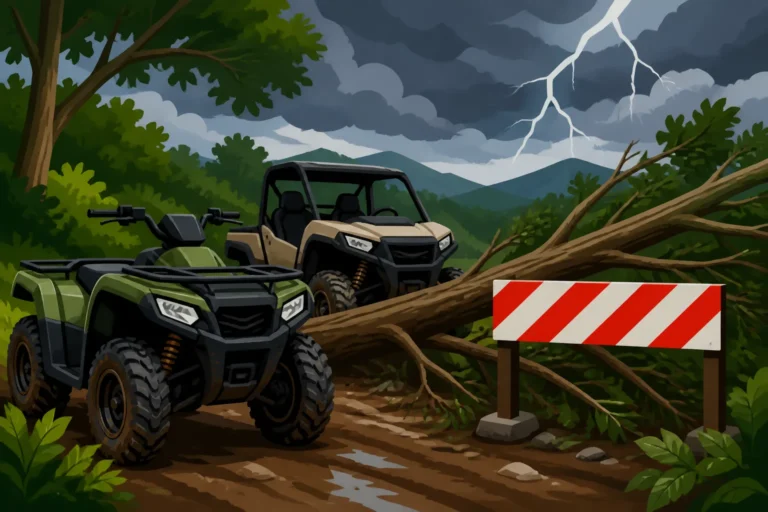
Pack out trash, secure gear, and leave gates as you found them unless posted instructions say otherwise. Never remove a sign, move a barrier, or follow a vehicle through a closed gate. If you come across a fallen tree or a washed-out road, report it to the land manager instead of making your own bypass. The guidance in Georgia Rules for Riding a Timber Road is a helpful reminder that a road’s appearance does not, by itself, grant permission to use it.
Make a practical pre-ride plan
Use a simple check-before-you-unload routine
A little preparation can save a long drive and an awkward conversation at the gate. Before loading your ATV or UTV, use this sequence:
- Name the exact property. “A WMA near Macon” is not specific enough to plan around. Confirm the property name and the entrance you intend to use.
- Read the property’s current access rules. Look for vehicle restrictions, designated roads, closures, permitted dates, and hours.
- Check the activity rules. Confirm whether your reason for visiting affects access or timing.
- Verify operator and permit requirements. Check minimum ages, supervision, licenses, permits, and any required tags.
- Review the route and land boundaries. Use an official map where available, and identify any transition to National Forest or other managed land.
- Save information for offline use. Cell service can be unreliable in wooded or rural areas. Keep a backup map and the property’s contact information.
- Recheck at the entrance. Posted notices or a closed gate take priority over a route you planned at home.
If you can’t confirm that a road is open, don’t treat uncertainty as permission. Choose another confirmed route or postpone the ride until you can check. That is frustrating when you’ve already packed the machine, but it’s better than discovering a restriction after you’re miles into the property.
Know when to change plans
Weather and on-the-ground conditions can make a route unsafe even when access is otherwise allowed. Heavy rain can turn clay roads slippery; a creek crossing can rise; branches can block a narrow track; and seasonal vegetation can hide hazards. If the route looks materially different from the map or the road condition is deteriorating, turn around.
Have a fallback activity in mind before you leave. That might mean choosing a nearby public riding area with clearly designated OHV trails, or simply switching to a non-motorized visit. A WMA is not automatically a substitute for a formal ATV trail system, and an OHV permit does not turn every public road into a riding route.
For broader planning beyond WMA roads, review Georgia WMA Access for a Quad and Georgia ATV Trails: Where You Can Legally Ride. They can help you separate WMA access questions from trail-system rules and find a better fit when recreational trail riding is the main goal.
Disclaimer
This article is for general informational purposes only and does not constitute professional advice. Laws, prices and regulations vary by location and change over time. Consult a qualified professional for guidance on your specific situation.