Highland Park’s 40 One-Way Trails
Highland Park Off-Road Resort near Cedartown, Georgia, is known for a one-way trail network often described as having about 40 routes. That sounds straightforward until you arrive with a machine that may not fit every trail, a group with mixed experience, or a map that doesn’t match a trail sign. This guide explains how to plan a safer, more enjoyable ride and what to check before you unload.
What to know about Highland Park’s one-way trails
How a one-way system changes your ride
One-way trails help reduce head-on encounters, but they don’t remove every trail hazard. Riders still need to watch for slower machines, changing terrain, blind corners, stopped groups, and people entering or leaving a route. On a narrow wooded trail, a rider moving in the marked direction can still meet someone who has stopped just beyond a rise or around a bend.
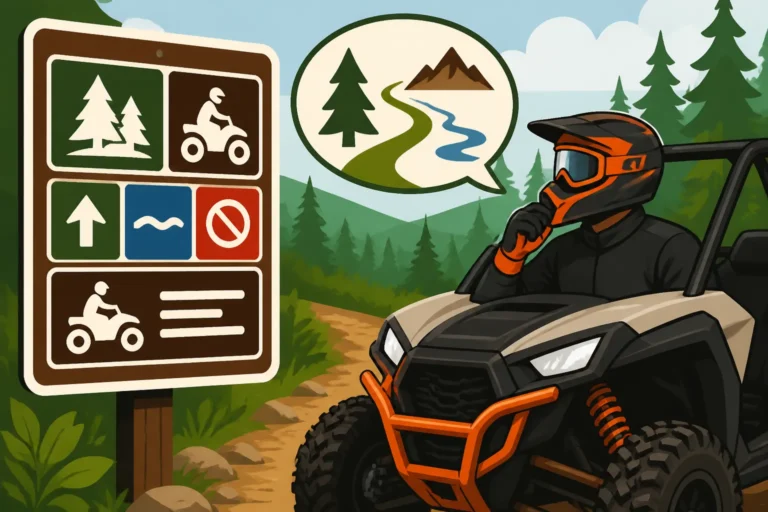
Follow the posted direction signs even if you think you know a shortcut or see a connection on a map. Trail layouts, closures, and signs can change, and a route that appears to loop back may not be intended for travel in both directions. If you take a wrong turn, stop somewhere with good visibility and check the park’s current map rather than reversing down a busy trail.
The one-way layout is especially helpful for groups with different riding speeds. Faster riders can keep a comfortable pace without assuming that traffic is coming toward them, while newer riders can take their time. Still, groups should agree on a meeting place before setting off and leave room between machines so a sudden stop doesn’t turn into a pileup.
Trail counts and maps need a little context
Highland Park is commonly described as having 40 one-way trails. Treat that number as a useful overview, not a promise that every route will be open or suitable for every machine on your visit. A trail count can also be less useful than it sounds: one rider may count a short connector as a trail, while another focuses on longer routes or distinct riding experiences.
Start with the park’s own current map and posted rules. Look for trail direction, difficulty, closures, machine restrictions, and connections between routes. If a sign at the trailhead conflicts with an older printed map, follow the sign and ask park staff for clarification before continuing. A map is a planning aid, not permission to ignore a closure or take a machine onto a route where it doesn’t belong.
Digital mapping can help you understand the surrounding area and plan how you’ll reach the park. Tools such as onX Offroad can be useful for organizing a route and keeping trip information handy, but use the park’s current map and signs for decisions inside the riding area. If you rely on a phone for navigation, prepare for patchy service and consider saving the information you’ll need before you ride.
| Before you ride | Why it matters | What to do |
|---|---|---|
| Check the current park map | Routes and closures may change | Review it before unloading and again at the trailhead |
| Confirm your machine fits the route | Width and vehicle type can limit access | Check posted restrictions and ask staff if uncertain |
| Agree on a group plan | Riders may spread out or take different routes | Choose a regrouping point and a plan for separated riders |
| Prepare for limited service | A phone may not connect throughout the area | Save maps and key details before leaving home |
| Check conditions | Rain can make some terrain difficult or unsafe | Review conditions and obey any closure signs |
For a broader overview of where riding is allowed, see Georgia ATV Trails: Where You Can Legally Ride. If you’re comparing parks based on machine access, Georgia ATV Trails That Allow Side-by-Sides can help you think through the questions to ask before you travel.
Choosing trails for your machine and experience
Match the route to the least-experienced rider
A group ride is only as comfortable as the pace and route that work for the people in it. If one rider is new to off-road terrain, start with a route that person can handle rather than choosing a difficult trail because the most experienced rider is eager to test a machine. Confidence can build over the day; a stressful first climb or tight turn can make a new rider reluctant to continue.
Talk through the group’s experience before you set off. Ask about comfort with steep slopes, uneven ground, tight turns, loose surfaces, and obstacles. “I’ve ridden before” can mean anything from a flat farm lane to technical trail riding, so specific questions are more useful than a general yes or no. Check Georgia Trail Ratings and What They Mean for a reminder that difficulty labels need to be interpreted alongside each rider’s skills and equipment.
Make the first route a manageable warm-up, then reassess. If everyone is comfortable, you can decide whether to try something more challenging. If someone is tense, tired, or struggling with the terrain, a shorter or easier ride is a better choice than trying to keep up appearances. You can make a good day out of a conservative route; you can’t easily undo a preventable injury or a damaged machine.
Check fit before you assume a trail is open to you
A trail network may serve different kinds of off-road machines, but that doesn’t mean every route suits every vehicle. Side-by-sides need enough room to maneuver, while some trails may be intended for narrower machines. Don’t judge a route solely by whether your vehicle can physically enter it. A tight section, steep turn, or limited room to pass can make a trail unsuitable even if you can get onto it.
Measure your machine before the trip and check the park’s restrictions. Include accessories that affect its overall width, such as mirrors, wheel spacers, or other add-ons. The guide Measuring Your Machine Before You Tow is useful for thinking about width and transport, but trail access should be confirmed against the park’s own rules and current signs. If you’re unsure about a particular machine or route, ask before heading out.
Bring only the gear you can secure properly. Loose cargo can shift on uneven ground, and bulky additions can make an already tight trail more difficult. Check tire condition, brakes, steering, and any protective equipment recommended for your machine. For a UTV, confirm seat belts and doors or nets are working as intended; for an ATV, wear suitable protective gear and ride within your own limits. The trail may be one-way, but it still demands attention and control.
Planning a safer day on the trails
Prepare for trail conditions and changing weather
Conditions can change significantly after rain. Red clay, roots, rocks, and slopes that feel manageable in dry weather may become slick or rutted when wet. A route that looks easy on a map can feel very different once the tires lose traction. Before leaving, check the park’s current conditions and any closure notices. Georgia Trail Conditions Before You Drive and Georgia Trails That Close After Rain offer useful reminders about why a quick conditions check can save a long drive and a frustrating day.
Pack for a full outing rather than the ideal version of one. Carry water, food, basic first-aid supplies, a charged phone, and whatever recovery or repair equipment is appropriate for your machine and experience. Tell someone outside your riding group where you plan to be and when you expect to finish. If a machine becomes disabled, avoid blocking the trail where possible, and make the group visible to approaching riders moving in the marked direction.
Take breaks before you’re exhausted. Fatigue makes it harder to spot changes in the ground, judge speed, and react smoothly. If visibility drops, rain begins, or the trail becomes more difficult than expected, reconsider the route. A ride doesn’t have to be completed exactly as planned to be a successful one. Turning back to a safe, familiar route is often the sensible choice.
Keep the group together without crowding
Before riding, decide how the group will communicate if it spreads out. Agree on a place to regroup, such as a clearly identified trail junction or a permitted staging area. Avoid choosing a vague landmark that could be mistaken for another similar-looking spot. If riders use phones or radios, make sure everyone understands that communication may fail in wooded or hilly areas.
Give each rider room to stop safely. Following too closely is particularly risky on uneven ground, where the rider in front may brake or change direction with little warning. Keep a pace that lets the least-experienced rider maintain control. If a faster rider wants to explore more challenging terrain, splitting into groups can work only if the park rules allow it and everyone has a clear plan for meeting again.
One-way riding also depends on courtesy. Pull over only where it’s safe and permitted, and avoid leaving a machine stopped around a blind turn. Keep noise, litter, and trail damage in mind, and never widen a route by driving around a muddy or blocked section. Georgia Trail Etiquette on One-Way Loops is a helpful companion for thinking about how small choices affect other riders and the trail itself. For practical planning around facilities and breaks, see Georgia Trailhead Restrooms and Water.
Making the most of your visit to Highland Park
Build a flexible route instead of trying to ride everything
It’s tempting to arrive with a goal of riding as many trails as possible, especially when a park is described as having dozens of one-way routes. That can turn the day into a race and leave little room to enjoy the terrain. Instead, choose a few routes that fit your group, leave time for breaks, and adjust based on conditions and energy. You’ll get more from a ride when you’re paying attention than when you’re hurrying to check off trail names.
At the trailhead, identify the routes that match your group’s experience and machine type. Note any loops or connections that could make it easier to shorten the ride if someone gets tired. Confirm where you’re allowed to stop and how to reach staff if a problem comes up. If you’re using onX Offroad to organize your day, treat it as a supplemental planning tool, not a replacement for current park directions or staff guidance.
If you’re visiting with riders who have different goals, talk about that before the engines start. One person may want a relaxed ride, while another is eager for more technical terrain. Agreeing on a shared first route and a later regrouping plan can keep the day pleasant without forcing everyone into the same pace. The best plan is one your whole group can follow safely.
Check the details again before you travel
Before setting out for Cedartown, confirm that the park is open to visitors, check its current operating information, and review any rules that affect your machine or group. Verify what gear is required, whether there are age or supervision rules, and whether trail access is limited for a particular vehicle type. Don’t rely on an old social media post or a map saved from a previous trip when the park’s own current information is available.
Give yourself enough time to travel, unload, review the map, and prepare your machine without rushing. Bring the paperwork or equipment you need for the trip, and make sure your trailer is secure before taking the road. If you’re visiting with a side-by-side, confirm that the routes you intend to ride are appropriate for its dimensions. If you’re unsure, ask park staff before entering a trail rather than discovering a restriction midway through the route.
A little preparation helps make Highland Park’s one-way system easier to enjoy: pick routes that suit the group, follow the signs, and stay willing to change plans. Keep the park’s current map as your authority for trail access, use digital tools such as onX Offroad only as a supplement, and leave enough time to ride at a pace that feels controlled. That approach works whether you’re visiting for the first time or returning to try a different set of trails.
Disclaimer
This article is for general informational purposes only and does not constitute professional advice. Laws, prices and regulations vary by location and change over time. Consult a qualified professional for guidance on your specific situation.