Cedartown and Its 85 Miles
Cedartown’s “85 miles” can sound like a simple promise: arrive, unload, and choose a trail. In practice, the number may describe a large private riding network, not a public route that is always open to every machine. This guide explains what to check before you tow to Cedartown, how to plan a ride, and how to make sense of the mileage.
What Cedartown’s 85 miles means
A trail network is not the same as 85 open miles
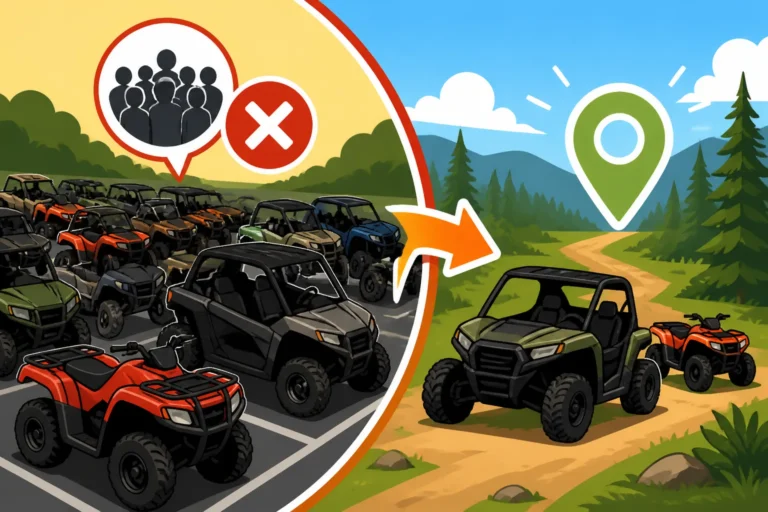
The 85-mile figure associated with riding around Cedartown is generally connected with Highland Park Off-Road Resort, a private off-road riding destination in the area. That distinction matters. A private park has its own entry process, operating schedule, machine rules, trail closures, and property boundaries. You should not assume that the mileage refers to public roads or trails available for casual access.
Nor does a stated total guarantee that every mile will be open on your riding day. A route may be closed for maintenance, weather, events, or safety reasons. Some sections may be suitable for one type of vehicle but not another. The best way to think about the number is as the scale of the riding network, not a promise that you can cover all of it in one visit.
Before setting out, confirm the park’s current access details directly with its operator. Ask which trails are open, what vehicle types are permitted, and whether any sections have restrictions. A quick check can prevent the frustrating scenario of arriving with a machine that cannot use the routes you hoped to ride.
Private park riding differs from public trail access
A private riding park may require check-in, payment, a release form, and compliance with posted rules. Those conditions are different from the rules that apply to a public trail system in a national forest. A Georgia forest permit, for example, should not be assumed to cover entry to a private park. Likewise, a private park pass does not grant access to nearby public land.
That distinction can be easy to miss when several kinds of riding areas appear in the same search results. For a broader comparison of public and private options, see [Georgia Private Off-Road Parks Compared]. If you are comparing the Cedartown destination with other riding areas, [Highland Park Off-Road Resort in Georgia] can help you explore the park-specific topic as well.
Cedartown sits in Polk County in northwest Georgia, within reach of places such as Rockmart, Rome, and the Alabama line. The area also has other outdoor attractions, including the Silver Comet Trail, but a paved multi-use trail is not an ATV or UTV riding route. Keep the activity and access rules separate when planning a trip: proximity on a map does not mean two trail networks share the same permissions.
Choosing trails for your machine and riding group
Match vehicle type to the routes that are open
Before you build a route plan, make sure the park currently allows your vehicle type. An ATV, dirt bike, and side-by-side do not necessarily have access to the same routes. A path that feels manageable on a narrow ATV can be tight for a wider UTV, particularly when trees, ruts, or uneven shoulders leave little room to maneuver.
This is where the advertised trail mileage can be misleading if you treat the whole network as one uniform system. A rider may find that a substantial portion of the park is appropriate for their machine while other routes are restricted or uncomfortable. If you ride with a mixed group, plan around the widest and least maneuverable machine rather than assuming everyone can follow the same loop.
For a general overview of machine compatibility, start with [Georgia ATV Trails That Allow Side-by-Sides]. Then ask the park specifically about any vehicle-width limits, one-way routes, and sections that exclude side-by-sides. If you use a mapping app such as onX Offroad to get oriented, treat it as a planning aid rather than permission to enter a route. The park’s current rules and signs take priority.
Use skill level, not just distance, to choose a route
A longer route is not automatically a better ride. A short, technical section can take more time and energy than several miles of smoother trail. If your group includes new riders, children, or people who have not ridden together before, choose manageable routes and build in time to stop, regroup, and turn around.
Ask how the park labels trail difficulty and what those labels mean in local conditions. A trail that seems straightforward when dry can become much more demanding after rain, especially where clay, roots, or steep grades are involved. The park’s own ratings are more useful than a generic color or difficulty label from another riding area. For background on interpreting marked routes, see [Georgia Trail Ratings and What They Mean].
A practical plan is to agree on a conservative first loop, then reassess after the group has ridden for a while. Make sure everyone knows where the group will stop and what to do if a machine has a problem. With onX Offroad, riders can review map context and prepare offline navigation, but do not rely on a phone app as your only way to find your way back. Download or carry the park’s official map if one is available, and follow posted signs.
| Planning question | Why it matters | What to confirm |
|---|---|---|
| Is my vehicle type allowed? | Access can differ for ATVs, UTVs, and dirt bikes. | Which machine types may ride and whether restrictions apply to particular routes |
| Are all routes open? | Weather, maintenance, or events may affect access. | Current closures and the trails available on your visit |
| What is the difficulty level? | A short technical trail may be harder than a longer easy route. | Difficulty descriptions and any steep or narrow sections |
| Is camping available? | An overnight stay may have separate rules from day riding. | Whether camping is offered, what facilities exist, and whether reservations are needed |
| What should I bring? | A small equipment gap can turn a minor delay into a long one. | Check-in requirements, safety gear, recovery equipment, and map options |
Measure and inspect before towing
If you are bringing a side-by-side, measure its overall width before leaving home. Include accessories that extend beyond the body, such as mirrors, wheel spacers, or aftermarket components. The number you find in the brochure may not match the machine as you use it today. Use [Georgia Trail Widths and What Fits] for broader context, and ask the park about its own restrictions rather than assuming a statewide trail rule applies there.
Check the trailer, tie-downs, tires, lights, hitch, and spare before the trip. At the park, a machine that cannot be unloaded safely or has a leaking fluid line can derail the day before the first trail. Give yourself enough time to inspect it in daylight, especially if you will be arriving after a long drive through rural roads.
For a practical pre-trip checklist, [Measuring Your Machine Before You Tow] is a useful companion. It is also worth checking your machine’s basic condition: brakes, throttle return, tire pressure, lights, belt or chain condition, and any loose steering components. A quick walk-around does not guarantee a trouble-free ride, but it can catch obvious issues while you are still near your tools and trailer.
Planning a day at the park
Check access, weather, and operating details
A good Cedartown ride begins before you pull out of the driveway. Confirm that the destination is open, check the day’s access rules, and ask whether reservations or advance registration are needed. Verify the latest instructions with the park itself, particularly if you are visiting around a holiday, during a special event, or after heavy rain.
Weather deserves special attention in northwest Georgia. Rain can change traction and visibility, and low spots can hold water after the skies clear. A trail that was comfortable on a dry weekend may be slick, rutted, or temporarily closed after a storm. Check [Georgia Trail Conditions Before You Drive] for broader trail-planning advice, then use the park’s updates for the conditions that apply to your visit.
If your group is traveling from Atlanta, Rome, or elsewhere in the region, give yourself a buffer for traffic, unloading, check-in, and any equipment adjustments. A rushed arrival makes it easier to miss a rule or start on a route that does not suit your group. Confirm the park’s opening and check-in procedures, and avoid assuming that an entrance will be available whenever you reach it.
Pack for riding, not just for the drive
Bring the safety equipment required by the park and suitable for your machine and riding style. A helmet is a basic part of a responsible riding plan, and eye protection, gloves, sturdy footwear, and weather-appropriate layers can make a long day more comfortable. If you are taking children or new riders, make sure their gear fits properly before the trip rather than trying to solve sizing at the trailhead.
Carry drinking water, snacks, a small first-aid kit, and the tools or spare parts appropriate to your machine. Riders often prepare for a dramatic breakdown and forget the smaller inconveniences: a loose fastener, a dead phone, a puncture, or a wet layer after an unexpected shower. A tow strap, tire repair supplies, and a basic tool kit may be useful depending on the vehicle and the park’s rules.
Do not assume the park has fuel, food, water, restrooms, or repair services available where you need them. Ask what facilities are open and whether there are limits on what you may bring. [Georgia Trailhead Restrooms and Water] offers general questions to consider when checking amenities, while the park’s own information should guide decisions for Cedartown.
Make a realistic route and regrouping plan
It is tempting to plan a full day around the largest loop on the map, especially when a park advertises many miles of trails. But travel time, check-in, warm-up riding, breaks, and changing conditions all reduce the time available on the machine. Start with a route that leaves room to adapt, then add more riding if the group is comfortable and the trails remain open.
Agree on simple group rules before anyone starts the engine. Decide who leads, who rides at the back, where the group will stop, and how riders should respond if someone needs to pull over. Keep enough distance to see dust, rocks, and sudden stops. On a tight route, passing may be unsafe or prohibited, so do not pressure a slower rider to speed up.
Use your map to support that plan, not replace it. onX Offroad may help you understand the broader area and mark points of interest, but app coverage and mapped details can differ from current trail markings. Carry the operator’s official map if provided, keep your phone charged, and follow signs at intersections. If a junction is unclear, stop somewhere safe and resolve it before the group splits up.
Staying safe and respecting the trail network
Ride to the conditions in front of you
Trail conditions can change within a single visit. A shaded section may remain slick while an exposed stretch dries out; a rut can become deeper after several machines pass; and dust can reduce visibility on a busy route. Adjust speed to the terrain and the people around you rather than riding at the pace you would choose on an empty, familiar trail.
If you encounter a route that feels beyond the group’s ability, turn around where it is safe to do so. There is no prize for forcing a difficult climb or squeezing a wide machine through a narrow passage. A cautious decision is particularly important when riders are tired, daylight is fading, or weather is moving in.
Stay on marked routes and respect closures, gates, and private-property boundaries. A shortcut through brush may damage the land, create a new unauthorized path, or put you in conflict with the operator. Park signs and staff instructions are part of the riding plan, not suggestions to ignore when the trail looks passable.
Keep the group together without crowding
A group can become separated quickly when visibility drops or riders have different comfort levels. Use agreed meeting points, slow down at turns, and make sure the last rider is accounted for before the group continues. If someone stops, notify the rest of the group instead of leaving one person behind to troubleshoot alone.
For families, plan around the youngest rider’s stamina and attention. A child who rides well for the first hour may become tired later, and fatigue can affect judgment. Schedule breaks before someone is exhausted, and make sure every rider knows how to get help or identify the group’s meeting point.
Mobile coverage can vary in rural and wooded areas. Do not assume that a call or map refresh will work everywhere. Share the day’s plan with someone who is not riding, keep emergency contacts accessible, and learn the park’s procedures for reporting an injury or breakdown before leaving the staging area.
Leave the trail in good shape
Mud is part of many off-road rides, but avoid riding through a closed or especially vulnerable area just because it looks passable. Repeated traffic on wet ground can deepen ruts and widen a route as riders try to avoid the worst sections. If the operator closes a trail after rain, respect the decision even if other routes remain open.
Pack out litter, secure loose items, and avoid disturbing wildlife or nearby property. Keep noise under control when arriving, loading, or riding near other visitors. If you see a hazard or damaged sign, report it to park staff rather than attempting an improvised repair that could create another problem.
At the end of the day, inspect the machine before loading it. Look for damaged tires, loose parts, leaks, and debris around hot components. Clean mud from areas where it could hide damage or interfere with controls, and secure the machine carefully for the trip home. A few minutes of cleanup and inspection can make the next ride easier and help protect both the vehicle and the trail area.
Getting the most from a Cedartown visit
Treat the mileage as a reason to plan, not a checklist
An 85-mile network suggests that there may be enough variety for more than one kind of ride, but it does not mean that a visitor should try to cover every available route. The better goal is to choose trails that suit your machine, ability, and time. A relaxed day on appropriate terrain is usually more enjoyable than racing across the map to claim a mileage total.
If this is your first visit, leave space in the schedule to learn the layout. Note where the staging area is, identify the main intersections, and ask staff which routes are good starting points. Once you understand how the park is organized, you can make better choices about longer rides on a return visit.
For a first trip, consider a simple plan: confirm access, arrive with enough time to check in, ride an easier route, pause to evaluate the group, and only then choose whether to continue. That approach is especially useful for mixed groups, new riders, and anyone bringing a machine whose size or handling is unfamiliar.
Separate the trip’s riding plan from nearby sightseeing
Cedartown and the surrounding Polk County area can make a pleasant regional outing, but do not confuse nearby attractions with off-road access. A town road, utility corridor, forest road, farm track, or paved path is not automatically open to motorized recreational riding. A route that appears connected on a general map may cross private land or have restrictions.
If you want to add another outdoor stop, check its rules independently. The Silver Comet Trail, for example, is a separate multi-use trail and should not be treated as an ATV or UTV route. Likewise, nearby public land may have its own designated-trail and permit requirements. Use official maps and signs to determine where you can ride.
A mapping app can help you orient yourself, and onX Offroad can be part of that preparation, but it cannot grant access or override closures. Confirm every riding area’s rules with the entity that manages it. For a broader look at trip planning and route options across the state, [Georgia ATV Trails: Where You Can Legally Ride] is a useful next read.
A practical checklist before you go
A little preparation can prevent a long drive from turning into a disappointing day. Before departure, verify that the park is open and that your vehicle type is allowed. Ask about current closures, check-in procedures, safety requirements, and available facilities. If you are bringing a side-by-side, confirm any width or route restrictions for your specific setup.
Review the machine and trailer, pack protective gear, bring water and basic repair supplies, and save the official map or park instructions where you can access them. Make sure the group understands the plan, knows where to regroup, and has a way to report a problem. If weather or trail conditions change, be ready to shorten the ride or choose a different route.
The most useful final question is not simply, “Are there 85 miles?” It is, “Which routes can our group ride safely and legally on the day we arrive?” With that answer in hand, Cedartown can be a much more enjoyable destination—without treating a headline mileage figure as a guarantee.
Disclaimer
This article is for general informational purposes only and does not constitute professional advice. Laws, prices and regulations vary by location and change over time. Consult a qualified professional for guidance on your specific situation.