Fence Cuts and Gate Etiquette
A gate across a Georgia dirt road can look like a small obstacle, but it may mark a property boundary, a livestock area, or a road that is closed to riders. Cutting a fence or guessing what to do with an open gate can turn a fun ride into a conflict. This guide explains how to approach fences and gates responsibly, protect land, and know when to turn around.
Why fences and gates deserve a cautious approach
A visible route is not automatically permission to ride
A worn track, open gate, or gap in a fence can make a route look public or abandoned. It does not establish that you have permission to ride there. The route may cross private land, serve a working farm, or be part of a timber road that is open only to authorized users. If you are unsure, stop before crossing and confirm that your access is allowed.
This matters even when the route connects two places where riding is permitted. Permission to use one trail or parcel does not necessarily extend to the next stretch of road. A posted sign is an obvious warning, but a lack of signs should not be treated as a yes. Review [Georgia Trespass Law for ATV Riders] and [Can a Georgia Landowner Order Riders Off Their Land?] before assuming that a familiar shortcut is fair game.
The same caution applies to land used for hunting, farming, or timber operations. A gate may be closed temporarily because equipment is moving, animals are grazing, or a landowner is limiting access. Before riding on a property you do not own, get clear permission that covers the route, dates, and type of machine. [Georgia Landowner Permission Forms] can help you think through how to document that permission.
A fence is a boundary and a working part of the property
Fences are not simply obstacles placed in the middle of a trail. They can keep cattle, horses, or other livestock contained; separate fields; protect crops; and mark where one landowner’s property ends and another begins. A cut wire may be hard to notice from a moving ATV or UTV, but livestock can find it quickly. Animals escaping onto a road or into another field can create danger and expense for the people responsible for them.
A broken fence can also be difficult to repair safely. Wire may be under tension, and a loose strand can whip, snag clothing, or catch a machine. If you come across a damaged fence, do not try to stretch or splice it unless the landowner has asked you to and you know how to do the work safely. Take note of where it is, keep people and animals clear, and contact the owner or responsible property manager.
If you spot riders cutting fences or entering land without permission, avoid confronting them if that could put you at risk. Note the location and report the issue through an appropriate landowner, property manager, or law-enforcement contact. For context, see [Reporting Riders on Posted Land]. Protecting the property and your own safety matters more than winning an argument on the trail.
How to approach a gate on an ATV or UTV
Stop, assess, and look for instructions
Reduce speed well before reaching a gate. Pull over where you will not block a road or trail, then check for signs, locks, cattle guards, nearby livestock, and other users. Look for posted instructions about access or whether the gate should remain open or closed. Do not assume that an unlocked gate is meant for public use, or that a closed gate is just a request to slow down.
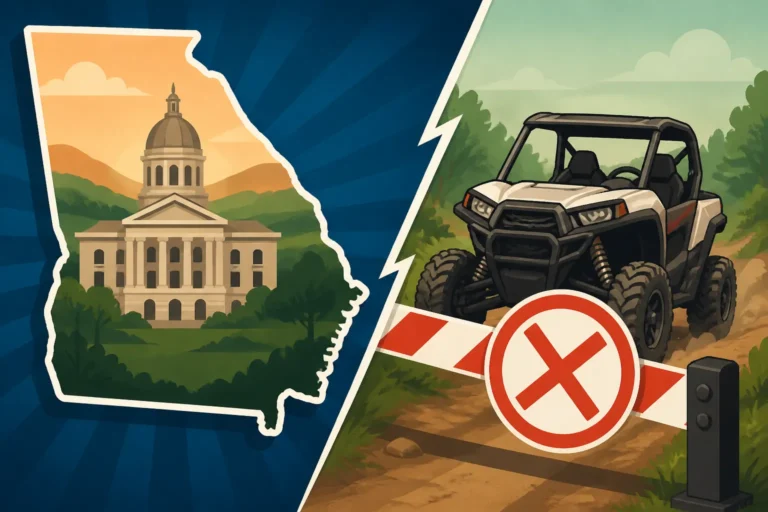
If the gate is locked, marked private, or has instructions you cannot follow, do not climb over it, cut the lock, or look for a way around it. Turn back unless you can contact the owner or responsible authority and receive permission. On an unfamiliar route, this can feel frustrating—especially if you have already ridden a long way—but continuing without authorization can create a much bigger problem than retracing your route.
Pay attention to what is on the other side before moving the gate. Livestock may be close to the opening, or a second vehicle may be approaching. Let a group know you are stopping, keep machines under control, and avoid crowding the entrance. If you are riding with children or inexperienced guests, explain beforehand that they should wait for your signal rather than driving toward or through the gate.
Leave it in the condition you found it
When you have permission to pass, follow the owner’s instructions exactly. If the gate is closed, open it carefully, guide the group through one at a time, and close it securely behind the last rider—unless the owner has told you to leave it open. If it was open when you arrived, do not automatically close it. The landowner may have left it open for livestock movement, another permitted vehicle, or a specific work task.
An easy group habit is to assign one person to watch the gate. The first rider can stop in a safe place beyond it, while the last rider checks that it is secured as instructed. This avoids the familiar scramble where everyone assumes someone else will handle it. A gate left open can let animals wander; a gate closed against an owner’s directions can interfere with work or access.
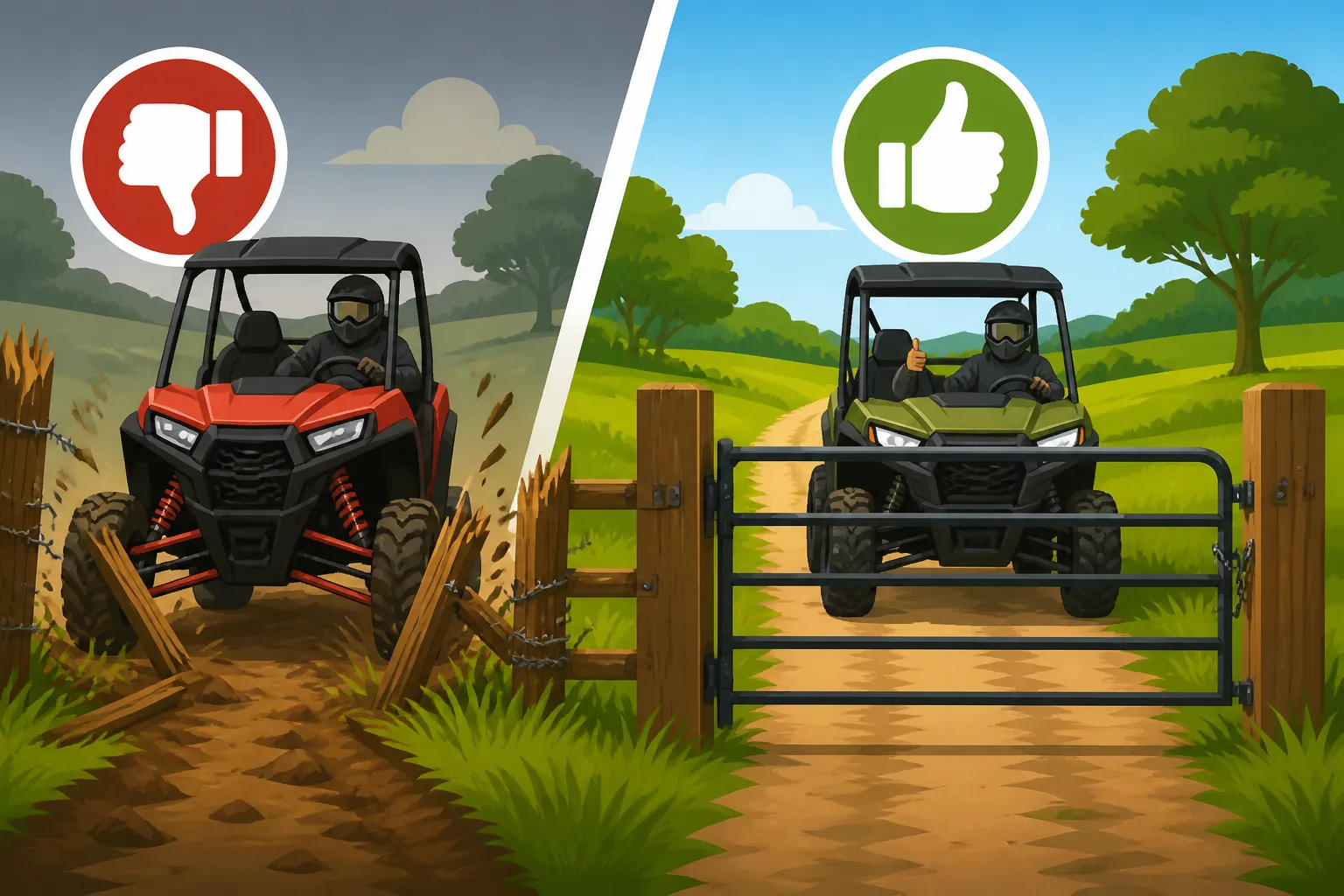
If a gate is difficult to operate, damaged, or caught on the ground, do not force it with your machine. Forcing it can bend hinges, damage a latch, or make the gate unsafe for the next person. Tell the property contact what happened and wait for guidance. Never use a vehicle to push, pull, or ram a gate unless the owner has specifically directed you to do so and it can be done safely.
| What you find | Responsible next step |
|---|---|
| A closed gate with clear instructions | Follow the instructions only if you have permission to use the route |
| A locked gate or a private-property sign | Stop and turn back unless the owner or authority grants access |
| An open gate with no instructions | Do not assume it is public; confirm permission and ask whether to leave it open |
| A damaged gate or fence | Keep clear, avoid attempting an improvised repair, and notify the responsible person |
| Livestock near the opening | Wait patiently, avoid chasing or startling animals, and follow the owner’s directions |
| A route that crosses unfamiliar land | Confirm permission before riding farther |
Prevent fence damage before it happens
Choose a route that does not depend on shortcuts
Plan your ride around trails and roads where access is permitted. If a route on a map appears to cross a fence line, private parcel, or working property, check the access details before setting out. This is particularly important for timber roads and hunting-club property, where access may depend on a lease, current landowner permission, or specific rules. [Georgia Timber Company Land Access] and [Georgia Hunting Club Lease Riding Rules] are useful topics to review when those lands are part of your plans.
A route that looks passable on a phone screen can end at a locked gate or cross a pasture that is not open to riders. Keep a known legal return route in mind, and avoid building a ride around “we’ll figure it out when we get there.” If you cannot confirm access, choose another trail. That small bit of planning helps you avoid pressure to trespass or damage property when daylight is fading or your group is tired.
For riders using a permitted farm route, clarify which roads and fields are included. A landowner may allow travel along a farm lane but not across a planted field or through a livestock enclosure. Asking first is more respectful than treating the entire property as one open riding area. [Georgia Rules for Riding a Pasture] offers more context about why permission and land use matter.
Ride slowly near fences and carry useful recovery equipment
Slow down around fence lines, gates, and narrow tracks. Keep enough space to stop if a wire, post, animal, or person appears ahead. Avoid spinning tires near fence posts, and do not turn a tight corner so close to a fence that a tire, rack, or cargo catches it. Passengers should keep hands and legs inside the vehicle, especially when riding through a narrow opening.
A winch can help recover a machine that is stuck in mud, but it is not a reason to attach to a fence post or gate. Pulling against a fence can bend posts, snap wire, or make the machine move unpredictably. Use a suitable recovery point and follow the equipment maker’s safety guidance. If you are considering a winch or other recovery accessory from SuperATV or another supplier, check that it is compatible with your machine and intended use before relying on it in the field.
If a machine becomes stuck beside a fence, pause before attempting a recovery. Keep bystanders away from the line of pull, do not wrap a winch line around a fence or gate, and avoid spinning the tires toward the barrier. A second rider can help spot hazards from a safe distance. SuperATV accessories may be one option riders research when assembling a recovery setup, but safe attachment points, sound technique, and permission to be on the land matter more than the brand on the equipment.
What to do if you encounter a cut fence or unclear access
Do not widen a gap or treat it as an invitation
A gap in a fence may have been made for a particular purpose, such as authorized farm access, equipment movement, or an emergency. Do not widen it, remove wire, move posts, or drive through unless you have permission. Even if other tire tracks pass through, that does not prove the route is open to you. The tracks could belong to the landowner, a worker, or someone who should not be there.
If the gap is not clearly intended for your use, stop and turn around. Avoid moving wire out of the way with your hands, since it may be under tension or difficult to see. If the opening appears dangerous or livestock could escape, contact the property owner or manager if you know who that is. Do not leave a gate or makeshift barrier in a different condition simply because you are unsure what it is meant to do.
A rider may be tempted to squeeze through to avoid losing time, especially when the group has already covered a lot of ground. That is precisely when it helps to agree on a rule before the ride: no one crosses a fence or gate unless the route is permitted and the group understands what to do with the barrier. If you ride on private land, discuss gate expectations with the landowner in advance and make sure every rider in the group knows them.
Handle accidental damage promptly and honestly
If your machine catches a wire or damages a gate, stop immediately. Move people and machines away from the hazard, and do not leave the area without making a reasonable effort to notify the owner or property manager. Do not conceal the damage or make a hurried repair that could be unsafe. Share the location and a clear description of what happened, then follow the owner’s instructions about next steps.
If the incident happens on land where you were authorized to ride, use the contact information provided when permission was granted. If you do not know who manages the property, note a nearby road, trail marker, or other identifying landmark and ask the relevant local land manager how to report it. A photograph can help communicate the damage, provided you can take it without approaching dangerous wire or disturbing animals.
Having a recovery kit does not change your responsibility to protect property. A SuperATV recovery accessory, for example, should be used only for an appropriate recovery—not to drag a machine through a fence opening or pull a gate aside. Before heading out, discuss with your group who will contact the landowner if something goes wrong and how the group will keep the area safe while waiting for help.
Good fence and gate etiquette is straightforward: know where you are allowed to ride, stop when access is unclear, follow the landowner’s directions, and leave every barrier as instructed. Those habits protect livestock, property, and your ability to be welcomed back. For the broader distinction between road access and off-road access, see [Georgia Rules for Riding a Timber Road] and [Georgia Rules for Riding a Utility Easement].
Disclaimer
This article is for general informational purposes only and does not constitute professional advice. Laws, prices and regulations vary by location and change over time. Consult a qualified professional for guidance on your specific situation.