Georgia Dealer Fees and the Advertised Price Rule
An ATV or side-by-side can look affordable in an online listing and cost more once you reach the dealership. In Georgia, the advertised-price rule is meant to prevent required dealer charges from appearing as surprise additions. The key is to separate the advertised selling price, government charges, and optional products, then compare the same complete set of costs before you commit.
What Georgia’s Advertised Price Rule Means
A dealer may charge for services such as processing paperwork, but Georgia does not set a specific dollar limit for dealer or documentation fees. The important issue is how a non-government fee is presented when a dealer advertises a vehicle.
According to the Office of the Attorney General Consumer Protection Division, any non-government fee collected as part of a vehicle sale must be included in the advertised price. A dealer cannot leave a required dealer processing fee out of the advertised price and rely on wording such as “plus dealer fee” to add it later. The office considers that kind of exclusion an unfair and deceptive practice. The rule is current as of November 2026.
Only official government charges may be excluded from the listed price. The Office of the Attorney General Consumer Protection Division identifies taxes, tags, titles, and Lemon Law fees as examples. That does not mean every transaction has all of those charges, or that each charge works the same way for an off-highway machine. It means a dealer should not present a mandatory dealership charge as though it were a government fee.
The rule is about the advertised price, not a set maximum for what a dealer may charge. A dealer fee can still be substantial; the question is whether a non-government fee that is part of the sale was included in the price shown to shoppers. If a dealer advertises a machine for one amount and then adds a required documentation or processing charge, ask the dealer to explain how that fee was handled in the advertised price.
A practical way to read an ad is to separate the numbers into three categories:
| Price component | What it generally covers | How to treat it when comparing offers |
|---|---|---|
| Advertised selling price | The dealer’s advertised price for the machine, including non-government fees collected as part of the sale | Compare it with other advertised prices for the same kind of machine |
| Government charges | Applicable taxes and official charges such as tags or registration | Ask for an itemized estimate; these may be excluded from the advertised price |
| Optional products or services | Items or services you can choose to accept or decline | Ask whether each is optional and whether you have agreed to buy it |
The table is a way to organize a quote, not a claim that every dealer uses the same labels. A charge’s name alone does not tell you whether it is a government fee, part of the dealer’s required selling price, or a genuinely optional product. Ask what the charge pays for and whether you can decline it.
For a broader overview of the purchase budget, see Buying an ATV in Georgia: Taxes and Fees. For an explanation of how dealer documentation charges fit into an advertised price, Georgia Dealer Doc Fee Rules is a useful next step.
How to Read an ATV or UTV Dealer Quote
An online ad is a starting point, not a complete purchase quote. Before traveling to a dealership or placing a deposit, ask for a written breakdown that identifies the machine, the advertised price, each government charge, and every add-on. A clear quote makes it easier to spot a required dealer fee that was not included in the advertised amount.
Match the quote to the advertised machine
Confirm that the quote is for the same model, configuration, and condition shown in the ad. A price for a different trim, accessory package, or machine may not be a valid comparison. If the advertised machine is no longer available, ask the dealer to identify what has changed and provide the new price in writing.
Be precise about what you are shopping for. An ATV and a side-by-side may be categorized differently, and a machine described casually as a “quad,” “UTV,” or “utility vehicle” may not match the category that matters for registration or road use. A dealer’s description is useful for shopping, but it does not itself establish a machine’s legal classification.
Ask the salesperson to show which amount is the advertised selling price and which charges are government fees. If the quote includes a dealer processing fee, documentation fee, setup charge, freight charge, or similar item, ask whether the amount was already included in the advertised price. The label is not enough to settle the question. What matters is whether the charge is required as part of the sale and whether it was included in the advertised price.
Ask for an itemized out-the-door estimate
A written out-the-door estimate helps you understand the whole transaction, including charges that may be added after the advertised price. Request that the estimate separate:
- The machine’s advertised price
- Government taxes and applicable official charges
- Dealer or processing fees
- Accessories and protection products
- Any service or delivery charges
- Trade-in credit, if applicable
- The amount due at signing and any amount being financed
This list is a checklist for discussion, not a claim that each line must appear in every transaction. If a charge does not apply, it should not be used to make an estimate look more complete than it is. If a fee does apply, its description should tell you what it is for.
For an explanation of why an out-the-door amount is useful when comparing dealers, see Georgia Dealer Out-the-Door Price. You can also compare the tax side of the transaction separately with Georgia Sales Tax on an ATV Purchase and [Georgia Sales Tax Due Before You Register]. Do not assume that a dealer estimate settles every later registration question; confirm applicable government charges with the office responsible for the specific transaction.
Compare like with like
A low advertised price does not necessarily mean a lower total cost, and a higher advertised price does not automatically mean a worse offer. One dealer may include a required non-government charge in the advertised price while another displays it separately. Under Georgia’s rule, a fee collected as part of the sale cannot be kept out of the advertised price simply by describing it as an additional dealer charge.
Ask each dealer for the same type of written estimate and compare the same components. If one quote includes accessories, delivery, or a service plan and another does not, separate those items before comparing the machines. Otherwise, you may mistake a difference in equipment or optional products for a difference in the underlying price.
The advertised price rule does not tell you whether a product is worth buying. It helps you determine whether required dealer charges have been included in the advertised amount. Your own comparison should still account for the machine’s condition, included equipment, warranty terms, and other details that matter to you.
Dealer Fees, Government Charges, and Optional Add-Ons
The hardest part of a sales quote is often not the arithmetic. It is deciding what kind of charge each line represents. Dealers may use different names for similar services, so ask what the charge covers, who receives it, and whether you can decline it.
Dealer and processing fees
A dealer or documentation fee is a non-government charge. Georgia does not regulate the specific dollar amount a dealership may charge for dealer or documentation fees, according to the Office of the Attorney General Consumer Protection Division. But if a non-government fee is collected as part of the sale, it must be included in the advertised price.
That means “we charge a fee” and “we can add the fee to the advertised price afterward” are different propositions. A dealer may explain that a fee covers administrative work, but that explanation does not convert it into an official government fee. Ask whether it is required to buy the machine and whether it was included in the advertised price.
If a dealer says the fee is mandatory but not part of the advertised price, ask for a written explanation and a corrected quote. Keep a copy of the advertisement and the written response. If the dealer says the charge is optional, ask what changes if you decline it. A clearly optional service is different from a charge you must pay to complete the purchase, but the dealer should be able to explain that distinction plainly.
Government charges
Official government charges are treated differently from dealer fees under the advertised-price rule. The Office of the Attorney General Consumer Protection Division says government fees such as taxes, tags, titles, and Lemon Law fees may be excluded from a listed price. A dealer may therefore show an advertised selling price and then estimate applicable government charges separately.
The actual government costs depend on the transaction and the machine. Ask the dealer to identify the charge and the authority or service it relates to, rather than accepting a vague line called “fees.” If the estimate includes a charge you do not recognize, confirm it with the relevant government office before relying on the quote.
Do not assume that every ATV or UTV purchase has the same title or registration costs as a car or truck. In Georgia, multipurpose off-highway vehicles do not receive titles upon registration, according to the Department of Revenue. That difference can affect which paperwork applies, but it does not excuse a dealer from explaining charges in the sale contract.
Accessories and other products
A quote may include accessories, a maintenance plan, a protection product, or another service. Ask which items are already installed or bundled with the machine, which ones you selected, and which ones the dealer says are required. Request a revised estimate that removes products you do not want, if they are optional.
Do not let an optional product obscure whether a dealer fee was included in the advertised price. Those are separate questions. A dealer might offer a package you can choose to buy while also charging a processing fee as part of the sale. The package should be identified as a product or service, and the required dealer fee should be treated according to the advertised-price rule.
If a product is financed with the machine, ask for its separate amount and how it changes the total amount financed. The monthly payment alone does not show whether you are paying for a product you wanted or whether a fee was added to the transaction. Compare the written selling price and itemized charges before discussing payment structure.
Why Registration and Vehicle Type Matter to the Cost
A dealer’s advertised price is only one part of ownership costs. Before you buy, it helps to understand whether the machine may qualify for Georgia’s multipurpose off-highway vehicle registration and what paperwork follows. A registration fee is not the same thing as a dealer fee, and a machine’s marketing label does not guarantee eligibility.
ATV versus multipurpose off-highway vehicle
Georgia government defines a multipurpose off-highway vehicle as a four-wheeled motorized vehicle with features intended for utility that can be driven on and off road. Georgia government describes an all-terrain vehicle as a four-wheeled motorized vehicle used off-road or on private dirt roads, not on public dirt roads, paved roads, or highways.
The Department of Revenue says multipurpose off-highway vehicle registration became voluntary on December 1, 2023. Registration does not provide a title: the Department of Revenue says registered multipurpose off-highway vehicles will not receive titles. That makes it especially important to get clear ownership paperwork from the seller and to understand what the registration does and does not establish.
The Department of Revenue lists a $20 annual registration fee for a multipurpose off-highway vehicle as of November 2026. Treat that as a separate government cost from any dealership charge, and confirm the current amount and applicability with the Department of Revenue before you budget around it.
A multipurpose off-highway vehicle must meet specific eligibility requirements. According to the Department of Revenue, only vehicles manufactured after January 1, 2000 may be registered. The vehicle must have four or more wheels, a nonstraddle seat, steering wheel controls, and a minimum cargo capacity of 350 pounds. It must be capable of operating between 25 and 65 mph, be no more than 80 inches wide, and have a gross vehicle weight of less than 4,000 pounds. Required equipment includes headlights, brake lights, taillights, a rearview mirror, and safety belts.
Those requirements can affect whether a buyer should count on registration as an option. For example, a machine with handlebars or a straddle seat does not match the described MPOHV design features. Check the full eligibility questions before assuming that a vehicle can be registered; Georgia MPOHV Eligibility: The Eight-Point Test and Georgia Side-by-Side Registration Checklist can help you organize that review.
Paperwork and identification
The Department of Revenue requires applicants to provide a valid Georgia driver’s license or ID card for identification and complete form MV-OHV, the Multipurpose Off-Highway Vehicle Inspection and Ownership Affidavit. The affidavit must be submitted to the county tag office in the owner’s county of residence, according to the Georgia Department of Revenue Motor Vehicle Division.
The Department of Revenue says proof of ownership may be established with a Manufacturer’s Statement of Origin or an out-of-state title. It may also be established with a previous owner’s valid registration and a bill of sale, or with an out-of-state registration. If the ownership documents are unavailable, the Department of Revenue requires form T-22B Certification of Inspection. If the chain of ownership cannot be verified, the Georgia Department of Revenue Motor Vehicle Division says the T-22B must be completed and signed by a law enforcement officer.
The Department of Revenue also requires proof of Georgia automobile liability insurance coverage, provided electronically or through an insurance binder. Ask the dealer which documents it will give you and what paperwork you will need to complete separately. For a closer look at the ownership and registration process, see Georgia MPOHV Registration Paperwork Checklist and Georgia County Tag Office Steps for an MPOHV.
These registration requirements are not dealer fees. A dealer may help with paperwork, but you should distinguish any charge for that service from the government requirements themselves. If the dealer collects a non-government charge as part of the sale, the advertised-price rule still matters regardless of whether the machine may later be registered.
Road use is a separate question
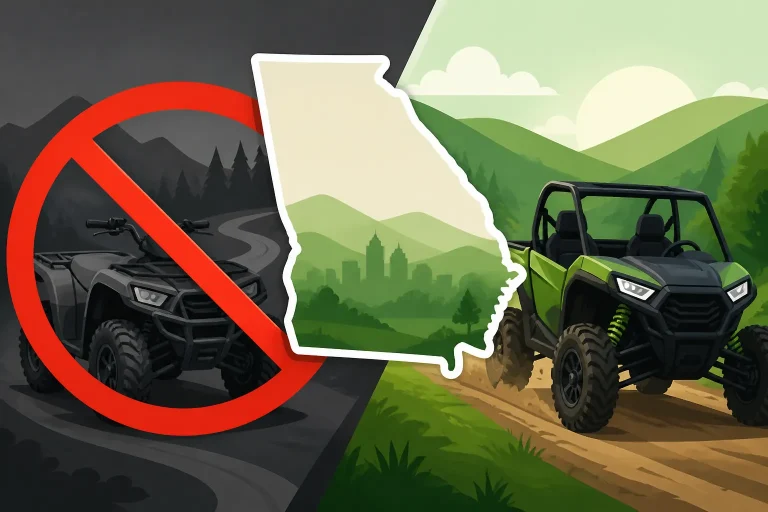
Registration does not mean every road is open to a machine. Georgia government says multipurpose off-highway vehicles may be street-legal if registered, insured, and properly equipped, but they are not allowed on municipal streets or State Routes and US Highways. Georgia government also says ATVs are not street legal, including on dirt roads that are not private property.
That distinction matters when evaluating what you are buying. A salesperson’s description of a machine as “road capable” is not a substitute for checking the rules that apply to the road and vehicle. Read Are Side-by-Sides Street Legal in Georgia? before treating potential road use as part of the machine’s value.
Trail access is separate again. The Forest Service says off-highway vehicles that are not licensed for public-road use must stay on designated OHV trails, and motorized trails may have width, weather, and vehicle restrictions. A machine that is suitable for your property or a private park may not fit a particular public trail system. Check the trail rules for your intended riding location before choosing a vehicle based on its advertised capabilities.
How to Shop and Negotiate Without Losing Track of Fees
A clean buying process keeps the advertised price, trade-in, financing, and optional products from becoming one confusing total. You do not need to agree with a dealer’s labels to ask for a clearer quote.
Get the advertisement and quote in writing
Save the listing or request a copy before visiting. The written record helps you compare the advertised amount with the dealer’s later quote. Note the machine’s description and included equipment, as well as any language about additional fees. If the ad says “plus dealer fee,” ask the dealer to explain how that wording complies with the requirement to include non-government fees collected as part of the sale.
Ask the dealer to provide the itemized estimate before discussing a monthly payment. A payment can be affected by the amount financed, the length of the loan, a down payment, and products added to the transaction. It is not a reliable substitute for a clear selling price and a list of charges.
Ask focused questions
You can keep the conversation straightforward. Ask:
- Is this the advertised price for the exact machine in the listing?
- Which non-government fees are part of the sale?
- Were those fees included in the advertised price?
- Which listed charges are government fees, and what do they cover?
- Are any accessories or services optional?
- Can you provide a revised estimate without the optional items I do not want?
- What documents will I receive to establish ownership?
- Is this machine eligible for Georgia MPOHV registration, or should I verify that separately?
The goal is not to argue over a label. It is to make sure the quote shows what you must pay to buy the machine and what you can choose to add. If the dealer cannot explain a line item, pause and ask for clarification in writing before signing.
Treat trade-ins as a separate part of the comparison
A trade-in can make the amount due look lower without changing the machine’s advertised price. Ask the dealer to show the purchase price, each fee, and the trade-in credit on separate lines. That lets you compare the deal without confusing the value assigned to your existing machine with the price of the one you are buying.
If you are also comparing the trade-in offer with a private sale, review Georgia Private Sale vs Dealer Purchase. A dealer may offer convenience, while a private sale may involve more work and different paperwork. The best choice depends on your priorities, and neither option changes how a dealer must present non-government fees in an advertised vehicle price.
Do not sign until the final figures match your understanding
Read the sales documents before signing and compare them with the written quote. Check whether the selling price, dealer charges, optional products, trade-in credit, and government charges appear as discussed. If a new fee appears or a previously optional item is shown as included, ask for an explanation and a corrected document.
If a dealer says a required non-government charge is excluded from the advertised price, preserve the advertisement and request a written response. You can contact the Office of the Attorney General Consumer Protection Division for guidance about a potentially deceptive advertising practice. Avoid assuming that a disagreement over one line automatically cancels a transaction or establishes a legal violation; the details matter.
What to Do When a Dealer Adds a Fee
A new charge on a worksheet is not automatically improper. It may be a government charge, a product you selected, or a dealer fee that should have been reflected in the advertised price. The useful first move is to identify what the charge is and whether it was required as part of the sale.
Ask the dealer to answer these questions in writing:
- What service or charge does this line represent?
- Is it a government charge or a non-government charge?
- Is it required to complete this purchase?
- Was it included in the advertised price?
- If it is optional, can it be removed from the contract?
Keep the advertisement, quote, and any written explanations together. If the dealer’s response changes the explanation, ask for a final itemized estimate that uses consistent descriptions. This gives you a clearer basis for deciding whether to continue, negotiate, or walk away.
A disclaimer such as “plus dealer fee” does not make a required non-government fee exempt from the advertised-price rule, according to the Office of the Attorney General Consumer Protection Division. At the same time, a legitimate government charge may be listed separately, and a product you freely choose may be treated differently from a mandatory dealer charge. Do not decide based on the phrase alone; ask what the charge is and how it functions in the sale.
If the issue remains unresolved, you can ask the Office of the Attorney General Consumer Protection Division about the advertising concern. Provide the ad and itemized paperwork so the question is grounded in the actual transaction. For help evaluating a machine’s ownership documents, What a Georgia Buyer Should Ask to See is also relevant, especially when the vehicle will not receive a title through MPOHV registration.
Frequently Asked Questions
Can a Georgia dealer charge any amount for a documentation fee?
Georgia does not set a specific dollar limit for dealer or documentation fees. However, according to the Office of the Attorney General Consumer Protection Division, a non-government fee collected as part of the sale must be included in the advertised price.
Can a dealer advertise a price and add “plus dealer fee” later?
A dealer cannot use a disclaimer such as “plus dealer fee” to exclude a non-government fee collected as part of the sale from the advertised price, according to the Office of the Attorney General Consumer Protection Division. Ask for an itemized quote if the dealer adds a charge after you respond to an ad.
Are taxes and tags included in the advertised price?
The Office of the Attorney General Consumer Protection Division says official government charges, including taxes and tags, may be excluded from the listed price. Ask the dealer to identify applicable government charges separately and confirm them with the relevant office.
Does Georgia MPOHV registration give my machine a title?
No. The Department of Revenue says multipurpose off-highway vehicles do not receive titles upon registration. Ask the seller for ownership documents and review the registration requirements before you buy.
Sources
- Department of Revenue — Registering a Multipurpose Off-Highway Vehicle | Department of Revenue (checked November 3, 2026)
- Georgia government — download (checked November 3, 2026)
- Georgia Department of Revenue – Motor Vehicle Division — download (checked November 3, 2026)
Disclaimer
This article is for general informational purposes only and does not constitute professional advice. Laws, prices and regulations vary by location and change over time. Consult a qualified professional for guidance on your specific situation.