Georgia Form MV-OHV and What It Asks
Navigating the world of off-highway vehicle (OHV) registration in Georgia can feel like trying to solve a puzzle with half the pieces missing, especially when you realize many machines don't get a traditional title. This guide will walk you through every critical section of Georgia Form MV-OHV, helping you understand precisely what information is needed, why it's requested, and how to complete it accurately to successfully register your multi-purpose off-highway vehicle (MPOHV) for limited road use.
Understanding the Georgia MPOHV Registration Landscape
For years, many folks in Georgia simply used their ATVs and side-by-sides on private land, never needing to worry about official state paperwork beyond a bill of sale. However, with the introduction of the MPOHV registration, a new pathway opened for limited public road access, bringing with it a whole new set of forms and requirements. This isn't just about getting a plate; it's about officially recognizing your machine's capabilities and your intent to use it on certain county roads. The process can seem a bit daunting at first, particularly because it's a departure from how traditional vehicles are handled. Many assume there should be a title involved, and when there isn't, the confusion begins.
Why Form MV-OHV is Crucial for Your Off-Highway Vehicle
The Georgia Form MV-OHV isn't just another piece of paper; it's the very foundation of your MPOHV registration. Think of it as your formal declaration to the state that your specific off-highway vehicle meets all the necessary criteria to be considered an MPOHV, and that you intend to use it within the bounds of Georgia law on designated public roads. This form collects all the pertinent information about you and your machine, from its physical attributes to your affirmation that it complies with safety and design standards. Without this document accurately filled out and submitted, your journey to getting that coveted MPOHV plate for county road access simply cannot begin. It's the central hub for the entire application process, detailing every aspect the state needs to know about your machine.
This form directly addresses the unique challenge Georgia faced: how to regulate and identify off-road machines for limited road use when the state traditionally hasn't issued titles for them. By requiring this specific form, Georgia created a dedicated process that bypasses the need for a traditional title while still collecting essential data. It serves as an affidavit of sorts, allowing you, the owner, to attest to your machine's characteristics and compliance. This approach was designed to bridge the gap between purely off-road recreational use and the desire for some rural residents to use their machines for practical purposes on local roads.
The Difference Between an ATV Title and MPOHV Registration
It's a common misconception that if you're registering something, you must also be titling it. In Georgia, for most off-highway vehicles like ATVs and UTVs, this simply isn't the case. The state does not issue traditional titles for these machines, which can be a real head-scratcher for new owners. A title, as we know it for cars and trucks, is a legal document proving ownership and recording any liens against the vehicle. It's a fundamental piece of paper for proving who legally owns a machine. You can learn more about [Why Georgia Does Not Title an ATV] if you're curious about the historical context.
MPOHV registration, on the other hand, is distinctly different. It doesn't confer a title of ownership, nor does it typically record liens in the same way. Instead, it's about granting specific, limited permission for a qualifying off-highway vehicle to be operated on certain public roads within Georgia. This registration provides your machine with a unique license plate and decal, making it identifiable by law enforcement and indicating that it has been approved for county road access. While it identifies you as the registered owner for road use purposes, it doesn't serve the same function as a title for proving legal ownership in transactions, nor does it typically carry the same weight for financial institutions when it comes to securing loans against the machine.
Navigating the Core Sections of Form MV-OHV
When you first get your hands on Georgia Form MV-OHV, it might look like a standard government document, full of blanks and small print. However, each section is carefully designed to gather specific information crucial for the state to determine your machine's eligibility for MPOHV registration. It's not just about filling in boxes; it's about providing accurate, verifiable details that align with Georgia's legal framework for these unique vehicles. Taking your time through each section can prevent headaches and delays down the road. This form is the cornerstone, so understanding its demands is paramount to a smooth registration.
Applicant Information: Who's Registering and Where
This section is all about identifying you, the person or entity seeking to register the MPOHV. It asks for your full legal name, current residential address, mailing address (if different), and contact information like phone numbers and email. This isn't just bureaucratic red tape; it's how the state identifies the responsible party for the machine and ensures that all official communications, like renewal notices or important updates, reach you. An incorrect address could mean missed deadlines or crucial information never reaching your mailbox.
Accuracy here is key. Double-check spelling and ensure your address matches what's on your driver's license or other proof of residency. If you've recently moved, make sure all your official documents reflect your current location. The county tag office will use this information to process your application and link your MPOHV to your legal residence within Georgia. Ensuring your information is up-to-date helps avoid delays and ensures you receive your plate and registration documents without issue. You'll want to review [Georgia MPOHV Registration Address Requirements] to be sure you're providing what's expected.
Vehicle Information: Identifying Your Specific Machine
This part of the form delves into the specifics of your off-highway vehicle itself. You'll need to provide details such as the Vehicle Identification Number (VIN), make, model, year, and fuel type. The VIN is arguably the most critical piece of information in this section, serving as your machine's unique fingerprint. It's how the state will positively identify your MPOHV, conduct any necessary checks (like for stolen vehicles), and link it to your registration. You can usually find the VIN stamped on the frame of your side-by-side or ATV, often near the front suspension or under the seat.
It's absolutely essential that the VIN you provide on the form matches the VIN physically stamped on your machine, exactly. Any discrepancies can lead to immediate rejection of your application and a lengthy process to correct it. If your machine's serial plate is damaged, missing, or appears tampered with, you'll face significant hurdles. In such cases, you might need a law enforcement inspection or other special procedures to verify its identity before you can proceed with registration. Be sure to check [Georgia Registration When the Serial Plate Is Gone] if you find yourself in this tricky situation.
Eligibility Certification: Meeting Georgia's Specific Criteria
Perhaps the most critical section of the MV-OHV form is the eligibility certification. This is where you, as the applicant, attest that your off-highway vehicle meets the stringent criteria set forth by Georgia law to be considered a multi-purpose off-highway vehicle (MPOHV). It's not enough to simply want to register your machine; it must physically and functionally qualify. This section asks you to check boxes or sign affirmations confirming that your machine complies with specific dimensions, speed capabilities, seating arrangements, and safety features.
Failing to meet even one of these criteria will prevent your machine from being registered as an MPOHV for road use. The form essentially functions as a self-declaration, putting the onus on the applicant to ensure compliance. The state expects you to have thoroughly reviewed and measured your machine against the established rules before submitting this form. This is where the rubber meets the road, so to speak, in determining if your side-by-side or qualifying ATV truly fits the MPOHV definition. It's strongly recommended to review [Georgia MPOHV Eligibility: The Eight-Point Test] before filling out this section.
Diving Deeper into MPOHV Eligibility on the Form
The eligibility requirements for MPOHV registration in Georgia are quite specific and designed to differentiate these machines from standard ATVs or golf carts. The Form MV-OHV will ask you to confirm several key attributes of your vehicle. These aren't arbitrary rules; they're in place to ensure that any machine granted road access is somewhat compatible with other vehicles on the road, while still acknowledging its off-highway nature. Understanding each of these points in detail is vital, as a single non-compliance can halt your registration process.
Width, Weight, and Payload Requirements: What the Form Asks You to Affirm
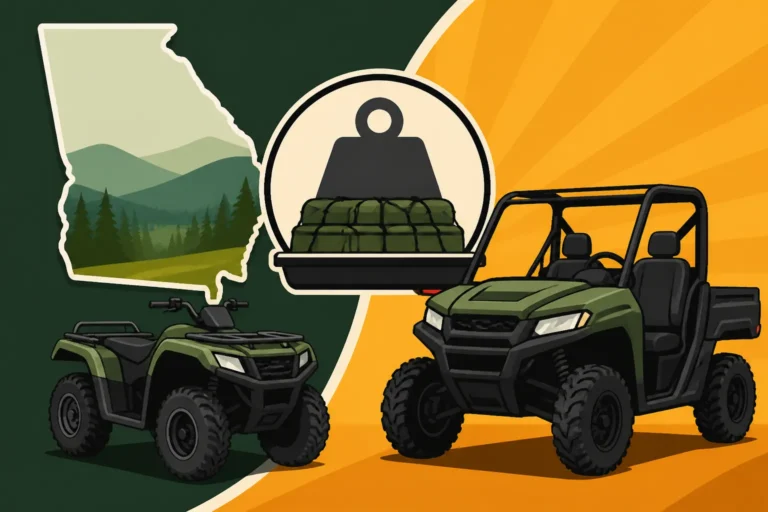
The physical dimensions and capabilities of your machine are a significant part of the MPOHV eligibility test. Form MV-OHV will require you to certify that your vehicle:
- Does not exceed 80 inches in width. This measurement is typically taken from the widest point of the vehicle, usually including the tires. It's designed to ensure the MPOHV fits safely on public roads without posing an undue hazard. You can find detailed guidance on [Measuring Width Against the 80-Inch Limit].
- Has a gross vehicle weight rating (GVWR) of 4,000 pounds or less. The GVWR includes the vehicle's weight plus its maximum payload. This limit prevents extremely heavy or oversized machines from being registered as MPOHVs. Understanding [Weighing a Machine Against the 4,000-Pound Limit] is crucial here, as it's not just the machine's curb weight.
- Has a minimum payload capacity of 350 pounds. This ensures the vehicle has some practical utility beyond just carrying a single driver. It reinforces the "multi-purpose" aspect of the MPOHV designation. For clarity on this, refer to [Measuring Payload Capacity Against 350 Pounds].
You might think, "My side-by-side looks about right," but a quick measurement can confirm or deny your assumption. Many modern UTVs are designed with various widths and weights, so checking your specific model's specifications is always the best approach. An owner of a utility-focused UTV, perhaps a large crew model or one with heavy attachments, might find themselves pushing the 4,000-pound GVWR limit once loaded up. If your machine, for example, is a large, heavily customized UTV that's been beefed up with extra armor and oversized tires, you'll absolutely need to verify its exact width and weight to avoid a disappointing denial at the tag office.
Speed and Seating Requirements: Crucial Differentiators
Beyond size and weight, the MPOHV form also focuses on how your machine performs and how passengers are seated. These are critical aspects that distinguish MPOHVs from traditional ATVs, golf carts, or even low-speed vehicles. You'll need to confirm that your machine:
- Is capable of exceeding 25 miles per hour but not exceeding 65 miles per hour. This speed range is a key identifier. Machines that top out below 25 mph are generally classified differently (like golf carts or LSVs), while those capable of highway speeds over 65 mph are typically not considered MPOHVs for county road use. This ensures a balance between usability on county roads and preventing high-speed dangers. The article on [Georgia's 25 to 65 mph Speed Requirement] delves deeper into this.
- Is designed to be operated with a non-straddle seat. This means bench seating or individual bucket seats, much like a car or truck, rather than the saddle-style seat found on a traditional ATV or motorcycle. This criterion is fundamental to the MPOHV definition in Georgia. For a full explanation, see [Why Georgia's MPOHV Rules Demand a Non-Straddle Seat].
- Is equipped with a steering wheel. This feature, again, aligns MPOHVs more with conventional vehicles than with ATVs or dirt bikes, which use handlebars. If your machine has handlebars, it simply won't qualify. You can read more about [Georgia Requires a Steering Wheel, Not Handlebars].
These particular requirements immediately exclude many common off-road vehicles. For instance, traditional quads, dirt bikes, and three-wheelers, all of which feature straddle seats and handlebars, are automatically disqualified from MPOHV registration in Georgia. Even if your quad meets other criteria, [Why a Straddle Seat Disqualifies a Machine] means it won't pass. Similarly, a high-performance sport UTV that easily surpasses 65 mph would also fall outside the permitted range, regardless of its seating or steering. An example might be a popular high-horsepower UTV marketed for extreme sport riding; while it might have a steering wheel and bucket seats, if its top speed is well over 65 mph, it won't qualify. The same goes for any machine that has handlebars, as explained in [Why Handlebars Disqualify a Machine].
Ownership and Financial Declarations on MV-OHV
Beyond the physical characteristics of your MPOHV, Georgia Form MV-OHV also requires declarations about your ownership status and how sales tax has been handled. Since these machines typically don't have traditional titles, proving you rightfully own the vehicle becomes a unique challenge that the form addresses directly. These sections are crucial for establishing legitimate possession and ensuring that all state financial obligations have been met before a plate is issued. It's where the administrative side of ownership intersects with the practical goal of registration.
Proof of Ownership Without a Title: The Affidavit's Role
Because Georgia does not issue traditional titles for most off-highway vehicles, the MV-OHV form itself often serves a dual purpose as an affidavit of ownership. This means you are essentially swearing under penalty of perjury that you are the rightful owner of the machine. To back up this claim, you'll need to provide supporting documentation. The most common and accepted form of proof is a clear, unambiguous bill of sale. This document, signed by both the buyer and seller, details the transaction, including the date, purchase price, and the vehicle's VIN. You can learn more about the role of the form as an affidavit in [Georgia Ownership Affidavit for an MPOHV].
Other acceptable proofs might include a manufacturer's statement of origin (MSO) for new machines, or in some cases, previous registration documents if the machine was registered in another state that also doesn't title ATVs/UTVs. The key is to establish a clear chain of ownership from the manufacturer to you. Problems often arise with machines bought in cash from private sellers without a formal receipt, or if there are gaps in the ownership history. If you're struggling with paperwork, even simple templates from services like LawDepot can help you create a legitimate bill of sale that holds up at the tag office. For additional guidance, refer to [Bills of Sale That Hold Up at a Tag Office] or [Proving You Own an ATV in Georgia Without a Title].
Sales Tax Affirmation: Paying Your Dues
Before you can register your MPOHV, Georgia requires that the applicable sales tax on the purchase has been paid. The MV-OHV form includes a section where you must affirm that this sales tax has indeed been remitted. For machines purchased in Georgia, this typically means paying 4% state sales tax, plus any applicable local county sales taxes, which can vary. This tax is usually paid at the time of purchase if you buy from a dealer, or you are responsible for remitting it if you buy from a private party. The article [Georgia Sales Tax Paid Before Registration] offers more details on this requirement.
It's important to understand that this is standard sales tax, not the Title Ad Valorem Tax (TAVT) that applies to titled vehicles like cars and trucks. Since MPOHVs are not titled in Georgia, they are exempt from TAVT. This is a significant distinction that can save you a considerable amount compared to registering a road-legal vehicle. Your bill of sale or dealer invoice should clearly show the sales tax collected. If you purchased the machine privately and haven't paid sales tax yet, you'll likely need to do so at the tag office when you register. Understanding [Why No Title Means No TAVT] clarifies this further.
Lienholder Information: If Your Machine Isn't Fully Paid Off
If you financed the purchase of your MPOHV through a bank, credit union, or other lending institution, that entity is considered a lienholder. This means they have a legal interest in your machine until the loan is fully paid off. The MV-OHV form provides a section to list any lienholder information, including their name and address. While Georgia doesn't title MPOHVs in the traditional sense, they still need to be aware of any financial encumbrances on the vehicle, especially since the registration document serves as the primary state record.
Providing accurate lienholder information ensures that the state's records reflect who has a claim on the machine. This can be particularly important if the machine is ever involved in an accident, repossessed, or needs to be sold before the loan is satisfied. The process for registering a machine with an active loan is usually straightforward, as lenders are accustomed to providing the necessary details. Be sure to check [Georgia Registration and Lienholder Records] for a comprehensive understanding of how liens are handled with MPOHV registration. This ensures transparency and helps protect all parties involved in the financing agreement.
Additional Documentation and the Branded Certificate
Filling out Form MV-OHV accurately is just one part of the equation; you'll also need to gather a collection of supporting documents to accompany your application. These documents verify the claims you make on the form and provide concrete proof of ownership, insurance, and other critical details. Furthermore, it's essential to understand a specific notation you might encounter: the "branded certificate" status, which carries important implications for your MPOHV. Being prepared with all necessary paperwork can drastically streamline your visit to the county tag office.
Attaching Supporting Documents: What Else You'll Need
When you head to the tag office with your completed MV-OHV form, you won't be going empty-handed. You'll need an array of supporting documents to verify the information you've provided. These typically include:
- Proof of ownership: As discussed, this is usually a bill of sale or Manufacturer's Statement of Origin (MSO). For homemade machines, this could involve receipts for parts and an affidavit. [Georgia MPOHV Registration for a Homemade Machine] provides specifics.
- Proof of residency: A Georgia driver's license or state ID card is usually sufficient.
- Proof of insurance: You'll need to show evidence of liability insurance that meets Georgia's minimum requirements for vehicles operating on public roads. [Georgia Liability Insurance Tied to Registration] explains this in detail.
- Photo identification: For the applicant submitting the form.
- Payment for registration fees and sales tax (if applicable).
Each of these documents plays a crucial role in validating your application. For example, your bill of sale confirms the transfer of ownership, while your insurance card proves you meet the legal requirements to operate on public roads. Without these supporting papers, even a perfectly filled-out MV-OHV form will be insufficient. It's a comprehensive process designed to ensure all bases are covered. Always use the [Georgia Registration Paperwork Checklist] to ensure you haven't overlooked anything.
Understanding the Branded Certificate of Registration
Sometimes, during the registration process, your MPOHV might receive a "branded" certificate of registration. This isn't necessarily a bad thing, but it's an important distinction to be aware of. A branded certificate typically indicates that the machine has a history that includes factors like being rebuilt, salvaged, or having a prior history of significant damage. The purpose of this branding is to alert future owners or anyone reviewing the registration that there's a specific history associated with the vehicle that might affect its value or condition. [Georgia Branded Certificates of Registration] offers a detailed explanation.
If your machine receives a branded certificate, it will be noted on the registration document itself. This serves as a consumer warning, much like a branded title on a car. For instance, if you purchase a used side-by-side that was previously involved in a major incident and rebuilt, the state might issue a branded certificate to reflect this. This is why it's vital to be transparent about your vehicle's history during the application process. Furthermore, in some cases, a law enforcement inspection might be required to verify the machine's identity and condition before a branded plate is issued, particularly if there are concerns about its origin or previous state. [What a Branded Registration Warns You About] and [Buying a Machine With a Branded Certificate] are crucial reads if you're dealing with such a situation, or are considering buying a machine with this notation. [Georgia Law Enforcement Inspection for a Branded Plate] may be a required step.
The Submission Process and What Comes Next
Once you've meticulously filled out Georgia Form MV-OHV and gathered all your supporting documentation, the next step is submission. This isn't merely dropping off papers; it's a formal process that initiates the state's review of your application. Understanding where to go, what to expect, and what happens after submission is crucial for setting realistic expectations and ensuring you complete the registration successfully. The journey doesn't end when you hand over the form; it merely transitions to the next phase.
Where and How to Submit Your MV-OHV Form
Your completed Georgia Form MV-OHV, along with all required supporting documents, must be submitted in person at your local county tag office. This is the designated point of contact for all vehicle registrations within Georgia, including MPOHVs. It's not an online process, nor can you mail it in. You'll need to visit the office during their operating hours, often prepared for a wait, especially during peak times. Bringing all your paperwork neatly organized will greatly assist the clerks. It's also wise to bring a pen and be ready to answer any questions or provide additional clarification if needed.
When you arrive, a clerk will review your entire packet: the MV-OHV form, your bill of sale, proof of insurance, ID, and any other necessary documents. They'll check for completeness and accuracy, and sometimes they may ask for an additional signature. They'll also collect the registration fees and any outstanding sales tax. Because this is a relatively new process for MPOHVs, some tag office personnel may be less familiar than others, so patience is key. For more details on the exact steps, consult [Georgia County Tag Office Steps for an MPOHV] and [Where the County Tag Office Fits In].
Receiving Your MPOHV Plate and Decal
Once your application is approved and all fees are paid, the county tag office will issue you an MPOHV license plate and a registration decal. This is the moment you've been working toward! The plate is specifically designed for off-highway vehicles and will typically have a distinct appearance to differentiate it from standard vehicle plates. The decal usually needs to be affixed to the plate itself, indicating the current registration year. You'll learn more about [Georgia Plates for Off-Highway Vehicles] when you receive it.
Upon receiving your plate and decal, it's your responsibility to properly display them on your MPOHV. The license plate must be securely attached to the rear of your machine, clearly visible and free from obstruction. The decal usually goes on the plate as instructed. Proper placement is essential to avoid potential issues with law enforcement. If, for any reason, your decal is lost, stolen, or damaged, you'll need to contact your county tag office to arrange for a replacement, which typically involves a small fee. You can find more information on [Georgia Plate Placement on a Side-by-Side] and [Georgia Registration Decal Replacement].
Ongoing Responsibilities: Renewal and Compliance
Getting your MPOHV registered isn't a one-and-done deal; it comes with ongoing responsibilities to maintain its legal status for road use. The registration is not permanent and must be renewed annually. You'll typically receive a renewal notice in the mail from the state, reminding you when it's due. This renewal process usually involves paying a fee and verifying that your insurance coverage remains active. For details on this, refer to [Georgia MPOHV Renewal Each Year].
Beyond renewal, you must also adhere to all the specific MPOHV road rules and regulations whenever you operate your machine on public roads. This includes staying on designated county roads, obeying speed limits, and ensuring your machine remains equipped with all the necessary safety features it qualified with. Failure to renew your registration or comply with the operating rules can lead to citations, fines, and even the impoundment of your machine. Understanding [Georgia MPOHV Road Rules: County Roads Only] and [Georgia Penalties for an Unregistered Road Machine] is crucial to avoid these pitfalls.
Common Challenges and Troubleshooting with MV-OHV
Even with the best intentions and careful preparation, obstacles can arise when dealing with government paperwork. The MPOHV registration process, while designed to be straightforward, can present unique challenges, especially concerning documentation or if your machine doesn't quite fit the mold. Knowing how to troubleshoot these common issues can save you a lot of time and frustration, ensuring your path to a registered MPOHV remains as smooth as possible.
Dealing with Missing or Incomplete Paperwork
One of the most frequent hurdles applicants face is missing or incomplete paperwork, especially concerning proof of ownership for older or privately purchased machines. If you bought your side-by-side many years ago with just a handshake and no formal bill of sale, or if the original Manufacturer's Statement of Origin (MSO) has been lost, you might struggle to establish a clear chain of ownership. In such cases, the county tag office may require additional steps. For instance, you might need to fill out a Georgia T-22B Inspection Certification, which is a sworn statement of inspection. This document is typically used when the identity of a vehicle needs to be verified or if there's no traditional title history. For more on this, check out [Georgia T-22B Inspection Certification].
Sometimes, an ownership affidavit can be used, particularly for machines that have been in your possession for a long time without formal documentation. Services like LawDepot can be incredibly useful here, offering templates for bills of sale or general affidavits that you can customize and have notarized. These tools help formalize your claim of ownership when original documents are unavailable. Always aim to provide as much verifiable proof as possible, even if it requires recreating some documentation. This due diligence can prevent your application from being rejected outright for lack of proper ownership proof.
Correcting Errors or Updating Information
Mistakes happen, and it's not uncommon to realize you've made an error on your MV-OHV form after submission, or that your personal information has changed. If you discover a mistake on your submitted form, such as an incorrect VIN or an transposed address, you should contact your county tag office as soon as possible. They will guide you through the process of correction, which might involve submitting an amended form or a separate affidavit to rectify the error. Timely correction is important to ensure your records are accurate and avoid future complications.
Similarly, if your personal information changes, such as your residential address, you are generally required to update these records with the state. An address change, for example, needs to be communicated to the tag office so that future renewal notices reach you. If you sell your registered MPOHV, the registration needs to be transferred to the new owner, or you may need to cancel your registration. This process involves specific steps to ensure the legal transfer of responsibility. Understanding [Georgia Registration Transfer After a Sale] is vital when selling your machine. These updates are crucial for maintaining legal compliance and ensuring you receive all official communications regarding your MPOHV.
What to Do If Your Machine Doesn't Qualify
Despite your best efforts, sometimes a machine simply doesn't meet Georgia's strict MPOHV eligibility criteria. Perhaps it has handlebars instead of a steering wheel, or its top speed is just under 25 mph. If your application for MPOHV registration is denied because your machine doesn't qualify, it can certainly be disappointing. However, this doesn't mean your off-highway vehicle is useless or illegal. It simply means it cannot be legally operated on public county roads under the MPOHV designation.
In such cases, your machine reverts to its status as a purely off-highway vehicle. This means its use is restricted to private property, designated off-road trails, or other areas where off-road vehicle operation is explicitly permitted. You can still enjoy your ATV or side-by-side for hunting, farming, recreation on your own land, or at private off-road parks. It's crucial to understand [Georgia Registration Versus Just Riding Private Land] to know the distinction. While it won't get that coveted MPOHV plate, it remains a valuable piece of equipment for its intended off-road purpose. Always be mindful of local ordinances and state laws regarding off-road vehicle use, even on private land, to avoid trespass issues or other violations.
Here's a quick summary of key MPOHV eligibility requirements often checked on Georgia Form MV-OHV:
| Requirement | Description | Why it Matters |
|---|---|---|
| Max Width | 80 inches or less (from widest point, typically including tires) | Ensures safe passage on county roads; prevents oversized machines. |
| Max Gross Weight | 4,000 pounds or less (vehicle weight + max payload) | Limits heavy commercial-style vehicles; promotes road compatibility. |
| Min Payload Capacity | 350 pounds or more | Emphasizes "multi-purpose" utility beyond simple recreational use. |
| Speed Range | Capable of 25 mph, but not exceeding 65 mph | Balances usability on rural roads with safety from high-speed traffic. |
| Seating Type | Non-straddle seat (e.g., bench or bucket seats) | Differentiates from traditional ATVs; aligns with more conventional vehicles. |
| Steering Mechanism | Steering wheel | Excludes ATVs and dirt bikes; aligns with more conventional vehicles. |
| Headlights/Brake Lights | Must be equipped and functional | Essential for visibility and safety, especially when sharing roads. |
| Rearview Mirror(s) | Must be equipped | Allows operator to see traffic behind them, crucial for road safety. |
| Factory Seat Belts | Must be equipped and functional | Safety feature for all occupants; standard for side-by-sides. |
| Manufacture Date | Must be manufactured on or after January 1, 2000 | Excludes older machines that may not meet modern safety or design standards. |
Disclaimer
This article is for general informational purposes only and does not constitute professional advice. Laws, prices and regulations vary by location and change over time. Consult a qualified professional for guidance on your specific situation.