Why a Four-Wheeler Cannot Be Registered in Georgia
It's a common frustration for many off-road enthusiasts in Georgia: you've got a fantastic four-wheeler, maybe a trusty sport quad you've ridden for years, and you'd love to legally take it on certain county roads. You see side-by-sides cruising around with license plates, and you think, "Why can't my ATV do that?" The reality is, despite the similarities in recreational use, Georgia law draws a very distinct line in the sand, and unfortunately for traditional four-wheelers, they simply do not meet the criteria for public road registration in the state. This guide will meticulously explain why your four-wheeler cannot be registered in Georgia, delving into the specific legal definitions, design distinctions, and the reasons behind these rules.
The Fundamental Disqualification: What an ATV Is
When we talk about a "four-wheeler" in the traditional sense, we're almost always referring to what the state of Georgia, and most other jurisdictions, legally defines as an All-Terrain Vehicle (ATV). These machines are built for off-road performance, agility, and often, a thrilling ride. Their very design, which makes them so excellent in the woods, on trails, or across fields, is precisely what disqualifies them from being registered for road use in Georgia. It’s not an oversight; it’s a deliberate distinction based on safety, design, and intended purpose.
What Georgia Law Says About ATVs
Georgia law is quite clear, even if it's not always widely understood. The state defines an "all-terrain vehicle" as "any motorized vehicle designed for off-road use, having a manufacturer's width of 50 inches or less, a dry weight of 1,200 pounds or less, designed to travel on three or more non-highway tires, and manufactured for recreational use by one operator." This definition immediately sets it apart from vehicles intended for street travel. The key phrases here are "designed for off-road use" and the specific dimensions and weight limits, which highlight its specialized nature. It's built for agility over rough terrain, not stability on paved roads. This foundational definition underpins every subsequent rule that prevents an ATV from getting a license plate. It establishes the ATV as a distinct category, separate from motorcycles, cars, or even the newly recognized "Multipurpose Off-Highway Vehicles."
Why Handlebars are a Dealbreaker
One of the most immediate and visually obvious reasons an ATV cannot be registered in Georgia boils down to its steering mechanism: handlebars. While exhilarating for weaving through trails, handlebars are fundamentally different from a steering wheel, which is a mandatory requirement for any vehicle seeking MPOHV registration in Georgia. Think about the control input: with handlebars, you lean into turns and use your body weight as a crucial part of steering, especially at higher speeds or on uneven ground. This dynamic, body-centric steering is simply not compatible with the predictable, stable control expected of a road-legal vehicle. [Why Handlebars Disqualify a Machine] dives deeper into this specific design criterion. The state sees this as a critical safety difference, making vehicles with handlebars unsuitable for shared public roadways where sudden, unpredictable movements could be hazardous.
The Straddle Seat Problem
Another significant disqualifier for traditional ATVs is their seating arrangement. ATVs are designed with a straddle seat, much like a motorcycle. This allows the rider to shift their weight, absorb bumps with their legs, and maintain aggressive control over varied terrain. However, Georgia's MPOHV registration requirements specifically mandate a non-straddle seat, designed to be sat in, much like a car seat, rather than on. This distinction is about rider security and stability. A non-straddle seat, often combined with seat belts, implies a more contained and less active riding position, which is deemed safer for road environments where stability and passive restraint are prioritized over active body-movement control. This focus on a contained seating position is a direct reflection of road safety standards, which traditional ATVs, with their inherent design for dynamic rider input, simply cannot meet.
Beyond Design: Georgia's Specific Road-Use Criteria
While the design aspects like handlebars and straddle seats are primary hurdles, Georgia's MPOHV registration criteria delve even deeper into performance and physical specifications that further exclude ATVs. These criteria aren't arbitrary; they're established with public safety and road compatibility in mind, ensuring that any vehicle granted road access meets certain minimum (and maximum) operational characteristics.
Speed Limits and Why They Don't Match
Georgia's MPOHV rules specify a particular speed range that registered vehicles must fall within: they must be capable of exceeding 25 mph but not capable of exceeding 65 mph. This range is carefully chosen to balance practical road use with safety. A vehicle too slow could impede traffic, becoming a hazard, while a vehicle capable of very high speeds might be deemed too powerful or unstable for the specific types of county roads it's allowed on. Most traditional ATVs, especially sport models, can easily exceed 65 mph, immediately disqualifying them under this rule. Conversely, utility ATVs might struggle to consistently maintain the 25 mph minimum on certain inclines or with heavy loads, placing them in a grey area but still problematic. It's a goldilocks zone that ATVs rarely fit into, further highlighting their off-road specialization. [A Machine That Tops Out Below 25 mph] or [A Machine That Exceeds 65 mph] explains these limits in detail.
Weight and Width Restrictions: A Tight Squeeze
The physical dimensions of a vehicle are critical for road compatibility, affecting everything from lane usage to maneuverability and interaction with other traffic. Georgia's MPOHV registration includes strict limits on both width and gross vehicle weight. The maximum width for a registered machine is 80 inches. While many side-by-sides fall within this range, some larger ATVs, especially those modified with wider axles or aftermarket components, might push this limit. More significantly, the weight restriction is a gross vehicle weight ceiling of 4,000 pounds and a payload requirement of at least 350 pounds. Most ATVs are well under the 4,000-pound GVW limit, but their design typically prioritizes a single rider and minimal cargo, often meaning they don't meet the minimum 350-pound payload capacity requirement designed for machines meant to carry multiple passengers or substantial loads. This combination of width and weight criteria directly targets the utility and passenger-carrying capabilities expected of a road-registered MPOHV, capabilities that are not central to the design philosophy of a traditional ATV. [Measuring Width Against the 80-Inch Limit] and [Weighing a Machine Against the 4,000-Pound Limit] offer more insights.
The Steering Wheel vs. Handlebars Rule Revisited
While we touched on handlebars earlier, it's worth reiterating the stark legal distinction that the presence of a steering wheel makes. For Georgia's MPOHV class, a steering wheel is not just preferred; it is explicitly required. This is a fundamental design difference that speaks to the very nature of how a vehicle is controlled and operated. A steering wheel provides a fixed, two-handed input that offers precise directional control, which is essential for safely navigating public roads, especially when interacting with other vehicles. It promotes a more stable, less dynamic driving posture compared to handlebars. The absence of a steering wheel on a four-wheeler is a non-negotiable point for registration, effectively acting as an impenetrable barrier for traditional ATVs seeking road legality in Georgia. It’s a clear indicator that the state views these machines as inherently different in their intended operational environment and their suitability for shared road spaces.
The Rise of the MPOHV: Why Side-by-Sides Are Different
The frustration many ATV owners feel often stems from seeing side-by-sides (SxS or UTVs) with Georgia license plates. This isn't a loophole; it's because Georgia created a specific category for these vehicles: the Multipurpose Off-Highway Vehicle (MPOHV). This new classification, which started accepting registrations in December 2023, was designed precisely to accommodate machines that bridge the gap between pure off-roaders and utility vehicles with some road-worthy characteristics.
Understanding the MPOHV Definition
The MPOHV category in Georgia was established to allow certain utility-focused off-highway vehicles, primarily side-by-sides, to legally operate on county roads. The definition is very specific, drawing clear lines between what qualifies as an MPOHV and what remains a pure ATV. An MPOHV is defined as a motorized vehicle that is 80 inches or less in width, has a dry weight of 4,000 pounds or less, has a minimum payload capacity of 350 pounds, travels on four or more non-highway tires, is designed for off-road use, and is designed to carry one or more passengers with a non-straddle seat and a steering wheel. It must also have working headlights, brake lights, and rear-view mirrors, and be capable of 25 mph but not exceeding 65 mph. This is a much more comprehensive definition than that for ATVs, detailing features that align with minimal road safety standards. This category exists because vehicles like Polaris Rangers, Kawasaki Mules, and John Deere Gators are built with these features in mind, unlike traditional ATVs. [What MPOHV Actually Stands For] offers a deeper dive into the specific terminology.
The Eligibility Checklist: Where ATVs Fall Short
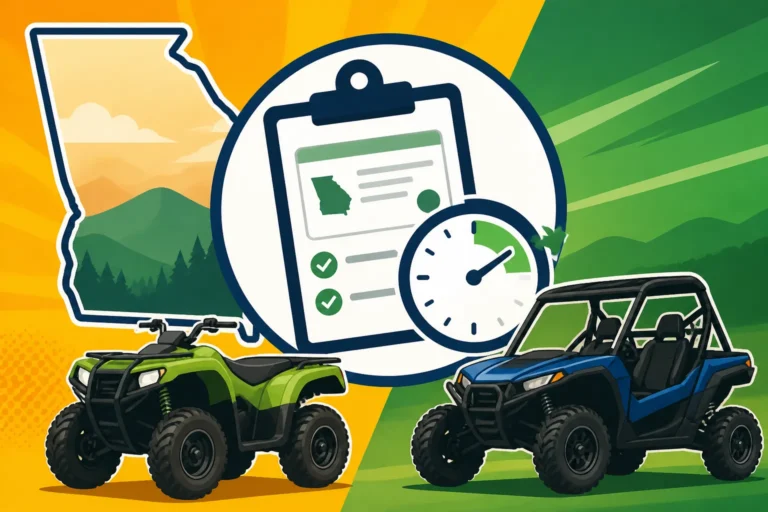
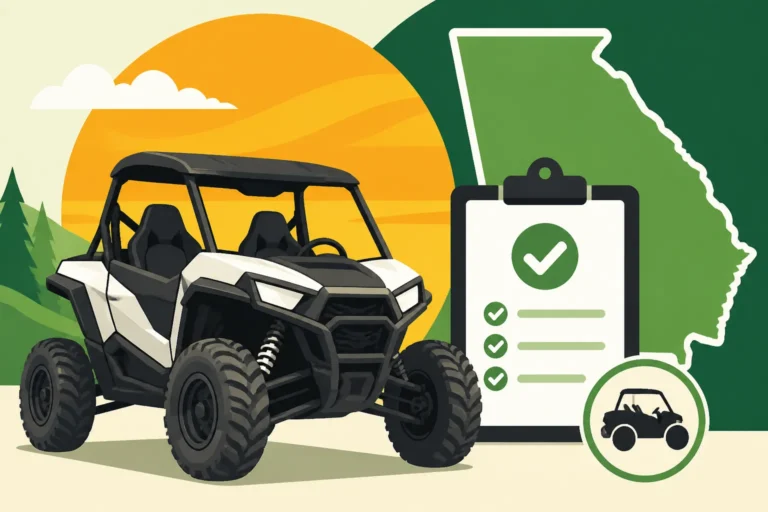
To illustrate the point, let's look at a side-by-side registration checklist compared to a typical ATV. If you were to take a traditional four-wheeler and try to tick off the boxes for [Georgia MPOHV Eligibility: The Eight-Point Test], you'd quickly find yourself stuck.
| MPOHV Eligibility Item | Typical Side-by-Side (UTV) | Typical Four-Wheeler (ATV) | Reason for ATV Disqualification |
|---|---|---|---|
| Steering Mechanism | Steering wheel | Handlebars | Fundamental design difference for control. |
| Seating | Non-straddle seat(s), often with seat belts | Straddle seat | Safety/stability for road use. |
| Minimum Width (80" max) | Usually 50-72 inches, fits requirement | Usually 40-50 inches, fits requirement | N/A (meets width, but other factors fail it). |
| Gross Weight (4,000 lbs max) | Often 1,500-2,500 lbs dry, fits requirement | Often 500-800 lbs dry, fits requirement | N/A (meets weight, but other factors fail it). |
| Payload Capacity (350 lbs min) | Often 500-1,000 lbs, meets requirement | Usually 100-200 lbs, fails requirement | Designed for a single rider and light cargo. |
| Tires | Four or more non-highway tires | Three or more non-highway tires | N/A (meets tire type, but other factors fail it). |
| Speed Range (25-65 mph) | Usually 35-70+ mph, fits requirement (if capped) | Often 50-80+ mph, fails requirement (often exceeds max) | Many ATVs exceed the 65 mph max. |
| Safety Equipment (Headlights, Brake Lights, Mirrors, Seat Belts) | Standard equipment | Often optional/aftermarket for some items | Required as standard for MPOHV. |
As you can clearly see, ATVs fail on multiple crucial points, especially the steering wheel, seating, payload capacity, and often the top speed. This isn't about modifying an ATV to look like it meets the criteria; it's about its fundamental design and engineering for a specific purpose.
What MPOHV Registration Allows
For those who do own a machine that qualifies as an MPOHV (i.e., most side-by-sides), Georgia registration opens up specific, limited road access. It allows these registered machines to be operated on county roads and across state highways at designated crossing points. This is a significant change, providing a legal framework for utility and recreational UTV owners to connect trails, reach hunting lands, or simply enjoy a ride to a local establishment on the appropriate roads. This new registration doesn't make UTVs street-legal on all roads; interstates and state highways remain strictly off-limits for general travel. However, for a side-by-side owner, it provides a sense of legitimacy and peace of mind when navigating their local rural county roads. [Georgia MPOHV Registration Explained] provides an in-depth look at this new system. This privilege, however, remains exclusive to machines that pass the stringent MPOHV eligibility test, unequivocally excluding traditional four-wheelers.
Common Misconceptions and What Is Permitted
The clear legal distinction between ATVs and MPOHVs often leads to confusion, particularly for those who assume all off-highway vehicles are treated the same. It's crucial to understand what is and isn't permitted for ATVs in Georgia, as the rules are designed to delineate safe and appropriate operational environments.
Private Land Riding vs. Public Road Use
The most fundamental distinction, and often the source of misunderstanding, is the difference between riding on private land and using public roads. Your four-wheeler is designed for, and legally intended for, private property. On your own land, or on land where you have explicit permission from the landowner, you can ride your ATV freely (subject to local noise ordinances and responsible operation). This includes trails, fields, and even private access roads. This is where the ATV truly shines and where its design is fully utilized.
However, the moment you transition onto a public roadway, regardless of how rural or unpaved it may seem, you enter a different legal realm. Public roads are governed by strict traffic laws and vehicle registration requirements, none of which an ATV is designed to meet. The simple fact that you can ride your ATV on private property with no issues does not translate into any right to operate it on public roads. This separation is key to understanding why Georgia's laws are structured the way they are; they protect the public on shared infrastructure while allowing enthusiasts to enjoy their machines in their intended environment.
Farm Use Exemptions and Limitations
Georgia law does offer some specific, very narrow exemptions for off-highway vehicles when used in agricultural operations. For instance, a four-wheeler might be legally operated on a public road for a short distance (e.g., crossing a road) if it is being used strictly for farming purposes and is traveling between parcels of farmland. This isn't a blanket exemption for all ATVs or all situations; it is specifically tied to active agricultural work. A farmer using their quad to check fences or herd cattle might briefly cross a county road to get to another field.
However, this "farm use" exemption does not mean you can register your ATV for general road use, nor does it allow you to ride it recreationally on public roads simply because you live on a farm. It’s a functional exemption for work-related transit, not a pathway to broad road legality. Even with this exemption, the operator must still exercise extreme caution and follow traffic laws to the best of their ability. These specific circumstances are a far cry from the general recreational road access that MPOHVs now enjoy, further solidifying the distinction. [Georgia MPOHV Registration and Farm Use] explores this in more detail.
Crossing Roads: A Narrow Window
Even without MPOHV registration, there are extremely limited scenarios where an ATV might briefly touch a public road, but these are exceptions, not permissions for general travel. Beyond the farm use exemption, in some very specific, highly localized circumstances, an ATV might be permitted to cross a public road at designated points, typically at right angles, to get from one section of a trail system or private property to another. This is often contingent on local ordinances and explicit signage, and it's a far cry from "riding" on the road.
The key here is "crossing," not "traveling." Even then, the ATV must yield to all traffic, and the crossing must be done as quickly and safely as possible. These situations are rare and should never be assumed without clear local guidance. For the vast majority of ATV owners, any public road interaction is illegal. It's a critical safety point that reinforces the message: ATVs are for off-road. [Georgia UTV Rules Crossing a State Route] and [Georgia Crossings at Designated Points] discuss how this applies to MPOHVs, but ATVs rarely, if ever, share even these limited crossing privileges.
Navigating Ownership Without Registration
Since your traditional four-wheeler cannot be registered in Georgia, the process of ownership, buying, and selling looks quite different than it does for a car or even a registered MPOHV. There's no state-issued title, no annual tag renewal, and no formal state record of ownership tied to a license plate. This doesn't mean ownership is impossible or precarious; it simply requires different documentation and practices to prove legitimate possession and facilitate transactions.
Proving You Own an ATV in Georgia Without a Title
Because Georgia does not title ATVs, proving ownership often relies on a paper trail of purchase documents. The primary document you'll rely on is a strong, detailed bill of sale. This bill of sale should include:
- The full names and addresses of both the buyer and seller.
- The date of the transaction.
- A clear description of the ATV, including make, model, year, and crucially, its Vehicle Identification Number (VIN) or serial number.
- The purchase price.
- A statement that the seller warrants they are the legal owner and have the right to sell the ATV, and that it is free of liens (unless stated otherwise).
- Signatures of both parties.
Beyond a bill of sale, other documents that can bolster proof of ownership include:
- The original manufacturer's Certificate of Origin (MCO or MSO) if you bought it new. This is akin to a birth certificate for the machine.
- Repair or service records with the VIN listed.
- Insurance declarations that list you as the policyholder and the ATV by its VIN.
- A notarized affidavit of ownership if records are sparse.
Companies like LawDepot can provide customizable templates for bills of sale and other legal documents, which can be very helpful for ensuring you have all the necessary information. It’s always wise to keep these documents in a safe place, as they are your primary proof. [Proving You Own an ATV in Georgia Without a Title] is a vital read on this topic.
Buying and Selling an Untitlable Machine
When buying or selling an ATV in Georgia, the absence of a title means you need to be extra diligent. For the buyer, it's about securing unambiguous proof of purchase and ensuring the machine isn't stolen or encumbered by undisclosed liens.
- For Buyers: Always insist on a detailed bill of sale with the VIN. Check the VIN against national stolen vehicle databases if possible (though this can be challenging without law enforcement access). If the seller has the original MCO, that's a huge bonus. Pay close attention to the seller's demeanor and willingness to provide documentation. A legitimate seller should have no problem providing a detailed bill of sale or an [Georgia Ownership Affidavit for an MPOHV] (adapted for ATV use, if applicable, to declare ownership). LawDepot offers templates for these kinds of documents, which can guide you through the process.
- For Sellers: Provide a clear, comprehensive bill of sale. If you have the MCO, pass it along. Be prepared to answer questions about the machine's history and maintenance. While Georgia doesn't have a title for these, transparency is key to a smooth transaction. You might also consider drafting an agreement using resources like LawDepot if the sale is complex, involving payments or specific conditions.
The lack of a formal state title also means there's no state-recorded lien information. This makes private sales riskier, as an undisclosed lien could mean a financing company still has a claim on the machine, even if you paid cash. Diligence in researching the seller and the machine's history is paramount. [Buying a Used Side-by-Side in Georgia] offers valuable advice that also applies to ATVs, especially regarding due diligence.
Insurance Considerations for Off-Road Use
Even though your ATV cannot be registered for road use, obtaining insurance for it is highly recommended. Most homeowner's policies offer very limited, if any, coverage for recreational vehicles, especially if they leave your immediate property. Specialized ATV insurance policies are available from various providers and can cover:
- Liability: Crucial for protecting you if you cause property damage or injury to someone while operating your ATV, even on private land or a designated trail. Imagine an accident with another rider or damaging a fence on leased land; liability coverage protects your assets.
- Collision: Covers damage to your own ATV in an accident.
- Comprehensive: Protects against non-collision incidents like theft, fire, or vandalism. ATVs are a common target for theft, so this coverage can be incredibly valuable.
- Uninsured/Underinsured Motorist: While less common for ATVs, some policies might offer it if you encounter another off-road vehicle that causes an accident and lacks insurance.
When talking to an insurance agent, be very clear that the ATV is for off-road use only and will not be registered for public roads. This clarity ensures you get the correct type of coverage tailored to your needs. While Georgia doesn't mandate insurance for unregistered machines, it's a wise investment for peace of mind and financial protection. [Georgia ATV Insurance Costs] can help you understand the financial implications of coverage.
The Future Landscape for Off-Highway Vehicles in Georgia
The landscape for off-highway vehicles in Georgia is not static. The creation of the MPOHV category is a relatively recent development, reflecting evolving recreational interests and the increasing popularity of side-by-sides. However, it also introduces a "sunset" provision that could impact how these vehicles are used on public roads in the future, and this indirectly affects the broader context of ATV use.
The July 2027 Sunset and What It Means
A critical piece of legislation for MPOHV owners, and one that all off-highway vehicle enthusiasts should be aware of, is the "sunset" clause associated with the law that permits MPOHV road access. This clause stipulates that the provisions allowing MPOHVs on county roads are set to expire on July 1, 2027. This means that, unless the Georgia General Assembly takes action to extend, amend, or make permanent these provisions, MPOHV registration and road access could cease to exist after that date.
For ATV owners, this doesn't directly change their current inability to register their machines. However, it underscores the temporary and sometimes experimental nature of public road access for vehicles not traditionally designed for it. It suggests that the state is evaluating the impact of these machines on public roads, and the future could bring new regulations or, conversely, a return to stricter limitations. It’s a reminder that rules can change, and what's permitted today might not be tomorrow. [Georgia's July 2027 Sunset on Road Access] is an essential read for anyone concerned about the longevity of MPOHV privileges.
Staying Informed About Georgia Laws
Given the dynamic nature of off-highway vehicle laws, especially with the relatively new MPOHV category and its sunset clause, staying informed is paramount. For ATV owners, this means understanding that the current inability to register your four-wheeler for road use is deeply entrenched in current definitions and safety requirements. While some might hope for a future where ATVs gain road access, the legislative trend in Georgia has been to create a separate, more stringent category for vehicles that share some characteristics with cars, rather than broadening the definition for traditional ATVs.
Resources to stay updated include:
- The Georgia Department of Revenue (DOR) website, particularly the Motor Vehicle Division section, for official updates on registration.
- The Georgia Department of Natural Resources (DNR) for rules pertaining to state lands, WMAs, and trails.
- Legislative tracking for bills introduced in the Georgia General Assembly that might impact off-highway vehicles.
- Reputable off-road clubs and forums can also be good places for community discussion and shared information, though always verify information against official sources.
Ultimately, for the foreseeable future, your four-wheeler in Georgia is designed for and confined to off-road use. Embracing its true purpose on trails, private land, and designated riding areas is the safest and most legal way to enjoy your machine.
Disclaimer
This article is for general informational purposes only and does not constitute professional advice. Laws, prices and regulations vary by location and change over time. Consult a qualified professional for guidance on your specific situation.