Tread Lightly on Erodible Clay
Georgia’s red clay can look firm at the trailhead and turn slick, deeply rutted, and easily damaged after a soaking rain. That leaves riders weighing a frustrating choice: continue and risk harming the trail, or change the day’s plan. This guide explains how to judge conditions, ride with less impact, and check Georgia trail access before unloading.
Why Georgia’s clay trails are vulnerable
What rain does to red clay
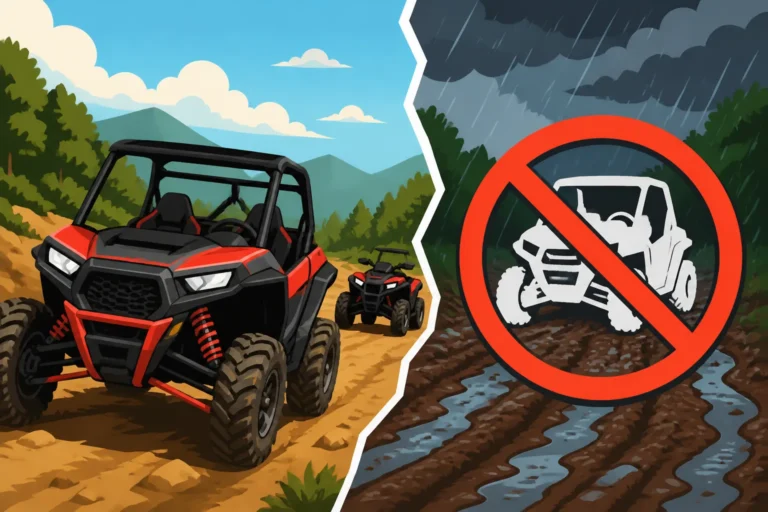
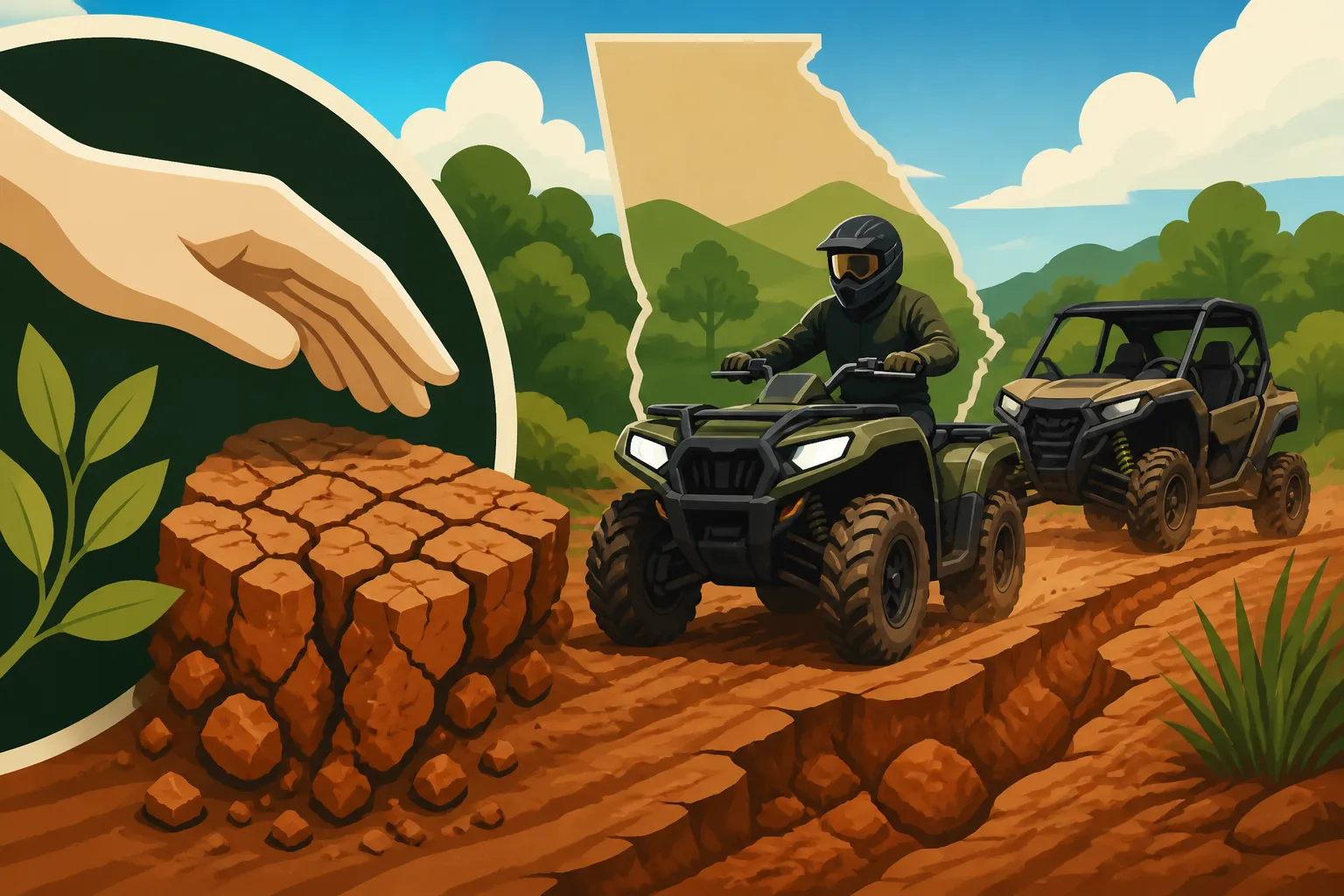
Georgia’s clay soils can hold water near the surface, especially where vegetation has been disturbed or water already runs across a trail. When the soil is saturated, tires may lose grip and churn the surface instead of rolling over it. That can create ruts that channel more water, carrying loose soil downhill and making the original problem worse.
The risk varies by location. A shaded section in the North Georgia mountains may remain wet after an exposed ridge has begun drying. A low spot, creek approach, or steep descent can also stay soft after nearby ground feels firm. A quick look at the parking area is not enough to judge every mile of a route.
For the machine, wet clay often means more than a muddy exterior. Slippery climbs can tempt riders to use more throttle, while clay packed around tires and components can make the machine harder to inspect afterward. For the trail, repeated wheelspin can deepen ruts and widen the route as riders try to find firmer ground. Georgia Red Clay and What It Does to a Machine explains why clay can be tough on both a vehicle and a ride.
Why a small rut can become a bigger problem
A rut is not just a mark left by one tire. Once it forms, water can follow it downhill rather than dispersing across the surrounding ground. That concentrated runoff can deepen the groove, expose roots, and wash sediment toward a stream or drainage area. Riders who leave the established route to avoid a muddy section may also flatten vegetation and create a second track that later becomes another erosion channel.
This is why “just one pass” can matter, particularly when many riders share a trail. A machine that climbs through a soft slope may leave damage for everyone behind it. If the tires begin to spin or sink, continuing to apply throttle can make the rut longer and harder to avoid.
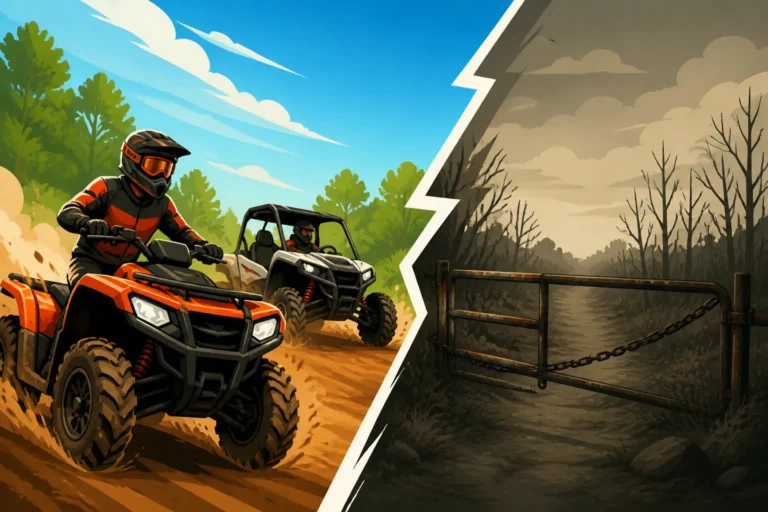
Trail systems are managed differently, and conditions can change quickly. Some routes may be closed after rain or restricted for other reasons. Do not assume that a trail is open simply because the gate is accessible or another vehicle has gone through. Check current access information and follow signs at the site. For more on changing conditions, see Georgia Trails That Close After Rain and Georgia Trail Conditions Before You Drive.
How to decide whether to ride after rain
Check the whole route, not just the entrance
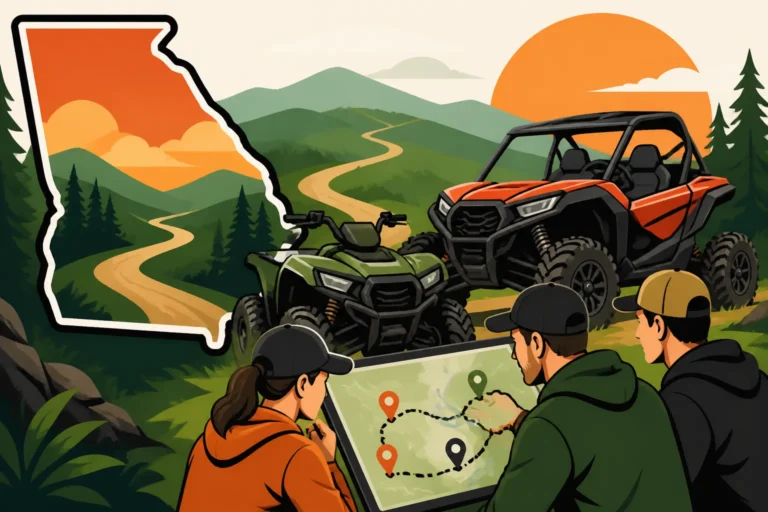
Before leaving home, look for current information from the managing agency or riding area. For a national forest trail, check the relevant Forest Service information and district updates. A private park may post its own closures and operating rules. A map can help you understand where a route goes, but it is not a substitute for an official closure notice, sign, or gate.
Tools such as onX Offroad can help you review mapped routes and orient yourself while planning. Treat any digital map as one planning aid, not proof that a route is open or suitable after rain. Before you travel, compare what you see on the map with the land manager’s current guidance. Once you arrive, posted signs and barriers take precedence over what an app appears to show.
Georgia has multiple national forest OHV systems, and their conditions or access rules may differ. A trail that works well in one area is not a reliable guide to another. If you are planning a trip around the Chattahoochee-Oconee National Forest, review Georgia’s Six National Forest OHV Systems and How to Check Georgia Forest Trail Status before setting out.
Use a conservative on-site test
At the trailhead, pause before committing to a long loop. Look for standing water, fresh tire grooves, exposed roots, flowing water across the route, or signs that vehicles are sliding on slopes. Ask staff at a private park or contact the managing office when conditions are uncertain. If the entrance looks dry but the route climbs into shaded or low-lying terrain, assume that conditions may vary along the way.
If you start riding and find a soft section, stop in a safe, stable place before deciding what to do. Avoid spinning the tires to test the ground. If the machine is losing traction, the surface is deforming, or riders are creating new paths around a muddy stretch, turn back if it is safe and practical. Do not push on just because you have already driven a long way to get there.
| What you notice | Lower-impact choice |
|---|---|
| Water is flowing across the trail | Turn around or choose another route |
| Tires are spinning or leaving deep grooves | Stop applying throttle and reassess |
| A route is blocked or marked closed | Do not ride around the barrier |
| Riders are making side tracks around mud | Stay off the damaged area and report the condition |
| Conditions look different farther along | Turn back rather than assuming the rest is passable |
How to ride with less impact on clay
Stay on the established route
Keep to the designated trail and avoid cutting corners, widening turns, or taking a new line around a muddy patch. Going around an obstacle may seem like the gentler choice for your machine, but it can damage plants and soil outside the managed route. If the established track is too wet to ride without spinning, the lower-impact decision is usually to turn around rather than create another track.
Follow trail markers, gates, and posted instructions. Forest roads, OHV trails, private property, and informal paths are not interchangeable. Riding off the signed route can damage land and create access problems for other riders. Georgia National Forest Trail-Only Rule and Reading a Forest Service Trail Sign offer useful context for understanding where riding is allowed.
On a one-way loop, respect the direction of travel and do not reverse along the route unless a sign or staff member directs you to do so. Other riders may be approaching around bends, and unexpected traffic can turn a slick section into a collision risk. Georgia Trail Etiquette on One-Way Loops covers the habits that make shared routes safer.
Use smooth, controlled inputs
When the trail is firm enough to ride, steady control is generally kinder to the surface than sudden acceleration, hard braking, or repeated wheelspin. Look ahead and choose a line on the established trail that avoids unnecessarily steep or visibly damaged ground. Leave enough space between machines so you are not forced to brake sharply or climb through soil churned by the vehicle in front.
A passenger, cargo load, tire choice, and machine size can all affect traction and handling. Ride at a pace that lets you respond to changing ground rather than charging into a section you cannot inspect. If you feel the machine sliding or digging in, ease off and reassess instead of trying to power through. For more background on wet-trail impacts, see Georgia Trail Riding After Heavy Rain.
Do not assume that a four-wheel drive setting, aggressive tires, or a winch makes a saturated trail a good choice. Those features may help in some situations, but they cannot prevent soil damage when the ground is too soft. A capable machine can sometimes travel farther into poor conditions, which can make recovery and trail damage worse if the route deteriorates.
What to do when a trail is damaged or conditions change
Turn back without creating a second route
If a section is deeply rutted, washed out, or blocked, do not widen the trail to bypass it. Avoid driving over vegetation, around a closed gate, or into a drainage area. If you can safely reverse along the route you used to arrive, do so carefully and give other riders notice where possible. If turning around would be unsafe, follow the site’s instructions or seek help from the park or land manager.
Never try to “fix” a public trail by moving barriers, digging drainage channels, cutting branches, or filling ruts unless the land manager has specifically authorized that work. An improvised repair can redirect water, hide a hazard, or violate site rules. Report serious damage or a blocked route to the appropriate park staff or managing agency, and provide a clear location description.
A map app such as onX Offroad can help you identify your general position when you need to describe where a problem is, but compare the map with signs and local landmarks. A saved route or mapped line should never persuade you to continue through a closure. If a trail is signed closed, treat that direction as final.
Prepare for the next ride
After a wet-weather ride, inspect the machine before the clay dries hard. Check around tires and fenders, and look for packed mud near moving or heat-sensitive parts. Clean the machine in a way that complies with the riding area’s rules, especially where wash water could carry sediment into a creek or drain. If the route was particularly soft, note the location and report damage rather than returning with a tool to make an unauthorized repair.
For your next trip, build flexibility into the plan. Choose a second riding area or a shorter route, and check conditions again before you leave. If recent rain has made the intended trail unsuitable, postponing the ride can protect the route and save you from a difficult recovery. Repairing a Trail After a Wet Weekend provides more context on why trail work should be left to the people responsible for managing it.
If you use onX Offroad during trip planning, save it as a navigation reference, then confirm access and conditions through the relevant land manager. That combination is more reliable than treating any single map as a live trail-status guarantee. The most responsible ride is sometimes the one that changes plans before tires touch saturated ground.
Disclaimer
This article is for general informational purposes only and does not constitute professional advice. Laws, prices and regulations vary by location and change over time. Consult a qualified professional for guidance on your specific situation.