Houston Valley’s 25 Miles Near Dalton
Houston Valley offers roughly 25 miles of off-highway trails in the mountains near Dalton, but its narrow routes are not a fit for every ATV or UTV. Before hauling up from Atlanta, Chattanooga, or elsewhere in North Georgia, check your machine’s width, the trail’s condition, access rules, and permit requirements. This guide helps you plan a safer, less frustrating ride.
What to expect at Houston Valley
Where the trail system is and what the ride is like
Houston Valley OHV Trail System is in northwest Georgia, within the Chattahoochee-Oconee National Forest area near Dalton. The setting is wooded and hilly, with winding routes, uneven ground, and terrain that can feel very different from a wide, maintained gravel road. It’s a place to ride designated OHV trails—not a general-purpose route network for exploring wherever a forest road happens to lead.
The system is commonly described as having about 25 miles of trails. That figure is useful for planning, but it does not mean every route will be open or suitable for every rider on the day you visit. Trail access and conditions can change with weather, maintenance, and closures. Before you go, check the trailhead information and current forest notices rather than relying on an old map or a ride report from a different season.
If you’re comparing nearby riding options, [Houston Valley OHV Trails in Georgia] gives you a useful starting point for understanding the system. Riders looking at its mileage and location can also read [Houston Valley's 25 Miles in North Georgia]. Treat any distance estimate as a broad guide, not a promise that every mile is available on your visit.
Which machines are a practical fit
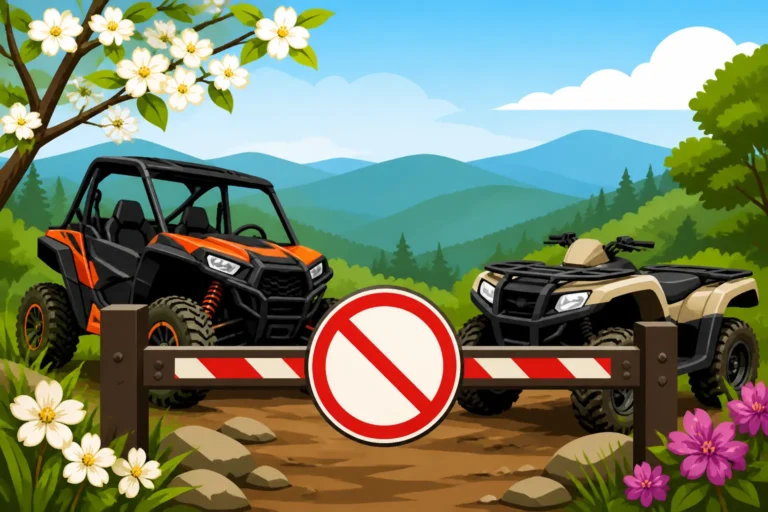
Houston Valley is best approached as a narrow-trail riding area. A machine that works well on farm roads or open private land may be too wide for the designated routes. In particular, many side-by-sides are not suitable for this system. A machine’s published width, tire setup, accessories, and the specific trail restrictions all matter, so don’t assume that a vehicle is allowed just because it is marketed as an ATV or UTV.
The 50-inch limit is an important part of planning for Houston Valley. Confirm how the limit applies to your machine and check the rules posted for the trail system before you tow. [Georgia's 50-Inch Width Cap at Houston Valley] explains why width can determine whether a machine fits the intended riding area. If you own a side-by-side, compare its measured width with the system’s restrictions before you make the drive; [Houston Valley Turns Away Side-by-Sides] addresses the practical problem of arriving with a machine that cannot use the trails.
Do not measure only the body panels and call it done. Tires, wheel spacers, fender flares, mirrors, and other add-ons can affect the machine’s overall width. Measure the widest point as the machine sits on the trailer, then compare that measurement with the current trail rules. The guide [Measuring Your Machine Before You Tow] can help you avoid a wasted trip caused by a last-minute fit issue.
| Planning question | Why it matters at Houston Valley | What to do before leaving |
|---|---|---|
| Is my machine within the width limit? | Narrow trail restrictions can rule out wider machines | Measure the widest point, including tires and accessories |
| Are the trails open? | Weather and maintenance can affect access | Check current forest and trailhead notices |
| Do I need a permit? | Forest OHV access may require an operator permit | Confirm the permit rules and carry proof |
| Is my route suitable for my experience? | Hills, loose surfaces, and changing conditions demand care | Choose a conservative route and ride within your ability |
| Does my map show designated routes? | A map can help prevent accidental travel off-route | Use an up-to-date trail map and follow posted signs |
Plan the visit before you load the trailer
Check trail conditions and closures
The most frustrating trail trip is the one where the group has already driven to the staging area before learning that conditions have changed. Rain can make clay and dirt surfaces slick, create ruts, and increase the chance of getting stuck or damaging the trail. A route that was manageable during a dry weekend may be a poor choice after heavy rain.
Check conditions shortly before your trip, and look for closures or restrictions posted by the managing agency. If recent weather has been wet, be prepared to change plans or postpone the ride. Staying off soft, damaged trails helps protect the route for everyone and reduces the chance that a recovery turns into a long day. [Georgia Trail Conditions Before You Drive] is a helpful reminder to make this check part of trip planning, not an afterthought.
Houston Valley riders should pay particular attention to information about recent rain and trail maintenance. [Houston Valley After a Heavy Rain] focuses on that specific issue. A social-media post from a rider who visited earlier in the week may be useful context, but it should not replace current closure information or signs at the trailhead.
Sort out permits, maps, and navigation
Before riding, confirm whether an OHV permit is required for your trip and how it applies to each person operating a machine. Forest OHV permits generally follow the operator rather than being a single pass for a vehicle shared by several riders. Read [Georgia's Day and Annual Forest OHV Permits] and [Georgia's Per-Operator Permit, Not Per Vehicle] to understand the distinction, then check the applicable purchase and display instructions for your visit.
Bring proof of any required permit in the form accepted for the riding area. Don’t wait until you reach the trailhead to discover that a permit was required or that you have no way to show it. The fact that a machine is registered, insured, or used only off-road does not automatically replace a trail-access permit.
Carry a trail map and keep track of intersections. A navigation app such as onX Offroad can be useful as a planning aid, especially when you want to review routes before leaving home or keep a digital map available. Still, app coverage and mapped lines should not override official signs, gates, or closures. Download or save the information you need before you lose service, and have a backup plan if your phone battery runs low.
Pack for a day on the trail
Even a short ride can take longer than expected when the group stops to regroup, check a machine, or navigate a confusing junction. Pack water, basic first-aid supplies, a charged phone, and any machine-specific tools or recovery gear you know how to use. Bring suitable protective equipment, and make sure each rider understands the plan if the group becomes separated.
A trail ride also goes more smoothly when the group is honest about experience and ability. A new rider who is uncomfortable on steep or uneven ground should say so before the machines leave the parking area. Choose a conservative pace, stop somewhere safe to regroup, and avoid pressuring anyone into a section they are not ready to ride. Your aim is to finish the day with everyone and every machine in good shape—not to cover the most ground.
Ride responsibly and avoid common mistakes
Follow the designated routes and posted rules
Stay on designated OHV routes, respect gates and closure signs, and don’t assume that an unmarked road or track is open to recreational riding. Forest boundaries can include roads with different rules, and a route that looks passable may be closed or intended for another use. If signage is unclear, stop and resolve the question before proceeding rather than taking a chance.
Keep your speed appropriate for visibility and terrain. Curves, loose surfaces, water, and other riders can appear quickly, especially in wooded areas. Leave space between machines so the person behind has time to react to dust, a sudden stop, or an obstacle. On a one-way route, follow its direction and watch carefully at junctions; on any trail, ride as if someone may be approaching from the other side unless signs clearly indicate otherwise.
Respect other visitors and the land. Avoid spinning tires or making unnecessary detours around muddy sections, since that can widen or damage the trail. Pack out trash, keep noise reasonable, and give wildlife room. If conditions are deteriorating, turning around is often the responsible choice—even when the group has already made the drive.
Make a realistic plan for side-by-side owners
Side-by-side owners should verify eligibility before setting out, rather than treating Houston Valley as a place to test whether a machine might squeeze through. Many UTVs are wider than the trail system allows, and a machine that cannot legally or safely use the routes is not made suitable by careful driving. Check the width rule, the current access information, and the machine’s actual measurements.
If your vehicle is too wide, look for another riding area that specifically allows side-by-sides instead of trying to force a fit. [Georgia ATV Trails That Allow Side-by-Sides] can help you compare the type of access you need. Use a trail system’s official rules to make the final decision, since the fact that another area accepts a UTV does not mean Houston Valley does.
If you’re carrying several machines, check every one. Two ATVs that look similar can have different widths because of tire choices, wheel offsets, or accessories. A quick measurement at home is easier than discovering at check-in that one person in the group has to sit out.
Avoid common trip-planning errors
A frequent mistake is assuming that a trail system’s advertised mileage means all trails are open every day. Another is relying on a map that is old, incomplete, or not intended to show closures. Use maps for orientation, but treat current signs and official trail notices as the authority for access.
It’s also easy to underestimate the effect of weather. A little rain can change traction and make a familiar hill much harder to climb or descend. If a route is muddy, do not assume that more throttle is the answer. Pause, reassess, and turn around if continuing could put a rider at risk or cause avoidable trail damage.
Finally, don’t leave the practical details until the last minute. Check machine fit, permits, conditions, fuel, and trailer readiness before the morning of the trip. If your group includes a first-time rider, explain the route plan and basic trail etiquette before starting. A few careful checks at home can prevent a long drive, a missed ride, or a problem on the trail.
Disclaimer
This article is for general informational purposes only and does not constitute professional advice. Laws, prices and regulations vary by location and change over time. Consult a qualified professional for guidance on your specific situation.