Georgia Snake Season on the Trail
Georgia’s warm-weather riding season can bring snakes onto the same trails, shoulders, and creek crossings you use on an ATV or UTV. That can make a routine stop feel tense, especially when the ground is covered in leaves or red clay. This guide explains when snakes are most active, how to reduce close encounters, what to do if you spot one, and how to respond to a bite.
When Georgia snakes are active on trails
The warm months bring the most encounters
Snakes in Georgia are most noticeable when temperatures are warm, generally from spring through fall. Activity can vary with weather: a cool morning may keep snakes still, while a sunny afternoon can bring them out to warm themselves or move between shelter and feeding areas. A sudden warm spell can also make a snake active outside the months when riders expect to see one.
That does not mean every warm-weather ride is dangerous. Most snakes would rather avoid people and machines. Encounters are more likely when a rider stops beside tall grass, steps off the trail near rocks or logs, or reaches into a space that cannot be seen clearly. The practical takeaway is not to cancel every summer ride; it is to pay attention at the places where you slow down or get off the machine.
Georgia riding areas can include shaded forest, rocky slopes, brushy trail edges, and damp low ground. Those conditions can provide shelter for snakes and other wildlife. If you are exploring the national forest systems around North Georgia, keep the possibility of wildlife encounters in mind along with changing trail conditions. [Georgia's Six National Forest OHV Systems] offers related guidance on the riding areas themselves.
Habitat matters more than a calendar date
A snake can turn up wherever cover, prey, and suitable temperatures overlap. Leaf litter, brush piles, fallen limbs, rock edges, and the margins of creeks or ponds deserve extra attention. A machine may pass over a trail without trouble, but a rider who dismounts beside a log or puts a hand under a seat to retrieve something has a different kind of exposure.
Copperheads and timber rattlesnakes are among the venomous snakes riders may encounter in parts of Georgia. Cottonmouths are associated with wet habitats, though a snake near water should not be identified by location alone. Color and pattern can be difficult to judge in poor light, and young or nonvenomous snakes can be mistaken for dangerous ones. Do not approach to identify a snake, and do not rely on an uncertain identification to decide whether a bite needs medical attention.
Plan for the habitat you are riding through rather than trying to predict the exact day snakes will appear. A damp trail edge, a sunny rock, and a pile of leaves beside a parking area all deserve a quick visual check before you step close. If you are choosing a route, use a map as one planning tool, not as a guarantee about wildlife or trail conditions. Riders sometimes use onX Offroad to review routes and orient themselves before a ride, then check land-manager notices for closures and restrictions.
How to reduce snake encounters while riding
Scan the trail and choose stopping places carefully
Keep your eyes moving over the trail ahead, especially where vegetation narrows the path or the surface changes from open dirt to leaf cover. You do not need to stare at every inch of ground. A steady scan helps you notice a snake early enough to slow down, give it room, and avoid startling it.
When you need to stop, choose an open, visible spot rather than pulling into brush or parking beside a log. Before stepping off, look at the ground around the footrests, tires, and the place where you plan to stand. This small habit is useful when taking a break, helping a riding partner, or stopping to check a map. If you are riding a new route, reviewing it in onX Offroad beforehand can help you anticipate where you may need to pause, but it cannot show whether an animal is on the trail at that moment.
Be especially deliberate around creek crossings and shaded bends. Move slowly enough to see what is in front of you, and avoid placing hands or feet where you cannot see the landing area. If a route is overgrown, visibility is poor, or the trail surface is concealing obstacles, turning around may be the sensible choice. [Georgia Trail Conditions Before You Drive] can help you think through conditions that may affect visibility and safe passage.
Wear practical gear and keep your hands out of hidden spaces
Sturdy, closed-toe footwear and long pants can provide a useful barrier against scratches, insects, and incidental contact with vegetation. They are not snake-proof, and ordinary riding gear should never be treated as bite protection. The more important habits are to watch where you step, avoid reaching blindly, and keep a safe distance from wildlife.
Use a light when you need to inspect a machine after dark or in a dim staging area. Do not put your hand under a seat, into a storage compartment, or behind a tire without looking first. If something falls into brush, use a tool or move the vegetation from a safe distance rather than reaching into it. At camp, check around boots, bags, and equipment before picking them up, particularly if items have been left on the ground.
Keep children and passengers close when you stop. A child who is excited to see a snake may move toward it before an adult can react, so explain in advance that the rule is to stay back and tell a grown-up. A calm, simple instruction is more useful than trying to teach detailed species identification at the trailhead. For broader trip preparation, [What Every Rider Carries on a Georgia OHV Trail] is a useful companion topic.
What to do when you see a snake
Give it space and let it move away
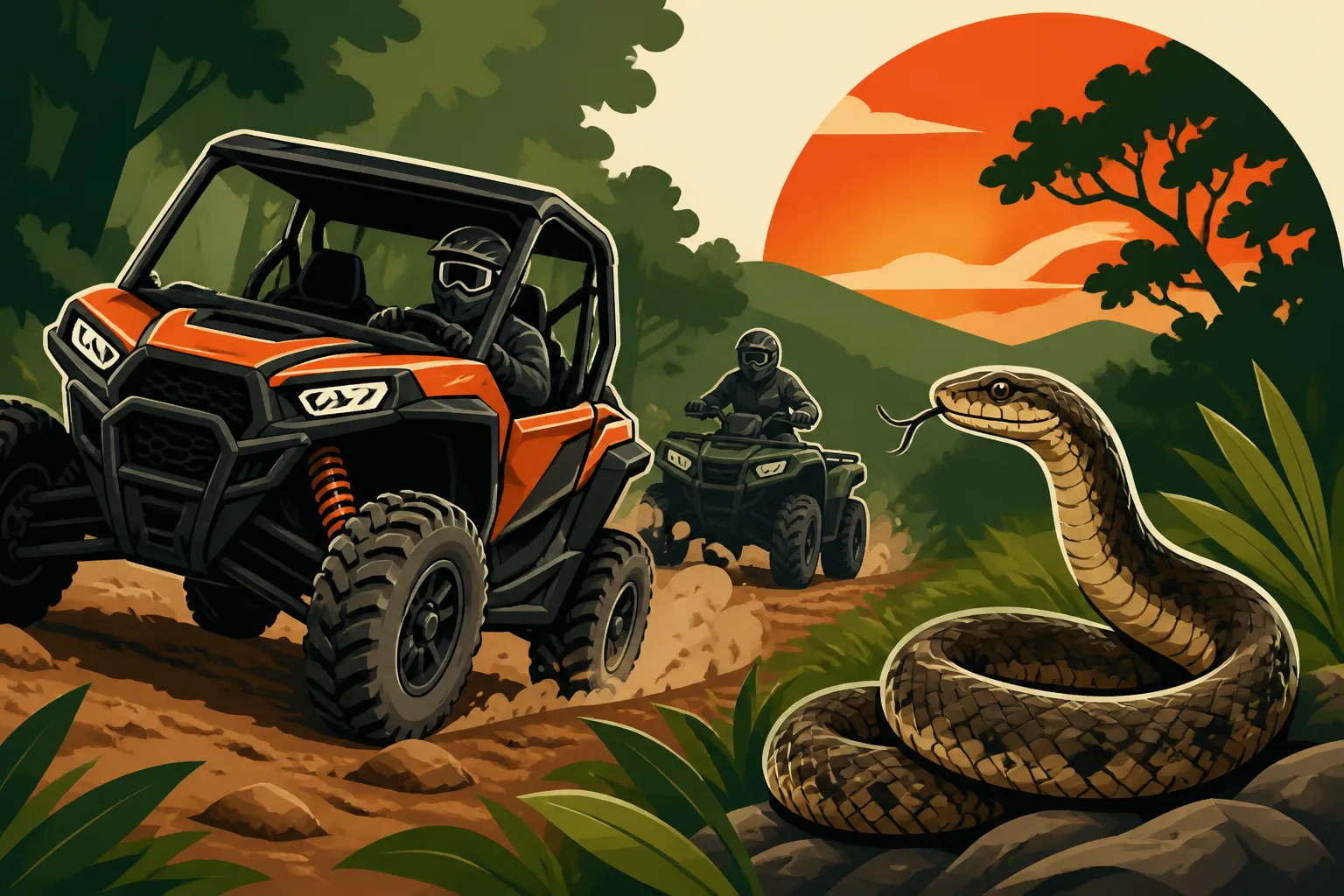
If you see a snake on or beside the trail, stop at a safe distance and give it room to leave. Do not ride toward it, try to push it off the trail with a stick, throw objects, or attempt to kill it. A snake that feels trapped may defend itself, and getting close to determine its species creates unnecessary risk.
If the snake is directly in the trail, wait quietly when it is safe to do so. If it does not move, or if the trail is too narrow to pass without getting close, turn back and choose another route. Do not assume that a snake has left simply because you lost sight of it in leaves or brush. Keep passengers and pets away while you decide what to do.
If a snake is in a staging area or another place where people could be at risk, notify the appropriate land manager or park staff when possible. Avoid crowding around it to take photos. A picture is not worth a close approach, and a distant observation is not a reliable way to identify a species for medical decisions.
Make route decisions with current conditions in mind
A route that looks straightforward on a map may have low visibility, dense growth, or a blocked section on the ground. If you are using onX Offroad or another mapping tool, treat it as a planning aid and keep a backup plan for turning around. Check the relevant land manager’s information for trail status and rules before heading out; map data alone does not confirm that a route is open or passable.
This matters on rides where the group is spread out or where a passenger has limited mobility. Agree on a stopping and regrouping plan before leaving the staging area. If one rider spots a snake, they can alert the group without everyone crowding the same spot. Follow posted signs and do not detour onto closed roads or undesignated trails to get around an obstacle. [Georgia ATV Trails: Where You Can Legally Ride] provides related context for choosing permitted riding areas.
A seasonal plan can also reduce rushed decisions. In spring, wet ground and leaf cover can limit visibility; in summer, heat can make people more likely to rush a stop or take a shortcut through brush. [Georgia Riding in Spring Mud] and [Georgia Riding in Summer Humidity] cover seasonal riding considerations that can affect how comfortably and safely you travel.
What to do after a suspected snakebite
Get emergency medical care promptly
Treat any suspected snakebite as an emergency, even if the person feels well at first or the bite marks are hard to see. Call 911 or the local emergency number, explain that a snakebite is suspected, and give the dispatcher your location as clearly as possible. If you are on a remote trail, share the trail name, nearby junction, trailhead, or other location details that can help responders find you. A mapping app such as onX Offroad may help your group describe its position, but do not delay the emergency call while trying to perfect a map pin.
Keep the person as calm and still as you reasonably can. Movement can worsen the spread of venom, so avoid walking them out if help can come to the location. Remove rings, watches, or tight clothing near the affected area before swelling develops, without disturbing the bite itself. If possible, keep the bitten area still and at a comfortable, neutral position while waiting for medical help.
Do not cut the wound, try to suck out venom, apply ice, use an electric shock, or tie a tourniquet. Do not try to capture or kill the snake. A description from a safe distance may be useful, but treatment should not depend on getting close enough for a photograph or identification. Medical professionals can assess the bite and decide what care is needed.
Make the ride plan useful in an emergency
Before riding, tell someone outside the group where you are going and when you expect to return. In a group, make sure more than one rider knows how to contact emergency services and how to describe the route. Keep a charged phone accessible, but remember that cell coverage can be unreliable in some wooded or mountainous areas. If coverage is poor, a riding group should know where it can reach a road or staffed facility without taking a risky shortcut.
A first-aid kit is useful, but it is not a substitute for emergency care after a suspected venomous bite. Check that riders know who will call for help, who will stay with the injured person, and who can meet responders at an access point if needed. Avoid sending the entire group away and leaving the injured person alone. [Georgia Trail Etiquette on One-Way Loops] offers additional ideas for communicating and moving safely as a group.
The goal is not to make every ride feel risky. It is to build a few unhurried habits into the day: scan before dismounting, keep hands out of hidden spaces, give wildlife room, and know how to summon help. Those steps are more dependable than trying to memorize every snake pattern or predict exactly when one might cross your path.
Disclaimer
This article is for general informational purposes only and does not constitute professional advice. Laws, prices and regulations vary by location and change over time. Consult a qualified professional for guidance on your specific situation.